














Security has always been a major concern for businesses. When it comes to mobile apps, this concern is even bigger. Today, every business has a mobile app that makes it easier for them to connect with their customers.
And if that business does not take proper security protections it can put their brand at risk. Mobile devices use more than one operating system, and because their parts are spread out, mobile app security often has issues.
A poll found that more than 75% of mobile apps will fail basic security checks. So it is mandatory to know the basic fundamental concepts on how to secure your mobile apps with great efficiency?
Thus, read this blog to know about the best practices and importance of mobile app security.
So, let’s begin!
Why is Mobile App Security Crucial?
For users’ privacy, the app’s image, and a smooth experience, mobile app security is important. With the number of online threats rising, it is important to put in place strong security measures.
For instance, encryption, strong authentication, and frequent checks for security. By putting app security first, a mobile app development company can gain users’ trust, and stop data breaches.
7 Best Practices To Ensure Mobile App Security
If you want to secure mobile apps, then you should follow the below tips. It will help you ensure mobile app security. Let’s have a look:
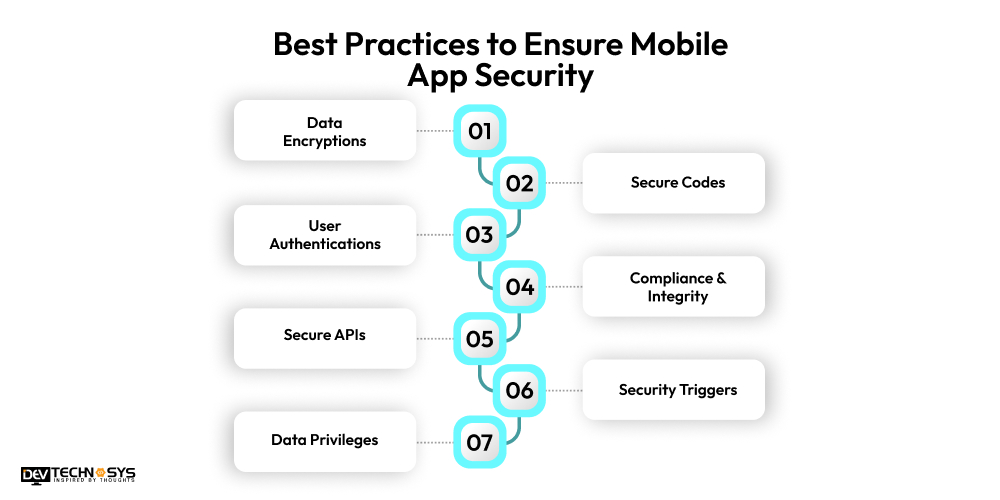
1. Data Encryptions
There are a lot of apps that many people use on different platforms and operating systems. So you need to ensure that the data sent through the app does not get leaked. Because of a flaw in any OS or device.
One way to do data encryption in apps is to secure the data that moves between apps. Hackers can not read data that has been encrypted because it is scrambled. You can protect info in two ways:
- Symmetric encryption
- Asymmetric encryption
When symmetric encryption is used, the security key is used to both secure and decrypt data. Asymmetric encryption, on the other hand, uses two separate security keys for encryption and decoding. Secure code is another good thing to do to keep your mobile app safe.
2. Secure Codes
At its core, every app has a design that is made up of many pieces of code. In this way, secure codes can be very important for keeping mobile apps safe.
A report says that 82% of vulnerabilities are found in the source code of the program. Making sure the source code is bug-free and does not have any holes is what this means.
As long as you hire dedicated developers, you can be sure that your mobile app is safe. Having an expert on board and checking the mobile app is the best way. It ensures that the code is safe and that hackers can not use any bugs.
3. User Authentications
In terms of user-generated material, the most contributions come from mobile apps. Cyberattacks can happen on UGC if there is not a good method in place for mobile app authentication. Hackers can get to users’ private data by tricking them into giving them information.
Once they get into user accounts, UGC makes it easy for bad people to add malware. You can use user login methods like multi-factor authentication here. But with one-time passwords, tokens, security keys, or other options, there is an extra layer of security on top of the normal login process.
As an example, a two-factor security system lets users prove who they are by entering an OTP that they receive on their device. Compliance is another important part of mobile app security.
4. Compliance & Integrity
When a mobile app is released, it has to meet certain security standards and requirements. App stores may tell android app developers what security steps they need to take to keep their apps safe. These steps could be for the process of getting an app downloaded and set up.
These days, smartphones have app stores that give people signed apps or software that needs to be code signed. This process makes sure that a site only shares applications that have already been checked out.
Developers can send their apps to the store, and both the developers’ names and the security needs of the apps are checked. As long as everything follows the rules set by the operating system, the app can be downloaded.
5. Secure APIs
APIs are needed to connect third-party services and make things work better. It makes it possible for different systems to talk to each other and share info. But to make your app safer, you need secure APIs that do not show the data being sent. Using data access authorizations is the best way to make sure API security.
6. Security Triggers
Certain prompts can be used to let your systems know if the application source code is being changed. For instance, AWS Lambda functions can be used to make sure that cloud-native applications are protected against hacking or malicious injection.
7. Data Privileges
Finding out who has access to the data is another way to make sure that hackers can not get into your application. Use the “least privilege” principle to make sure that only certain people can view sensitive data. This will make sure that someone who does not have access to the data but wants to do harm gets to private information.
Conclusion
These mobile app security checklists can help you before you start your business or even while you are already running one. It will help you keep your business safe from theft or damage.
We understand that security is a big issue that can not be fixed by following a few steps. So, it is important to consult with mobile app developers who can give you assistance over mobile app security.
FAQs
1. How To Ensure Mobile App Security?
You can secure your mobile app just by following the below tips:
- Strong Encryption
- Secure Authentication
- Regular Updates
- Secure Coding Practices
- Secure Third-Party Integrations
- Penetration Testing
- User Awareness
2. How Does Mobile App Security Work?
The mobile app security ensures data privacy and integrity using encryption. It secures coding practices, network protection, authentication. Lastly it goes for regular updates to thwart vulnerabilities and attacks.
3. What Are the Security Techniques Used in Apps?
To secure mobile applications, the mobile app developers will use the below multiple techniques. Let’s have a look at them:
- Increase user authentication security using multi-factor authentication.
- Ensure the software supply chain is secure.
- Secure data.
- Ensure safely managed sessions.
- Use the concept of least privilege.
- Modify your testing strategy.
- Use app shielding.