









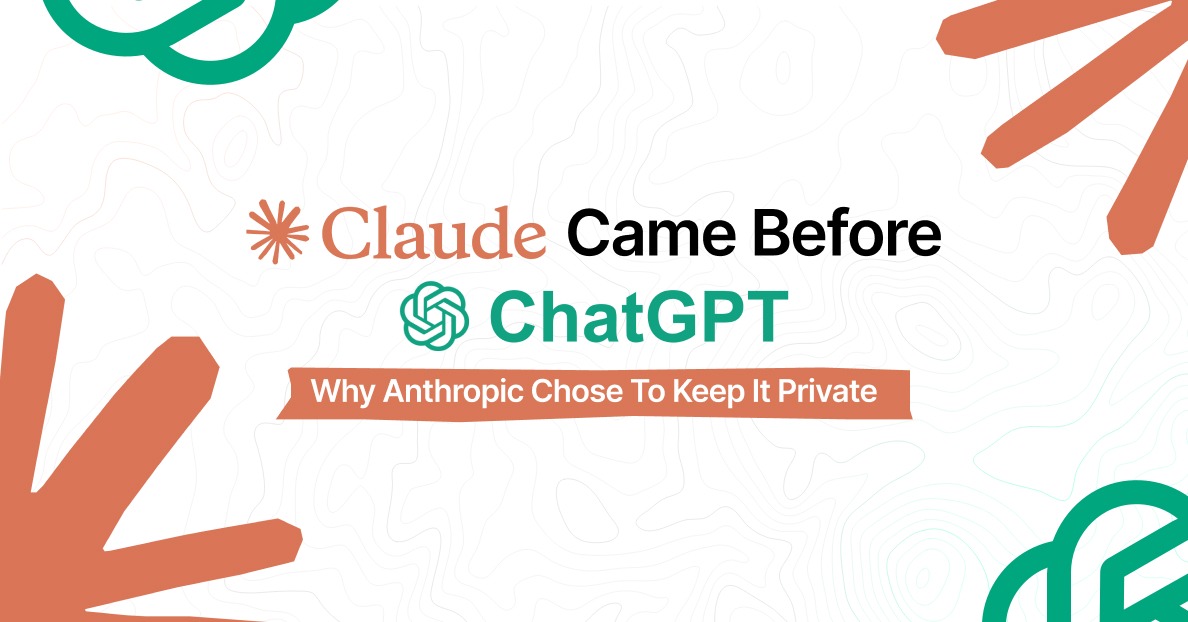
During November 2022, OpenAI caused a global stir by launching ChatGPT; however, Anthropic had quietly developed a similar system and internally decided to keep it under wraps. The reasoning behind it reveals a lot about the way the company thinks about AI safety.
After the explosive launch of ChatGPT in November 2022, it seemed a common narrative took over the media. OpenAI was the first to break the new frontier, and the rest of the world was just trying to catch up. Anthropic was a company established only a year before by former OpenAI researchers, and it showed up as a promising but still a bit lagging challenger.
The story, however, completely overlooked the fact that Anthropic had already created its own large language model of comparable capability and had made a conscious, principled decision to keep it secret.
That was Claude 1. And according to statements from the company’s top management, including co-founder and CEO Dario Amodei, the industry had been transformed by ChatGPT’s public unveiling. Still, a working version was already in place beforehand.
It was a company decision based on the core philosophy that unleashing powerful AI without doing enough safety work first is not a competitive advantage; it is a risk not only for the users but for the whole society.
“We weren’t trying to win a race. We were trying not to lose the thing that matters more — the ability to actually understand what we were building.”
– Claude Team
Anthropic was founded in 2021 by Dario Amodei, Daniela Amodei, and other colleagues who had become concerned about what they saw as OpenAI’s rush to deployment at the expense of interpretability and alignment research.
They didn’t leave because they disagreed with the idea of building powerful AI; rather, they were, in their words, “doubling down” on it. They just disagreed on the way to go about it. The public should only see products that have first been thoroughly understood, probed, and red-teamed.
Therefore, the internal development period for Claude 1 was not based on a change of mind about the product to be developed. It was Anthropic road-testing its potential signature approach, “Constitutional AI”. Instead of depending solely on human feedback to guide model behaviour, Constitutional AI gives the model a set of principles, a “constitution”, and has it judge and improve its own outputs based on those principles. The approach was intended to make alignment both more scalable and more transparent. Claude 1 was, to some extent, the experimental ground for that technique.
The difference with OpenAI’s approach could hardly be greater. ChatGPT was made available as a “research preview” with the very limitations that were recognised and openly communicated, including the fact that it sometimes makes up facts and can give harmful content responses to certain prompts.
OpenAI was right to think that making their work public would lead to faster development and more funding. Their risk was greatly rewarded; they literally opened the floodgates to a gold rush that swept in giants like Google, Microsoft, and Meta, plus a dozen startups,within a few months.
Anthropic chose a different path. When Claude 1 was made public in March 2023, four months after ChatGPT launched, it was almost like a different beast: it spoke more cautiously, admitted its uncertainties more transparently, and was significantly less susceptible to being tricked into producing harmful content. An approach that also influenced evolving ChatGPT Integration Services focused on safety, reliability, and responsible AI deployment.
The time Anthropic spent secretly perfecting Claude would, ironically, become their loudest declaration of the kind of AI company they aimed to be. Advantage in AI has proven to be a strong competitive edge during the period when Claude was still an internal tool, when OpenAI’s brand recognition, user base, and enterprise-level integrations exploded.
Some others have disagreed with this perspective, noting that Anthropic has secured billions in investment from Amazon and Google, developed a committed group of enterprise customers who prioritise reliability over innovation, and is currently recognised as one of the two or three most advanced AI laboratories in the world.
Takeaway!
The main takeaway from the Claude 1 misstep is that deciding when to release AI is more than just a business decision. It’s a matter of ethics, and the answer a company gives determines its culture, research agenda, and the kind of trust it establishes with the public.