













Key Takeaways:
Overall Cost Range: Music streaming app development cost in 2026 typically range between $10,000 to $30,000+, depending on app complexity and features.
Cost Breakdown by Complexity:
-
- Basic/MVP App: $10,000 – $17,000 (core features like music player, login, playlists)
- Mid-Level App: $17,000 – $30,000 (includes offline mode, integrations, better UI/UX)
- Advanced App: $30,000+ (AI recommendations, real-time analytics, multi-device sync)
Key Cost Factors:
Features, UI/UX design, music licensing, backend infrastructure, third-party integrations, and platform selection (iOS, Android, Web).
Development Timeline:
On average, it takes 3 to 9 months to develop a fully functional music streaming app.
Regional Cost Rates:
Development in regions like India can be 40–60% more cost-effective compared to the US or Europe.
Additional Costs:
Ongoing expenses include maintenance (15–20% annually), cloud hosting, licensing fees, updates, and marketing.
The need for music streaming apps is expected to increase significantly in 2026, as changing user preferences, the demand for on-demand content, and AI-driven personalization drive this. Companies of all sizes, from startups to big corporations, are investing heavily in developing platforms like Spotify and Apple Music to tap into this expanding market.
The worldwide music streaming market is expected to exceed $54 billion by 2025 and grow at a compound annual growth rate (CAGR) of almost 15% through 2030. Creating a streaming music app with a range of features will require you to pay for services such as UI/UX design, licensing, backend infrastructure, and highly sophisticated features like AI recommendations.
This blog offers a detailed analysis of the expenses involved in music streaming app development in 2026, along with feature sets, pricing models, and the major factors impacting your financial commitment.
What is Music Streaming App Development?
Music streaming application development is the process of creating digital platforms that enable users to enjoy music online without downloading files.
These apps combine features such as playlisting, recommendations, offline availability, and social media sharing by leveraging cloud storage, APIs, and AI algorithms to deliver uninterrupted, personalized audio experiences.
How Much Does It Cost to Develop a Music Streaming App in 2026?
The cost to build a music streaming app in 2026 usually ranges from $10 000 to $17 000+, depending on features, complexity, and development location. The development of simple apps with music-playing, searching, and playlist functions can be done within a budget of $17,000–$30,000.
If you plan to add features such as user profiles, subscriptions, and offline mode, a medium-level app can deliver the same. The approximate cost to develop a music streaming app can range from $10,000 to $17,000. High-end apps with features such as AI-based song recommendations, live streaming, and exquisite UI/UX can cost more than $30,000.
Licensing fees, backend infrastructure, and third-party integrations are some factors that can greatly influence the overall music app development cost. Hence, it is very important to set your requirements clearly before starting the development process.
Music Streaming App Development Cost Breakdown in 2026
App Level |
Features Included |
Timeline |
Best For |
Estimated Cost |
Team Size |
| Basic (MVP) | Music playback, search, playlists, basic UI | 3 – 5 months | Startups, idea validation | $10,000 – $17,000 | 3 – 5 members |
| Medium (Mid-Level) | User profiles, subscriptions, offline mode, better UI/UX | 5 – 8 months | Growing businesses, scalable apps | $17,000 – $30,000 | 5 – 8 members |
| Advanced (Full-Scale) | AI recommendations, live streaming, social features, premium UI/UX | 8 – 12+ months | Enterprises, global platforms | $30,000+ | 8 – 12+ members |
Types of Music Streaming App Development: Cost Breakdown in 2026
Knowing the types of top music streaming apps is a prerequisite for a proper budget estimation. Since feature sets, complexity levels, and pricing vary by app type, choosing the right model for 2026 is a critical decision.
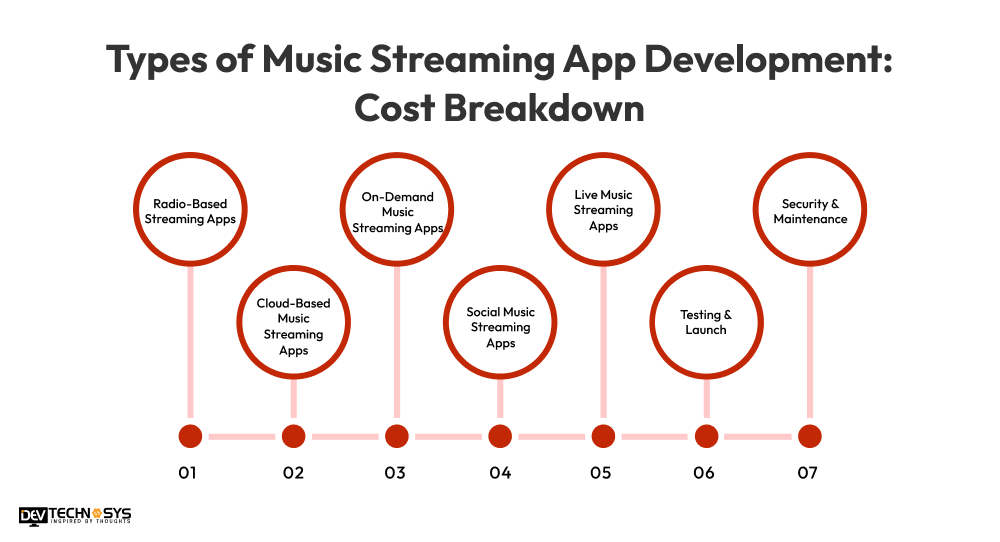
1. Radio-Based Streaming Apps
Radio streaming apps deliver music continuously based on criteria such as genres, moods, or artists, without the user having to make a song selection. They use the user’s preferences and other inputs to offer a curated, enjoyable music listening experience. So, these music apps need a medium-level backend and quite limited interactive features.
Estimated Cost: $15,000 – $30,000
2. On-Demand Music Streaming Apps
On-demand music streaming app development solutions enable users to search for, play, and download songs instantly, along with personalized playlists and AI-driven song suggestions.
Developing such apps requires a powerful backend system, licensing, and an intuitive UI/UX to enable uninterrupted playback and increase user engagement.
Estimated Cost: $12,000 – $26,000
3. Cloud-Based Music Streaming Apps
Cloud-based music applications permit users to upload, save, and play their own music collections from any device. For such apps, the need for a secure cloud storage, synchronization, and data management system makes the development a bit complicated, with the main focus being on the scalability and security of user data.
Estimated Cost: $10,000 – $18,000
4. Live Music Streaming Apps
Live music streaming applications allow users to watch concerts or live events in real-time. Among other things, they rely on features such as high-performance servers, low-latency streaming, and real-time user interactions like comments and reactions. As a result, development complexity and infrastructure costs increase substantially.
Estimated Cost: $14,000 – $30,000
5. Social Music Streaming Apps
Social music apps are a mix of streaming services and community platforms. They share playlists, follow users, and engage in collaborative listening among other social engagements. Such apps require, in addition to the general advanced backend, real-time syncing and social integrations. As a result, they are more complex and feature-rich.
Estimated Cost: $18,000 – $30,000
Real Cost Breakdown of Popular Music Streaming Apps in 2026
Learn about the actual music streaming application development cost in 2026. In this part of the guide, we will talk about the cost to create a music streaming app, main features, and also show you some statistics from leading platforms, which can be helpful for you in the planning phase.
1. Spotify
Spotify is one of the frontrunners worldwide in music streaming. It offers users access to millions of tracks, as well as podcasts and the possibility of creating personal playlists. Spotify app development solutions are based on very sophisticated AI that obtains great results in offering music to users according to their tastes, all over the world.
- $15,000 – $25,000+
Key Features:
- AI-based music recommendations
- Personalized playlists (Discover Weekly)
- Offline listening mode
2. YouTube Music
YouTube Music is a new approach to music streaming through video. The users can switch between audio and video. It is based on YouTube’s massive library and on its AI-driven recommendations that offer highly diversified entertainment.
Estimated Development Cost:
- $13,000 – $25,000+
Key Features:
- Audio and video switching
- Smart recommendations
- Background play
3. Apple Music
Apple Music is a high-class, subscription-based streaming service that is deeply integrated into the Apple ecosystem. An app like Apple Music, besides the curated playlists, exclusive releases, and excellent syncing with Apple devices, also offers users high-quality audio streaming.
Estimated Development Cost:
- $16,000 – $30,000+
Key Features:
- High-quality lossless audio
- Seamless Apple ecosystem integration
- Curated playlists by experts
4. Amazon Music
Amazon Music is a paid subscription streaming platform that provides access to millions of songs, carefully prepared playlists, and integration with Amazon devices like Alexa. It aims to bring a convenient and voice-assisted music experience to users.
Estimated Development Cost:
- $12,000 – $24,000+
Key Features:
- Alexa voice integration
- Ad-free streaming
- Offline downloads
5. SoundCloud
SoundCloud is a platform aimed at independent artists, enabling them to upload, share, and be discovered. It combines music streaming with social interaction and the distribution of content created by the artists.
Estimated Development Cost:
- $10,000 – $25,000+
Key Features:
- User-generated content uploads
- Artist community engagement
- Music sharing and reposting
Want a chatbot demo or pricing? Fill the form and talk to our experts today.
Pick what you need below — you can select more than one — then tap Get detail to continue.
-
Chatbot demo dashboard
-
Cost to develop an app
-
Industry report
-
Case study
Don’t Start Development Until You Know Factors Affecting Music Streaming App Cost
Launching a music streaming app can be thrilling. However, if you don’t get a grasp on the key cost factors, the budget can get out of control very fast. Besides music streaming app developers, licensing, and advanced features, the investment can be influenced by any decision you make.
Here’s the real set of music streaming app development cost factors in 2026 that you need to know before you start.
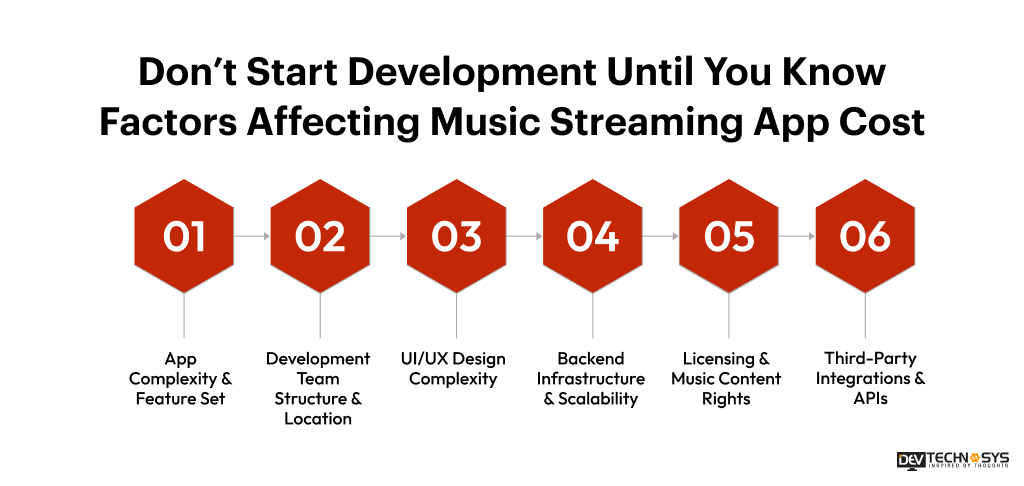
1. App Complexity & Feature Set
The overall complexity of your music streaming app plays a major role in the music streaming app development cost. Basic apps with limited features cost less, while advanced apps with AI recommendations, live streaming, and social features significantly increase development time, resources, and technical requirements.
Cost Impact Table:
Complexity Level |
Features Included |
Estimated Cost |
Timeline |
| Basic (MVP) | Playback, search, playlists | $10,000 – $16,000 | 2 – 4 months |
| Mid-Level | Offline mode, subscriptions, profiles | $16,000 – $30,000 | 4 – 7 months |
| Advanced | AI, live streaming, social features | $30,000+ | 7 – 12 months |
2. Development Team Structure & Location
The composition, expertise, and geographical location of the team engaged in development are some of the factors that largely influence the final custom music streaming app development cost.
Hiring developers, mobile app designers, testers, and project managers who are experts from regions like the US is costlier than hiring from India or Eastern Europe.
Team Type |
Location |
Hourly Rate |
Estimated Cost |
Timeline |
| Freelancers | Global | $15 – $40/hr | $12,000 – $40,000 | 3 – 6 months |
| In-house Team | US/UK | $80 – $150/hr | $80,000 – $200,000+ | 6 – 12 months |
| Outsourced Agency | India | $10 – $20/hr | $10,000 – $30,000 | 4 – 8 months |
3. UI/UX Design Complexity
An attractive and user-friendly UI/UX will increase user retention, it will make design efforts costlier. Skilled designers are needed for custom animations, interactive interfaces, and making the app responsive across devices. Multiple development iterations are usually required.
Design Level |
Features |
Estimated Cost |
Timeline |
| Basic UI | Simple layouts | $12,000 – $20,000 | 2 – 3 months |
| Custom UI | Interactive elements | $20,000 – $30,000 | 3 – 5 months |
| Premium UI | Animations, micro-interactions | $30,000 | 5 – 7 months |
4. Backend Infrastructure & Scalability
If you plan for a large number of users, large music libraries, and real-time streaming, a powerful backend is a must. Cloud integration, database management, and scalability planning not only increase your initial video streaming app development costs but also significantly affect the size of your maintenance budget.
Backend Type |
Features |
Estimated Cost |
Timeline |
| Basic Server | Limited users, storage | $10,000 – $17000 | 2 – 4 months |
| Scalable Cloud | AWS/GCP integration | $17,000 – $30,000 | 4 – 7 months |
| Enterprise Level | High traffic, real-time sync | $30,000+ | 6 – 10 months |
5. Licensing & Music Content Rights
Music licensing is undoubtedly one of the most expensive and fairly important factors. You have to negotiate music license deals with record companies as well as music distributors and ensure that the business is functioning in accordance with the law, which is very important when it comes to royalties, content distribution, etc. This activity requires you to have a very large budget, which is a significant factor in your overall cost to develop a music streaming app.
Licensing Type |
Scope |
Estimated Cost |
Timeline |
| Limited License | Small catalog | $12,000 – $19,000 | 1 – 3 months |
| Standard License | Regional rights | $19,000 – $27,000 | 3 – 6 months |
| Global License | Full catalog access | $30,000+ | 6 – 12 months |
6. Third-Party Integrations & APIs
Adding additional functionalities like payment gateways, analytics tools, social media sharing, cloud services to the app makes them integrable. API development services positively impact the functionality of the app but they also increase the complexity of the entertainment app development, require testing, and their use may involve subscription and usage based charges. Developers use the remote servicing suite to manage security concerns remotely.
Integration Level |
Tools Included |
Estimated Cost |
Timeline |
| Basic | Payment gateway | $12,000 – $16,000 | 1 – 2 months |
| Moderate | Analytics, social sharing | $16,000 – $30,000 | 2 – 4 months |
| Advanced | AI APIs, cloud, multiple integrations | $30,000 | 4 – 6 months |
Market Stats on Music Streaming Apps in 2026
- The global recorded music industry generated around $31.7 billion in 2025, showing steady year-on-year growth.
- Music streaming contributed nearly 70% of total global music revenue, making it the dominant revenue source.
- Spotify has between 678M–751M monthly active users worldwide, making it the largest platform.
- YouTube Music has around 80M+ paid subscribers and trial users combined.
- Paid music streaming alone generated more than $22 billion in revenue worldwide.
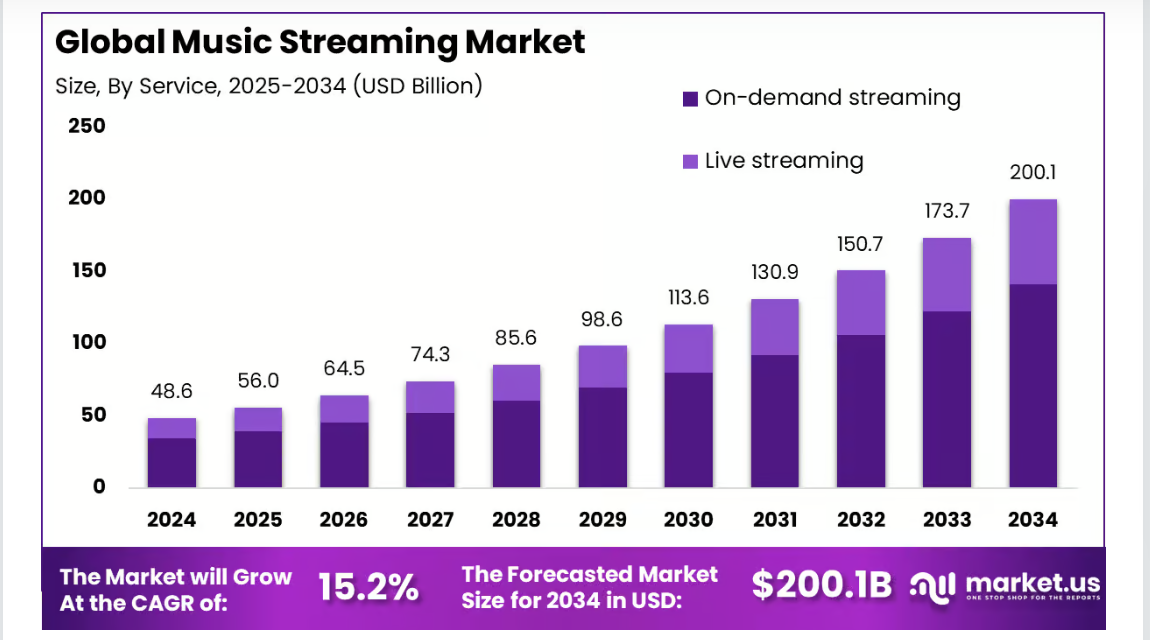
- The global music streaming market is growing at an estimated ~15% compound annual growth rate (CAGR).
- There are now more than 837 million paid music streaming subscribers globally.
- The worldwide user base for music streaming services has crossed 600 million+ active subscribers and users combined.
- Mobile devices account for nearly 59% of total music streaming consumption globally.
Key Features That Drive Music Streaming App Development Costs in 2026
Ultimately, the number of features you want to add to a music streaming app determines the cost to develop a music streaming app. It can be a complex task to add AI recommendations or to provide a seamless playback experience, so each of the features in the music streaming app that you add is capable of increasing the development budget for the year 2026.
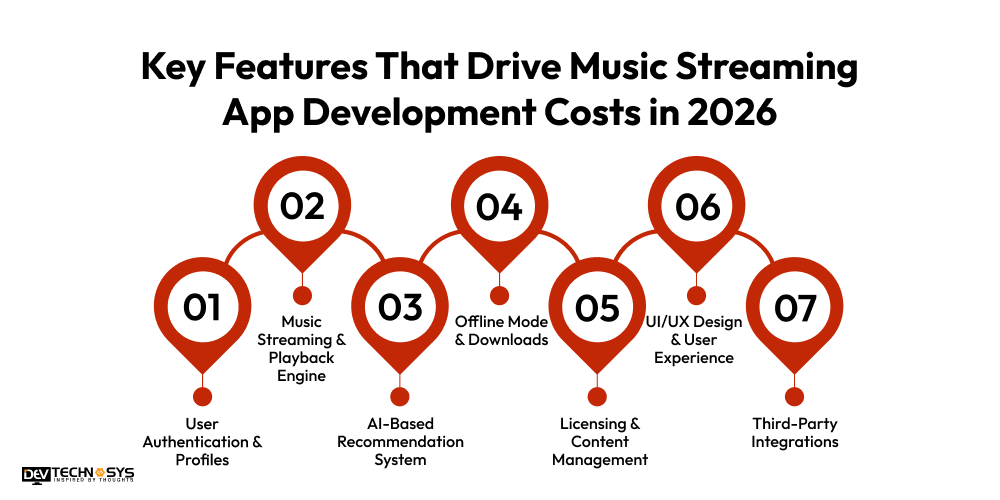
1. User Authentication & Profiles
Developing secure user registration, login, and profile management systems is not an easy task from a technical perspective because these involve social logins, multi-device syncing, and personalized user preferences, which further complicate the development.
2. Music Streaming & Playback Engine
Building a seamless audio streaming engine with minimal buffering, adaptive bitrate streaming, and high-quality playback requires strong backend infrastructure and advanced technical implementation.
3. AI-Based Recommendation System
Music streaming AI development solutions, including personalized music suggestions, creating playlists, and analyzing user behavior, will escalate the cost to create a music streaming app considerably due to both data processing and machine learning-related aspects.
4. Offline Mode & Downloads
Allowing users to download songs and listen offline requires secure storage, DRM protection, and synchronization features, which add complexity and increase the overall cost of developing a music streaming app.
5. Licensing & Content Management
The legal costs associated with music licensing, paying for copyright compliance, and managing audio libraries create one of the highest costs to develop a music app.
6. UI/UX Design & User Experience
Creating an engaging, intuitive, and visually appealing interface with smooth navigation, animations, and responsiveness across devices directly impacts the cost to build an Android app like Spotify.
7. Third-Party Integrations
Integrating payment gateways, analytics tools, social media sharing, and cloud services adds functionality but increases development cost due to API handling and system compatibility requirements.

Hidden Costs of Music Streaming App Development You Can’t Afford to Ignore
While the costs for development may seem clear, many costs for Android and iOS app development services can be hidden, creating financial challenges to the overall development budget.
By knowing about these hidden development costs, developers can reduce their financial risk by better planning for the development project’s success in 2026.
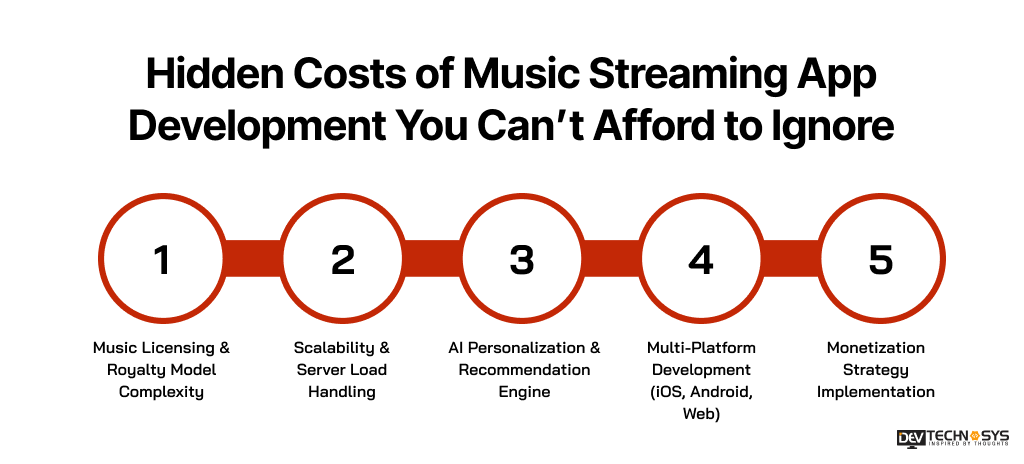
1. Music Licensing & Royalty Model Complexity
Music licensing does not end with one purchase or the payment of one licensing fee because you must pay for ongoing royalty payments, or a stream-based rate, based on your streaming activity, location, and specific licensing agreement with a label. The various pricing models represent some of the largest hidden scalable expenses associated with developing a mobile application.
License Type |
Scope |
Estimated Cost |
Timeline |
| Indie/Small Labels | Limited catalog | $10,000 – $17,000 | 1 – 3 months |
| Regional Licensing | Multi-label access | $17,000 – $30,000 | 3 – 6 months |
| Global Licensing | Major labels, full catalog | $30,000+ | 6 – 12 months |
2. Scalability & Server Load Handling
You must have the ability to implement auto-scaling of your servers and create some form of load balancing, as well as create an optimized Content Delivery Network (CDN) for your application’s media content.
Poor planning or investments into this essential functionality can cause your application to crash, making scalability the most critical and hidden investment.
Scale Level |
Infrastructure |
Estimated Cost |
Timeline |
| Startup Level | Basic cloud hosting | $15,000 – $25,000 | 2 – 4 months |
| Growing App | Auto-scaling + CDN | $25,000 – $30,000 | 4 – 7 months |
| Large Scale | Distributed global servers | $30,000+ | 6 – 10 months |
3. AI Personalization & Recommendation Engine
Leveraging artificial intelligence or machine learning technology when building your application and creating recommendation systems that are based on user listening behavior, mood detection, and predictive analytics are critical data engineering projects.
They will be very challenging to develop and will require continuous retraining of your machine learning models, creating long-term hidden costs.
AI Level |
Features |
Estimated Cost |
Timeline |
| Basic | Rule-based suggestions | $12,000 – $19,000 | 2 – 3 months |
| Mid-Level | Behavior-based recommendations | $19,000 – $30,000 | 3 – 6 months |
| Advanced | ML + predictive analytics | $30,000+ | 6 – 10 months |
4. Multi-Platform Development (iOS, Android, Web)
Copying and pasting code, the multiple-platform solution also means building the same app three times, since different codebases are not consolidated to less complicated native apps, which significantly increases the total podcast app development services budget.
Mobile app lower-bound costs are reduced by using cross-platform tools, but at the same time, the upper bounds (performance analytics, user experience) are limited compared to native development
Platform Type |
Scope |
Estimated Cost |
Timeline |
| Single Platform | Android or iOS | $12,000 – $18,000 | 2 – 4 months |
| Cross-Platform | Flutter/React Native | $18,000 – $30,000 | 4 – 7 months |
| Multi-Native | iOS + Android + Web | $30,000+ | 6 – 10 months |
5. Monetization Strategy Implementation
Integrating monetization models such as subscriptions, ads, and freemium tiers requires various components like payment gateways, ad networks, and revenue tracking systems. Each model adds to the technical and operational complexity, thus affecting the overall cost of development and maintenance.
Model Type |
Features |
Estimated Cost |
Timeline |
| Basic | Ads integration | $12,000 – $19,000 | 1 – 2 months |
| Standard | Subscription model | $19,000 – $30,000 | 2 – 4 months |
| Advanced | Multi-revenue streams | $30,000 | 4 – 6 months |
Why Budgeting for Your Project is Crucial?
Budgeting is an essential part of your music streaming app project. It helps you plan resources, control expenses, and mitigate unforeseen financial risks during development.
A detailed budget helps you focus on the features that matter most. It also allows you to select the most suitable mobile application development agency and maintain a feasible timetable.
A lack of proper budgeting can lead to rapid cost increases from licensing, infrastructure, or advanced features. Proper budgeting also helps make wise decisions, attract investments, and ensure the app’s long-term sustainability.
With effective planning, you can scale your app while maintaining high quality and performance.
How Long Does It Take to Build a Music Streaming App in 2026: Timeline Breakdown
If you are planning to develop a music streaming app in 2026, draw up a detailed plan for each phase of the project. Start with designing and move to launching.
The schedule changes depending on the project’s complexity, features, and team size. These factors directly affect the speed of development and overall project delivery.
Development Stage |
Key Activities |
Estimated Timeline |
| Planning & Research | Market research, feature finalization, roadmap | 1 – 2 weeks |
| UI/UX Design | Wireframes, prototypes, and user journey design | 2 – 4 weeks |
| Frontend Development | App interface for iOS/Android/web | 6 – 10 weeks |
| Backend Development | Server, database, APIs, streaming engine | 8 – 12 weeks |
| Integration Phase | Payment gateways, APIs, cloud, and AI features | 3 – 6 weeks |
| Testing & QA | Bug fixing, performance testing, security checks | 3 – 5 weeks |
| Deployment & Launch | App store submission, final setup | 1 – 2 weeks |
Smart Ways to Cut Music Streaming App Development Costs Without Compromising Quality
Developing a music streaming app may involve substantial expenses, but one can deploy clever tactics to reduce costs significantly. Optimizing your development approach and choosing the right features are key to launching a high-quality app within your budget.
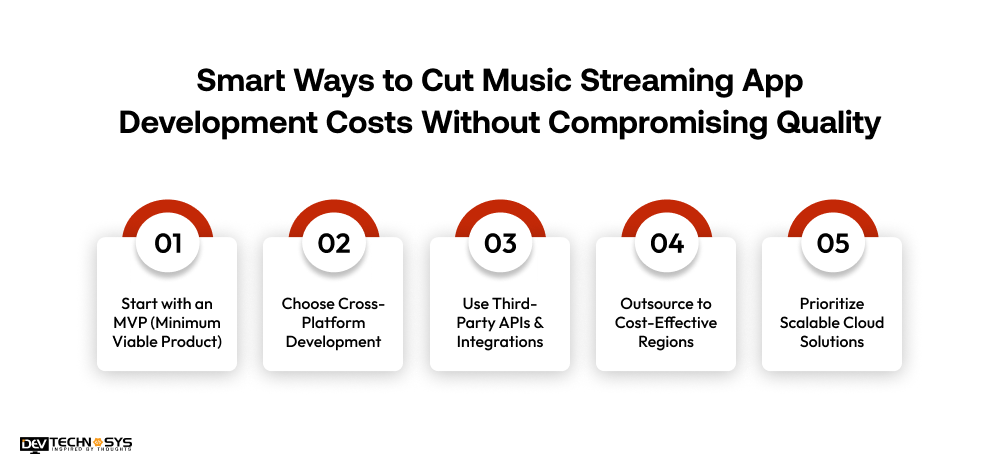
1. Start with an MVP (Minimum Viable Product)
By focusing first on core features such as music playback, search, and playlists rather than a complete app, you significantly reduce the time and costs of developing a music streaming application. This way, you can test your idea with minimal investor risk before adding more advanced functionality.
2. Choose Cross-Platform Development
It allows you to develop applications for both iOS and Android simultaneously. Besides saving you the effort of programming separately for each platform, it also significantly reduces the overall cost of developing an AI music generation app.
3. Use Third-Party APIs & Integrations
Replacing the creation of every feature with APIs can be a great way to save time. Hire PHP developers to integrate predefined APIs for payments, analytics, and cloud services to simplify your workflow with lesser complexity, quicker launch, and at the same time, keep your expenses under control.
4. Outsource to Cost-Effective Regions
If you choose to employ development teams in regions such as India or Eastern Europe, it will be a great step towards reducing costs compared to hiring teams based in the US. You will get high-quality content development services at lower hourly rates, making it a very cost-effective solution.
5. Prioritize Scalable Cloud Solutions
Get the most out of cloud platforms like AWS or Google Cloud with their pay-as-you-go pricing models. According to the enterprise mobile app development company, this investment-related pitfall can be completely avoided, and you can also gradually increase your resources as the number of users and demand grow.
3 Ways to Monetize a Music Streaming App in 2026
A music streaming app cannot be successful without a consistent stream of revenue. If you want your idea to be profitable in the long run, it is simply a must to find ways to monetize your app.
By selecting the appropriate revenue models, you can not only keep your business running smoothly but also increase user satisfaction and drive loyalty through excellent experiences.
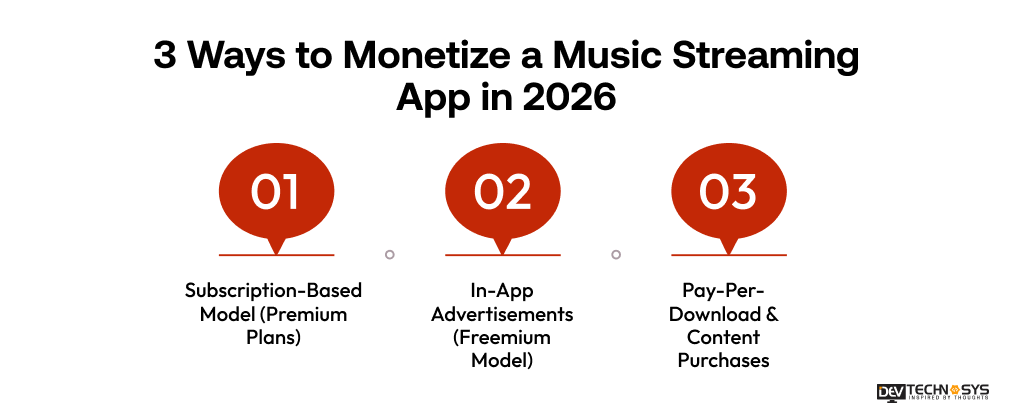
1. Subscription-Based Model (Premium Plans)
Offer your users a subscription that attracts the most faithful. Perhaps with the provision of the absence of advertisements, the ability to download music and listen to higher sound quality.
It will work if it is combined with the exclusion of content, the creation of personalized playlists, and the provision of a seamless experience that will increase user retention.
2. In-App Advertisements (Freemium Model)
Offer a free version of your product with advertisements inserted between tracks or in the interface. You may choose to display audio, video, or banner ads to earn revenue while letting your customers upgrade to a premium service for a continuous experience.
3. Pay-Per-Download & Content Purchases
Let users buy individual songs, albums, or even specific pieces of content directly from the app. This model finds a good foundation with niche customers and creators of independent music, as it not only gives additional income but also supports the subscription and advertisement monetization models.
Conclusion
The cost to build a music streaming app in 2026 is determined by a number of elements, such as features, complexity, licensing, and the method of development. Whether you’re creating a simple MVP or a comprehensive platform, careful planning and budgeting are still necessary to keep costs low and make sure your project is successful.
Businesses can develop scalable and engaging music applications by selecting the right features, technology stack, and hiring dedicated developers. Smart investing means lowering risk and ensuring that your product is competitive in an ever-changing marketplace based on evolving user expectations.
How Dev Technosys Can Help You Build a Trending Music Streaming App?
Dev Technosys is a music streaming app development company that has been developing scalable and rich-featured music streaming apps for over 15 years and understands the importance of aligning the right technology with the client’s business objective.
We provide high-quality experiences from UI/UX design through advanced features such as artificial intelligence recommendations and offline streaming, to seamless, integrated application support and development, providing the client with end-to-end development support.
We offer cost-effective solutions, reduced time-to-market, and high-performance applications. Whether you are a start-up or an enterprise, Dev Technosys, a major tech company in San Francisco, can help convert your idea into a competitive, user-friendly music streaming application that will help you compete within the music streaming industry as it continues to change.
Frequently Asked Questions
Find answers to the most common questions related to this article.
The typical cost to build a music streaming app is between $10,000 and $30,000 or more, depending on the number of features and complexity of the app and the location of the development team. Basic apps will be at the lower end of that range, but advanced apps will be significantly more expensive as they will likely have features such as artificial intelligence, licensing costs, and integrations that will add to the overall music streaming application development cost.
Music streaming applications will generate revenue from multiple sources, including subscriptions, in-app advertising, and premium features, including offline downloads and the ability to listen without ads. Additionally, music streaming platforms may generate income from partnerships, sponsored content, and artist promotions that enable them to create multiple income streams and therefore create scalable income sources.
Your goals and budget will determine which approach to take for developing an app. Native applications generally provide better performance and user experience than cross-platform solutions; therefore, native applications are typically ideal for developing high-end applications.
Developing a music streaming app typically takes 3 to 12 months, depending on complexity and features. Basic apps require less time, while advanced apps with AI, real-time streaming, and integrations take longer due to increased development and testing efforts.
You can save money on the music streaming app development cost by developing an MVP, utilizing a cross-platform framework, incorporating third-party APIs, and outsourcing the development of your application to a low-cost country careful pre-planning and prioritizing which features are most important to you will keep you within your budget without sacrificing value.