

















Key takeaways:
-
- To integrate a payment gateway with POS systems, follow these steps: identify business needs, choose a compatible payment gateway, verify security, API integration, configure payment settings, test, launch, and monitor.
- Maintain security by following PCI DSS standards, implementing encryption, tokenization, and secure authentication for payment data protection.
- Integration benefits include operational efficiency, reduced manual work, accurate reporting, enhanced security, and better business decision-making.
- Ensure compatibility between the payment gateway and POS system through APIs, plugins, SDKs, or native integration support.
Consumers demand faster, safer, and easier ways to pay for goods and services in today’s busy retail world. Companies must take advantage of the combination of a payment gateway and a Point-of-Sale (POS) System.
According to Grand View Research, the payment gateways market was valued at around $58.8 billion in 2026, and it is expected to grow to around $245.71 billion by the end of 2033.
A Business can process real-time transactions using this integrated solution, improving safety and decreasing the number of manual errors while improving overall operational efficiency. A Payment Gateway combined with a POS allows any type of business, such as a retail store, restaurant, or e-commerce-enabled store, to create and manage efficient checkout processes. As digital infiltration into the payment industry continues to grow, understanding how to integrate a payment gateway into your POS System.
This is fundamental to providing a seamless customer experience, maximizing revenue opportunities, and staying competitive in an increasingly technology-focused world.
What is a Payment Gateway?
A payment gateway is a provider of data services that perform transactions between customers, merchants, and financial institutions, enabling the secure transfer of payment information between all parties to complete a transaction.
When a customer pays with a card or digital wallet:
- The payment gateway will encrypt the payment data.
- Send a transaction request to the appropriate payment processing company and card network.
- The payment processing company will communicate with the issuing bank to approve or deny the transaction.
- The result of credit/debit approval or denial will be sent to the merchant and customer in usually a matter of seconds.
What is a POS System?
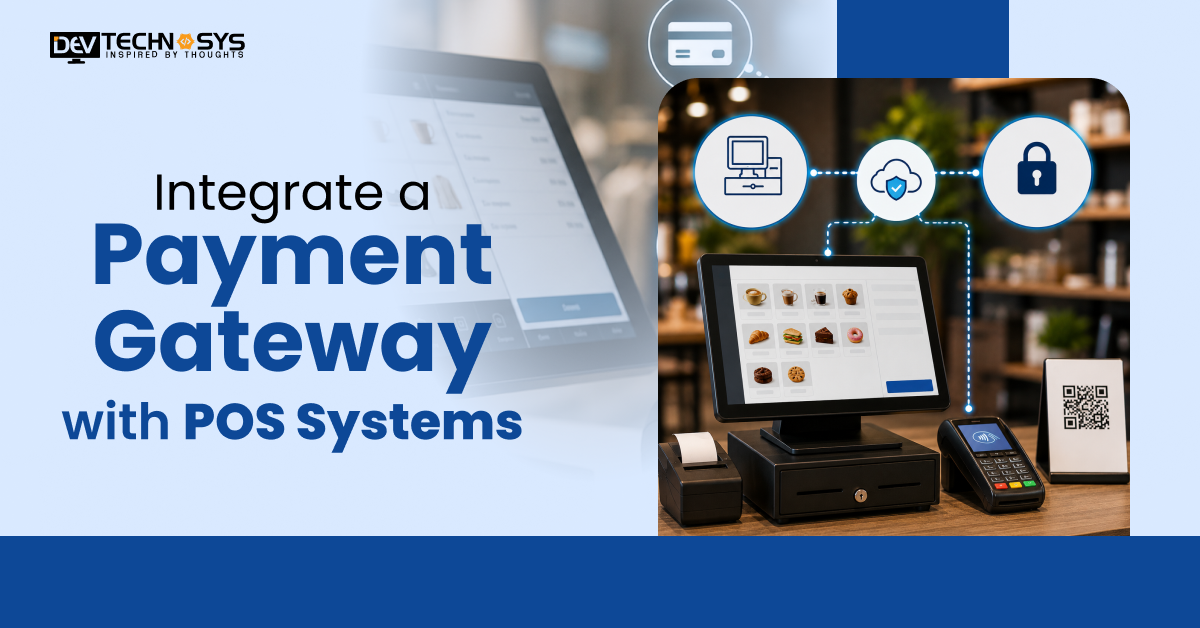
A POS System is basically a combination of hardware and software utilized by businesses to process their sales by providing a full range of options for processing sales through various means, including:
- A checkout/point of sale register
- A card reader/ credit card payment terminal
- Cash drawer
- Receipt printer
- Inventory tracking tool
- Sales reporting tool
Industry Insights:
“According to the Capgemini reports, an accelerating shift toward integrated POS and payment gateways is driven by omnichannel commerce and embedded financial services adoption.”
How Do Payment Gateways Relate to a POS System?
The Payment Gateway provides the link between POS systems, banks, and credit card networks for secure transaction processing. The point of sale will initiate the payment process as part of the checkout process. The Payment Gateway will then encrypt, transmit, and authorize the payment transaction from the point of sale to the appropriate financial institutions, ensuring fast approval and secure processing of credit card transactions, resulting in the successful sale of merchandise.
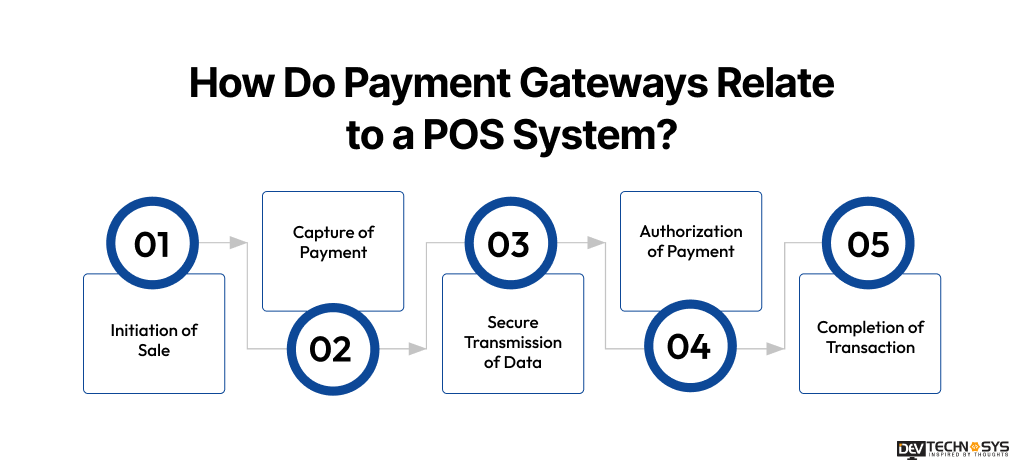
1. Initiation of Sale
The customer has selected their items for purchase, and at the point of sale system, the total amount due for the order will be calculated upon checkout.
2. Capture of Payment
Customers will either tap, insert, or swipe their card at the point of sale system, which will securely capture the payment information.
3. Secure Transmission of Data
The point of sale system will send the payment details to the payment processing gateway, which will securely transmit them to the acquiring bank for authorization.
4. Authorization of Payment
The acquiring bank and card network will verify that sufficient funds exist, returning either an approval or a decline response in seconds.
5. Completion of Transaction
The payment processing gateway will send the approval or decline back to the point-of-sale system, at which time the sale will be considered complete.
Planning a Pos Project?
Get a tailored development cost estimate in a few simple steps.
- 3 quick steps
- 100% free
- Reply in 1 business day
2 Minutes Read
Types of Payment Gateway Integration Methods
The most common methods include: API-based Integration Method, which provides the merchant with complete control over the transaction, Hosted Payment Pages, which provide simplicity and security, and Direct POS Integration Method, which offers seamless transactions in an actual store. An SDK or Plugin-based Integration Method, which allows for simple implementation with moderate customization.
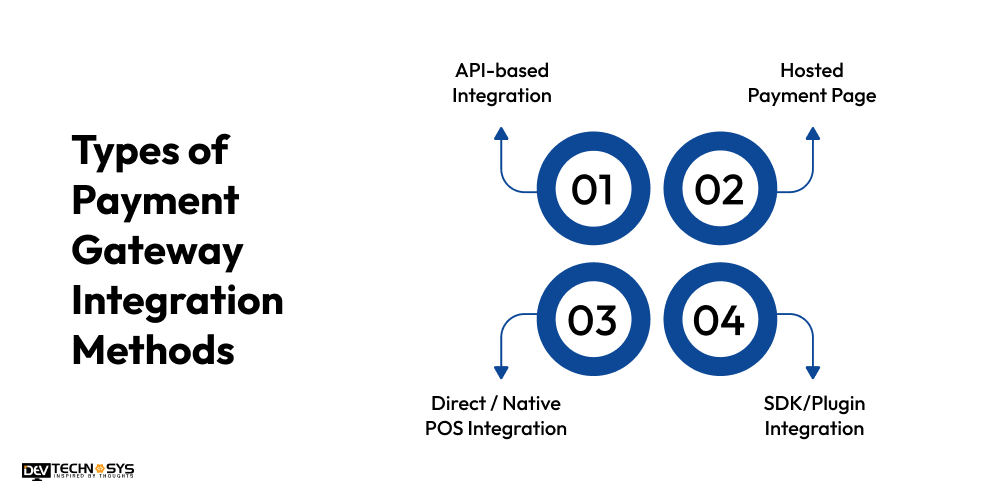
1. API-based Integration
With API-based integration, the merchant platform is installed directly on the server of the payment gateway. The merchant has complete control over the checkout process, and transaction processing for each transaction is done in real time. Payment gateway providers such as Stripe have developed their technology using APIs. This has made this type of payment gateway integration the most commonly used and the most flexible method of integration.
2. Hosted Payment Page
A hosted payment page integration method will redirect the buyer to an outside host to complete the checkout process. The payment provider will manage the security, compliance, and data while the buyer completes the transaction. This type of payment integration is less of a responsibility for the merchant. However, the redirecting of the customer to an outside remote location to complete the checkout process can interfere with the customer’s experience. Paypal provides a hosted payment page for its customers.
3. Direct / Native POS Integration
Direct or native POS integration is the method of payment processing where the payment processing is completely embedded inside the pos system. Seamless integration that creates functional payment processing and quick checkout. Very effective for retail merchant locations but requires strong security and compliance. Square is an example of a payment gateway providers that provide payment processing within its native POS systems.
4. SDK/Plugin Integration
Integrate a payment gateway with POS systems through SDKs or plugins provides developers with ready-to-use gateway POS solutions they can use to add payment capabilities to an app or website. This method allows developers to implement payment systems relatively easily, with some ability to customize the solution. Most importantly, SDKs and plugins are ideal for smaller to mid-sized companies that want the ability to implement a payment system quickly but don’t want to have to do extensive engineering work in order to accomplish it.
Look What Dataintelo Says About Integration of Payment Gateways with POS:
Visa and Mastercard processed over 71% global card network volume, enabling billions of POS + gateway transactions worldwide annually.
7 Simple Steps to Integrate a Payment Gateway with POS Systems
Integrating a payment gateway to your supermarket billing software development solution is beneficial for streamlining the transaction process, increasing security, and providing a better overall customer experience. The seven steps to successful integration include: selecting a compatible gateway, assessing the POS system requirements, testing the system, deploying the system, and monitoring the system regularly.
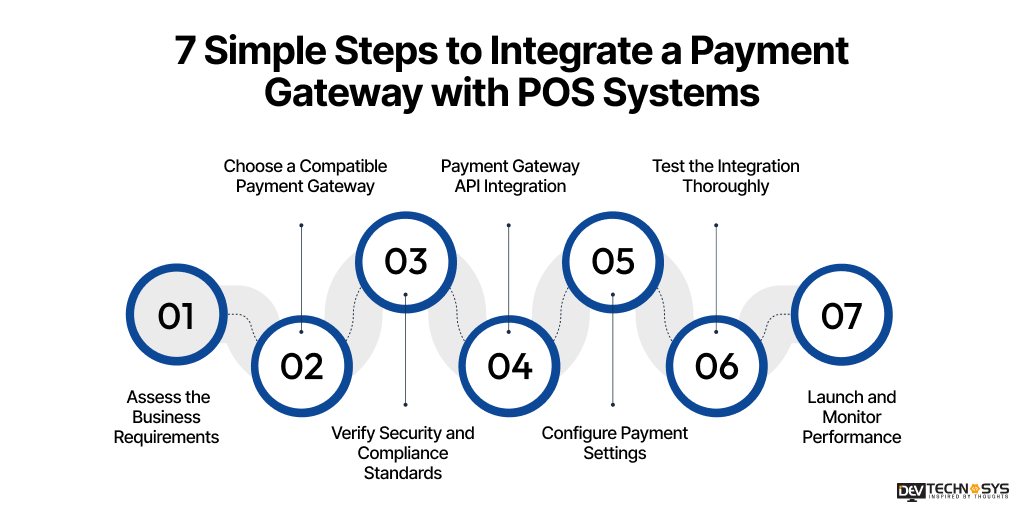
1. Assess the Business Requirements
Evaluate your own business by considering the following: Your business needs, transaction volumes, customer preferences for payment, your industry requirements, etc. You should then determine if you need: credit cards, digital wallets, contactless payments, and multi-currency transactions. Knowing what your business requirements are will help you determine which type of payment gateway is going to be best for you, as well as which type of POS solution you need.
2. Choose a Compatible Payment Gateway
Choose a payment gateway that integrates with your existing POS solution without any issues. Factors you need to consider include transaction fees, PCI compliance, the type of payment methods accepted (i.e., credit card, debit card, etc.), scalability, and customer support. Hire a POS software development services provider to select a compatible payment gateway, which ensures that there is good communication between the two systems and reduces the possibility of having a difficult time merging both systems.
3. Verify Security and Compliance Standards
Verify to make sure that both the payment gateway and the POS system are in compliance with industry regulations, i.e., PCI DSS. Having a strong security system in place (which may include encryption, tokenization, and fraud detection) will protect the customers’ information and reduce your business’s risk of being a victim of a cyber attack. Having security measures in place will also build trust between your company and your customers.
4. Payment Gateway API Integration
To connect your Payment Gateway API to the Point of Sale system, you must first use the Payment Gateway API/integration tools provided by the Payment Gateway to create a channel between their Payment Gateway and their POS system. It is essential that you read the Payment Gateway documentation thoroughly for how to configure payment processing, authentication, and transaction routing within their system. Once configured, the Payment Gateway will be able to authorize payments in real-time and facilitate transactions.
5. Configure Payment Settings
When configuring the Point of Sale (POS) system’s payment options, you will have to employ a professional hospitality POS software development company to specify payment types accepted, tax calculations, receipt generation, currency options, and how to handle refunds for all payment methods accepted. Proper configuration of those options will help ensure correct transaction processing and a consistent customer checkout experience across all forms of payment accepted by the POS System.
Example API Call (cURL):
curl https://api.stripe.com/v1/payment_intents \
-u sk_test_YourSecretKey: \
-d amount=5000 \
-d currency=inr \
-d payment_method_types[]=card
6. Test the Integration Thoroughly
Thorough testing should occur prior to going live. Hire a hotel POS software development company to verify that payment processing functions, including refunds, cancellations, receipts, and reporting, must be done. Multiple transaction scenarios should be simulated to expose possible problems at an early stage. Comprehensive testing of your newly installed integration will minimize disruptions and establish working reliability.
7. Launch and Monitor Performance
Once you have completed your successful testing, you are ready to deploy your integrated solution. During this time, you will be monitoring transaction success rates (both in content and volume), System uptime, customer feedback, and security alerts, to name a few areas of performance. Regular recurring maintenance, updates, and performance reviews will allow you to continue optimizing operations and ensure ongoing reliability.

Real Case Study: POS System
Recently, we integrated a payment gateway with the POS system to streamline their payment operations. In this project, we have a team of 5-6 people, including 2 developers, 1 tester, 1 QA engineer, 1 business analyst, and a project manager. We faced many challenges, such as payment transaction failures because of slow payment confirmations, poor internet connectivity, and managing PCI-DSS security compliance. The team implements some strong functions and checks the backend process. At the end, the outcome is that payment success rates are improved and checkout time is decreased.
Client Name: Michael
Team Size: 6 People
Timeline: 10 Weeks
Narayan Das
– Delivery Head
Top Payment Gateways Compatible with POS Systems in 2026-27
The rise of consumer preference for seamless transaction experience, whether debit/credit cards, contactless, or mobile wallets, will mean selecting a payment gateway for your POS system is now a strategic decision. The decision should be made based on factors like cost-effectiveness, fraud protection, compatibility with your POS system, speed of funds settlement, and level of support rather than just brand recognition.
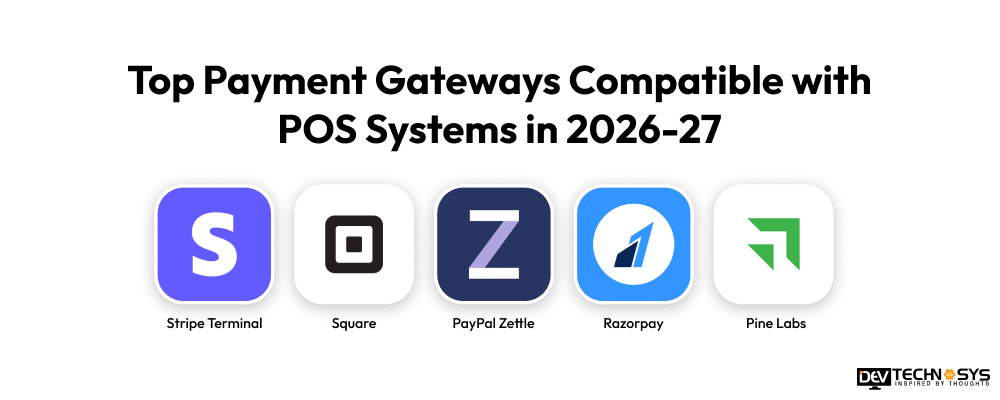
1. Stripe Terminal
Stripe terminal is a strong choice for companies looking for flexible API driven POS payment gateway integration across both online and in-store channels. It delivers powerful developer tools, robust fraud detection, and worldwide scalability. However, it typically requires more technical effort compared to plug-and-play POS systems.
Ideal for: Tech-savvy companies; businesses that operate in multiple channels
Drawback: Power but labor-intensive to set up
2. Square
Square is one of the most complete POS ecosystems available today. The combination of hardware, software, and payment processing makes deploying their system quick and easy. This is one reason why Square is so widely adopted by small and mid-sized companies. The main disadvantage of using Square is that it does not provide much flexibility in creating complex enterprise custom POS solutions.
Ideal for: Small companies, retailers, coffee shops.
Drawback: Simple to set up, but not extensible at scale
3. PayPal Zettle
Paypal Zettle was developed with a focus on mobile, easy-to-use POS payments. There is a high level of trust in the brand, and it has a strong name/brand presence around the world. You can expect to have very quick access to basic POS functions when you integrate this system, but the advanced POS functions available in dedicated retail POS systems are limited.
Ideal for: Small retailers, mobile vendors
Drawback: Simple and trusted but limited advanced POS depth
4. Razorpay
Razorpay is one of the recognized payment gateway systems and mainly for the indian market ot businesses. It offers robust omnichannel and POS capabilities, includes UPIs, QR-based payments, cards, and more. Razorpay has limited international expansion features compared to global payment gateways. This also offers a solid developer API and quick onboarding.
Ideal for: Indian startups and SMEs
Drawback: Best local coverage, but limited in global reach
5. Pine Labs
Pine Labs is basically used in enterprise and retail POS setups, and it mainly excels in physical environments, and is less focused on developer-first API ecosystems. Pine Labs offers robust in-store payment POS terminal integration and merchant financing options. It is widely used across India, and most of the big retail organizations use this to enhance their payment operations.
Ideal for: Large retail chains, offline-heavy businesses
Drawback: Strong hardware ecosystem, weaker developer flexibility
Security Standards You Must Meet: Integrate Payment Gateway With POS System
Integrate a POS system is a regulatory and operational requirement. Businesses must meet globally accepted standards (PCI-DSS), use strong encryption methods, and have mechanisms in place to prevent fraud in order to protect their customer’s payment data.
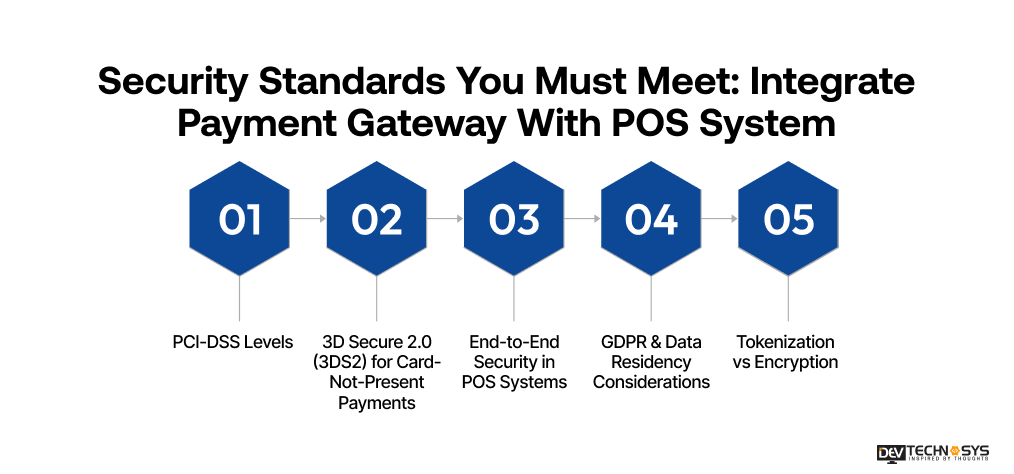
1. PCI-DSS Levels
Here’s how different levels of PCI-DSS apply to your business.
Level 1: More than 6 million transactions per year, this level has the most stringent requirements for both auditing processes and the security controls in place.
Level 2: Between 1-6 million transactions per year, requires a self-assessment annually with an audit required every other year.
Level 3: Between 20,000 and 1,000,000 e-commerce transactions per year, require quarterly scans.
Level 4: Under 20,000 transactions per year, requires only compliance testing.
Every business using a POS system must follow the PCI-DSS requirements for the secure handling of cardholder data.
2. 3D Secure 2.0 (3DS2) for Card-Not-Present Payments
3D Secure 2.0 (3DS2) is the newest version of the 3D Secure payment authentication protocol that provides a 3rd layer of security when making purchases without a card present. It uses one-time passwords, biometrics, and risk-based evaluations to help ensure that a customer’s identity is authentic. By doing this, 3D Secure 2.0 reduces instances of fraud and chargebacks, as well as improving the overall customer experience at checkout.
3. End-to-End Security in POS Systems
To provide end-to-end security in your payment software solutions, choose a payment processor whose payment systems have robust encryption, tokenization, and fraud detection capabilities, and partner with your POS provider to ensure that your entire system (not just the payment processor) is compliant with the payment processor’s compliance and security standards.
4. GDPR & Data Residency Considerations
Organizations that manage consumer information must pay attention to applicable data protection legislation:
General Data Protection Regulation (GDPR) (EU): Refers to how personal information regarding European Union Citizens will be collected and used.
Digital Personal Data Protection Act 2023: Regulates how organizations will collect and retain personal digital data.
Note: Your online check-out must include a payment processing platform that fits all regional data protection laws, which will create legal and compliance exposure for both you and your business if not followed properly.
5. Tokenization vs Encryption
Sensitive cardholder data is transformed by encryption into an unreadable form with the use of cryptographic keys and can be decrypted when necessary. The cardholder data is replaced with a random token using a tokenization technique, which is of no use anywhere outside of the system.
Key Difference: Encryption secures data while it is in transit, while tokenization totally removes sensitive data from the merchant’s system. Tokenization is much safer for POS environments.
Integration Challenges and How to Overcome Them
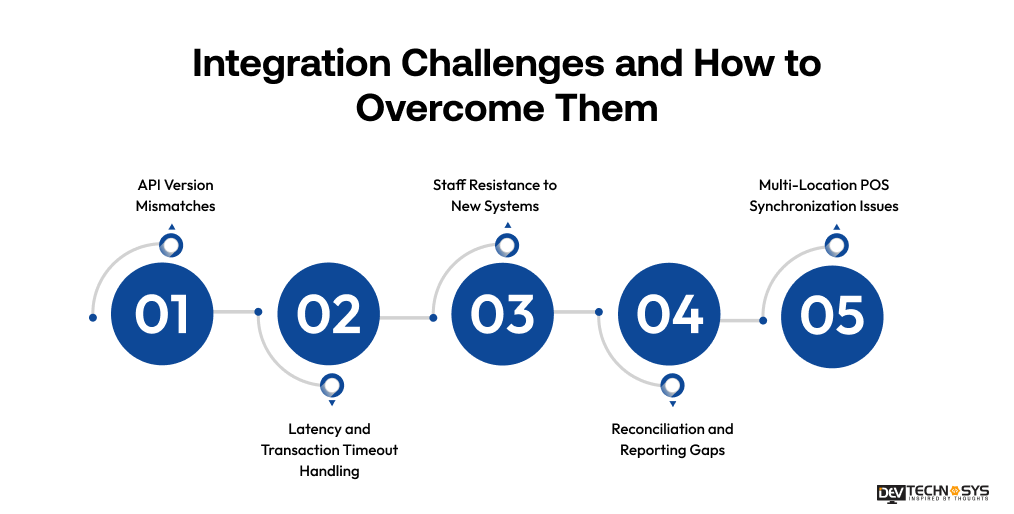
When integrating a payment gateway with a POS system, you may run into difficulties with API compatibility, transaction delays, regulatory compliance, reconciliation errors, and employee adoption; however, these obstacles can be overcome through extensive testing, adequate security measures, automated reports, real-time sync, and full training for staff members.
1. API Version Mismatches
API version mismatch between POS systems and payment gateways may cause unsuccessful transactions and compatibility issues. Create a versioning management strategy, perform testing of integration in a staging platform frequently, and monitor updates done by the POS gateway to ensure compatibility.
2. Latency and Transaction Timeout Handling
Latency & Timeout issues on networks can tamper with payments or provide an unsatisfactory experience for the customer. The introduction of retry mechanisms for transactions, asynchronous transaction processing, status checks, and experience for the end user are ways to ensure the reliability of transactions.
3. Staff Resistance to New Systems
Employees may be resistant to adopting new payment workflows. To overcome this resistance, it would be beneficial to provide open lines of communication, hands-on training, and demonstrations of how the new payment systems reduce manual work, expedite the checkout process, and reduce user errors during checkout.
4. Reconciliation and Reporting Gaps
Inconsistencies between POS records and the payment gateway settlements will create a situation where there is an accounting disparity. By ensuring that there is automation for reconciling, implementing a real-time reporting dashboard, and doing a daily report of settlements, accurate tracking of the store’s finances will be maintained.
5. Multi-Location POS Synchronization Issues
Retailers that have more than one store frequently have inconsistent transaction and inventory data across their stores’ POS systems. To provide uniformity for accurate data across every store, they have utilized cloud-based architecture with a centralized database and ‘real-time’ sync features.
What’s Next: The Future of Payment Gateway + POS Integration
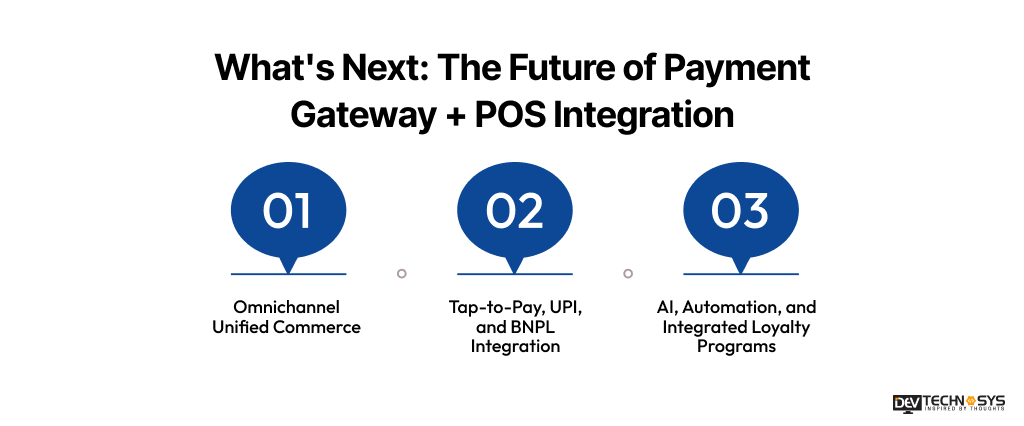
Payment gateways and point-of-sale (POS) integrations will be automated, AI-based security technology will offer faster settlement processes, and create a more unified commerce experience by using multiple technologies such as digital wallets, UPI, BNPL, and integrated loyalty programs.
1. Omnichannel Unified Commerce
The integration of modern payment gateways with POS systems allows businesses to combine all of their online and offline sales into one place. This will provide greater visibility into transactions, sales patterns, and customer behavior across multiple channels in real-time so that businesses can create more seamless shopping experiences, as well as operate more efficiently and make better data-driven decisions.
2. Tap-to-Pay, UPI, and BNPL Integration
Many POS systems today are able to accept all types of payment methods, including Tap-to-Pay, UPI, digital wallets, and Buy Now Pay Later (BNPL) solutions. This enables businesses to speed up the checkout process , improve customer satisfaction (by providing them with more convenient ways to pay), reduce their cash reliance (by encouraging customers to use non-cash payment methods), and meet the changing needs of today’s consumers.
3. AI, Automation, and Integrated Loyalty Programs
With the increasing use of AI for fraud detection, as well as more automated settlement processes, the future of payments looks bright. When businesses combine secure methods of processing payments with customer loyalty programs and analytical tools, they create better security for their customers, increase customer retention rates, and develop a sustainable competitive advantage.
Conclusion
In conclusion, integrating the payment gateway with the POS system is important for businesses to achieve speedy transactions, improved security, and enhanced customer service. The integration process requires planning, a technology partner, security practices, and testing. Overcoming common challenges like compatibility of APIs, troubleshooting issues with reconciliation, and obtaining staff buy-in will assist businesses in streamlining their operations and preparing for future growth. A POS software development company providing an integrated POS solution will help businesses be more efficient, flexible, and customer-focused.
Frequently Asked Questions
Find answers to the most common questions related to this article.
A payment gateway is distinct from a POS (Point of Sale) system, while the latter manages all aspects of sales, such as inventories, billing, and receipts. The payment gateway manages the secure transmission of payment information between your system and the bank of your customer’s payment card issuer. A POS can keep track of sales, but will not have the ability to accept digital payments unless the gateway has been installed.
The main methods to integrate a payment gateway with a POS are to use either an API, a hosted page, or direct integration with the POS itself. In some situations, you may see various combinations of integration methods or require writing custom code. An API integration provides you with the greatest amount of options and flexibility.
To integrate a payment gateway with POS systems with simple functions, it usually takes around 1 to 3 days. The customized API integration typically takes 2 to 6 weeks, depending on specific factors. It involves security, testing, staff training, omnichannel setups, complex multi-location setups, and more.
The cost to integrate a payment gateway with POS systems varies based on the different areas or segments. It involves $0–$500+ in setup fees, $0–$50/month in gateway fees, and 1.5% to 3% per transaction. Additional costs include hardware ($50–$1,000), developer/integration fees ($500–$5,000+), and PCI compliance charges, which are usually based on the providers and complexity.
Fraud detection is supported through the use of AI, and blockchain is gradually making its way into settlement processes. Early adopters of these technologies should be able to establish a competitive advantage. Transactions can now be assessed using fraud scoring at the gateway level, utilizing AI before they are completed, leading to a reduction in chargebacks without blocking valid customers.