


















Are you curious about the powerful AI tools from Amazon Web Services (AWS)?
If you’re exploring machine learning and want to build smart apps, you’ve probably heard of Bedrock and SageMaker.
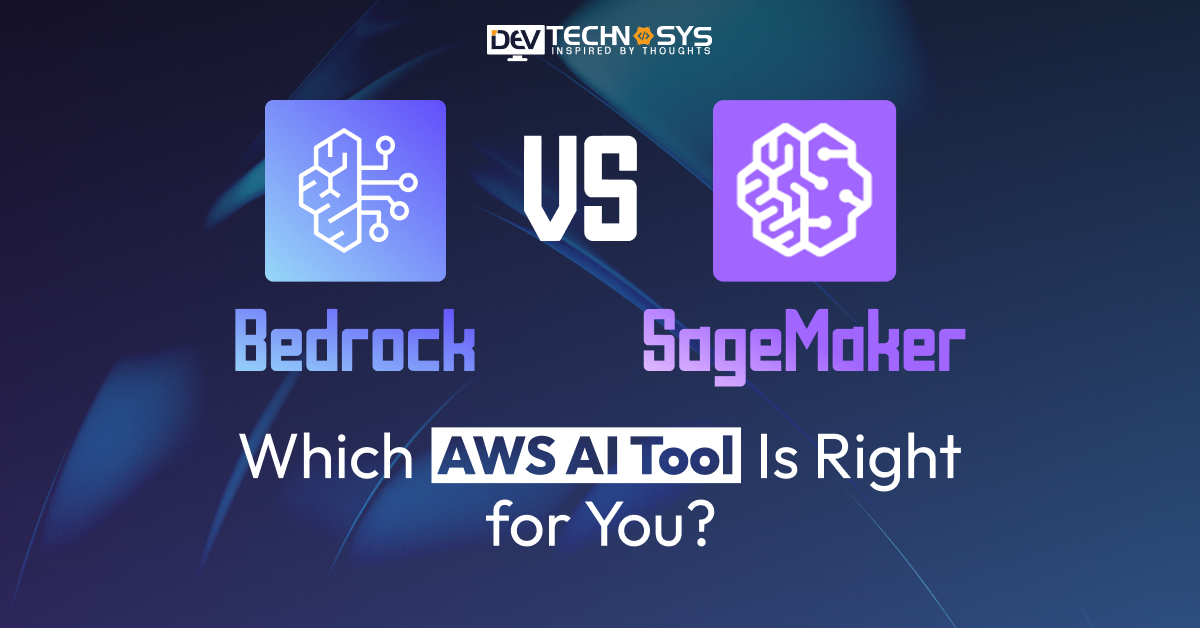
But which one should you choose, Bedrock vs SageMaker?
AWS Bedrock makes it easy to work with AI models without needing to manage servers, while SageMaker gives you full control to train and tune your own models.
In this article, we’ll compare both tools in a simple and clear way, so even beginners can understand.
Whether you’re just starting out or aiming to become an AI expert, this guide will help you decide which tool is right for your journey into the world of artificial intelligence.
What is Amazon Bedrock?
Launched in 2023, Amazon Bedrock is a relatively new artificial intelligence (AI) service that enables customers to create and scale generative AI applications utilizing foundation models (FMs) from several suppliers, including as Anthropic, Cohere, Meta, Stability AI, and Amazon’s own Titan models, all of which are available through a straightforward API.
In contrast to SageMaker, which necessitates a more active approach to model construction, Bedrock is a serverless platform that enables customers to incorporate AI capabilities into their applications without having to worry about infrastructure management or model training.
Key Features of Amazon Bedrock:
- Availability of many Foundation Models (FMs) from leading suppliers of AI models.
- Serverless architecture provides low operating overhead and simple scaling.
- Fully managed experience without the need to supply infrastructure.
- Customization through prompt engineering and fine-tuning.
- Integration with additional AWS services, including Amazon CloudWatch, Lambda, and API Gateway.
- A private, secure setting that complies with data governance regulations.
Ideal Use Cases for Bedrock:
- Virtual assistants and chatbots.
- Creation and summary of text.
- Creation of images (using models such as Stability AI).
- Instruments inside the computer that need to understand normal words.
- Quick creation of MVPs or prototypes driven by AI.
Want a chatbot demo or pricing? Fill the form and talk to our experts today.
Pick what you need below — you can select more than one — then tap Get detail to continue.
-
Chatbot demo dashboard
-
Cost to develop an app
-
Industry report
-
Case study
What is Amazon SageMaker?
Developed in 2017, Amazon SageMaker is a sophisticated, all-inclusive platform for creating, honing, and implementing machine learning models on a large scale. It covers every step of the machine learning lifecycle, including preprocessing and data labeling, training, model deployment, hyperparameter tweaking, and monitoring.
Data scientists, machine learning experts, and businesses creating unique models for particular commercial applications will find SageMaker to be more flexible and controllable than Bedrock.
Key Features of Amazon SageMaker:
- Support for well-known machine learning frameworks (e.g., TensorFlow, PyTorch, Scikit-learn) and Bring Your Own Model (BYOM).
- Integrated algorithms for grouping, regression, classification, and other tasks.
- Jupyter Notebooks are integrated for interactive development.
- For a comprehensive ML IDE experience, use SageMaker Studio.
- Model deployment using A/B testing and endpoints.
- Automatic Debugging and Model Tuning.
- For MLOps workflows, model, monitor, clarify, and pipeline.
Ideal Use Cases for SageMaker:
- Forecasting and predictive analytics.
- Bespoke models for NLP and machine vision.
- Training models on huge private datasets.
- Reinforcement learning and deep learning.
- MLOps and AI infrastructure at the corporate level.
Bedrock vs SageMaker: A Feature-by-Feature Comparison
| Feature | Amazon Bedrock | Amazon SageMaker |
| Model Type | Pre-trained foundation models (FMs) | Trainable custom models or use built-in models |
| Customization | Prompt tuning, limited fine-tuning | Full model customization and training |
| Infrastructure Management | Serverless (fully managed) | Requires setup and configuration |
| Ease of Use | Beginner-friendly, low-code/no-code | Requires ML expertise |
| Data Handling | Minimal; mostly prompt-based inputs | Full control over data pipelines |
| Training Required | No | Yes |
| Supported Frameworks | Prebuilt model providers (Anthropic, Meta, etc.) | TensorFlow, PyTorch, MXNet, XGBoost, etc. |
| MLOps Tools | Limited | Integrated MLOps tools |
| Deployment Options | API-based access to models | Custom endpoints, batch jobs, real-time inferencing |
| Integration | Easily integrates with Lambda, API Gateway, etc. | Full integration with AWS ecosystem |
| Pricing Model | Pay per use (API calls, tokens) | Pay for compute, storage, training time |
Which Tool Is Right for You?
The technological capabilities, project needs, and intended results will determine which of Bedrock and SageMaker is best for you. We examine many situations below to assist you in making an informed choice:
Choose Amazon Bedrock if:
- Utilize pre-existing generative AI models such as Titan, Llama, or Claude.
- Instead of training models from scratch, your use case entails the production of text, images, or code.
- Without having to worry about model construction, you can swiftly include AI capabilities into apps.
- You are a company, a product manager, or a dedicated developer who wants speed and simplicity.
- You wish to try prompt engineering and multi-model access.
- A pay-as-you-go approach without resource allocation is what you prefer.
Choose Amazon SageMaker if:
- You must use private data to build specialized machine learning models.
- There are data scientists or machine learning engineers working for your company.
- You must handle the whole machine learning lifecycle, including pipelines, debugging, and monitoring.
- You’re developing enterprise-scale machine learning systems that must meet strict governance and performance standards.
- Explainability, bias detection, and compliance tools (like Clarify and Monitor) are necessary.
- You want complete control over the infrastructure, datasets, and training methods.

Pricing Comparison: SageMaker vs Bedrock
Amazon Bedrock Pricing:
Bedrock uses a usage-based pricing model. You are charged based on:
- Number of input/output tokens used per API call.
- Model provider and model size (e.g., Claude 3, Titan, Llama 3).
- Optional model customization.
Example:
- Using Claude 3 Sonnet might cost $0.003 per 1,000 input tokens and $0.015 per 1,000 output tokens.
- Fine-tuning options and inference throughput may have additional charges.
Amazon SageMaker Pricing:
SageMaker pricing is modular and includes:
- Compute (training and inference instances).
- Storage (for datasets and models).
- Data processing jobs.
- SageMaker Studio IDE.
- SageMaker Canvas (low-code interface).
- Optional autopilot features.
Integration and Ecosystem Support
Despite their differences, both services are closely linked inside the AWS ecosystem.
Bedrock:
- Pairing with CloudWatch, Step Functions, API Gateway, and AWS Lambda is simple.
- Suits microservices architectures nicely.
- Provides safe access using IAM and VPC roles.
- Provisioning of infrastructure is not required.
SageMaker:
- It can handle data by connecting to Amazon S3, Redshift, Glue, Athena, and Kinesis.
- Supported by MLOps tools, CodePipeline, and CloudFormation.
- Gives users more precise control over IAM and network options.

Performance and Scalability
Bedrock:
- Built with AWS’s serverless backbone for instant scalability.
- AWS handles instance management; you don’t.
- Token limitations and model type affect performance.
- Excellent for experimentation and sporadic workloads.
SageMaker:
- Requires manual or automated configuration.
- More appropriate for multi-step pipelines, high-throughput inferencing, and lengthy training tasks.
- Multi-model endpoints and controlled spot training can be used to optimize it.
Real-World Examples
Using Amazon Bedrock:
- Customer Support Bots: Automate customer queries with Anthropic Claude or Amazon Titan.
- Content Generation Tools: Develop apps that write articles, ads, or social media posts.
- AI Copilots: Integrate generative code assistants into developer tools.
- Conversational Analytics: Extract insights from documents and conversations.
Using Amazon SageMaker:
- Fraud Detection Models: Train classification models with proprietary transaction data.
- Image Recognition Systems: Build deep learning pipelines for medical or industrial applications.
- Supply Chain Forecasting: Use time series data to build demand forecasting models.
- Personalized Recommendations: Build collaborative filtering engines.
Conclusion
Within the AWS AI ecosystem, Amazon Bedrock vs SageMaker have different functions. Bedrock is perfect for low-code users and rapid prototyping because of its exceptional simplicity, speed, and generative AI access.
SageMaker, on the other hand, supports sophisticated data science teams and provides complete control over the ML lifecycle in addition to extensive customisation.
Whether you want a plug-and-play foundation model or a full-featured platform for creating, honing, and implementing unique AI solutions will ultimately determine your decision.
Frequently Asked Questions
1. Can I Train My Own Models In Bedrock?
No, Bedrock does not support custom training. Use basic models that have already been trained and have the option of Retrieval-Augmented Generation (RAG) or fine-tuning.
2. How Do Bedrock And Sagemaker Differ In Purpose?
- Bedrock focuses on foundation models and generative AI workflows.
- SageMaker supports the entire ML lifecycle, including traditional supervised/unsupervised learning.
3. Which Service Offers More Control Over Infrastructure?
Amazon SageMaker offers more infrastructure control, including instance types, networking, security, and custom configurations.
4. Which Should I Use For Building Genai Applications Quickly?
Choose Amazon Bedrock for fast, low-code GenAI application development. Choose SageMaker for custom ML workflows and model training needs.