


















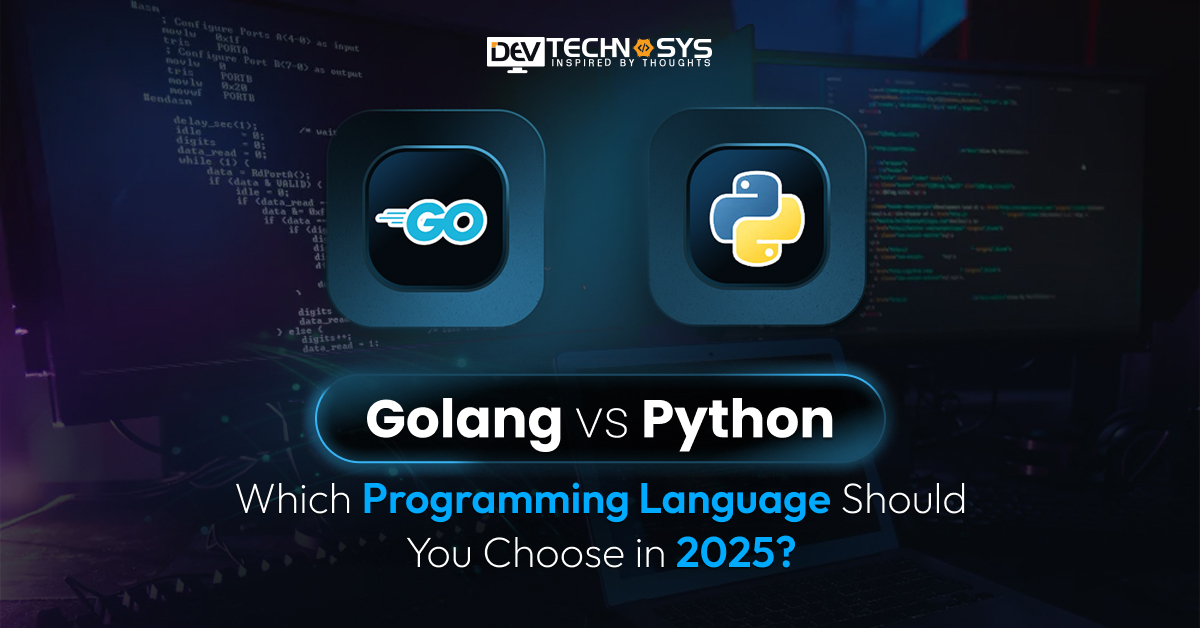
Most developers have always been curious about which programming language is better, Golang vs Python.
Professionals all over the world use both of them because they are powerful in their own ways. Python is famous for being very easy for beginners to learn. You can also use it for AI, data science, and building websites.
On the other hand, Golang (or Go) is famous for its speed, simplicity, and performance in building large-scale applications.
In this comparison, we will explore how each language works, where they shine, and which one might be the right choice depending on your goals.
Whether you’re just starting out or want to build something big and fast, understanding the strengths of each language can help you make smarter decisions in your programming journey.
Let’s dive in!
What is Golang(Go)?
Google created the statically typed, compiled language Golang in 2007 and made it available to the general audience in 2009. Go was created with performance and simplicity in mind, making it perfect for creating concurrent, scalable systems.
It is used in cloud-native tools like Docker and Kubernetes, microservices, and backend development because of its clear syntax and speedy compilation.
What is Python?
Python was created by Guido van Rossum and came out in 1991. It is an interpreted language with dynamic typing. It is renowned for its readability and adaptability.
Python’s vast ecosystem and user-friendly syntax make it a popular choice for Python development, data research, automation, artificial intelligence, and education.
Want a chatbot demo or pricing? Fill the form and talk to our experts today.
Pick what you need below — you can select more than one — then tap Get detail to continue.
-
Chatbot demo dashboard
-
Cost to develop an app
-
Industry report
-
Case study
Syntax and Ease of Use: Python vs Golang
Python:
Python’s syntax is often praised for its clarity and brevity. It’s very easy for beginners to learn, and coders can get the same results with fewer lines of code than with other languages.
Example – Hello World in Python:
print(“Hello, World!”)
Golang:
Go has a relatively minimalistic syntax but is more verbose than Python. It enforces stricter typing and structural integrity, which can lead to fewer runtime errors but a steeper learning curve for beginners.
Example – Hello World in Go:
package main
import “fmt”
func main() {
fmt.Println(“Hello, World!”)
}
Result: Python wins in terms of ease of learning and rapid development, especially for prototypes and scripts.
Performance: Golang vs Python
Golang:
Since Go is a written language, its source code is turned into machine code before it is run. This results in faster runtime performance, lower memory usage, and efficient concurrency. Go is ideal for building high-performance network servers, concurrent applications, and real-time services.

Python:
Python’s nature as an interpreted language makes it inherently slower than Go. However, Python offers C-extensions (like NumPy, TensorFlow) that can improve performance for specific tasks.
Result: Go significantly outperforms Python in raw execution speed and concurrency, making it better for performance-intensive applications.
Concurrency and Parallelism: Golang or Python
Golang:
One of Go’s standout features is its goroutines, lightweight threads managed by the Go runtime. Go’s go keyword and channels make concurrency easy and safe without relying on external libraries.
go doSomething()
Python:
The Global Interpreter Lock (GIL) in Python stops more than one thread from running at the same time in the same process. While libraries like asyncio, multiprocessing, and concurrent. Futures offer workarounds; they add complexity.
Result: Go is purpose-built for concurrent and parallel programming, giving it a clear advantage in this area.
Scalability: Python or Golang
Golang:
Go’s efficient memory management, goroutines, and simple deployment make it an excellent choice for scaling applications. It is extensively used in places with a lot of stress, including cloud platforms and distributed systems.
Python:
Python can be scaled, but it often requires more effort. Frameworks like Django, FastAPI, and tools like Celery help in building scalable apps, but performance bottlenecks are a concern as the system grows.
Result: Go offers better scalability out of the box, especially for backend services.
Community and Ecosystem: Golang vs Python
Python:
Among the biggest and busiest communities is Python. With libraries for almost every domain, including web, AI, automation, and data science, Python’s ecosystem is vast and well-documented.
Golang:
The Go community is vibrant and expanding, despite being smaller than Python’s. It has excellent support for backend, DevOps, and system-level programming, but lacks in domains like machine learning and data analytics.
Result: Python wins in ecosystem diversity, especially for multidisciplinary projects.

Use Cases and Applications
Python Use Cases:
- Web Development: Django, Flask, FastAPI
- Data Science and Machine Learning: Pandas, Scikit-learn, TensorFlow
- Automation and Scripting
- AI & NLP
- Education
Golang Use Cases:
- Backend Development: APIs, microservices
- Cloud Infrastructure: Docker, Kubernetes
- DevOps Tools: Terraform, Prometheus
- Networking Services
- High-Performance APIs
Result: Python dominates in scientific computing and rapid development; Go excels in system-level programming and performance-critical applications.
Error Handling: Python or Golang
Python:
Python uses try-except blocks for error handling, making it clean and intuitive.
try:
result = 10 / 0
except ZeroDivisionError:
print(“Cannot divide by zero”)
Golang:
Go handles errors by using return values instead of exceptions. While this increases code verbosity, it encourages dedicated developers to handle errors explicitly.
result, err := divide(10, 0)
if err != nil {
fmt.Println(“Cannot divide by zero”)
}
Result: Python’s approach is more intuitive; Go’s is more rigorous and suited for large-scale, fault-tolerant systems.
Development Speed: Golang or Python
Python:
Python allows quick development cycles and rapid prototyping, making it ideal for startups and research-based projects.
Golang:
Go requires more boilerplate and planning during development but rewards with stability and runtime safety.
Result: For MVPs and startups, Python may be better. For production-grade systems, Go provides long-term benefits.
Tooling and Compilation: Golang vs Python
Golang:
- Comes with a built-in toolchain (formatting, testing, compiling)
- Fast compilation and deployment
- Single-binary executables for easy deployment
Python:
- Requires external tools for packaging and deployment
- Slower startup time
- Virtual environments needed for dependency management
Result: Go simplifies build and deployment workflows significantly.
Job Market and Popularity: Python or Golang
Python:
- One of the top languages by job demand in 2025
- Widely taught in universities
- Used across a broad range of industries
Go:
- Rising demand, especially in backend, cloud, and DevOps roles
- Used by top companies like Google, Uber, and Dropbox
- Competitive salaries in niche areas
Result: Python leads in job volume; Go offers high-paying, specialized roles.
Security: Golang or Python
Go:
- Type safety and no pointer arithmetic reduce risks
- Built-in features like memory safety, concurrency management
Python:
- Dynamic typing can lead to runtime errors
- Still widely used in security tools, but needs extra testing
Result: Go’s static typing and compiled nature offer better built-in security.
When to Pick Between Python and Golang
| Scenario | Recommended Language |
| Rapid prototyping and MVPs | Python |
| Machine Learning or Data Analysis | Python |
| Backend services for high traffic | Go |
| CLI or DevOps tools | Go |
| Academic or educational projects | Python |
| Cloud-native applications | Go |
| Cross-domain (ML + Web) projects | Python |
| Low-latency systems (e.g., streaming) | Go |
Final Thoughts
In conclusion, both Golang and Python excel in different areas. Python is easy to use and has a large community, which makes it perfect for fast development, data science, and AI.
Golang, on the other hand, offers superior performance, concurrency, and scalability, making it perfect for backend and system-level programming.
The right choice depends on your project goals, opt for Python for flexibility and speed, or choose Go for efficiency and reliability in production-grade systems. Both are powerful tools in a modern developer’s toolkit.
Frequently Asked Questions
1. Which Language Is Easier To Learn For Beginners?
Python is a widely favored introductory language because to its straightforward and comprehensible syntax.
2. Is Golang a Better Backend Development Language Than Python?
Yes, Golang is better for high-performance, scalable backend services, while Python is better for rapid development and prototyping.
3. Which Language Is More In Demand In 2025?
Python remains more in demand overall, especially in AI and data fields, while Go is rising fast in backend and DevOps roles.
4. Which Is Better For Building APIs: Python Or Go?
Both are good, but Go is faster and more scalable. Python is quicker to develop with frameworks like Flask or FastAPI.