




















Key Takeaways:
E-commerce website development costs typically range from $8,000 to $30,000+, depending on complexity, features, and scale. Basic online stores start at $8,000 – $15,000+, mid-level platforms cost $15,000 – $20,000+, while advanced, enterprise-grade marketplaces can exceed $20,000 – $30,000+. Costs are influenced by design customization, integrations, scalability, and development team expertise.
Cost Breakdown by Development Complexity:
-
- Basic/MVP ($8,000 – $15,000+): Includes product listings, shopping cart, secure checkout, and simple admin panel.
- Medium ($15,000 – $20,000+): Adds custom UI/UX, payment gateways, inventory management, and third-party integrations.
- Complex ($20,000 – $30,000+): Features AI recommendations, multi-vendor marketplace architecture, real-time analytics, and global scalability.
Key Cost Drivers:
-
- Features: Advanced search, personalization, and automation increase development costs.
- Platform Choice: SaaS platforms are cheaper than custom-built solutions.
- Integrations: Payment, shipping, SSL certificate integration, CRM, and ERP integrations add to expenses.
- Scalability: High traffic handling, CDN optimization, and cloud infrastructure raise costs
Development Timeline:
-
- MVP: 2– 4 months.
- Medium: 3 – 5 months.
- Complex: 6 + months or more.
Cost Based on Countries:
-
- USA: $10,000–$30,000, resulting in higher overall costs.
- United Kingdom: $9,000 – $29,000 with strong quality standards.
- Australia: $8,000 – $27,000, balancing cost and expertise.
- Canada: $8,500– $25,800 offering cost-effective cloud-based eCommerce solutions.
Additional Costs:
-
- Maintenance: 10 – 20% annually.
- Marketing: SEO, ads, and promotions.
- Hosting & Security: Ongoing server and protection costs.
- Content management, product photography, and ongoing updates also contribute to long-term expenses.
Developing an SEO-friendly eCommerce website is no longer a straightforward pricing decision. Many business leaders face the challenges of balancing cost with performance and scalability. It’s hard to give ballpark numbers as many factors are involved, especially in a custom ecommerce website development.
Ecommerce is on the way to becoming the largest share of global retail. It has been showing steady upward growth as more consumers shop online. Most organizations still make the mistake of underestimating costs, focusing only on initial build expenses. Elements like architectural choices, platform constraints, and future integration introduce additional costs down the line.
Are you thinking about launching an e-commerce website? If yes, then you must be wondering about the cost to build an e-commerce website in 2026. In this blog, you’ll find the ecommerce website pricing breakdown by types, along with factors and tips to reduce the cost.
Global E-Commerce Market Report
The global ecommerce market is driven by increasing digital adoption, shifting consumer behaviors, and advancements in secure payment methods. Below is the market summary for 2026-2031 from Mordor Intelligence.
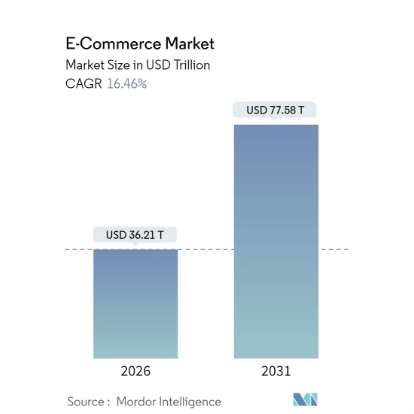
- In 2026, the ecommerce market size stands at USD 36.21 trillion.
- By 2031, it is projected to reach USD 77.58 trillion, with a 16.46% CAGR.
- By geography, Asia-Pacific accounted for 54.46% of revenue in 2025.
- By product, consumer electronics accounted for 27.88% in 2025.
- By business model, B2C led with 54.89% share in 2025.
- By device, smartphones captured 72.67% at an 18.17% CAGR.
How Much Does It Cost To Build An E-Commerce Website In 2026?
Ideally, ecommerce website development cost ranges from $8,000 to $30,000, depending on the business scope and objectives. The final ecommerce website development price includes the cost of custom design, software development, payment processing, hosting, custom features, and any additional upfront fees.
The cost will be minimal compared to a custom website development if you desire one with a few capabilities. Truth be told, the cost estimate depends entirely on what you want and how you wish to develop it.
Website Type |
Best For |
Key Features Included |
Estimated Cost (USD) |
| Basic E-Commerce Website | Startups, small stores | Pre-built theme, basic UI, standard checkout, 1–2 payment gateways | $8,000 – $12,000 |
| Small Business Store | Growing businesses | Custom design tweaks, product catalog (50–200 items), basic integrations | $12,000 – $18,000 |
| Mid-Level E-Commerce Website | Scaling brands | Custom UI/UX, advanced filters, multiple payment gateways, shipping APIs | $18,000 – $25,000 |
| Advanced / Custom E-Commerce | High-growth brands | Fully custom design, automation, CRM/ERP integration, performance optimization | $25,000 – $30,000 |
What Is The Cost Of Different Types Of Ecommerce Websites?
When it comes to online store development, there are different models. An ecommece website development company designs each model to serve unique business goals, user behaviors, and revenue strategies.
Each ecommerce website has its own technical requirements and cost implications. To choose the right website type for your business, you must first understand the costs.
1. Subscription-Based E-commerce
The cost of a subscription-based ecommerce website is influenced by recurring billing systems, automated payments, and subscription lifecycle management.
Features like plan customization, retention analytics, and user dashboards increase the expenses. Compared to the cost of a basic website, this model is moderately expensive.
Component |
Estimated Cost (USD) |
| UI/UX Design | $2,000 – $3,000 |
| Subscription Logic & Billing System | $3,000 – $5,000 |
| Payment Gateway Integration | $1,500 – $2,500 |
| Backend Development | $2,500 – $4,000 |
| Testing & Deployment | $1,000 – $1,800 |
| Total Cost | $9,000 – $14,800 |
2. Marketplace Model
Among B2B ecommerce development pricing, marketplace platforms are among the most expensive. The reasons are the multi-vendor architecture, commission systems, and complex admin controls. With vendor onboarding, dispute management, and scalability requirements, development costs rise.
Component |
Estimated Cost (USD) |
| Multi-Vendor System | $4,000 – $6,000 |
| Admin Dashboard | $2,500 – $3,500 |
| Commission & Payment Logic | $3,000 – $4,000 |
| UI/UX Design | $2,000 – $3,000 |
| Security & Testing | $1,500 – $2,500 |
| Total Cost | $13,000 – $19,000 |
3. On-Demand E-commerce
Website development cost for on-demand ecommerce is high due to real-time features such as order tracking, order management system (OMS), and instant notifications. GPS tracking, logistics APIs, and performance optimization increase the expenses. The frontend and backend development costs are higher than for traditional e-commerce website development.
Component |
Estimated Cost (USD) |
| Real-Time Tracking System | $3,500 – $5,000 |
| Order & Delivery Management | $3,000 – $4,000 |
| Third-Party Integrations (Maps, APIs) | $2,500 – $3,500 |
| UI/UX Design | $2,000 – $2,800 |
| Backend Infrastructure | $2,500 – $3,500 |
| Total Cost | $15,000 – $21,000 |
4. Social Commerce
Ecommerce website development cost for small business is affordable when it’s the social commerce type. It requires investment in engagement-driven features like social sharing, influencer integrations, and live streaming. This model offers a lower entry cost, but interactive and real-time engagement tools might increase the expenses.
Component |
Estimated Cost (USD) |
| Social Media Integration | $2,500 – $4,000 |
| Interactive Features | $2,500 – $3,500 |
| Product Catalog Setup | $2,000 – $3,000 |
| UI/UX Design | $1,500 – $2,500 |
| Testing & Optimization | $1,000 – $2,000 |
| Total Cost | $10,000 – $15,500 |
5. Mobile Commerce
The e-commerce website development cost is affected by mobile app complexity, third-party API integration, and performance optimization. Cross-platform compatibility, push notifications, and mobile e-wallets are the major factors that increase the overall cost. Compared to a web-only platform, this model requires additional investment.
Component |
Estimated Cost (USD) |
| Mobile App Development | $5,000 – $7,000 |
| API & Backend Integration | $3,000 – $4,000 |
| UI/UX Optimization (Mobile-First) | $2,000 – $3,000 |
| Testing & Deployment | $1,500 – $2,500 |
| Maintenance Setup | $1,500 – $2,500 |
| Total Cost | $16,000 – $22,000 |
Want a chatbot demo or pricing? Fill the form and talk to our experts today.
Pick what you need below — you can select more than one — then tap Get detail to continue.
-
Chatbot demo dashboard
-
Cost to develop an app
-
Industry report
-
Case study
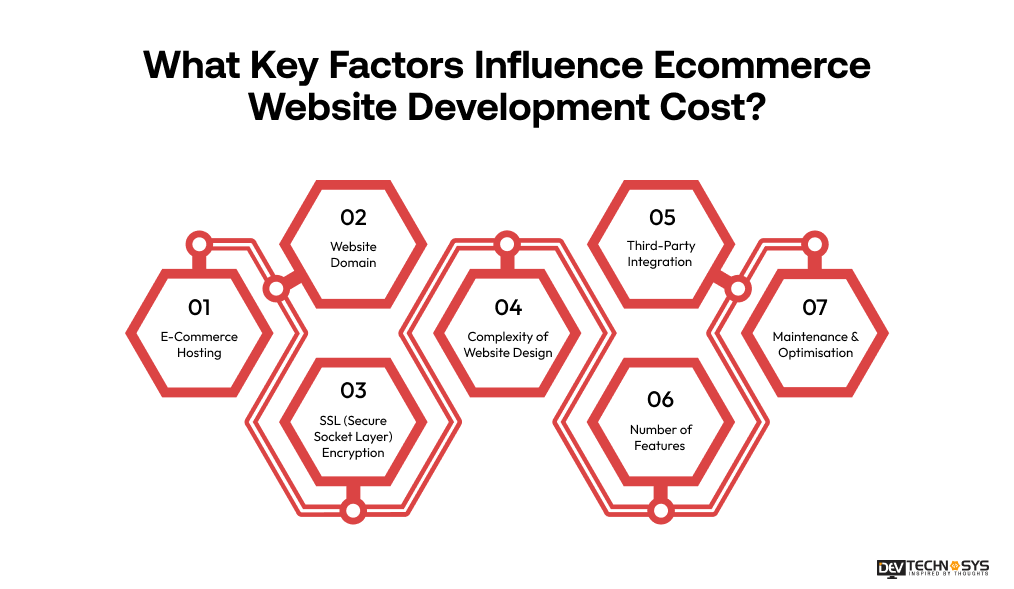
What Key Factors Influence Ecommerce Website Development Cost?
The cost to build an e-commerce website in US depends on how complex, scalable, and future-ready the platform needs to be. Unsurprisingly, the cost to develop ecommerce website from scratch is never about a single line item. There are several considerations you need to address. To hire ecommerce website development services, evaluating key factors is important.
1. E-Commerce Hosting
The cost to start an online business is affected by hosting. Hosting is necessary to store your data or files so they are accessible to Internet users. There are several types of hosting you can choose from: shared, cloud, VPS, and dedicated hosting. Based on your choice, your cloud hosting cost for ecommerce is determined.
Hosting Type |
Features Included |
Impact Cost (USD) |
| Shared Hosting | Basic performance, limited resources | $100 – $200 |
| VPS Hosting | Better speed, moderate scalability | $200 – $300 |
| Cloud Hosting | High scalability, reliability | $300 – $400 |
2. Website Domain
The next factor that influences the cost to create an e-commerce website is the Domain. A domain is the address of your website on the Internet. It is human-readable and corresponds to an IP address, allowing users to access your website. Domain registrars, domain extensions, registration periods, and premium domains affect domain costs.
Domain Type |
Features Included |
Impact Cost (USD) |
| Standard Domain | Common extensions (.com, .net) | $10 – $50 |
| Premium Domain | High-value keywords, branding | $200 – $500 |
| Renewal & Protection | Privacy + yearly renewal | $100 – $200 |
3. SSL (Secure Socket Layer) Encryption
For every startup and enterprise website development, security is the top priority. Secure transactions and data security allow users to share information confidently.
An SSL certificate establishes an encrypted connection between the user’s browser and the web server. Compared to basic SSL certificates, advanced SSL certificates may cost more.
SSL Type |
Security Level |
Impact Cost (USD) |
| Basic SSL | Standard encryption | $50 – $150 |
| Wildcard SSL | Covers subdomains | $150 – $250 |
| EV SSL | Highest trust level | $250 – $450 |
4. Complexity of Website Design
Ecommerce website development cost in 2026 is mainly influenced by the design you choose. Responsive web design isn’t all about pretty looks but also about making the buy-sell process simple and fast. Hire a marketplace development company to get detailed estimates of website design. A custom-focused design requires greater investment in design and testing.
Design Level |
Features Included |
Impact Cost (USD) |
| Template-Based Design | Pre-built themes | $2,000 – $4,000 |
| Semi-Custom Design | Customized UI elements | $4,000 – $7,000 |
| Fully Custom UI/UX | Unique design, animations | $7,000 – $9,000 |
5. Third-Party Integration
Integration of third-party tools directly determines the cost to develop ecommerce website from scratch. Payment gateway integration cost includes digital wallet integration, tokenization, multi-currency support, and checkout optimization. Live chat applications to call or SMS your customers will add additional charges to ecommerce website pricing.
Integration Type |
Examples |
Impact Cost (USD) |
| Payment Gateways | Stripe, PayPal | $1,000 – $1,500 |
| Shipping APIs | FedEx, DHL | $800 – $1,200 |
| CRM/ERP Integration | Salesforce, HubSpot | $1,200 – $2,000 |

6. Number of Features
For custom website development, you need to add features such as product pricing and reviews, a search bar with filters, an admin panel, etc. The number of features you choose and their complexity define the ecommerce website development cost estimate. A market-ready ecommerce platform should support all the essential features and functionalities. Here’s the table showcasing the custom eCommerce website cost based on feature level.
Feature Level |
Features Included |
Impact Cost (USD) |
| Basic Features | Cart, checkout, product pages | $2,000 – $3,000 |
| Moderate Features | Filters, reviews, wishlist | $3,000 – $5,000 |
| Advanced Features | AI, chatbots, automation | $5,000 – $8,000 |
7. Maintenance & Optimisation
Regular maintenance and support are essential to ensure your website runs at peak performance. Hire dedicated developers for ongoing security patches, bug fixes, and performance work.
For custom websites, security maintenance costs are higher. Maintenance is an ongoing expense that never stops, as it is necessary for seamless performance.
Maintenance Type |
Services Included |
Impact Cost (USD) |
| Basic Maintenance | Bug fixes, updates | $1,000 – $1,500 |
| Performance Optimization | Speed, SEO improvements | $1,500 – $2,500 |
| Advanced Support | Security, scaling, upgrades | $2,500 – $4,000 |
Industry Insight:
According to DollarPocket data, the global cart abandonment rate was around 70% in 2026, underscoring the importance of investing in checkout optimization.
What Is The Cost Of Popular E-Commerce Websites?
For ecommerce website development, taking inspiration from famous websites is always a good idea. But how to create an eCommerce website from scratch? well, to build a website like global giants, you need careful planning and scalable architecture. Every platform has unique development requirements, which influence the cost to build an e-commerce website.
1. Amazon-like Website
Ecommerce website development cost for an Amazon-like website is higher due to its robust backend infrastructure. AI-driven features, multi-category management, advanced search algorithms, personalized recommendations, and complex product catalogs all contribute to development costs. Partner with an MVP development company to create a website like Amazon.
Component |
Features Included |
Impact Cost (USD) |
| UI/UX Design | Advanced, scalable interface | $3,000 – $4,500 |
| Product & Search System | Filters, recommendations | $4,000 – $6,000 |
| Backend Development | High-performance architecture | $4,000 – $6,500 |
| Integrations | Payments, logistics, APIs | $3,000 – $4,500 |
| Total Cost | — | $14,000 – $21,500 |
2. eBay-like Marketplace
An eBay-like marketplace requires secure payment gateways and scalable backend systems to manage real-time interaction. The cost to create an e-commerce website for an eBay-like platform is influenced by multi-vendor functionality, bidding systems, and transaction management. The integration of auction features, seller dashboards, and dispute-handling mechanisms further increases costs.
Component |
Features Included |
Impact Cost (USD) |
| Multi-Vendor System | Seller onboarding, dashboards | $3,500 – $5,000 |
| Auction/Bidding System | Real-time bidding logic | $3,000 – $4,500 |
| Payment Integration | Secure transactions | $2,500 – $3,500 |
| Backend Development | Scalable infrastructure | $3,000 – $4,500 |
| Total Cost | — | $12,000 – $17,000 |
3. Etsy-like Platform
An Etsy-like platform has a user-friendly interface and an emphasis on niche products and vendor management. Interactive features such as storefront personalization, reviews, and search filters affect the cost of fashion ecommerce website development. The multi-vendor functionality and product customization make it more expensive than other top commerce websites.
Component |
Features Included |
Impact Cost (USD) |
| Vendor Management | Seller profiles, listings | $3,000 – $4,000 |
| Product Customization | Variants, personalization | $2,500 – $3,500 |
| UI/UX Design | Clean, creative interface | $2,000 – $3,000 |
| Backend Development | Moderate scalability | $2,500 – $3,500 |
| Total Cost | — | $10,000 – $14,000 |
4. Walmart-like Store
For a Walmart-like website development, you need enterprise-level infrastructure. The cost to build an online store is influenced by large inventory management, supply chain integration, and high-performance systems.
Walmart-like stores offer advanced administrative controls, analytics, and scalability, with a focus on efficiency and speed. This increases the cost to develop an e-commerce website in the USA.
Component |
Features Included |
Impact Cost (USD) |
| Inventory Management | Large-scale product handling | $3,500 – $5,000 |
| UI/UX Design | High-performance interface | $3,000 – $4,000 |
| Backend Development | Enterprise-grade system | $4,000 – $5,500 |
| Integrations | Supply chain, payments | $3,000 – $4,000 |
| Total Cost | — | $13,500 – $18,500 |
5. Alibaba-like Platform
From the perspective of a shopping app development company, an Alibaba-like platform is the most complex and expensive to develop. B2B functionality, bulk pricing systems, and international trade features increase the cost to build an e-commerce website. Currency conversion, multi-language support, and advanced vendor systems further raise the ecommerce website price in 2026.
Component |
Features Included |
Impact Cost (USD) |
| B2B Marketplace System | Bulk orders, negotiations | $4,000 – $6,000 |
| Multi-Language & Currency | Global support features | $3,000 – $4,000 |
| Backend Development | High scalability | $4,500 – $6,000 |
| Integrations | Payments, logistics APIs | $3,500 – $4,500 |
| Total Cost | — | $15,000 – $22,000 |
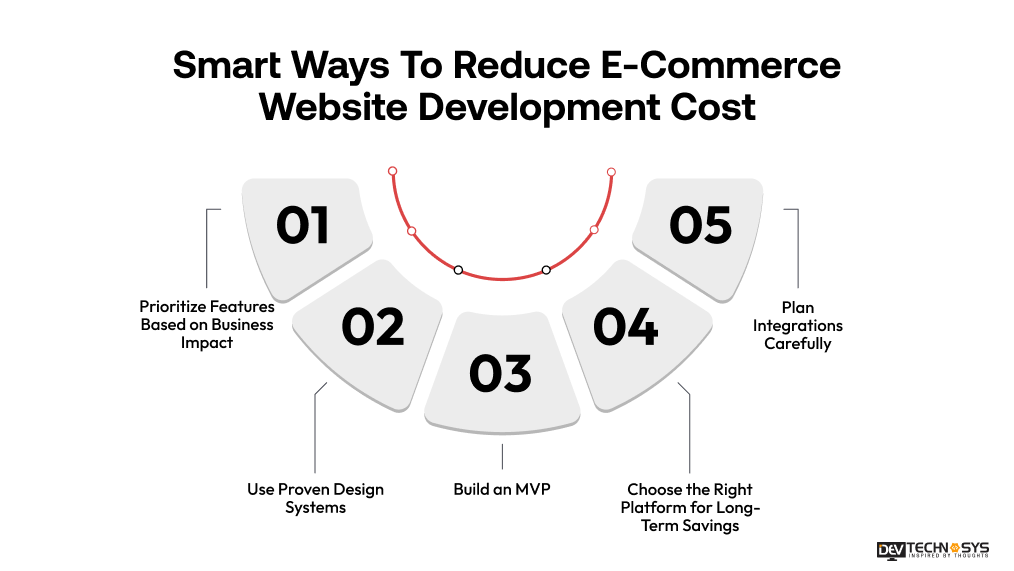
Smart Ways To Reduce E-Commerce Website Development Cost
Without clear planning and considerations, the cost of custom ecommerce website development can rise rapidly. Many startups make common mistakes that lead them to exceed the set budget. With proven strategies, you can reduce the cost to build an e-commerce website while maintaining quality, capacity, and customer experience.
1. Prioritize Features Based on Business Impact
Not all features are equally valuable or essential. Some features just increase the complexity and the cost of e-commerce website maintenance services. To keep your budget on track, prioritize only the features that align with your business. Your chosen features must facilitate simpel navigation, secure checkout, and mobile optimization.
2. Use Proven Design Systems
Instead of using custom UI/UX, you can use established design systems. A custom design is a great way to make your website unique, but it significantly increases the ecommerce website cost. Do not recreate common layouts from scratch; use tested UI components, and design with usability in mind rather than novelty.
3. Build an MVP
Launching your website with everything at once costs you more. So start the launch phase with a Minimum Viable Product (MVP). It makes the development process cheaper and quicker, and you can gather user feedback for improvements. Your MVP strategy must focus on essential product discovery, core functionalities, and secure payment flow.
4. Choose the Right Platform for Long-Term Savings
One tested method to reduce the cost to develop an e-commerce website is the clever platform choice. Because the platform you choose has a significant impact on the affordable eCommerce website development cost estimate.
A wrong platform choice increases costs, time, and effort. Shopify vs WooCommerce cost comparison will help you choose the right platform for your website.
5. Plan Integrations Carefully
Careful integration during the initial phase of development will save you the expense of fixes and bug fixes. Ensure you implement a speed-optimization plan throughout your development lifecycle to avoid rework in the long run. Take early measures such as optimized images, minimal scripting, a scalable hosting setup, and structurally clean code.
Industry Insight:
According to Marketing LTB, mobile commerce contributes approximately 59–73% of total e-commerce sales globally.
Proven Ways To Monetize Your E-Commerce Website
If you successfully launch an e-commerce website, then the potential wins are lucrative. Most organizations believe that product sales are the only way to generate revenue from an e-commerce website.
But monetizing your e-commerce platform goes beyond product sales. Below, we’ll show you some of the best ways to monetize an ecommerce website in 2026.
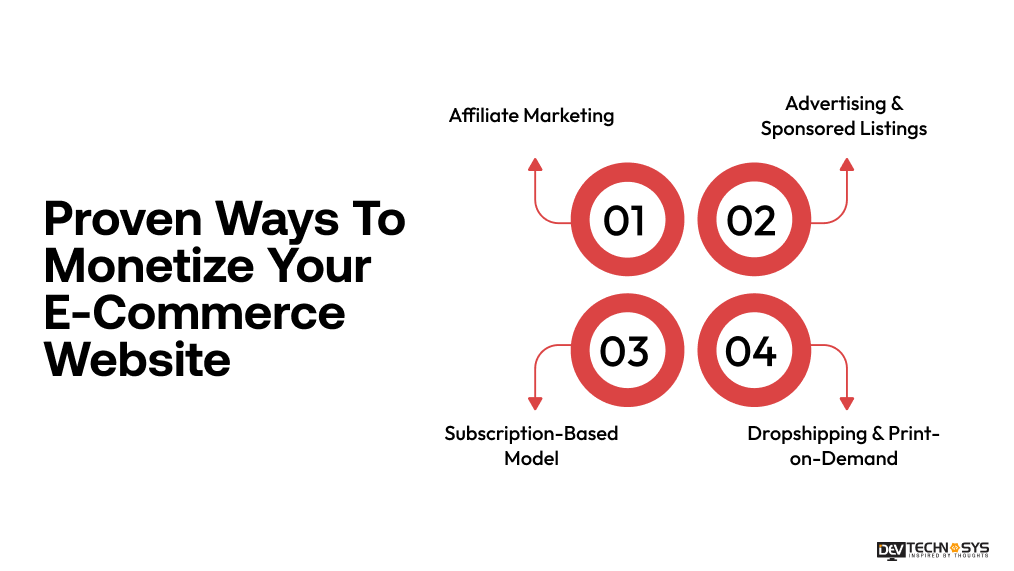
1. Affiliate Marketing
Promoting third-party products and services is how ecommerce platform makes money under affiliate marketing. It allows businesses to generate passive income by integrating links into product pages and blog posts. The success of this model usually depends on relevant partners and trust.
2. Advertising & Sponsored Listings
By displaying ads, ecommerce platforms can monetize the website traffic. This approach is best suited for high-traffic websites, and revenue increases with visibility and engagement. Sponsored listing is a mutually beneficial monetization strategy that helps sellers gain exposure.
3. Subscription-Based Model
Partner with a shopping app development company to adopt a subscription-based model for recurring revenue. Under this model, websites offer products and services through monthly or annual memberships. Providing exclusive benefits and a personalized experience can increase profitability.
4. Dropshipping & Print-on-Demand
To avoid inventory, online stores use dropshipping and print-on-demand strategies. Businesses sell products fulfilled by third-party suppliers, reducing the upfront costs. The profit margin depends on supplier branding and pricing. To succeed with this model, one must focus on niche products.
You can reach out anytime; we are available 24/7. Our team provides a quick response.

Summing Up!
With that, our ecommerce website development cost breakdown concludes. Clarity is the first and foremost step in determining the cost to build an e-commerce website. Often, vague requirements lead to delayed delivery and budget overrun. When estimating website costs, consider the business model, target users, feature priorities, platform selection, and integration needs.
Look for reliable ecommerce website development companies in Manchester for website development solutions. They will help you control spending, reduce risk, provide timeline expectations, and scalability plans for long-term growth.
Frequently Asked Questions
Find answers to the most common questions related to this article.
The cost to develop ecommerce website from scratch starts from $8,000 and goes up to $30,000. This includes essential features like product listings, a shopping cart, and payment integration. The final cost varies depending on multiple factors that directly influence the timeline.
Yes, absolutely, you can easily build an ecommerce website on a limited budget. Use pre-built templates and open source platforms. Go for minimal features and focus only on essential functionality to reduce costs. As the business grows, upgrade to advanced features and custom design.
Developing an ecommerce website usually takes around 2 to 6+ months, depending on features, team size, project scope, revisions, and complexity. A basic ecommerce website development process is faster, while a custom, advanced website would require additional time and effort.
The platform you choose for your ecommerce website development significantly affects the cost. SaaS platforms are more affordable with fixed pricing. You will need a higher investment for custom-built solutions. The platform selection impacts maintenance costs, scalability, and customization.
Features such as ERP or CRM integration, multi-vendor support, real-time inventory sync, custom UI/UX, personalization, and performance optimization. Integrations with third-party APIs, complex checkout processes, and scalability increase the cost to develop an e-commerce website.