















Key takeaways:
-
- Agentic AI in healthcare acts like a digital healthcare coordinator that not only understands medical information but also takes intelligent actions to help improve patient care.
- According to McKinsey, 19% of healthcare organizations have started to use Agentic AI. This indicates the growing interest in autonomous systems in planning and executing medical procedures easily.
- Traditional healthcare automation helps organizations streamline repetitive administrative tasks, whereas Agentic AI acts as an intelligent healthcare assistant capable of understanding context, making decisions, and taking action.
- According to Mordor Intelligence, the fastest-growing market of Agentic AI is the Middle East.
Patients require a personalized treatment whenever they visit a hospital. Most of them prefer an online consultation. Healthcare AI Solutions have changed the way doctors used to treat patients. But Agentic AI in Healthcare is a more advanced version that shares a detailed report with the patients, including a treatment recommendation.
Agentic AI can analyze information and, based on this, help doctors to make decisions, monitor patients in real-time, and streamline administrative options. As healthcare providers continue to improve their digital transformation journey, Agentic AI is emerging as a powerful technology to deliver more efficient healthcare services.
In this blog, we will explore how Agentic AI works in Healthcare, the technologies used, the benefits, and Healthcare Regulations.
What is Agentic AI in Healthcare?
Traditional healthcare automation is limited to analysis and predefined workflows. But agentic artificial intelligence adapts to changing situations, shares more detailed reports of patients, and even recommends the treatment without human intervention. Agentic AI can make contextual decisions, allowing patients to gather a more detailed analysis of their medical report.
These intelligent agents leverage advanced technologies such as Large Language Models (LLMs), Generative AI, Natural Language Processing (NLP), and Retrieval-Augmented Generation (RAG) to support clinical decisions. The best example is that an Agentic AI can schedule an appointment for a patient and notify healthcare professionals about the patient’s medical history.
Characteristics of AI Agents
Agentic AI has the ability to understand context, improve its performance continuously, and execute clinical tasks autonomously. These capabilities enable healthcare organizations to deliver more personalized patient care.
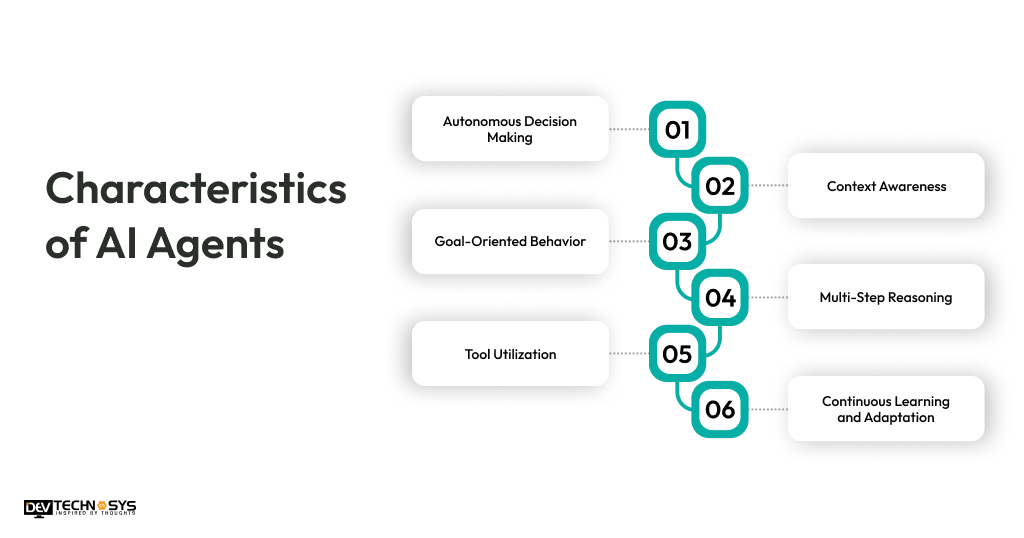
- Autonomous Decision Making: These agents can handle regular medical tasks efficiently without human intervention.
- Context Awareness: AI Agents are capable of handling the context of a health condition from doctor notes, prescriptions, health records, and other medical data.
- Goal-Oriented Behavior: AI agents accelerate clinic behavior by handling administrative tasks to support the clinical staff.
- Multi-Step Reasoning: The agent not only analyzes the health of a patient but also validates findings and initiates follow-up instructions.
- Tool Utilization: These AI agents can interact with electronic health records (EHRs) to gather data, generate reports, and help doctors to make necessary improvements.
- Continuous Learning and Adaptation: Agentic AI consistently learns and improves from a patient’s or doctor’s feedback. Hospitals need to ensure the accuracy and privacy of data that is assured by this AI.
Global Market Size Analysis of Agentic AI in Healthcare
Based on our research and findings from Mordor Intelligence, it is clear that Agentic AI is one of the emerging technologies for the healthcare industry. The ability to make AI-powered clinical support decisions, automation of complex tasks, predictive analytics, and AI-driven patient care is driving widespread adoption of agentic AI. One of the growth factors is continuous patient monitoring in real time, which is not possible by a usual healthcare provider.
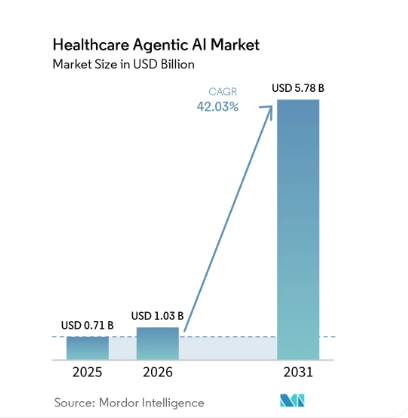
- Increasing demand for virtual patient care, use of agentic AI systems is expected to grow at a CAGR of 43.03%. Remote patient monitoring is predicted to provide solutions for chronic disease management and create a personalized healthcare plan.
- Healthcare AI is gradually becoming the fastest-growing segment with an increase of 42.03% CAGR between 2026 and 2031.
- The global agentic AI market is projected to grow from USD 1.03 billion in 2026 to USD 5.78 billion by 2031.
- North America has accounted for 44.74% market share in 2025, driving maximum AI investments.
Agentic AI vs Traditional Healthcare Automation
Where traditional AI requires human interpreters to manage responses, Agentic AI offers a more proactive approach for clinical decision intelligence. By automating documentation and routine administrative tasks, clinicians can spend time reviewing the health of a patient.
Parameter |
Traditional Healthcare Automation |
Agentic AI in Healthcare |
| Core Function | Automates predefined and repetitive tasks | Advanced autonomous reasoning to support clinical decisions |
| Decision-Making Ability | Follows fixed rules and workflows | Uses reasoning and contextual analysis to make informed decisions. |
| Adaptability | Limited to programmed scenarios | Easily adapts to changing patient conditions |
| Human Intervention | Requires frequent human supervision for exceptions | Operates with minimal human intervention |
| Data Processing | Processes structured data within predefined parameters | Analyzes structured and unstructured data, including clinical notes, medical images, and wearable device data |
| Problem Solving | Handles single-step tasks only | Perfect for complex problem-solving |
| Learning Capability | Does not improve unless manually updated. | The feature of continuous learning and improvement through user feedback |
| System Integration | Connects with limited healthcare systems and workflows. | Interacts with multiple tools, APIs, EHR systems, and communication platforms |
| Patient Care Approach | Reactive and task-oriented. | Proactive, personalized, and outcome-driven |
| Example Use Case | Sending appointment reminders or processing insurance claims. | Monitoring patient health, recommending interventions, scheduling follow-ups, and alerting clinicians automatically |
| Operational Impact | Reduces manual effort for routine tasks. | Enhances clinical decision-making, workflow efficiency, and patient outcomes |
| Future Readiness | Suitable for basic process automation. | Designed for intelligent, autonomous healthcare ecosystems |
How Agentic AI Works in Healthcare?
Agentic AI operates in a multi-layered architecture to perform autonomous decisions effectively. These agents provide support to the clinical staff to make context-aware decisions based on the patient’s history.
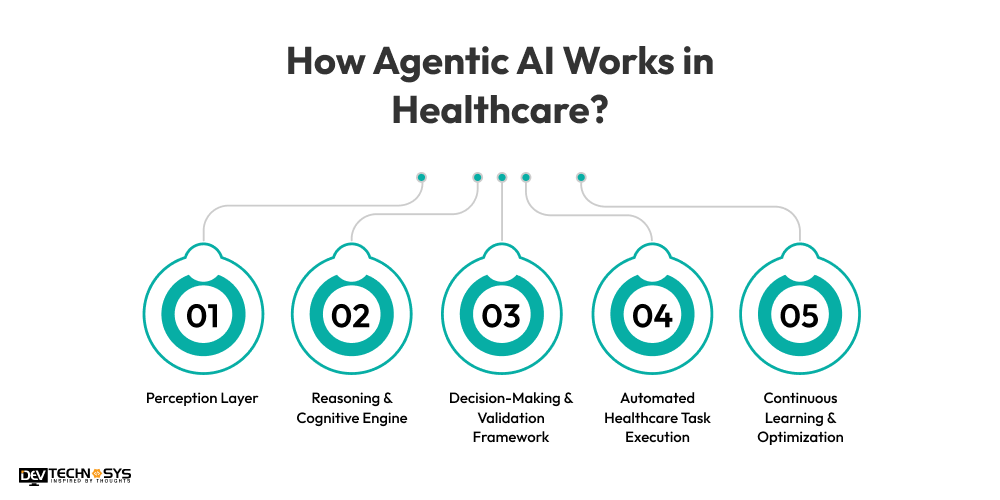
1. Perception Layer:
Multimodal data intake from multiple sources, including EHRs, DICOM images, IoT wearables, and clinical notes. The agents then create a unified patient profile that gives a comprehensive understanding to the doctors for patient monitoring and treatment planning.
2. Reasoning & Cognitive Engine:
Advanced large language models and Chain-of-Thought (CoT) processes the data into meaningful information. Such as symptoms, treatment, next steps in diagnosis, and guidelines for patients.
3. Decision-Making & Validation Framework:
Government policies and healthcare rules have to be followed. Hence, Agentic AI generates evidence-based data according to the medical laws.
Industry Insight:
According to a survey by McKinsey, 50% of healthcare organizations have already implemented Agentic Artificial Intelligence to improve clinical productivity and patient management. This highlights a growing shift of traditional AI to Agentic AI.
4. Automated Healthcare Task Execution:
AI automation in software development, it can automatically updates patient data, schedules appointments if required, recommends tests, and manages workflow, reducing the burdens of administrative tasks.
5. Continuous Learning & Optimization:
Reinforcement Learning from Human Feedback (RLHF) with clinicians is gradually making these agents more intelligent. Also, these are helping healthcare providers to gain an in-depth knowledge to improve operational efficiency and personalize patient care.
Key Technologies Behind Agentic AI in Healthcare
AI in healthcare app development solutions are a combination of advanced artificial intelligence technologies that are a foundation to support clinical workflow execution. These systems can be easily accessed by patients, doctors, and clinical staff.
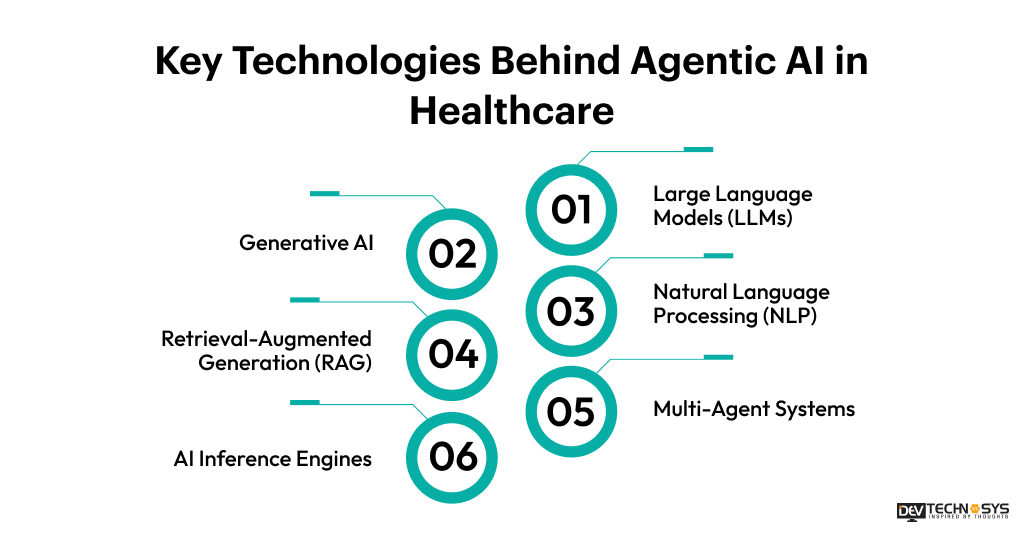
1. Large Language Models (LLMs):
Models such as Llama, MedPalm, and GPT help to maintain clinical documentation. The models read, understand, and deliver structured data. These are capable of answering patient queries after analyzing the input data.
2. Generative AI:
This technology helps healthcare organizations to create patient data. This includes medical reports, treatment plans, patient discharge details, and clinical documentation.
3. Natural Language Processing (NLP):
Human-written prescriptions or diagnosis reports are converted to improved medical insights through applications. These analyze, understand, and interpret data for risk prediction.
4. Retrieval-Augmented Generation (RAG):
RAG combines with Generative AI to share real-time patient information. The details are generated according to the data analyzed by AI healthcare technology. Healthcare providers believe in this data because it gives factual accuracy while maintaining regulatory standards.
5. Multi-Agent Systems:
These systems solve healthcare challenges by sharing data for different illnesses or diseases. Rather than distributing responsibilities to the medical staff, these specialized agents generate radiology images, review laboratory results, and support clinical decisions across different healthcare departments.
6. AI Inference Engines:
These are a support to the AI healthcare applications in their functioning. A large volume of data is processed while meeting compliance requirements such as HIPAA. AI Inference engines optimize model performance, reduce latency, and enable real-time decision support for clinical applications.
Planning a Mobile App?
Get a tailored development cost estimate in 3 simple steps — app basics, features, timeline, and your contact details.
- 3 quick steps
- 100% free
- Reply in 1 business day
2 Minutes Read
Top Agentic AI Use Cases in Healthcare
Agentic AI for patient care management has multiple uses, from supporting clinical decisions to evaluating medical reports. These systems are even helpful for remote patient monitoring.
1. Clinical Decision Support:
Advanced reasoning models are used for intelligent patient monitoring and medical diagnosis. This highlights health risks, treatment suggestions, and provides evidence-based recommendations reducing clinical complexity while assuring improved diagnosis.
2. Intelligent Patient Triage:
Agentic AI Applications in Hospitals detects early symptoms, shares urgency level, and provides referrals for specialists according to the patient data. This helps hospitals to assign medical staff immediately to a patient, reducing delays.
3. Remote Patient Monitoring:
Most people prefer to get a diagnosis remotely. They share their medical information through healthcare applications, wearable devices, and IoT sensors. This allows AI-Driven Patient Care to check their heart rate, oxygen, and glucose levels in real-time.
Comprehensive SWOT Analysis of Agentic AI in Healthcare
As many healthcare organizations are adopting smart healthcare IT solutions such as agentic AI, conducting a SWOT analysis is important for evaluating their long-term value. Health centers must be aware of the challenges and opportunities that these systems can bring in the future.
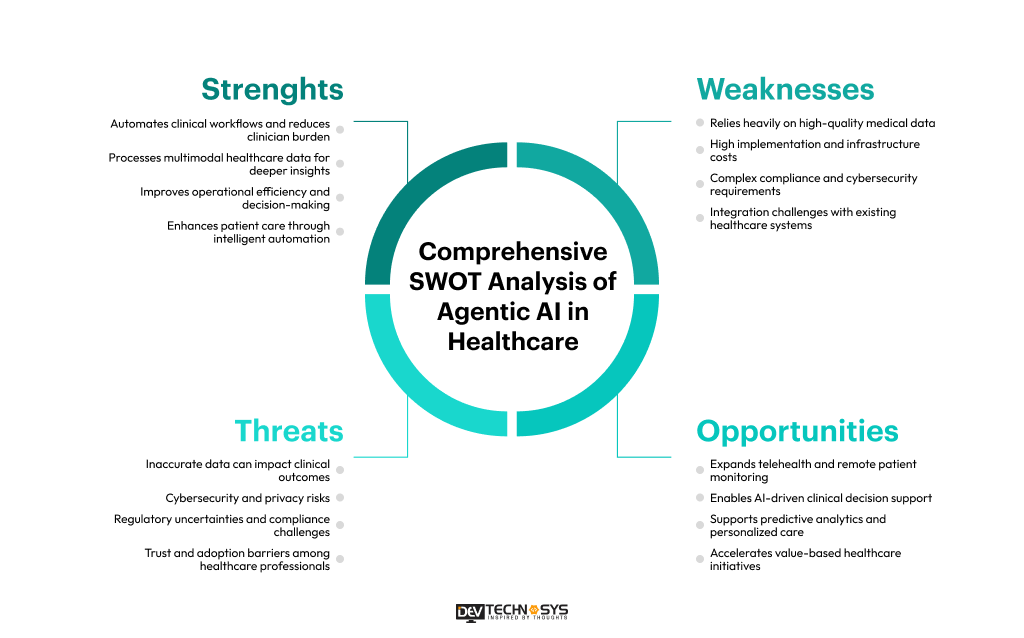
1. Strengths:
Agentic AI increases operational throughput with its advanced AI technologies while reducing clinician cognitive load. The biggest strength is its ability to process multimodal data to provide comprehensive clinical insight. These systems improve workflow efficiency with an automated workflow, thereby reducing the burden on healthcare providers.
2. Weaknesses:
Agentic AI in healthcare is dependent on data quality. Medical centers should provide annotated data to such systems to receive valuable patient information. Also, healthcare organizations have to spend higher infrastructure costs for model training, regulatory compliance, cybersecurity, GPU, and cloud computing.
3. Opportunities:
The AI-powered clinical decision support, telehealth services, and remote patient monitoring present multiple opportunities for the adoption of Agentic AI. Health agencies are increasingly investing in such systems to identify health risks, assess patient data in detail, and support value-based care.
4. Threats:
The most significant risk is inaccurate data. In multi-agent environments like these, incorrect information might affect data processing. Healthcare organizations must focus on providing relevant information to the AI agents for healthcare operations while following regulatory compliance.
Benefits of Agentic AI in Healthcare
Agentic AI is transforming clinical decision intelligence in multiple ways. From understanding the existing medical condition of a patient to coordinating clinical workflows, many healthcare organizations are adopting it for multiple reasons.
1. Improved Patient Outcomes:
From traditional ways of treatment, now healthcare organizations can view a detailed report of a patient and provide the essential treatment. There is no need to conduct multiple tests or diagnose a patient.
2. Reduced Administrative Burden:
Agentic AI supports billing, patient documentation, clinical note generation, and referral management. This allows medical staff to utilize more time in a patient’s care and invest less time in paperwork. This ensures convenience to patients and medical staff to check a record.
3. Faster Clinical Decision-Making:
Patients’ medical history is analyzed in real-time, allowing clinical staff to make faster decisions. The staff can quickly check the lab results, imaging studies, and diagnostic reports for patient care.
4. Lower Operational Costs:
AI agents have a lower maintenance cost as compared to medical staff. Hospitals can prevent staff readmissions and avoid documentation. Healthcare organizations can simply connect to a healthcare app development company to build an agentic AI-based application.
5. Better Resource Utilization:
Traditional medical centers need to hire staff members to accomplish specific clinical tasks. But healthcare AI solutions intelligently allocate resources to improve patient flow management and optimize staff workload.
6. Enhanced Patient Experience:
Modern patients have stopped encouraging long wait times and traditional diagnosis practices. Agentic AI supports patients’ expectations through virtual assistants. They deliver faster responses and shared personalized health recommendations
Real-World Case Study: Healthcare Application “Allevia”
At Dev Technosys, we developed “Allevia”, a cloud-based, mobile-optimized platform that extracts data from existing EHR and patient portal systems. The app features appointment scheduling, effective communication with doctors, and hassle-free online payment. Patients can complete the process from any device. They can easily connect to the doctors through email or text messages for any queries.
Challenges Faced: The main bottleneck was to protect user data during partner interactions. Another was to maintain app performance while optimizing high-quality images used in the app.
Project Highlights
- Project Name: Allevia
- About Client: John Chen
- Industry: Healthcare & Clinical Workflow Management
- Client Location: United States
- Development Timeline: 12 Months
- Team Size: 5 Developers
- Platform Type: AI-Powered Clinical Intake, Patient Management & Healthcare Automation Platform

Healthcare Regulations and Compliance Considerations
Regulatory compliance is a critical requirement to process sensitive patient information, generate clinical recommendations, and support automation. Whether a business is planning to develop a healthcare app or software, it must be aware of the legal standards.
1. HIPAA Compliance
Agentic AI systems must implement security and privacy protocols to maintain the Health Insurance Portability and Accountability Act. Under this act in the United States, systems must be traceable and auditable for the Government to implement Protected Health Information (PHI). Hire dedicated developers to establish Business Associate Agreements to ensure accountability requirements.
2. General Data Protection Regulation (GDPR) Requirements
Healthcare organizations that are serving under the European Union must comply with this law. It states that healthcare AI systems must obtain consent from the patient before processing their sensitive information. Organizations must answer how AI-driven decisions are made because critical patient data is involved in this process.
3. FDA Guidelines for AI-Based Healthcare Solutions
U.S Food and Drug Administration reviews AI-based applications for clinical validation, model transparency, and risk assessment. AI systems are evolving, and it is important for these to maintain compliance.
4. Data Governance Best Practices
Before build an AI agent, healthcare organizations must implement AI governance frameworks, conduct regular compliance audits, and use Retrieval-Augmented Generation (RAG) architectures to reduce hallucinations.
Industry Insight:
According to the World Health Organization, AI applications should be developed with compliance and regulations such as HIPAA, GDPR, and FDA guidelines. This ensures patient safety and maintains public trust. Following the legal rules will reduce potential risks and promote the long-term success of AI applications.
Conclusion
Agentic AI is fast and introduces autonomous reasoning that supports clinical decisions. Industry projections estimate that the AI healthcare market is rapidly adopting advanced technologies for intelligent diagnostics and virtual care. Looking ahead, Agentic AI systems reduce human intervention and generate better medical data. That is the primary reason that most organizations are searching for an AI Consulting & Development Services Company in the USA to build generative AI-based applications.
Frequently Asked Questions
Find answers to the most common questions related to this article.
AI Agents in healthcare are support systems that automate clinical tasks, not to replace the medical staff. While agents can process large volumes of data, they cannot replicate human expertise. Healthcare professionals will remain responsible for making patient treatment decisions while AI agents act as a tool to enhance the productivity of the medical staff.
Healthcare organizations must ensure data privacy to protect the system against unauthorized access and data breaches.
Incomplete or biased datasets have to be completely avoided to reduce ethical risks.
Health centers must follow regulatory compliance to avoid accountability challenges.
Traditional AI systems only provide recommendations, while Agentic AI creates complex documentation, supports clinical decisions, and can monitor patients in real time. This gives sufficient time to healthcare providers to focus on patient care rather than engaging in documenting patient records or billing.
Yes, Agentic AI is safe if AI development companies and Healthcare organizations implement best practices. Data encryption, audit trails, and validation frameworks must be included to ensure reliability and patient safety. HIPAA Compliance, GDPR, and FDA guidelines have to be followed to develop such systems.
The growing demand for multi-agent systems, remote patient monitoring, automated workflow, and intelligent virtual assistants in healthcare is accelerating the adoption of Agentic AI across the healthcare industry. Agentic AI is helping medical centers to optimize operational efficiency by automating complex clinical tasks.













