


















Quick Summary:
The cost to develop a trading app with basic features is around $8,000 to $14,000, with mid-range or premium features costing $15,000 to $20,000. The AI-powered or highly complex trading app development cost goes up to $25,000 or higher.
Trading App Development Cost, Complexity-Wise:
-
- Basic Trading App($8,000 – $15,000): It involves simple or MVP-based features such as simple buy/sell functionality, user registration, basic charts, and limited asset trading.
- Advanced Trading App($15,000 – $20,000): Includes premium or rich features like real-time market data, advanced charts, multiple asset trading, and a watchlist.
- Enterprise Trading App($20,000 – $25,000): Integrate modern features such as AI-based trading insights, high-frequency trading, and a liquidity management system.
Trading App Development Cost, Region-Wise
-
- The cost to develop a trading app in New York, USA, is around $18,000 to $25,000; it can go up due to higher living costs, experienced developers, and project complexity.
- The trading platform development cost in Sydney, Australia, lies between $13,000 and $20,000, mainly based on project demand, developer experience level, and technologies.
- The cost to build a trading app in London, UK, ranges from $17,000 to $24,000; this can fluctuate because of the hiring model, onboarding cost, project type, and many more factors.
Trading App Development Cost, App-Types:
-
- Stock Trading App: $8,000 – $15,000
- Crypto Trading App: $12,000 – $20,000
- Forex Trading App: $15,000 – $22,000
- Commodity Trading App: $10,000 – $18,000
- Options Trading App: $16,000 – $21,000
- Multi-Asset Trading App: $18,000 – $25,000
Additional or Extra Cost:
-
- Maintenance Cost: The cost to maintain a trading app is around 10% to 20% of the initial cost of trading app development. It involves fixing bugs, applying security patches, regular updates, and more.
- Security Measures: Integrating strong security measures is important to protect from unauthorized accessibility. It involves two-factor authentication, encryption techniques, biometrics, and more.
The trading app becomes more than just a means to trade, but now serves as the foundation of all investing activities, including stocks, cryptocurrency, and commodities. Firms are rushing to create advanced trading platforms that provide fast speeds, guaranteeing the secure handling of sensitive data, and producing intelligent research.
However, this raises another question: How much will it cost to create trading apps? The answer depends on multiple factors, including functionality, the technology and software developed, security controls implemented, and usability of the system.
If you are a start-up or large business, understanding the costs associated with developing trading apps will help to eliminate unpredictable costs and improve your business planning. In this blog, we will cover each of the elements required to deliver a successful trading platform in 2026 in a straightforward manner. So you will know what is needed both technically and financially.
What is the Trading App Development Cost in 2026?
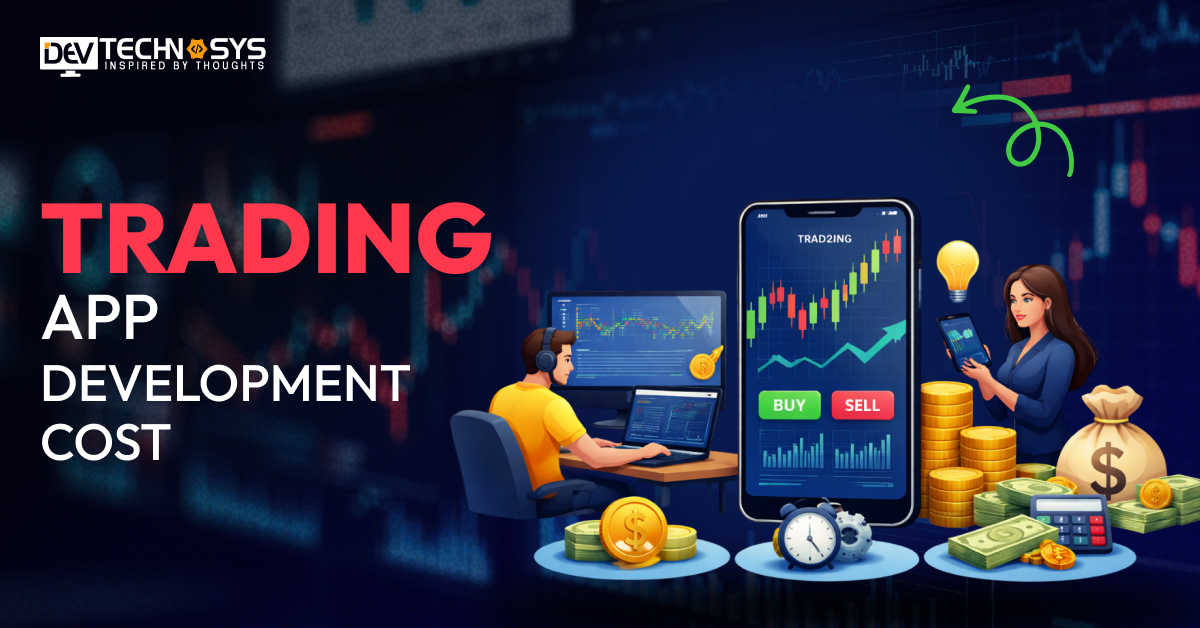
The cost to build a trading app lies between $8,000 and $25,000, based on advanced functionalities and customization type. There are many different types of trading apps available with unique features; each has a different cost because of its services and functions.
It includes many factors that affect the total cost, such as backend processes, security & regulatory compliance, third-party integrations, UI/UX design complexity, maintenance & updates, and development team. By observing the trading app complexity, businesses can get a clear estimate of the cost to develop trading software:
App Complexity |
Features Included |
Estimated Cost (USD) |
| Basic Trading App (MVP) | User login, basic trading, simple UI | $8,000 – $12,000 |
| Moderate Trading App | Charts, APIs, payments, and a user dashboard | $12,000 – $18,000 |
| Advanced Trading App | Real-time data, AI insights, security layers | $18,000 – $22,000+ |
| Enterprise Trading Platform | High scalability, compliance, and multi-asset trading | $25,000+ |
How Much Do Different Trading Application Development Costs in 2026?
Building a trading app is a massive opportunity, but which type of trading app and what’s its cost? This section clearly explains all the confusion and provides detailed information about the costs of different equity trading apps. Check your specific trading app and build within your budget.
1. Stock Trading App($8,000 – $15,000)
The stock trading apps are one of the most used types in the trading industry; they enable users to sell, buy, and monitor shares in real-time. It involves various types of features such as secure login systems, market charts, wishlists, portfolio tracking, and secure login systems.
The cost of mobile trading platforms is lower because their complexity is lower and includes limited features as compared to others.
Level |
Cost Range |
Features |
| Basic | $8,000 – $10,000 | Buy/sell, portfolio tracking |
| Standard | $10,000 – $13,000 | Charts, watchlists, alerts |
| Advanced | $13,000 – $15,000 | Real-time data, analytics |
Industry Insights:
According to the Market Research Future, trading apps are increasingly integrating crypto and blockchain technologies, expanding beyond traditional stock trading.
2. Crypto Trading App($12,000 – $20,000)
The crypto trading applications allow users to trade in digital assets such as Bitcoin and Ethereum. These apps have a higher cost because of a higher number of security integrations, wallet functionality, blockchain integration, encryption, and more.
The online trading app development cost is mainly higher due to API integrations with crypto exchanges, DeFi support, staking, and multi-currency support.
Level |
Cost Range |
Features |
| Basic | $12,000 – $14,000 | Wallet, simple trading |
| Standard | $14,000 – $17,000 | API integration, security |
| Advanced | $17,000 – $20,000 | Multi-currency, DeFi support |
3. Forex Trading App($15,000 – $22,000)
The forex trading apps are basically designed for currency trading, and they offer real-time exchange rate updates. It includes advanced functionalities such as risk management tools, automated trading, technical indicators, and more. With these premium services and functions, the forex trading development cost goes higher.
Level |
Cost Range |
Features |
| Basic | $15,000 – $17,000 | Currency trading, basic charts |
| Standard | $17,000 – $20,000 | Indicators, real-time rates |
| Advanced | $20,000 – $22,000 | Automation, risk tools |
4. Commodity Trading App($10,000 – $18,000)
The commodity trading applications allow users to trade in gold, oil, agricultural products, and more. These apps mainly require secure transactions, track live pricing, historical data analysis, and many more.
The hybrid app development cost basically depends on various factors, such as predictive analytics, data integrations, AI tools, decision-making capabilities, and more.
Level |
Cost Range |
Features |
| Basic | $10,000 – $12,000 | Price tracking, trading |
| Standard | $12,000 – $15,000 | Charts, historical data |
| Advanced | $15,000 – $18,000 | Analytics, predictions |
5. Options Trading App($16,000 – $21,000)
The options trading apps are more advanced than others because they offer derivatives trading with features such as expiry tracking, strike price analysis, and risk calculations.
It requires various types of advanced functionalities such as real-time data processing, algorithms, simulations, strategy builders, analytics dashboard, and more. At last, the cost is higher due to complex financial models.
Level |
Cost Range |
Features |
| Basic | $16,000 – $18,000 | Options trading basics |
| Standard | $18,000 – $20,000 | Strategy tools, charts |
| Advanced | $20,000 – $21,000 | Simulations, analytics |
6. Multi-Asset Trading App($18,000 – $25,000)
The multi-asset trading apps support various types of trading on a single platform, such as crypto, stocks, forex, commodities, and others. It includes API integrations, unified dashboards, strong backend architecture, security requirements, scalability, performance optimization, AI insights, and cross-asset analytics. It can easily go up to a higher brokerage app development cost.
Level |
Cost Range |
Features |
| Basic | $18,000 – $20,000 | Multi-asset support |
| Standard | $20,000 – $23,000 | Unified dashboard |
| Advanced | $23,000 – $25,000 | AI insights, integrations |
Which Factors Affect the Trading App Development Cost?
Before beginning the trading app development, you must know which types of factors can impact the budget. It includes several factors such as basic and advanced features, application complexity, backend infrastructure, developers’ location, design UI/UX, and more. Observe every factor in detail:
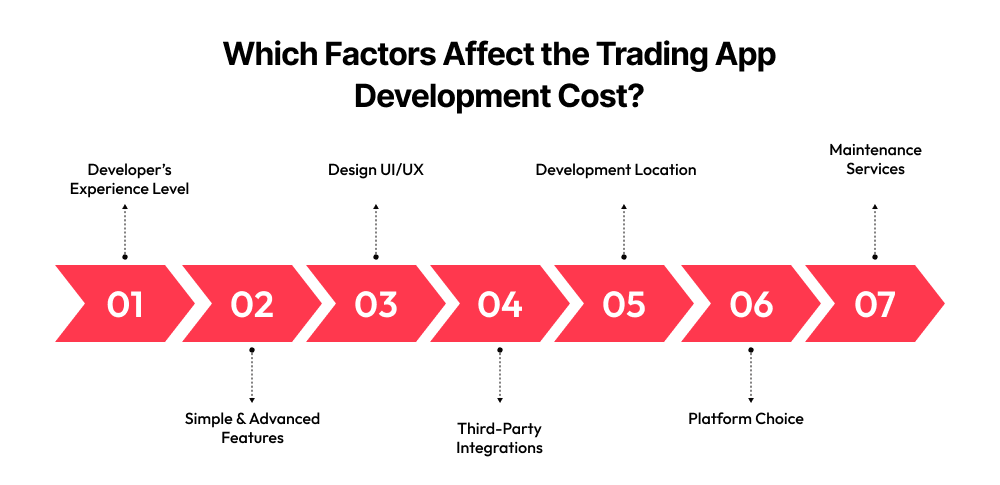
1. Developer’s Experience Level
Your developer’s experience level is one of the most significant factors that will affect your total AI trading app development cost. Highly experienced developers generally charge a premium for their work, but their resultant performance, security, and scalability tend to be of a higher standard than the results achieved by less skilled developers.
Experience Level |
Hourly Rate (USD) |
Cost Impact |
| Junior Developers | $10 – $15 | Low |
| Mid-Level Developers | $15 – $20 | Medium |
| Senior/Expert Developers | $20 – $25+ | High |
2. Simple & Advanced Features
The fintech app development cost depends largely on the features featured in your app. For example, building an investment platform with the most basic features like Login, Dashboards, and a simple trading tool can be delivered at a lower cost.
Whereas more advanced features, such as AI-based analytics, live data tracking, automated trading, and advanced charting, increase the overall budget for your app.
Feature Type |
Cost Range |
Cost Impact |
| Basic Features | $2,000 – $3,000 | Low |
| Moderate Features | $3,000 – $4,000 | Medium |
| Advanced Features | $4,000 – $5,000+ | High |

3. Design UI/UX
Great UI/UX design increases user engagement and usability within your trading application. Building a simple design will create less expense than developing a custom, interactive, and visually engaging design, but investing in an excellent user experience increases the likelihood your users will remain engaged, ultimately resulting in higher investment app development costs.
Design Level |
Cost Range |
Cost Impact |
| Basic UI | $3,000 – $4,000 | Low |
| Custom UI | $4,000 – $5,000 | Medium |
| Advanced UI/UX | $5,000 – $6,000+ | High |
4. Third-Party Integrations
Incorporating third-party APIs, such as payment gateways, market data providers, and security tools, increases the functionality of your stock market apps. While also increasing the overall costs you must pay to develop your application.
Each additional API requires investment in CDC, and an API is subject to ongoing maintenance. Premium APIs often require a subscription fee, adding to both initial and ongoing costs for your project.
Integration Type |
Cost Range |
Cost Impact |
| Basic APIs | $5,00 – $1,000 | Low |
| Market Data APIs | $1,000 – $1,500 | Medium |
| Advanced Integrations | $1,500 – $2,000+ | High |
5. Development Location
The location of the development team has a direct impact on the amount of money that you will pay for fintech app development services. Developers from North America and Europe tend to have a higher development rate compared to those from Asia.
Offshore development can provide significant cost savings, but be sure that you are finding the balance between costs, communications, quality assurance, and project management efficiency.
Location |
Hourly Rate |
Cost Impact |
| Asia (India, etc.) | $20 – $50 | Low |
| Eastern Europe | $40 – $80 | Medium |
| North America/Europe | $80 – $100 | High |
6. Platform Choice
The choice of iOS, Android, or a cross-platform will also have an impact on how much your app will cost for trading system development. If you opt to develop separate native applications for each platform, the cost will be considerably higher than developing a cross-platform solution.
The selection of which platform will be developed will also depend on other factors such as your target audience, performance specifications, and long-term scalability of the app.
Platform Type |
Cost Range |
Cost Impact |
| Single Platform | $5,000 – $7,000 | Low |
| Cross-Platform | $7,000 – $9,000 | Medium |
| Native (iOS + Android) | $9,000 – $11,000+ | High |
7. Maintenance Services
Post-launch maintenance is needed to keep an application updated, secure, and free of bloopers. To keep an application operating optimally over the long term, it must receive updates on a regular basis, be optimised for performance, and have existing features enhanced.
The amount spent on maintenance generally ranges from 15% to 20% of the cost to develop a mobile app per year and is a reflection of the complexity of the application and its size.
Maintenance Type |
Annual Cost |
Cost Impact |
| Basic Maintenance | 10% – 15% | Low |
| Standard Maintenance | 15% – 18% | Medium |
| Advanced Maintenance | 18% – 20%+ | High |
Industry Insights:
According to the Fortune Business Insights, the global online trading platform market is valued at $11.57 billion in 2026, showing steady growth driven by digital adoption.
What is the Cost to Develop Popular Trading Apps in 2026 Globally?
To develop a well-known trading application in 2026, it will take a lot of money, depending on its features, scalability, and security requirements. One can expect to see costs associated with wealth management apps project anywhere from a simple minimum viable product (MVP) to an enterprise-level platform.
1. App Like Robinhood
Robinhood is an easy-to-use, commission-free trading application that offers a sleek user interface. To build a trading app like RobinHood in 2026 will require investment in the range of $15,000 to $25,000+, depending on a business’s requirements for real-time data integration and regulatory requirements.
App Version |
Estimated Cost (USD) |
Key Inclusions |
| Basic (MVP) | $15,000 – $18,000 | User signup, stock listing, basic buy/sell, simple UI |
| Mid-Level | $18,000 – $22,000 | Real-time data, wallet integration, portfolio tracking |
| Advanced | $22,000 – $25,000 | AI insights, multi-asset trading, advanced charts |
2. App Like eToro
eToro provides users with a unique opportunity to follow the trades of expert traders through its social trading and copy trading capabilities. Businesses that desire to build an application that functions similarly to the eToro application can expect to develop an application with a total cost of $14,000 to $22,000+ due to the very complex backend systems and real-time feeds of data to each user.
App Version |
Estimated Cost (USD) |
Key Inclusions |
| Basic (MVP) | $14,000 – $17,000 | Basic trading, dashboard, and user portfolio |
| Mid-Level | $17,000 – $20,000 | Social trading, notifications, analytics |
| Advanced | $20,000 – $22,000 | Copy trading, AI recommendations, multi-asset support |
3. App Like Zerodha Kite
Zerodha Kite is currently the top trading application in India because it provides advanced charting capabilities, quick trade execution, and low brokerage fees.
The approximate cost to develop a trading app like Zerodha is $12,000 to $20,000+. Businesses are focusing on responsive design, analysis tools, and secure transaction capabilities.
App Version |
Estimated Cost (USD) |
Key Inclusions |
| Basic (MVP) | $12,000 – $15,000 | Trading dashboard, order placement, KYC integration |
| Mid-Level | $15,000 – $18,000 | Advanced charts, real-time sync, analytics tools |
| Advanced | $18,000 – $20,000 | High-speed execution, APIs, enterprise-grade security |
4. App Like Webull
With advanced analytics, technical indicators, and real-time market data, Webull provides commission-free trading. A comparable application developed in 2026 could cost between $12,000 and $21,000+, depending on how many data visualizations, performance optimizations, cloud infrastructures, and advanced trading tools are required.
App Version |
Estimated Cost (USD) |
Key Inclusions |
| Basic (MVP) | $12,000 – $14,000 | Market data, basic trading, watchlist |
| Mid-Level | $14,000 – $19,000 | Technical indicators, charts, alerts |
| Advanced | $19,000 – $21,000 | Deep analytics, margin trading, and real-time feeds |
5. App Like Stock Trainer
Stock Trainer is a virtual trading application that permits users to simulate stock trades using real-time market data at no financial risk. The application includes tracking of portfolios, analytics, and education. Build an app like Stock Trainer in 2026 would cost approximately $16,000 to $23,000+, depending on the features, APIs, and scalability.
App Version |
Estimated Cost (USD) |
Key Inclusions |
| Basic (MVP) | $16,000 – $18,000 | Virtual trading, demo account, basic UI |
| Mid-Level | $18,000 – $21,000 | Simulated market data, leaderboard, analytics |
| Advanced | $21,000 – $23,000 | AI training modes, gamification, and advanced reports |
Planning a Mobile App?
Get a tailored development cost estimate in 3 simple steps — app basics, features, timeline, and your contact details.
- 3 quick steps
- 100% free
- Reply in 1 business day
2 Minutes Read
How to Reduce the Trading App Development Cost in 2026?
You can reduce the trading bot development cost in 2026 by using intelligent planning, technology approaches, and phased development approaches. You will also want to concentrate on essential functionality, use cross-platform development tools, and use third-party integrations to minimize your costs.
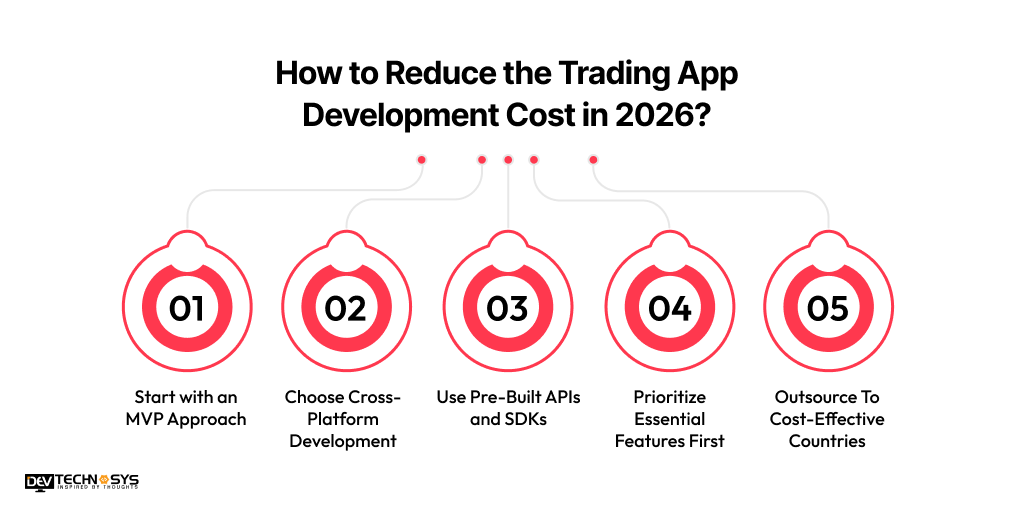
1. Start with an MVP Approach
The MVP approach allows for beginning the project with a focus on the most important and essential trading functionality only. Using this approach will reduce the initial algorithmic trading app cost and help speed up the time it takes to launch an application. And provide an opportunity for the trading app development agency to receive real user feedback prior to making any significant investment.
2. Choose Cross-Platform Development
By utilizing frameworks, such as Flutter or React Native, that can build a single application for both Android and iOS, you can avoid the need to create separate teams for each platform.
Write less code, and thus lower the total trading platform development cost, and provide the same performance level from device to device for both platforms.
3. Use Pre-Built APIs and SDKs
Instead of building the functionality into your digital trading platforms, you should integrate third-party APIs to utilize existing functionality without developers having to invest time and effort into creating the same functionality from scratch. The use of pre-built APIs helps you reduce development time and complexity, resulting in lower overall stock trading app development costs.
4. Prioritize Essential Features First
As with many stock exchange apps, there is a tendency to add more and more advanced features prior to the MVP being in use. In this case, focus on features that allow for the application to be used.
Adding many advanced features early on will result in an increase in development time and cost. So incrementally add to the number of features provided based on demand from users and growth in your business.
5. Outsource To Cost-Effective Countries
When you hire skilled developers from places like a trading app development firm in India, you will reduce development costs significantly while also maintaining the same level of quality.
You can also access teams with experience and knowledge, get your project completed faster, and have flexible pricing structures. Outsourcing is a good strategy for small businesses, startups, and larger companies in 2026.
How to Generate Profit From Trading Applications?
The generation of income via trading applications in 2026 will be driven by the combination of a variety of revenue streams, including commissions, subscription services, premium tools, and advertising revenue.
The offering of value-added features and expanding monetization strategies will allow businesses to maximize overall revenue, increase user engagement, and grow the platform over time.
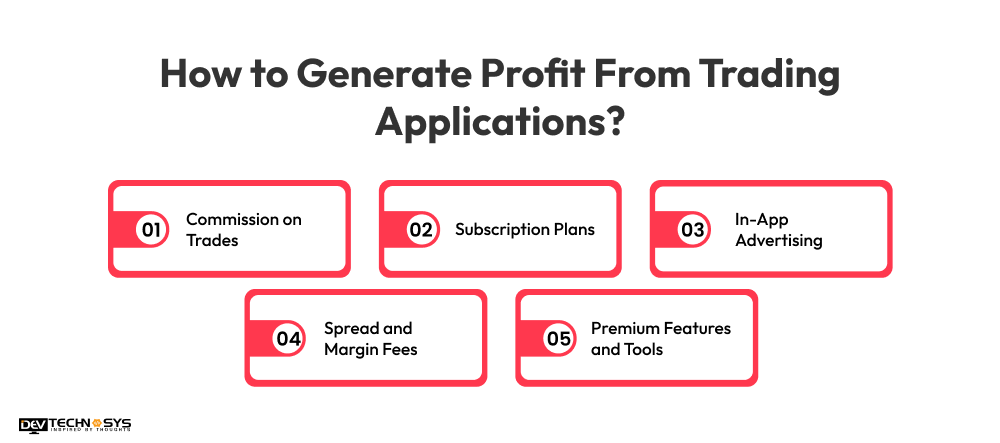
1. Commission on Trades
Charging commissions on trades within your app is one of the most effective ways to create an income stream from your users. Although it is not unusual to charge a minimal fee per trade, as your user base and the amount they trade in your app grow, it will produce a significant amount of income for your business.
2. Subscription Plans
Providing subscriptions that allow your users to have access to features such as analytics, expert insight, and advanced charting tools is another way that, by offering monthly subscription plans, you can create a continual and consistent source of revenue, while providing serious traders with value-added services and enhancing their overall trading experience on your application.
3. In-App Advertising
You can use your online trading app to generate revenue by offering ads in the app, sponsored content, or partnerships with investment firms. If you are able to place the ads properly, they can generate consistent revenue for your app without disrupting the user experience. Even more importantly, they can be placed in a way that makes them relevant to the user.
4. Spread and Margin Fees
Another effective way to create income is by using the spread and margin fees . By making minor adjustments to the spread and forming margins from the trade, financial trading apps have the ability to generate a very significant amount of income. According to the mobile app development company, while providing users with greater opportunities to complete their trades successfully.
5. Premium Features and Tools
Premium features and tools will provide a paid service to gain access to exclusive features such as AI-powered trading signals, portfolio management tools, and risk analysis tools.
Those users who are motivated to enhance their trading strategies will pay for these tools. Creating additional streams of revenue for the platform, in addition to the revenue created from traditional trading.
Conclusion
In summary, the cost to develop a trading application will depend on several factors such as features, platform, technology stack, and development methodology. Picking the right development partner will help reduce costs on your trading application through minimal viable product (MVP) strategies, the use of scalable solutions, and the development of a high-quality trading application in partnership with someone who has experience developing similar solutions.
Working with a reputable trading app development company will ensure your trading application is of high quality and secure, and meets your long-term business objectives.
Frequently Asked Questions
Find answers to the most common questions related to this article.
The cost to build a trading app in New York starts from $8,000 and ends at $25,000 or based on the complexity and project size. The total project budget can fluctuate due to various factors such as backend processes, features, tech stacks, third-party integrations, and many more.
To create an MVP-based trading app, it takes around 2 to 4 weeks. Developing an AI-powered or fully-featured trading app usually takes 6 months or longer. The total timeline of trading app development mainly depends on the customization level, integrating specific features, backend infrastructure, and more.
The maintenance cost of the trading application is around 10% to 20% of the total app development cost. It includes many maintenance services such as fixing bugs or glitches, solving security patches, optimizing performance, UI/UX improvements, content updates, regular updates, upgrading OS versions, and more.
The cost to hire trading app developers lies between $15 and $25 per hour, depending on project complexity and type. The overall hiring cost is mainly based on several elements such as hiring model, developers' experience level, living location, skill set, and many more.
There are various types of hidden costs that occur during the trading app development process:
Third-party API integration costs
App maintenance & updates
Cloud hosting & server cost
Payment gateway charges
Regulatory compliance & licensing fees