

















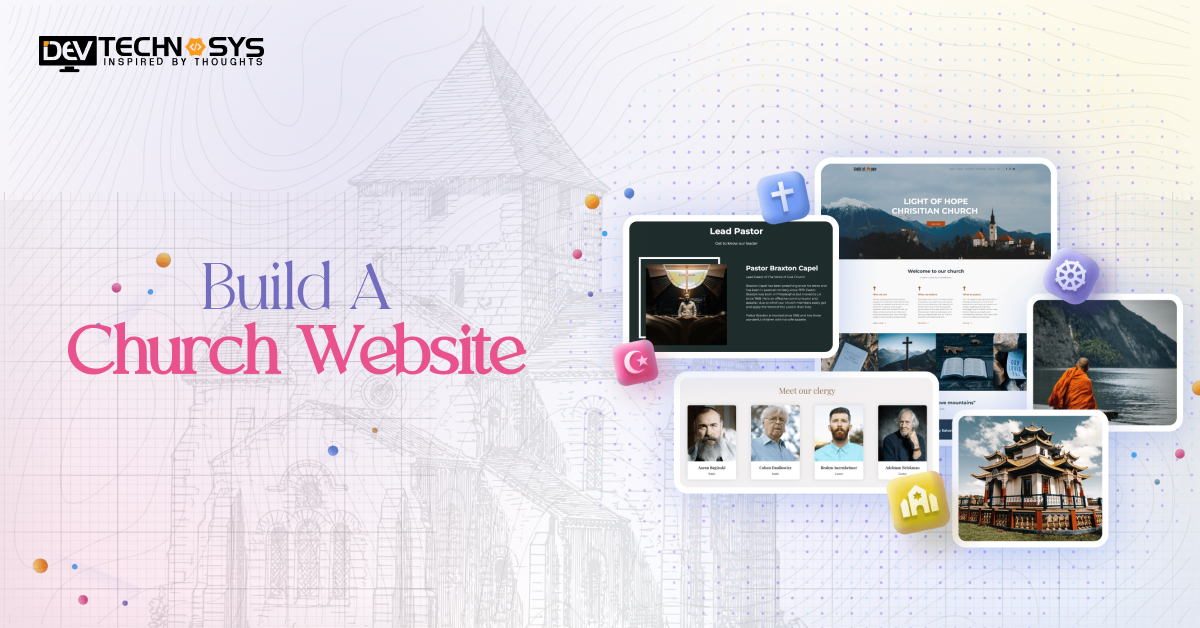
“Expand your church teachings globally with a website.”
Suppose you go to a church daily and participate in all religious activities. It is obvious to get some perks like membership or event contracts. For this, you can build a church website to deliver various information like church locations, donation portal, and upcoming prayer meets. This will help other visitors, encouraging them to become community members.
Key takeaways:
-
-
- Over 70% of churchgoers research a church online before attending services, highlighting the need for a professional digital presence.
- Building a church website involves user research, clean interface design, backend integration for donations, and ongoing maintenance.
- Costs range from $2,000 to $10,000 depending on complexity, features, and developer expertise.
- A church website enhances community outreach, simplifies donations, and keeps members connected to events and resources.
-
You need to know various topics like the need to make a church website, development cost, and features before investing money. Additionally, it is mandatory to find out development time, maintenance charges, and security of user data.
So, in this church web development guide, we will discuss all the topics with detailed information. Let’s get started and know more.
Why Invest in Church Website Development?
You can develop a church website to provide a strong online presence and connect people from all over the world. It is easy to talk to each other, get involved in the community, and perform modern worship:
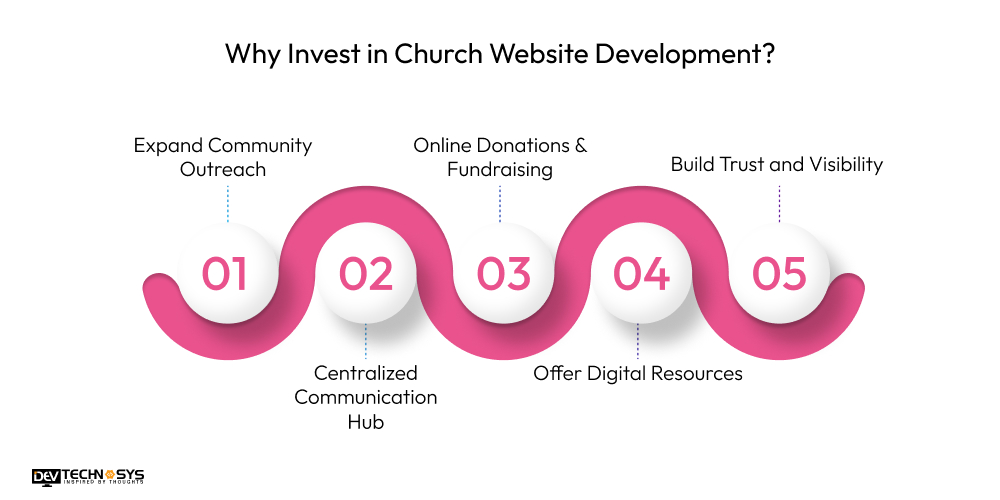
1. Expand Community Outreach
Ministries can reach people who don’t live near them and get new members using church website development solutions. The church can reach out to people looking for spiritual advice by putting sermons, event details, and contact information online.
2. Centralized Communication Hub
The website is a single place where people may share news, event calendars, and announcements. People may quickly get all the relevant information without using more than one way of communication. You should hire dedicated developers to make sure that messages are sent and received timely.
3. Online Donations & Fundraising
With a safe online donation system, fans can give money whenever and wherever they choose. Churches can use the site to plan fundraising events, build projects, or help people in their communities. This is among the best benefits of church website for businesses.
4. Offer Digital Resources
Church websites can have archives of sermons, study materials, and prayer requests for members. These digital tools help people study and grow spiritually everyday. It is important to use church website development services for people with physical disabilities.
5. Build Trust and Visibility
A great website makes the church look orderly and friendly, which boosts its reputation. Visitors will trust you more if you show them information on testimonials and community projects. It is beneficial to create a church website, so people can find the church more easily.
Want a chatbot demo or pricing? Fill the form and talk to our experts today.
Pick what you need below — you can select more than one — then tap Get detail to continue.
-
Chatbot demo dashboard
-
Cost to develop an app
-
Industry report
-
Case study
Use of AI in Church Websites
AI can make church websites better by automating jobs, tailoring the experience for each user, and getting more people involved in the community. AI solutions help churches connect with members, make operations run more smoothly, and instantly give relevant spiritual resources. You can develop a church website with tools like smart chatbots and content recommendations.
- Suggests relevant sermons, blogs, or events based on user preferences.
- Provides instant answers to queries about services, donations, and event schedules.
- Analyzes visitor behavior to optimize outreach and improve member engagement strategies.
How to Make Websites for Churches?
Now, it’s time to learn how to build a church website in 7 simple steps. So, as a business investor, you can easily plan your budget and manage the development cost:
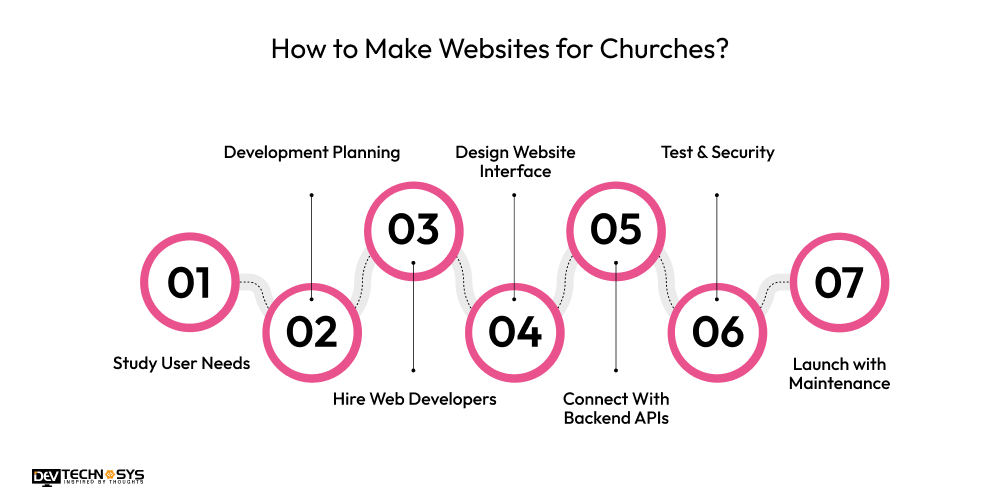
1. Study User Needs
To develop a church website, start by learning about the church’s aims, target audiences, and features, like event listings or ways to make donations. To get ideas, hold discussions or surveys with church leaders and people.
Look at the websites of other churches to get ideas and see how well they work. This process makes sure that the website meets both spiritual and practical needs.
2. Development Planning
Make a plan to list the cost to make a church website and main features. Pick the hosting, tech stack, and CMS platform based on what the church needs. Make sure your plan can grow to include new features like online sermons or community forums in the future.
A well-documented plan cuts down on delays and keeps development on track. You must know church website layout tips to prevent extra expenses.
3. Hire Web Developers
Depending on your budget, you can hire freelancers or in-house teams from a website development company. Look at portfolios, read client evaluations, and see if they have worked on non-profit or faith-based websites before.
Make sure to balance expenses, deadlines, and assistance after the launch with church website design ideas. Strong teamwork makes sure that the website fits with the church’s goals.
4. Design Website Interface
Make sure the church website design is clean and inviting, and that it shows the church’s principles. Make sure that navigation is straightforward to understand, that the site works well on mobile devices, and that sermons and contribution sites are easy to find.
Use colors that are peaceful and pictures that are good quality to encourage people. Hire a church website development company to make sure that elderly and disabled members may use the site easily.
5. Connect With Backend APIs
Use secure APIs to connect donation systems, event calendars, and media streaming services. Make sure that data flows correctly between the front end and the back end so that everything works smoothly. API connections also make it possible to make improvements in the future without having to overhaul the site.
To make maintenance easier, choose APIs that are dependable and well-documented. It is important to use a church website builder for integrating APIs.
6. Test & Security
Do thorough tests on speed, mobile compatibility, and usability on all devices. Check for problems, broken links, and slow load times to make sure everything works well. To keep sensitive data safe, use SSL certificates, firewalls, and regular security checks.
Testing properly makes sure that the launch is safe and easy to use. So, you must make church website that is highly secure and safe.
7. Launch with Maintenance
After getting final clearance and doing pre-launch testing, put the website on a live server. After the launch, keep an eye on metrics like uptime, customer feedback, and traffic. Set up regular updates for new material, security patches, and new features.
The church website will stay reliable and useful for a long time if it is maintained regularly. This may affect the cost to create church website, but provides efficiency.
Key Features in a Missionary Website
A missionary website encourages people to get involved and connect with the mission. These church website features make sure that everyone can see events, get involved, and reach other people:
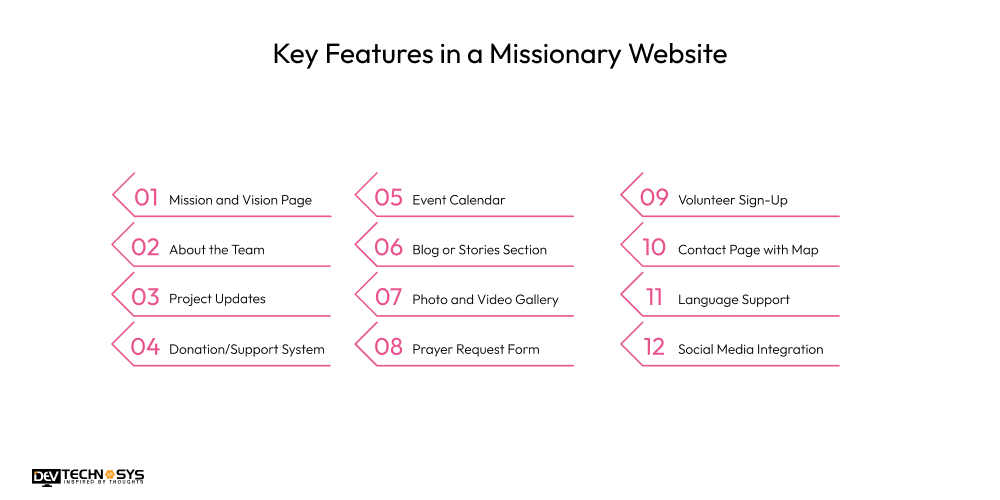
1. Mission and Vision Page
Highlights the core goals and spiritual objectives of the mission work. You may create a church website to help visitors understand the purpose and long-term vision of the ministry.
2. About the Team
Introduces missionaries, leaders, and volunteers behind the mission. It is beneficial to develop church website that builds trust by showcasing their experience and dedication.
3. Project Updates
Provides regular progress reports on active and completed projects. Keeps supporters informed and engaged with the mission’s impact.
4. Donation/Support System
Enables secure online giving for one-time or recurring donations. Simplifies financial support for missions and community programs.
5. Event Calendar
Displays upcoming events, mission trips, and outreach programs. Businesses should make church website that allows users to stay informed and plan participation accordingly.
6. Blog or Stories Section
Shares testimonies, missionary experiences, and field stories. You should hire web developers to implement this feature that inspires readers and deepens their connection to the mission.

7. Photo and Video Gallery
Showcases images and videos from mission trips and community work. A responsive church website design and visual storytelling enhances credibility and emotional connection.
8. Prayer Request Form
A church website CMS allows visitors to submit prayer requests or pray for others. Builds a sense of spiritual community and support online.
9. Volunteer Sign-Up
Provides a simple form for individuals to register as volunteers. Encourages active participation in mission trips and events.
10. Contact Page with Map
Lists contact information and an embedded map for easy navigation. The best platform for church website facilitates direct communication with the missionary team.
11. Language Support
You must build church website to offer multilingual options to cater to global audiences. Ensures accessibility for supporters from different regions.
12. Social Media Integration
Connects the website to active social platforms for wider reach. Enables sharing updates and engaging followers in real time.
What is the Cost to Build a Church Website?
The cost to build a church website varies due to a number of factors. The average development cost ranges between $8,000 to $25,000. Each factor affects design, development time, and maintenance costs. Knowing these things helps you make budget-friendly choices without sacrificing quality:
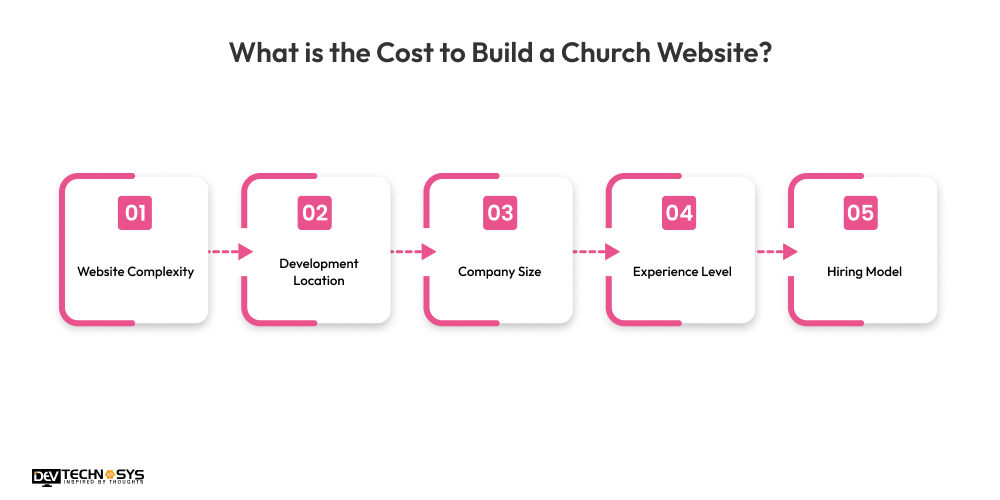
1. Website Complexity
The cost to develop a church website increases due to web pages, live streaming features, and integrations. A simple informational site costs a lot less than a platform with dynamic features that works. More complicated designs also take longer to make and test.
| Website Complexity | Development Time | Estimated Cost |
| Simple | 2-5 months | $5000-$10000 |
| Moderate | 5-8 months | $10000-$15000 |
| Complex | 8-12 months | $15000-$20000 |
| Premium | More than 12 months | $20000-$25000 |
2. Development Location
The cost to create a church website depends a lot on where the development team is located. Teams in North America or Europe charge more than teams in Asia or Eastern Europe. Outsourcing to places where costs are lower can help you save money without lowering quality.
| Development Location | Estimated Cost |
| USA | $25000-$30000 |
| Australia | $20000-$25000 |
| India | $5000-$12000 |
| UK | $15000-$20000 |
| UAE | $8000-$15000 |
| Brazil | $12000-$16000 |
3. Company Size
Big agencies might provide full-service packages, but they normally charge a lot for them. Mid-sized companies can offer a fair website development cost with specialized knowledge. Freelancers cost less, but you might need to keep an eye on them and supervise them more.
| Company Size | Estimated Cost |
| Small Enterprise | $8,000-$12,000 |
| Mid-Sized Enterprise | $12,500-$15,000 |
| Large Enterprise | $15,000-$20,000 |
4. Experience Level
Experienced web developers provide a high church web development cost due to advanced knowledge. They can make designs that seem better, work better, and make the user experience smoother. Entry-level workers are cheaper, but they might not have the strategic skills needed for complicated church initiatives.
| Experience Level | Cost Estimation (USD) |
| Junior/Entry-Level | $8000-$12000 |
| Mid-Level/Experienced | $12000-$16000 |
| Senior/Expert | $16000-$20000 |
| Professional | $20000-$24000 |
5. Hiring Model
The overall church website development cost depends on the hiring model. Hourly rates are good for projects with changing scopes, whereas set prices are good for projects with clear goals. Dedicated teams are better for keeping things up to date and maintaining them over time.
| Hiring Model | Estimated Cost |
| In House Team | $5,000-$8,000 |
| Full-Time Freelancers | $3,500-$5,000 |
| Developer Outreach | $8,000-$15,000 |

Tech Stack Needed for Developing Church Websites
To make a church website, you need a good mix of front-end, back-end, and support tools. These parts make sure that everything works smoothly, can be scaled up, and is safe.
| Component | Recommended Tools/Technologies |
| Front-End Framework | React.js, Angular, Vue.js |
| Back-End Framework | Node.js, Django, Laravel |
| Content Management System (CMS) | WordPress, Strapi, Drupal |
| Database | MySQL, PostgreSQL, MongoDB |
| Hosting | AWS, Bluehost, DigitalOcean |
| Payment Gateway | Stripe, PayPal, Razorpay |
| Media Streaming | Vimeo, YouTube API, JW Player |
| Email & Notifications | SendGrid, Mailchimp, Firebase Cloud Messaging |
| Analytics & Tracking | Google Analytics, Hotjar, Matomo |
| Security & SSL | Cloudflare, Let’s Encrypt, Sucuri |
How to Monetize a Church Website?
A church website that is well-designed can bring in money by managing the cost to build a church website. These ways to make money are in line with the mission’s principles and make sure it will last:
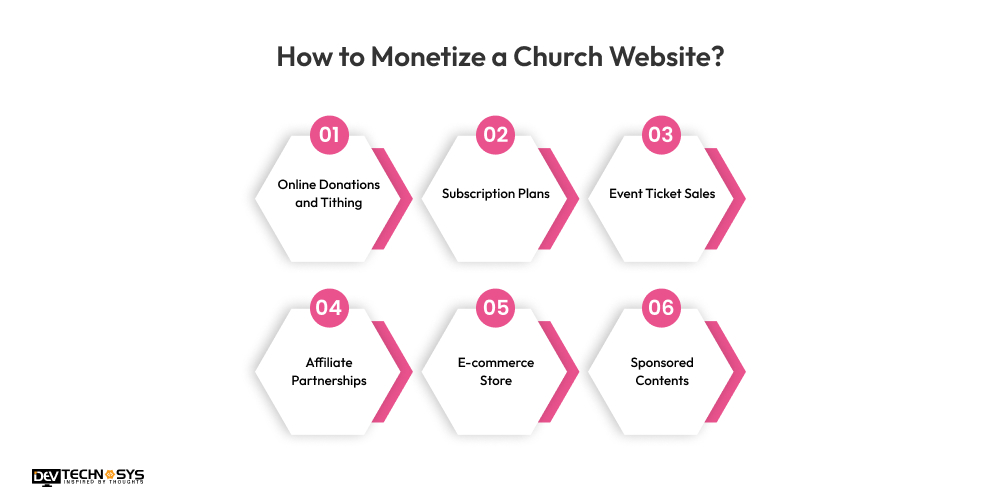
1. Online Donations and Tithing
Add a safe donation system so that members can give tithes once or on a regular basis. You should make a church website with an easy donation system for supporters. It also makes it easier for the church to keep track of donations.
2. Subscription Plans
Give premium members access to specific content like recorded sermons, study resources, or events. Subscriptions that are paid for every month or year bring in a steady stream of money. You should invest money to create church website for users seeking membership.
3. Event Ticket Sales
You can sell tickets for conferences, worship nights, or fundraising banquets right on the website. Online booking cuts down on paperwork and makes it easy to monitor attendees. It is easier for people to sign up, which increases involvement and helps to balance the cost to develop a church website.
4. Affiliate Partnerships
Use affiliate links to promote Christian books, devotional materials, or other Christian goods. The church gets a cut of every sale made through these links. This method makes money from content without increasing the web development cost.
5. E-commerce Store
Open a store to sell church-related items, literature, or handmade crafts from mission projects. This helps the church get more money and get the word out about who they are and what they stand for. You should build church website to help local artists who are connected to the ministry.
6. Sponsored Contents
Publish articles or ads that are founded on faith from trusted partners. Sponsorships are a way to make extra money while helping important causes in your community. To develop church website that keep members’ trust, make sure that the material fits with church beliefs.
In a Nutshell!!
The idea to build a church website is beneficial for fundraisers and charity holders. They must approach a website development company like Dev Technosys to proceed in an organized manner. By connecting with the firm, you get:
- A certified approach to create a church website.
- Flexible model on the custom church website development cost.
- And, services which include consulting, designing, and maintenance.
So, you must start early and focus on increasing the target audience as much as you can. This will increase both profit and brand value.
FAQs
1. How Long Does it Take to Build a Church Website?
- A basic website with static pages takes 3 to 4 weeks.
- Feature-rich sites with payment gateways require 2 to 3 months.
- The timeframe may increase to more than 3 months due to custom designs.
2. How Does a Church Website Work?
- It functions as a central hub to share events and church updates.
- Integrates donation systems and contact forms.
- Operates through CMS platforms to allow easy sharing.
3. What is the Role of Website Maintenance?
- Ensures regular updates and bug fixes.
- Maintains security to resolve outdated plugins and downtime risks.
- Supports content like new sermons and community news.
4. How to Optimize the Cost to Develop a Church Website?
- Use CMS platforms like WordPress to lower development costs.
- Prioritize essential features and focus on scalability.
- Choose affordable hosting and open-source tools.
5. What is the Process to Hire Web Developers?
- Define requirements to create a clear project brief.
- Evaluate portfolios and client reviews to shortlist experienced developers.
- Set clear contracts covering timelines and costs.