








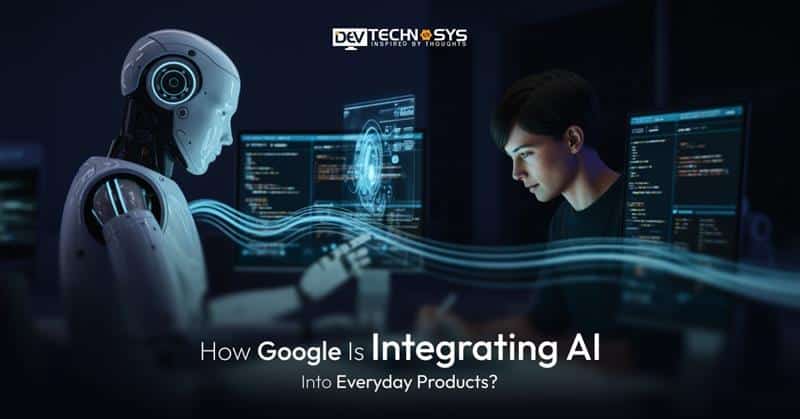
People are becoming more used to AI-powered productivity tools in everyday life. With this game-changing progress, AI integration in Google products has also been steadily increasing. Whether it’s finding the quickest route to a doctor or the nearest restaurant to have dinner. Google services are already helping billions of users every day by integrating AI into their products.
After the invention of the Transformer in 2017, Google has developed AI into everyday products models such as BERT, PALM, MUM, and LaMDA to integrate AI into its products more efficiently. Products like Lens and Translate rely entirely on AI technologies such as machine learning and optical character recognition.
AI into Everyday Products for Google Services
Google is integrating AI in everyday products continuously to enhance the user experience and ease of use of the service. These products include Google Search, Google Maps, Google Photos, Google AI Assistant, Gmail, Google Ads, Google Cloud, Google Gemini, and many more. Google uses AI and its applications in different products in different ways, as mentioned below.
1. AI in Google Search
After years of traditional searches by entering words directly, users can now search not only by text but also by photos and by voice. With Google introducing Multisearch, people can now search with photos and text together in the Google app. With the integration of Google AI Overview in the search engines, it has become really easy for people to find answers to their questions without jumping from website to website.
2. AI in Google Maps
The idea behind integrating AI development solutions into maps is to assist people by providing up-to-date data on traffic conditions and delays caused by specific reasons. AI also allows maps to update road speed limits and road closures while you are travelling. These data are collected in real time using AI from the locations of Google devices and past occurrences at the respective times.
3. AI technology in Google Photos
In 2015, Google implemented AI in Photos in order to classify the photos according to their date, making them easier to locate. Recently, Google has made upgrades to Memories to recount your memories with photos from a particular date. Cinematic Photos was introduced in December, 2025, which creates a vivid 3D version of your pictures using machine learning and computational photography.
4. Google AI Assistant
Now it’s very easy to perform tasks using Google. Using Natural Language Processing (NLP), Google AI Assistant allows you to use not only your phone but also your home, TV, and other appliances in day-to-day life. Just say “Hey Google, where is the nearest diner?” and get the directions to the diner instantly.
5. AI in Gmail
Have you wondered why Gmail looks less spammy? Check out the Google AI technology. Powered by AI, Google’s spam filtering helps to block any spam, phishing emails, and malware before it reaches users’ inboxes. There are also Google AI features like autocomplete and spell checker that help users write emails efficiently.
6. AI in Google Ads
To help small and large businesses all over the world, Google introduced “Performance Max Campaigns” last year. With this Google AI tool, an advertiser can just add their requirements and objectives, and the AI will assist them in constructing an efficient campaign plan, where the ads will be placed on all the platforms, all in one place.
These platforms are YouTube, Display, Search, Discover, Gmail, and Maps. To the user, the integration of Google AI allows him or her to personalize advertisements on the basis of what he or she searches on Google and uses other Google products.
7. AI in Google Cloud
Google is not only integrating AI in its own products but also launching Google AI tools for other businesses to integrate. Using Google Cloud, they launched a number of Google AI innovations for customers to cater to them according to their needs. Such as DocAI for document processing, Contact Center AI for call center operations, Translation Hub for translation into 100+ languages, Vertex Vision AI for video & image analysis, and many more. Using these tools, businesses can transform the way they work and operate.
8. Google Gemini
Launched in December 2023, Google Gemini has quickly become one of Google’s most famous products. It was started as a simple AI chatbot; by 2026, Gemini was integrated into almost every product of Google. Products like Google Search, Ads, and Pixel device can run completely on Google Gemini. As it is an open-source, Gemini is also integrating with tools like GitHub and Visual Studio Code as a coding assistant.
From mobile phone to computer, everything is integrated with Google Gemini AI for enhancing the productivity of tools and products. It helps with numerous tasks such as managing emails, searching with pictures and texts, shopping, works as an assistant to your device, and much more.
The application of AI in the daily lives of people utilizing digital devices has revolutionized the process, and Google is contributing significantly to the trend. It has incorporated AI in all its products, which include Google search, Gmail, Google Maps, Google photos and many other products. Such AI-based products are assisting users with their everyday lives by making the various tasks they have easier and more productive.
Google continues with AI innovations and integrates AI into its products so that they can be used by users more efficiently. With the coming of Google Gemini, the usage of AI has transformed completely. Creating an ecosystem synced with every device makes it easier for users in their everyday lives.