















Key takeaways:
-
- Best personalization engines 2026 use customer information and conduct to suggest relevant products, services, discounts, and product-related information via online stores.
- Top personalization programs include AI-based search, market segmentation, behavioral targeting, personalized content, and cross-channel personalization.
- Personalization engines that utilize AI technology are effective in improving product visibility, boosting sales through cross-selling and upselling capabilities, thus providing a better shopping experience.
- In order to have efficient personalization, businesses need to collect first-party data that helps them link browsing activities to purchases, loyalty, and accounts while ensuring compliance with privacy regulations.
- Choosing the right headless commerce personalization engine varies depending on the business needs, platform used, and budget.
Customers expect online stores to “get” them. They want relevant products, smarter search results, timely offers, and recommendations that actually match what they need, not another generic shopping experience.
That’s where ecommerce personalization engines come in. By 2026, these platforms will not just give recommendations, but will use AI, real-time behavioral data, predictive analytics ecommerce, and automation to personalize the consumer journey at scale.
But with dozens of solutions offering improved engagement and more conversions, it may rapidly become confusing to select the proper platform.
In this informative blog, we review the 15 best personalization engines for online retail in 2026, explaining their strengths, AI features, critical features, and use cases to help you find the perfect one for your ecommerce business.
What Is an E-commerce Personalization Engine?
An e-commerce personalization engine is a software tool that provides personalized recommendations to all users in real-time. It utilizes information and machine learning algorithms for suggesting products, services, advertisements, and search results depending on the user’s current location, history of purchases, preferences, and actions. The system includes product suggestions, cross-channel marketing, personalized content, and tailored search options as its main features.
How Does it Work?
- Data gathering: Collects user actions such as clicks, browsing history, earlier purchases, type of device used, and location.
- AI and Machine Learning Recommendation Systems: Evaluates trends and patterns to suggest customers’ next purchases.
- Real-Time Decision-making Process: Updates recommendations instantly as the user clicks or changes search terms during a visit.
Why Online Retailers Need Personalization Engines in 2026?
In 2026, traditional shops can’t compete anymore. The cost of traffic is too high for discounts to be sustainable, and shoppers start the purchasing process when they trust the product. Personalized technologies can work on the initial steps of the purchase process and greatly optimize the shopping experience.
Key Drivers:
- Real-Time Intent: Each search, scroll, click, and even product comparison creates a new signal. Personalized systems react to the customers’ actions in real-time and adjust the offer to the customer’s needs.
- AI Shopping Agents: AI systems are already able to search and compare products and help customers make purchases. Retailers need AI personalization tools for online retail to make product info and recommendations effective for the retailers and the AI-driven industry in general.
- First-Party Data: Due to the fact that third-party cookies are becoming less reliable, retailers begin to rely on their own first-party and zero-party data, including purchase history, preferences, and loyalty data.
- Revenue Growth: Personalization directly affects the company’s results. According to McKinsey, ecommerce personalization companies USA that have a good personalization strategy receive 40% more income from personalization compared to average companies.
- AI-Powered Content at Scale: Generative AI product recommendations helps retailers create personalized product content, promotions, and campaigns faster and at lower production costs.
How Do E-commerce Personalization Engines Work?
The best ecommerce personalization software USA uses customer data, AI, and behavioral insights to understand individual shoppers. It then delivers relevant products, content, offers, and experiences across every stage of the buying journey.
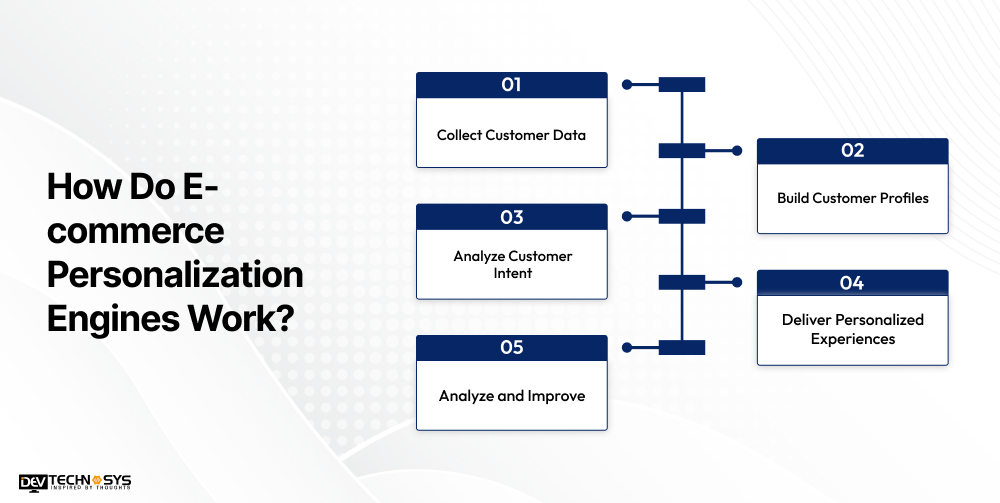
Step 1: Collect Customer Data
- Browsing Habits: Monitors clicks, views of products, scrolling activities, and time spent.
- Purchase History: Studies past purchases, habits, and interests in products.
- Search Queries: Shows what products and categories have been searched by customers.
- Shopping Cart & Wishlist Actions: Keeps records of saved, removed, added, and neglected purchases.
- Demographics & Preferences: Customer personalization software collects data from geographical location, interests, and provided choices.
Step 2: Build Customer Profiles
- Segmentation: Categorizes people based on behavior patterns, interests, and purchases made.
- Behavior-based profiles: Results are produced based on behavior and purchase history.
- Real-time information: The profiles are updated based on current behavior.
Step 3: Analyze Customer Intent
- Machine learning: Responsible for identifying the patterns and relationships in behavior.
- Predictions: Show what products will be purchased by customers in the future.
- AI models: Rank the items and decide what matters the most.
Step 4: Deliver Personalized Experiences
- Recommendations: Online retail personalization platform recommends relevant products based on the interests of individual users.
- Personalized search: Ranks search results according to the intention of customers.
- Dynamic Content Personalization: Adjusts banners, categories, and content on the home page.
- Special offers: Provides discounts and promotional offers to customers.
- Email & push notifications: Personalized email marketing helps businesses send messages according to the actions of customers.
Step 5: Analyze and Improve
- A/B testing: Tests different recommendations, content, and offers at the same time.
- Real-time model training: Applies new behavior data in order to raise the accuracy of AI systems.
- Feedback loops: Analyzes clicks, purchases, skips, and conversions.
15 Most Effective Personalization Engines for Online Retail in 2026
From AI-powered recommendations and personalized search to real-time customer journeys, today’s leading platforms go beyond basic product suggestions. The right personalization engines for online retail depends on your business size, catalog complexity, channels, data maturity, and personalization goals.
1. Dynamic Yield
Dynamic Yield by Mastercard is built for brands who want to manage personalization, suggestions, experimentation, and customer experiences all in one platform. This personalization engine for online stores has an OS that can bring data together from CRM, CMS, ESP, CDP, analytics, and other sources.
Main Services:
- Product suggestions
- Personalization on the Web & Mobile
- A/B testing and multivariate testing
- Segmentation of audiences
- Targeting by behavior
- Personalization across channels
- Real-time decisioning
- AI features: Its AdaptML and AffinityML capabilities leverage past and real-time behavior to determine product affinities and forecast purchasing intent.
- Why Choose it: Good for major merchants needing thorough experimentation + customization, not just a recommendation widget.
- Best for: Enterprise merchants with complicated omnichannel personalization and experimentation requirements.
2. Bloomreach
Bloomreach stands out as one of the popular personalization engines for online retail for its unique blend of search, product discovery, consumer data, and marketing engagement. Its Loomi AI is built to enable AI-driven search, recommendations, campaign generation, and personalized customer experiences.
Main Services:
- AI-driven product search
- Recommendations for products
- Merchandising Search
- Email / SMS customization
- Personalization on the web
- Segmentation behavior
- Marketing Automation Tools
- AI Capabilities: Loomi AI is able to help with semantic search, personalized product ranking, predictive engagement with customers, and AI-assisted campaign workflows.
- Why Choose it: Ideal for big catalogs and multi-brand stores that wish to avoid separate systems for search, merchandising, and personalization.
- Best for: A big custom eCommerce development company combines customization, search, merchandising, and marketing automation.
3. Nosto
Nosto is largely focused on e-commerce merchandising and on-site customization, which makes it suitable for organizations that want marketers and merchandisers to control experiences without relying on developers alone.
Main Services:
- Recommended products
- Custom content
- Pop-ups on site
- Targeting behaviors
- Merchandising by category
- Customer 360 data integration
- Customer segmentation
- AI capabilities: Nosto uses behavioral data, NLP, vector search, and machine learning to enhance product discovery and ranking.
- Why you should choose it: Best for: Shopify Plus and other growing shops seeking a reasonably commerce-focused customizing platform.
- Best for: Mid-market and developing e-commerce firms who want robust customization but don’t want to do a lot of engineering.
4. Algolia
As one of the most effective personalization engines for online retail, Algolia is particularly strong when personalized search is the core requirement. This behavioral targeting ecommerce
Engine offer a search infrastructure that can be customized extensively for large product catalogs and complex storefronts.
Main Services:
- AI-powered search
- Faceted navigation
- Product discovery
- Merchandising controls
- Search analytics
- Recommendations
- Conversational shopping
- AI capabilities: NeuralSearch combines keyword and vector-based approaches to better understand search intent, while its AI capabilities can support conversational product discovery.
- Why choose it: this personalized shopping experience software is best suited to retailers with strong technical teams that want control over their search and recommendation architecture.
- Best For: Developer-led e-commerce teams that prioritize fast, flexible search and discovery.
5. Insider
Insider is a service where customer data meets journey orchestration throughout web, mobile, email, SMS, WhatsApp, and push notifications.
Main Services:
- Customer segmentation
- Web personalization
- Mobile personalization
- Product recommendations
- Journey orchestration
- Predictive analytics
- Cross-channel campaigns
- AI Capabilities: Predictive segmentation and AI-driven decisioning help choose the specific experience or message.
- Why Choose It: This customer segmentation software is a good fit for global retailers running multiple digital channels using solely one customer interaction solution.
- Best For: Corporate brands preferring omnichannel personalization.
6. Salesforce Personalization
Salesforce is among the effective and popular personalization engines for online retail. It becomes even more relevant when the customer, commerce, service, and marketing data already exists within Salesforce.
Main Services:
- Real-time customer profiling
- Product recommendations
- Personalized content
- Predictive segmentation
- Commerce personalization
- Journey orchestration
- Integration with CRM
- AI Capabilities: Salesforce’s AI capabilities help predict customer behavior and content selection.
- Why Choose It: Should be considered when CRM and personalization have to operate from one data platform.
- Best For: Enterprises already using Salesforce.
7. Adobe Target
Adobe Target is an ecommerce recommendation engine that focuses on A/B testing, audience targeting, and personalized digital experiences, helping retailers deliver tailored content and offers based on customer behavior, preferences, and intent.
Main Services:
- Testing via A/B
- Testing via multiple variables
- Automated user interaction
- Audience targeting
- User process improvement
- Personalized content
- Capabilities in Automation: Powered by AI, the real-time personalization engine can focus on the identity of audiences in need of this or that experience.
- Reason for Selection: Perfect for those firms already having Adobe Analytics, Adobe Experience Manager, or other components of Adobe Experience Cloud.
- Ideal For: Major firms utilizing Adobe Experience Cloud.
8. SAP Emarsys
SAP Emarsys is based on customer engagement and multichannel marketing, which makes it valuable for retailers wanting their personalization to be targeted throughout the whole lifecycle process.
Main Services:
- Segmentation of customers
- Personalization via email
- SMS campaigns
- Personalization over the web
- Management of loyalty
- Behavioral triggers
- Marketing automation
- Capabilities in Automation: Predictive engagement scoring and automated campaigns help retailers recognize customers’ behaviors and react accordingly.
- Reason for Selection: It is a good choice for large retailers wanting to offer their clients personalized solutions while also taking care of the already given loyalty.
- Ideal For: Retail businesses combining retail personalization technology with the tools of marketing automation and loyalty.
9. Klevu
Being among the top personalization engines for online retail, Klevu specializes in AI-powered search, product discovery, and merchandising, and integrates with leading commerce systems.
Main Services:
- Product recommendations
- First-party data personalization
- Category Marketing
- Search using NLP
- Product ranking (English)
- Search analytics
- AI Capabilities: Its product recommendation algorithm help assess search intent and shopper behavior to optimize product ranks and category ordering.
- Why it’s a Good Alternative: A smart solution for shops that want a quick implementation without constructing an advanced search and personalization system from scratch.
- Best For: E-commerce stores that have surpassed basic platform search.
10. Clerk.io (SaaS)
Clerk.io is a personalization engine for ecommerce that is known for delivering suggestions, search, email, and other customer experiences, all powered by shared behavioral and sales data.
Main Services:
- Product Suggestions
- Customized search
- Personalizing your email
- On-site recommendations
- Chat Bot
- Segmenting customers
- AI Capabilities: Predictive recommendations and AI-powered shopping help retailers personalize discovery and engagement.
- Why it’s Great: Perfect for Shopify, Magento, and WooCommerce stores wanting personalization without the bells and whistles of big enterprise platforms.
- Best For: SMB and mid-market merchants looking for an approachable personalization platform.

11. Recombee
Recombee is especially effective when a business wishes to implement recommendation intelligence directly into its own website, marketplace, mobile app or custom commerce platform, unlike complete marketing suites.
Main Services:
- Recommendation API
- Real-time recommendations
- SDK’s
- Cold start handling
- Item and user recommendations
- Use cases for custom recommendations
- AI Features: The recommendation stack includes machine learning, collaborative filtering algorithm, deep learning, and other advanced recommendation approaches.
- Why Choose: Great for engineering teams who want to design their own custom e-commerce experiences and not just a full marketing interface.
- Best For: Developers who want to use an API-based personalization to create a recommendation engine.
12. Coveo
Coveo blends AI search, recommendations, personalization, and content discovery. This comes in handy beyond the usual product catalogs.
Main Services:
- Product suggestions
- Custom Navigation
- Discovering content
- Merchandising on the fly
- Behavioral analytics
- AI Skills: Machine learning and deep learning capabilities can be used to tailor search and recommendations to customer intent.
- Why Choose It: It’s powerful for big enterprises where customers need to search across products, manuals, articles, support content, and other information.
- Best For: Big B2B and B2C companies with complicated product and content ecosystems.
13. Constructor
Constructor aims to leverage shopper behavior and intent to automatically improve search results, category pages, and product discovery.
Main Services:
- Custom search
- Ranking products
- Personalized browsing
- Helped shopping
- Merchandising controls
- Behavioral optimization
- AI Capabilities: AI-driven strategy can leverage behavioral and contextual information to decide what products to show to particular buyers first.
- Why Choose it: Good for stores moving from manually configured merchandising to more automated, shopper-specific ranking.
- Best For: Retailers in need of AI-based product discovery and personalized rating.
14. SegmentStream.
SegmentStream is about measurement and attribution. SegmentStream specializes in attribution, incrementality testing, and cookieless measurement, helping businesses understand which channels and campaigns truly drive growth.
Main Services:
- Attribution without cookies
- Omni-channel measurement
- Testing incrementality
- Marketing Analysis
- Budget optimization
- AI Capabilities: Machine learning algorithms help link together different marketing data and measure the effectiveness of campaigns.
- Why Use It: Best for when your primary difficulty is not personalization implementation, but proving which personalization and marketing efforts truly drive incremental revenue.
- Best For: Marketing and analytics teams who want to prove customized ROI.
15. VWO
VWO combines experimentation, audience targeting, and behavioral personalization, allowing retailers to create segmented experiences, run A/B tests, and measure their impact before scaling successful strategies.
Features Include:
- A/B testing
- Multivariate testing
- Segmentation of the audience
- Visual Edit
- Behavioral signals
- Campaign analytics
- AI capabilities: AI-assisted audience development and campaign analysis can help teams spot possibilities and optimize tests.
- Why choose it: A solid starting place for firms who wish to test personalization hypotheses, measure ROI, and scale successful experiences gradually.
- Best For: Teams that want to try personalization before committing to a broader platform.
AI vs. Traditional Personalization Engines: What’s Different?
According to a top AI development services provider, in traditional personalization, the products, offers, or content that are shown are chosen by fixed rules, predefined customer segments, and past data.
Personalization powered by AI goes even further by looking at real-time behavior, buy intent, contextual signals, and customer patterns to make choices that change based on these factors.
Besides providing AI-driven product recommendations, AI engines can also guess what customers might want next, learn from conversations all the time, and make sure that customers have a personalized experience across all channels.
According to our tech expert Mohit Nag, traditional engines follow rules that have already been set, but engines that are powered by AI learn, predict, and change in real time.
Factor |
Traditional Personalization |
AI-Powered Personalization |
Decision-making |
Rule-based |
AI/ML-driven |
| Customer segments | Predefined segments | Dynamic, continuously updated profiles |
| Data analysis | Historical data | Historical + real-time behavioral data |
| Recommendations | Manually configured rules | Predictive, behavior-based recommendations |
| Intent detection | Limited | Real-time intent and contextual analysis |
| Content delivery | Predefined experiences | Dynamically generated and selected experiences |
| Scalability | Requires more manual configuration | Automates personalization at scale |
| Learning | Periodic manual optimization | Continuous learning from customer interactions |
| Predictive capabilities | Limited | Predicts purchase intent, churn, preferences, and next-best actions |
| Best suited for | Simple, predictable personalization needs | Large catalogs, omnichannel commerce, and complex customer journeys |
Common Ecommerce Personalization Mistakes to Avoid
Even the most advanced personalization engines may fall short if the retailer suppresses usage of technology in favor of prioritizing customer relevance, data quality, and measurable business results.
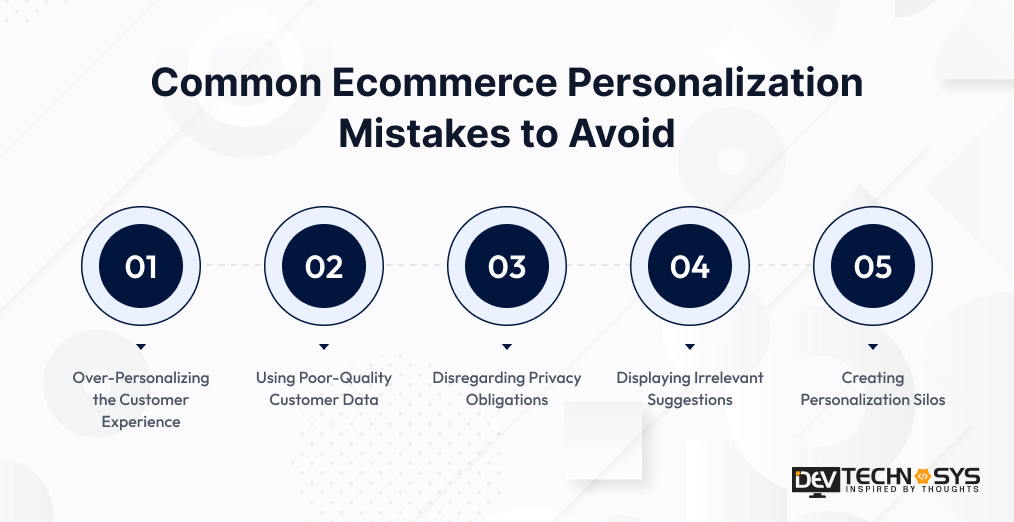
1. Over-Personalizing the Customer Experience
Having too much personalization can make customers feel uncomfortable and violated. Focus on making relevant recommendations and creating meaningful experiences instead of bombarding the consumer with hyper-personalization retail and hyper-targeted communications, using every possible data point about them.
2. Using Poor-Quality Customer Data
Using incomplete, outdated, or irrelevant customer information leads to poor targeting and ineffective recommendations. Keep data clean, updated, and consolidated.
3. Disregarding Privacy Obligations
Make sure to collect and utilize customer data openly and according to consent and security standards. Compliance with laws and communicating openly about the use of customer data are essential prerequisites for successful personalization implementation.
4. Displaying Irrelevant Suggestions
Bad suggestions can annoy buyers and decrease their trust. Monitor the recommendation process by combining information about user behavior, product relevance, inventory levels, and current customer intentions.
5. Making Personalization Silos
Using different personalization solutions for websites, applications, emails, and other channels leads to disjointed experiences. Integrate customer information with decision-making systems to ensure consistent cross-channel personalization.
Which Personalization Engine Is Right for Your Online Retail Business?
In reality, no single method exists that works for every person. Different businesses use different types of personalization depending on their size, technology stack, customer data, catalog’s complexity, channels, and goals of pursuing personalization.
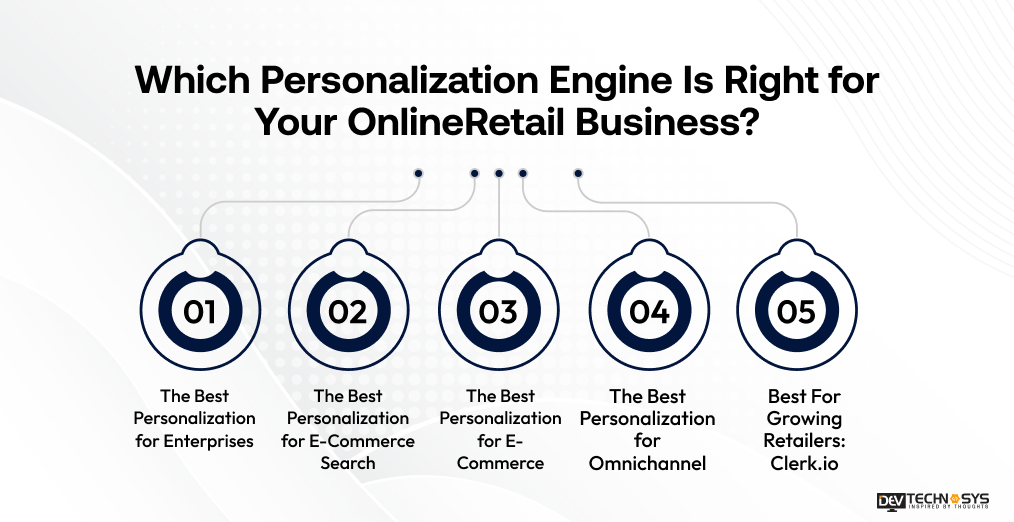
1. The Best Personalization for Enterprises:
Dynamic Yield / Adobe Target / Salesforce Personalization. These personalization engines are the best to use for large organizations seeking advanced experimentation, integration of customer data, and scalability of personalization in complex commerce environments.
2. The Best Personalization for E-Commerce Search:
Algolia / Klevu: This is the best solution for those whose main aim is to develop product discovery capabilities, search relevance, merchandising, and personalization of rankings.
3. The Best Personalization for E-Commerce:
Nosto / Bloomreach: the best option for those doing retail and looking for product recommendations, behavioral personalization, AI-powered merchandising.
4. The Best Personalization for Omnichannel:
Insider / SAP Emarsys. These customer data platform (CDP) are perfect for businesses interested in connecting personalization across web, mobile, email, SMS, push notifications, and other touchpoints.
5. Best For Growing Retailers: Clerk.io-
This is a good solution for small or medium-sized businesses that require recommendations and implement AI-driven customer engagement without technical difficulties that come with big solutions.
Remember to start your journey from understanding the priorities of your business rather than looking for the benefits of a particular platform. If your business is highly specialized and personalization features are under fast evolution, the development of customized AI-based personalization engines can guarantee you the maximum flexibility, control, and scalability in the long-term perspective.
Conclusion:
E-commerce personalization technology reached a new milestone of sophistication moving from simple product suggestions to artificial intelligence powered solutions that provide individual shopping experiences in real time through search, web sites, applications, email, and other channels. The optimal personalization technology depends on a number of factors including catalog size, business objectives, data readiness and technology capabilities.
As consumer expectations are becoming higher and higher, the personalization process needs to be more targeted instead of using an increasing amount of customer data. The greatest effectiveness is achieved by the combination of quality first-party data, AI technologies, continuous tests, measures for privacy protection and revenue-oriented metrics.
Frequently Asked Questions
Find answers to the most common questions related to this article.
The term mobile app security compliance refers to taking proper measures for security, privacy, and data protection of the users by abiding by the mobile app security compliance checklist and all the rules and regulations relevant to the mobile app throughout its lifecycle.
Standard security compliance frameworks for mobile apps include OWASP MASVS, NIST CSF, ISO/IEC 27001, SOC 2, and PCI DSS. The choice of which one is the right one is made by evaluating the industry, secure data, business model, and markets of the app.
OWASP compliance is generally not a legal requirement. However, OWASP MASVS and MASTG are widely recognized security resources that businesses can use to identify vulnerabilities, establish security controls, and evaluate mobile application security.
No, not every mobile app needs to comply with GDPR. It is necessary when an organization processes personal information covered by the legislation, including certain situations when the user lives in the EU or the European Economic Area.
Startups can enhance mobile app data protection and security from the start by integrating encryption, MFA, RBAC, secure APIs, secure data storage, dependency monitoring, secure coding principles, penetration testing, vulnerability control processes, and adequate privacy measures.
Security testing before launch can cover such testing methods as SAST, DAST, vulnerability testing, API security tests, mobile penetration tests, dependency analysis, and secure code reviews. The scope of testing should reflect the risks associated with the application.
Mobile apps should undergo security audits periodically and after significant changes to application code, infrastructure, APIs, integrations, or compliance requirements. High-risk applications may require more frequent assessments and continuous security monitoring.
OWASP is all about application security, while ISO 27001 mobile app security is about information security management systems. SOC 2 assesses control measures for ensuring that customer data is protected during service operations.