




















Key takeaways:
-
- Encoding is for compatibility, not security; anyone can reverse it without a key.
- Encryption is for protection; only authorized users with the correct key can decrypt it.
- Never use encoding to protect sensitive data, as it offers zero security against threats.
- Hashing, encoding, and encryption all serve different purposes; using the wrong one can cost you significantly.
Whenever you send a message on WhatsApp or make an online payment, a large amount of data is transformed behind the scenes continuously. And there are two main processes that make it possible: encoding and encryption. Frequently, these two are lumped together, but they are fundamentally different entities and serve different roles in digital security.
It is not just a matter of technicality for developers to understand encryption vs encoding. It is required for everyone who is engaged in building such mobile apps that handle user data. If a developer confuses the two of them, then it could lead to many vulnerabilities, data breaches, and ultimately loss of user trust.
In this blog, we will elementarily break down every detail on encoding vs encryption, how they are applied, how they are used in the real world, and most importantly, you will not make mistakes choosing the wrong one.
Let’s get started.
What Is Data Encoding?
The sole purpose of data encoding is to ensure that the data remains usable, readable, and compatible with all platforms and systems. Keep in mind – encoding is not for data security. It converts data from one format to another using different algorithms, which are mostly available publicly.
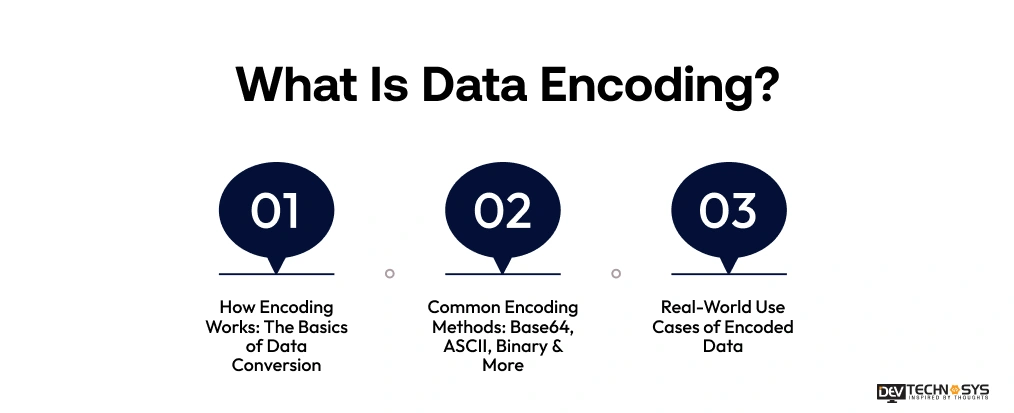
How Encoding Works: The Basics of Data Conversion
The core process of encoding is data conversion. It transforms data from one format to another without using a secret key or hidden methods, just by using publicly available algorithms.
The goal is not to provide security; it is for data compatibility.
For example, think of it as translating a book from Spanish to English. Meaning stays the same, just translated so that other people can read the book who do not know the Spanish language.
Common Encoding Methods: Base64, ASCII, Binary & More
Data encoding is widely used using several encoding methods and standards in modern mobile app development. These methods are completely open, stating that anyone can use or decode without having any security key or special permission.
- Base64 Encoding: Turns binary data into ASCII text, often used in emails and web data transfer.
- ASCII & Unicode: It links numbers to characters so texts seem the same on different computers.
- Binary Encoding: This converts data to 0s and 1s, the most basic kind of data conversion.
- URL Encoding: This transforms special characters into a web-safe format for browsers.
Real-World Use Cases of Encoded Data
Data encoding powers daily digital life without anyone noticing. Here are a few ways encoding works with modern computing.
- Displaying images and icons directly on web pages
- Transmitting emails with attachments across different mail servers
- Formatting URLs so browsers can read special characters
- Storing and streaming audio and video files across platforms
What Is Data Encryption?
Data encryption means to convert the normal readable data into an unreadable format called ciphertext. It is done by using an encryption algorithm and a secret key.
Encryption is the gold standard for privacy protection and data security in digital computing.
Without encryption, any data you communicate, every password you write, every transaction you perform, every message you send, would be exposed for anybody to see who intercepts it.
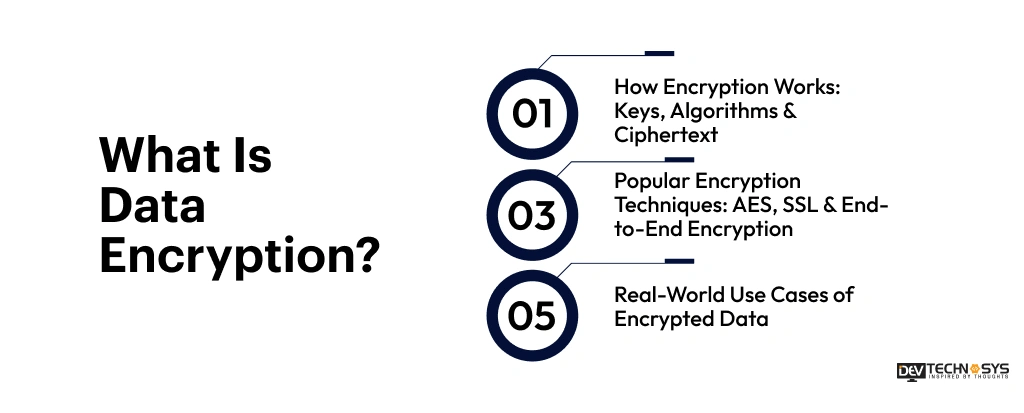
How Encryption Works: Keys, Algorithms & Ciphertext
The process of encryption entails scrambling the information that one can read to render it in an unreadable format. It is achieved by combining the plain readable information known as plaintext with the secret key, and only the authorized user can decrypt it.
There are mainly two types of encryption techniques:
- Symmetric Encryption: The same key is used to encrypt and decrypt data. Fast, efficient, good for massive amounts of data. The most popular example is the AES encryption.
- Asymmetric Encryption: Encrypts with the public key and decrypts with the private key. Slower, yet necessary for safe authentication and digital signatures. The most common example is RSA.
Popular Encryption Techniques: AES, SSL & End-to-End Encryption
The basis for modern cybersecurity is a handful of proven encryption techniques:
- AES Encryption: Advanced Encryption Standard utilized by governments, banks, and online platforms worldwide to protect critical data
- SSL Encryption: It protects the data you send to and from browsers and servers. It powers all the HTTPS sites you visit.
- End-to-End Encryption: Protects messages so that only the sender and receiver can read them, often used in messaging and secure file-sharing services.
Real-World Use Cases of Encrypted Data
Encrypted data is the backbone of modern digital interactions. Here are a few real-world examples of how encryption works in the digital security world.
- Protecting passwords and financial credentials in banking platforms
- Securing card transactions and wallets in fintech applications
- Enabling private conversations in messaging apps
- Safeguarding sensitive documents during secure file sharing
- Powering secure communication across enterprise network security systems
Encryption vs Encoding: The Core Differences Explained
Now that we know what they both are, let’s compare them head-to-head. Encryption vs encoding is more than a technical argument. It’s a vital difference that affects how securely your data is treated, stored, and passed via digital systems.
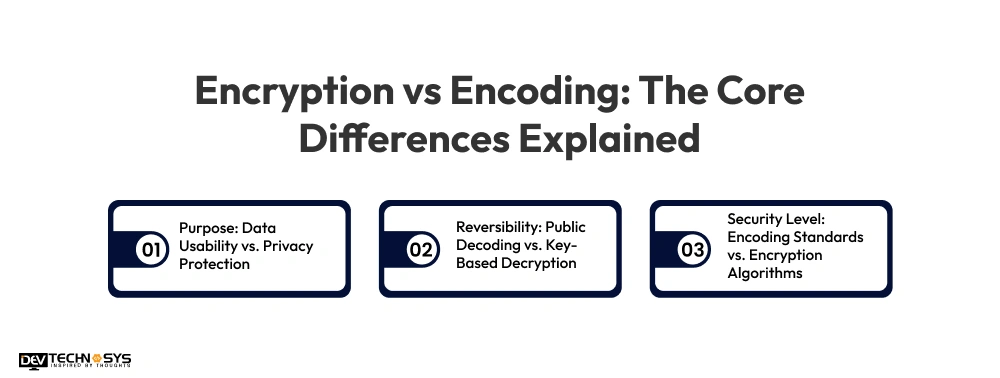
1. Purpose: Data Usability vs. Privacy Protection
The most fundamental difference between encryption and encoding lies in their purpose.
Data encoding is for compatibility purposes only. It guarantees that data can be read, transported, and processed properly across multiple systems and platforms. The data is not meant to be secret – it’s just laid out differently for ease of use.
Data encryption, on the other hand, is all about privacy protection. It changes data into an unreadable format with the sole purpose of preventing unwanted access. Encryption isn’t a side effect of security; it is security.
2. Reversibility: Public Decoding vs. Key-Based Decryption
Another major difference in encoding vs encryption is how each process is reversed:
- Anyone can decode the encoded data with the same publicly available technique – no key, no authorization, and no limitation.
- The encrypted data can be decrypted by someone who knows the secret key. Using strong encryption techniques, unauthorized access is almost impossible.
This is the one distinction that makes utilizing encoding for sensitive data a severe cybersecurity faux pas.
3. Security Level: Encoding Standards vs. Encryption Algorithms
Base64 or ASCII type data encoding standards are zero security. They are open, recorded, and reversible by design.
Encryption methods such as AES and SSL are technically sophisticated and are designed to withstand attack, brute force attempts, and illegal decryption.
Feature |
Data Encoding |
Data Encryption |
| Purpose | Data usability & compatibility | Data security & privacy protection |
| Reversible? | Yes – by anyone | Yes – only with secret key |
| Uses a Key? | No | Yes |
| Security Level | None | High |
| Common Examples | Base64, ASCII, Binary | AES, SSL, End-to-End |
| Used For | Data transfer, formatting | Secure communication, authentication |
| Who Can Decode? | Anyone | Authorized users only |
Hashing vs Encryption vs Encoding: What Sets Them Apart?
Encryption vs encoding are two different ideas, but there is a third phrase that comes up very often, hashing. Anyone serious about the fundamentals of cybersecurity and the protection of data needs a strong understanding of all three.
The input to a hash function is a message that can be of arbitrary length and produces an output of fixed length called a hash value. A hash function cannot be used for encryption since the process of hashing cannot be reversed.
Here is how all three compare at a glance:
Feature |
Encoding |
Encryption |
Hashing |
| Purpose | Compatibility | Security | Integrity verification |
| Reversible? | Yes – by anyone | Yes – with a key | No – never |
| Uses a Key? | No | Yes | No |
| Security Level | None | High | Medium |
| Common Examples | Base64, ASCII | AES, SSL | MD5, SHA-256 |
| Best Used For | Data formatting | Secure communication | Password storage |
The golden rule of digital security: use encoding for compatibility, encryption for confidentiality, and hashing for integrity verification.

Where Encryption & Encoding Is Used: Practical Applications in Cybersecurity
The difference between encoding and encryption is one thing in theory, but understanding where each is employed in the real world is what makes the distinction click.
Both are vital across industries, but in very different ways.
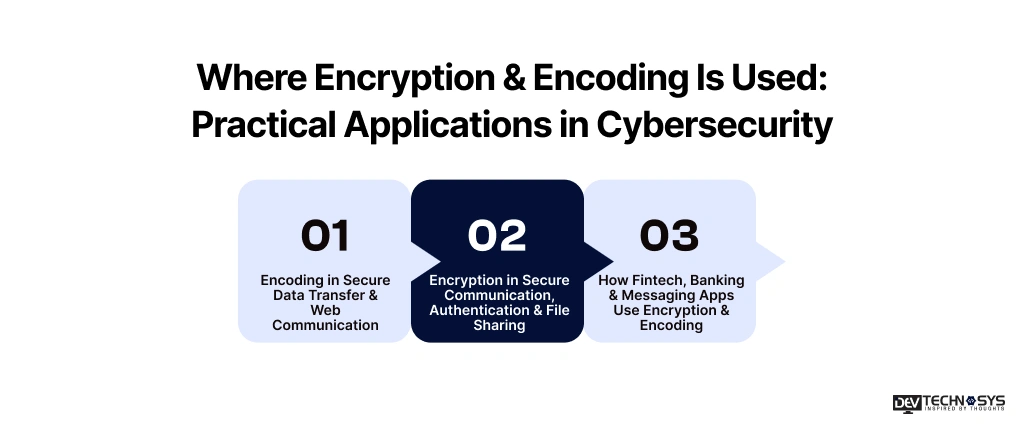
Encoding in Secure Data Transfer & Web Communication
Data encoding is the backbone of everyday web functionality. Here is where encoding methods are actively used:
- Email transmission: Attachments are Base64 encoded so they can be safely transported between mail servers.
- Web URLs: Special characters are URL encoded so that browsers can handle them properly.
- Web pages: Images and icons are incorporated directly into the HTML as Base64, so they load faster.
- Secure data transfer: Encoding transforms data into a suitable format before sending it over the network.
Remember: Encoding makes data transferable, not secure. It is always the first step, never the last line of defense.
Encryption in Secure Communication, Authentication & File Sharing
Encrypted data drives every encounter where privacy is paramount:
- HTTPS websites: SSL encryption keeps every bit of data exchanged between your browser and the server safe.
- Secure authentication: Passwords and credentials are encrypted prior to storage or transmission.
- End-to-end encryption: Ensures only the sender and receiver can view communications on communication platforms.
- Secure file sharing: Sensitive documents are encrypted to prevent unauthorized access during transfer
- Network security: Enterprises encrypt data moving across internal and external networks, stopping breaches.
How Fintech, Banking & Messaging Apps Use Encryption & Encoding
Both processes need to be running in tandem for sensitive user data industries. Encoding makes the data compatible, and encryption locks it down for security. Neither one can substitute for the other in a production situation.
Fintech app development provides systems where every financial transaction must be properly formatted and fully safeguarded. Encoding prepares the data structure while AES and SSL encryption secure the actual transaction values, user passwords, and account details that go through the system. If they don’t work together, the platform is either incompatible or dangerously exposed.
To secure client accounts and payment histories, banking app developers deploy numerous levels of encryption at every touchpoint, from login authentication to fund transfers. Encryption needs to be enforced at every level because one unsecured data point within a banking system might be the gateway to a full-scale breach.
Communication systems have an equally crucial difficulty. Messaging app development teams employ end-to-end encryption to ensure that only the sender and recipient can access the data of a conversation.
Encoding concurrently takes care of media formatting, so that photos, videos, and documents can be effortlessly distributed across different devices and operating systems, without corruption or compatibility difficulties.
Common Mistakes: When People Confuse Encrypted Data with Encoded Data
One of the worst cybersecurity misconceptions is to believe that encoded data is the same as encrypted data. At first glance, they look alike, both gathering data and rendering it unidentifiable, but the security consequences couldn’t be more different.
Here are the most common mistakes developers and businesses make:
Mistake 1: Base64 as a Security Technique –
Many developers Base64 encode sensitive data, believing they are secure. No, it isn’t. Base64 is a public encoding scheme that anyone may decode in seconds without a key or other additional tools.
Mistake 2: Storing Passwords as Encoded Strings –
One of the worst data security failures is to store user passwords as encoded values, rather than properly using encryption methods or hashing. When your database is hacked, the encoded passwords are totally exposed.
Mistake 3: Confusing URL Encoding with Secure Communication –
URL encoding is a way of formatting data so that it can be understood by browsers. It has nothing to do with secure communication or data protection.
Mistake 4: Assuming Encoded Data Transfers Are Safe –
Encoding gets data ready for safe data transport, but without encryption on top of that, the data is readily readable to anyone intercepting the connection.
There is one easy rule to avoid these problems – never employ data encoding when data encryption is needed.
Conclusion
At the end of the day, understanding encryption vs encoding is not just a technical checkbox; it is a business-critical decision. Encoding makes your data usable and compatible across systems. Encryption protects it from bad actors.
Mixing the two or worse, utilizing one in place of the other, might expose your platform to major data security vulnerabilities and user trust difficulties.
With cyber security threats becoming ever more sophisticated, it’s more vital than ever to develop systems with the correct data protection foundations. Whether it’s a finance platform, a messaging app, or an enterprise solution, the proper skills are a game-changer.
Want to design secure and scalable digital products? Hire dedicated developers with extensive cryptography, information security, and modern encryption knowledge to make sure your platform is safe from day one.
Frequently Asked Questions
Find answers to the most common questions related to this article.
The main difference between hashing and encryption is that hashed data cannot be reversed to its original form; it is permanent. In contrast, encrypted data is reversible and can be decrypted to its original form by any authorized individual through the security key.
No, Base64 is an encoding scheme, not an encryption scheme. It only uses a publicly available method to turn binary data into a human-readable text format. It may be decoded by anybody without a key, and is hence utterly ill-suited for the purposes of data security or privacy protection.
Yes, encoded data has no security protection. Encoding utilizes no secret key, so anybody with a simple technical knowledge may reverse it in no time. If you’re dealing with sensitive user data, always use proper encryption methods such as AES or end-to-end encryption, never just encoding.
Not usually, but certainly, absolutely for sensitive data. When sending passwords, financial information, or personal data, encryption is important. Encoding methods may serve for non-sensitive data, like graphics or formatting compatibility.
“In cybersecurity, when in doubt, always default to encryption to maximize data protection”
Both, although for different reasons. Banking and finance apps utilize encryption techniques such as AES and SSL encryption to protect financial transactions and user credentials. Internal encoding for formatting and transfer compatibility is employed. Security-critical operations always depend on good encryption, not only encoding.
HTTP uses SSL/TLS, which is encryption, not encoding. It establishes an encrypted tunnel between your browser and the server. So if anyone intercepts the data, it is absolutely unreadable without the key to decrypt it. That is why HTTPS is a trusted standard for secure communication and a validated Google ranking indication for websites.
No way, encoding passwords with Base64 or similar methods is a major cybersecurity blunder. Encoded passwords can be decoded instantaneously by anyone, without any key needed. Make sure you use strong algorithms for encryption or hashing, such as SHA-256, for password storage and safe authentication to ensure optimal data protection.