




















Mojo or Rust? Choose your programming language wisely.
In today’s period, programming languages are evolving rapidly. Blending technology with languages like Python, incorporating AI and machine learning code, is offering developers more scalable and advanced systems.
Mojo is a new programming language that resembles Python, which is significantly faster, comparable to C++, or even faster in some cases. Rust, on the other hand, is a modern language designed to provide safe, quick, and reliable software.
If you are looking forward to building advanced systems and the future of machine learning in 2025, then you must make the right choice by selecting the correct programming language that can shape your developer journey.
So, let’s dive into this blog to find out the features, benefits, and differences between Mojo and Rust.
What is Mojo?
Mojo programming language is an advanced, next-generation language designed to combine the simplicity of Python with the performance of low-level languages like C and C++.
This language is primarily developed by Modular, which aims to provide users with ultimate solutions for high-performance computing, AI, and machine learning (ML). The key features of Mojo language include Python compatibility, high performance, and AI/ML focus.
What is Rust?
The Rust programming language is a high-performance and modern language, primarily known for its concurrency capabilities, memory safety, and speed.
This language is developed mainly by Mozilla and supported by a vibrant open-source community, as well as the Rust Foundation. The Rust language is primarily designed for system-level programming. However, Rust is widely used in the web development of blockchain infrastructure.
Feature Comparison between Rust and Mojo Language
Rust for developers is a system-level programming language that is mature and focused on zero-cost, memory safety, and concurrent programming. This offers a reliable and secure benefit to its users.
On the other hand, Mojo for developers is a blend of C-level performance and Python’s simplicity. This language mainly targets machine learning and AI workloads.
Are you still confused about which language to learn between Mojo and Rust?
Then, let’s examine the Mojo vs Rust table below to analyze the features of both languages. This comparison will help you identify the best programming language to learn.
Let’s conduct an in-depth analysis to compare Mojo vs Rust for beginners; both languages offer powerful benefits to developers, catering to their diverse learning styles and needs.
Mojo is an efficient programming language that offers a friendly experience to users with a Python background. With this, you can also harness machine learning and AI. While in Rust, developers can benefit from features like high performance and secure applications.
| Feature | Rust | Mojo |
| 1. Primary Use Case | Systems programming, backends, embedded, security apps | AI, machine learning, data science, performance computing |
| 2. Syntax | C-like with modern features | Python-like, clean and beginner-friendly |
| 3. Performance | Near C/C++ speed | Often faster than C++ in ML workloads |
| 4. Learning Curve | Steep (due to ownership & lifetime rules) | Easy for Python developers; low barrier to entry |
| 5. Memory Safety | Built-in via ownership, borrowing, and lifetimes | Planned ownership model (still maturing) |
| 6. Typing System | Strong static typing with generics | Gradual typing: dynamic by default, static for speed |
| 7. Concurrency | Safe and efficient concurrency built-in | Planned support; not yet fully implemented |
| 8. Compilation | Ahead-of-time (AOT) compilation | AOT and JIT compilation using MLIR |
| 9. Ecosystem Maturity | Mature, stable, with broad adoption | Early stage; rapidly evolving and focused on AI |
| 10. Package Management | Cargo (robust, fast, feature-rich) | Limited; tooling still under development |
| 11. Interoperability | Easy with C/C++, good Python support via PyO3 | Full Python interoperability; designed to run with Python code |
| 12. Tooling & IDE Support | Excellent (Rust Analyzer, Cargo, Clippy) | Still basic; improving over time |
| 13. Error Handling | Strong pattern-based system | Similar to Python’s static version planned |
| 14. Community Support | Large, active, with lots of open-source contributions | Small but growing fast, backed by Modular.ai |
| 15. Target Audience | Backend devs, system engineers, security-focused devs | Python developers, AI/ML engineers, performance-focused devs |

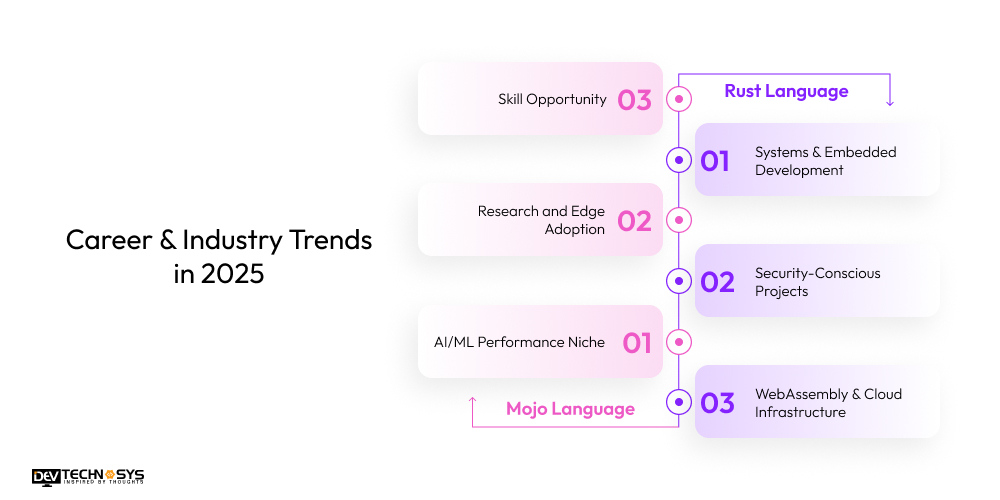
Career & Industry Trends in 2025
The software landscape market is continuously evolving, which means that in 2025, there will be a high demand for programming languages that offer developer efficiency and high performance.
AI development and machine learning aspects, as well as security-focused development features, are future trends in 2025, which require developers to have a deep understanding of Mojo or the Rust language.
Mojo Language
Let’s come and identify the career and industry trends that the Mojo programming language is offering to developers in 2025.
1. AI/ML Performance Niche:
In 2025, Mojo primarily targets high-performance and deep learning computing, leveraging the combination of Python’s usability and near-C performance.
With this language, developers working on model training, deployment pipelines, and optimization can deliver C-level speed. In the future, this Mojo will integrate with AI hardware, allowing developers to create next-generation AI infrastructure.
2. Research and Edge Adoption:
There is a dramatic increase in the use of Mojo in edge computing and research, where developers require more control over computation without compromising their productivity.
In 2025, startups, universities, and AI research labs will be focusing on using Mojo to create high-performance kernels.
3. Skill Opportunity:
In 2025, Learning Mojo will offer Python developers the opportunity to transition into roles that involve AI systems and performance engineering. With efficient experience in C++ and Python, engineers have the chance to work on performance-focused AI projects.
Want a chatbot demo or pricing? Fill the form and talk to our experts today.
Pick what you need below — you can select more than one — then tap Get detail to continue.
-
Chatbot demo dashboard
-
Cost to develop an app
-
Industry report
-
Case study
Rust Language
We will now discuss the career and industry trends that the Rust programming language is expected to shape in the future.
1. Systems & Embedded Development:
The trends in 2025 show that Rust is being widely used to build real-time OS components, firmware, and safety-critical embedded applications. It states that the need for rust is dramatically increasing due to its performance, safety, and memory safety benefits.
2. Security-Conscious Projects:
In many security-conscious projects in industries such as cybersecurity, fintech, and blockchain, Rust is being used. This language is commonly used to eliminate vulnerabilities, which is expected to increase its demand in 2025.
3. WebAssembly & Cloud Infrastructure:
In today’s period, Rust is being widely used in cloud infrastructure development. According to the 2025 future trends, Web Assembly has the potential to power serverless platforms and high-performance microservices, as Rush is a key player in this area. Developers with this language knowledge can experience concurrency and reliability.
Mojo or Rust: Which Language Should You Learn First in 2025?
The programming language that you choose mainly depends on your needs and goals. If you’re aiming to dive into machine learning, AI, and data-intensive computation, then Mojo is beneficial. If your goal is to build system-level programming with scalability and security, then Rust is a game-changer.
To make your decision-making easier, Mojo vs Rust comparison is discussed based on the coding differences. This will help developers gain an in-depth understanding of Rust vs. Mojo performance.
1. Language Basics: Syntax Comparison
i. Hello World
| Mojo: | Rust |
| fn main():
print(“Hello, Mojo!”) |
fn main() {
println!(“Hello, Rust!”); } |
ii. Variables and Types
| Mojo (Python-like, optional typing): | Rust (strong static typing): |
| let x = 10 # inferred
var y: Int32 = 20 # explicit |
let x = 10; // immutable
let mut y: i32 = 20; // mutable |

2. Performance-Critical Code
Looping & Computation
| Mojo | Rust |
| fn sum_array(arr: [Int32]):
var total = 0 for val in arr: total += val return total |
fn sum_array(arr: &[i32]) -> i32 {
let mut total = 0; for &val in arr { total += val; } total } |
3. Memory Safety & Ownership
| Rust: Borrow Checker Demo: | Mojo: No ownership model like Rust (Pythonic model): |
| fn main() {
let s = String::from(“hello”); let s2 = s; // s is moved println!(“{}”, s); // compile-time error! }
|
def use_string(s: String):
print(s)
let s = “hello” use_string(s) # no ownership rules enforced
|
Why Developers Should Use Rust
If you are looking forward to eliminating null pointer dereferences and data races, then let’s find out some fantastic features that make developers select Rust.
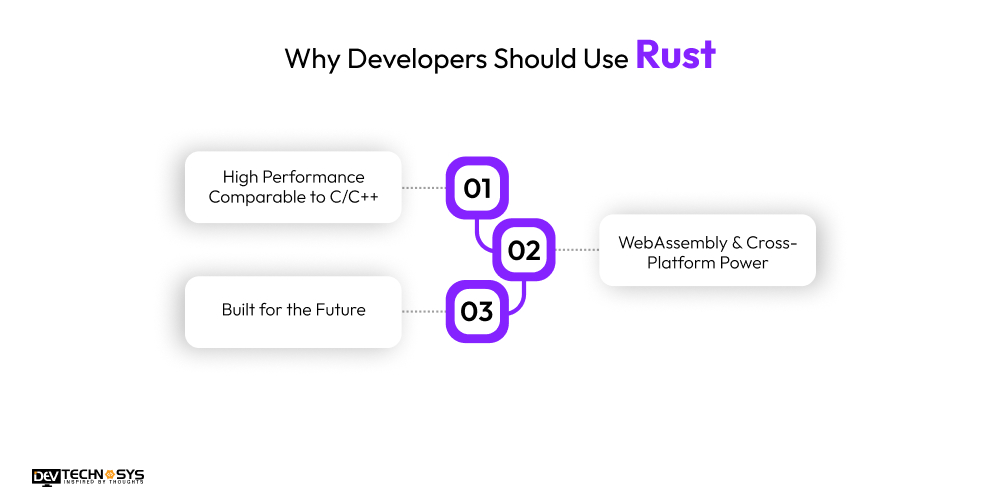
1. High Performance Comparable to C/C++
Rust code primarily compiles to machine code, which helps in offering performance on par with C and C++. With the help of this, developers can experience an efficient development facility for real-time applications and systems programming.
2. WebAssembly & Cross-Platform Power
Rust is primarily a top-tier language for compiling to WebAssembly. This offers developers an opportunity to experience fast and secure development of web apps and cross-platform solutions.
3. Built for the Future
The modern computing environment mainly focuses on scalability, concurrency, and safety. The Rust language supports all these aspects, offering developers the opportunity to achieve secure and high-performance development.
Why Developers Should Use Mojo
Still confused why you should select Mojo? Then let’s come and identify some attractive reasons.

1. Python Compatibility with Supercharged Performance
The Mojo language is designed to be effectively compatible with Python. With the help of this, developers can use syntax and have easy access to efficient speed improvements and low-level control.
2. Built for AI and Machine Learning Workloads
Modular develops Mojo language, which developers can use for AI model training and deployment, TPU-level performance optimization, and low-level kernel development.
3. Modern Language Features
As Mojo supports Python interoperability, it enables developers to seamlessly reuse Python libraries, such as NumPy or PyTorch, for writing performance-critical parts. With the help of this, developers can avoid mixing C++/CUDA extensions with Python code.
Conclusion
In today’s modern era, the programming world is evolving at a rapid pace. This offers developers an opportunity to harness advancements in Mojo and Rust for innovative next-generation developments.
Developers can effectively learn Mojo or Rust by reading the above blog. To build a high-performance and secure system, you must rely on Rust. If, on the other hand, AI, machine learning, and data science are your objectives, then, as discussed in the above blog, Mojo is your programming tool.
FAQ
1. What is the main difference between Mojo and Rust?
The primary difference between Rust vs Mojo is that Mojo enables you to harness data science, AI, and high-performance computing. With Rust, developers can experience high-performance systems.
2. Which is better for AI and machine learning?
For AI and machine learning, Mojio is better as it combines Python and C++, which is efficient for working with ML and AI models.
3. Is Rust better for system-level programming?
Yes, Rust is better for system-level programming as it provides low-level control with efficient memory safety.