




















Key Takeaways:
The cost to maintain a mobile banking app ranges from 15% to 20% annually of the total development cost of the app. Maintenance cost is affected by app complexity, security infrastructure, compliance & regulatory requirements, server infrastructure, third-party integrations, technology stack, and user base.
Types of maintenance:
-
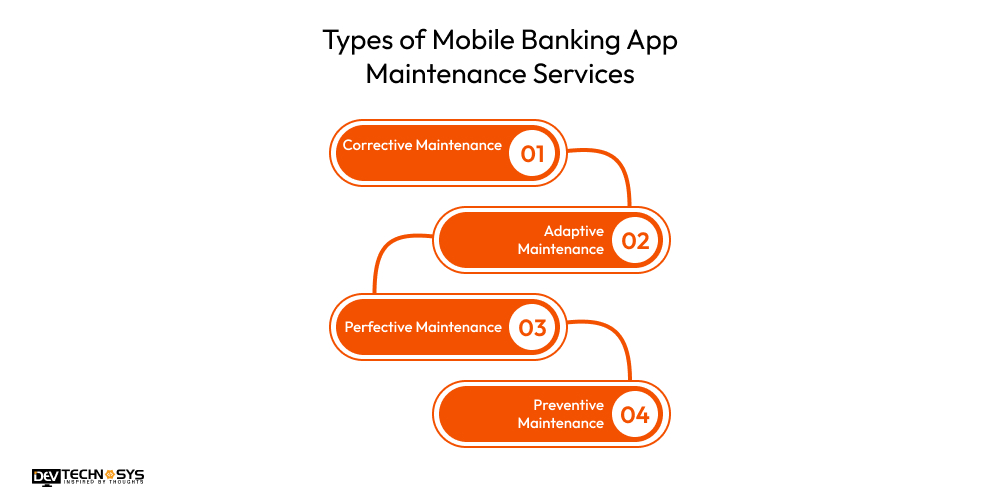
- Corrective Maintenance: In this maintenance, a fix is launched after the issues have occurred.
- Adaptive Maintenance: This maintenance is used to upgrade to keep compatibility with new OS and technologies.
- Perfective Maintenance: Improve app performance and user experience by using this type of maintenance.
- Preventive Maintenance: This maintenance is to foresee problems and prevent them from happening.
Core Components of Banking App Maintenance:
-
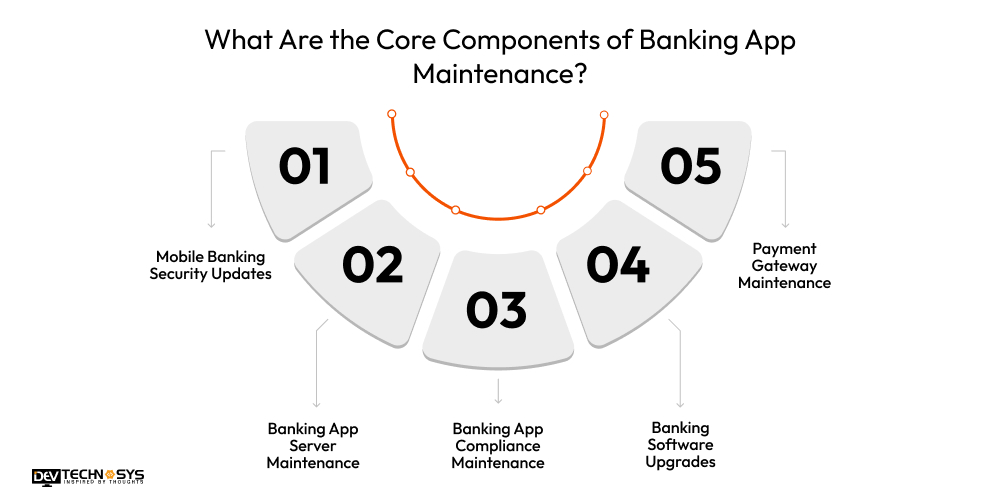
- Security Updates: These updates help in preventing cyber threats by preventing vulnerabilities and adding encryption techniques.
- Server Maintenance: This maintenance helps in preventing problems during high user traffic.
- Compliance Maintenance: This helps in keeping the mobile in compliance with financial laws.
- Software Upgrades: These upgrades help mobile banking apps improve overall functionality.
- Payment Gateway Maintenance: This maintenance is to monitor and update payment gateways to promote safe transactions.
Key Factors to Reduce Maintenance Cost:
-
- Building scalable architecture
- Automating testing and deployment
- Using reliable cloud infrastructure
- Monitoring regularly for performance & security
- Choosing the right maintenance partner
Mobile apps have become an integral part of daily life in this modern world. And with the launch of apps like PayTM, PhonePe, and Google Pay, banking has transformed completely. Making transactions through mobile banking apps is faster, more secure, and accessible at any point in time and place.
Now, financial institutions and fintech startups are investing heavily in building mobile banking apps to grow in this competitive market. However, developing an app is just the start. They focus on the mobile banking app development cost and ignore the mobile banking app maintenance cost, which affects them in the long-term.
This blog gives you detailed information regarding the maintenance cost of mobile banking apps. How you evaluate the cost, factors that affect the cost, how you reduce the cost, and the essential services involved in the maintenance of mobile banking apps. You will also get information on how to choose the right partner for mobile banking app maintenance services. Let’s get started!
Why Mobile Banking Apps Require Maintenance?
Before going on to the mobile banking app maintenance cost, you have to understand why mobile banking apps require maintenance. Is it necessary? Yes, all mobile banking apps require maintenance. Banking apps handle financial transactions and sensitive user data, which requires strict and continuous updating and monitoring.
Banking apps have several cyber threats, which make regular mobile banking security updates critical. In addition to this, banking apps also require continuous banking app compliance maintenance to ensure the app meets legal and industry standards.
Customers expect a feature-rich app without any issues and a prime experience. To ensure the performance, regular banking app bug fixes, performance improvements, and banking app server maintenance are required. Thus, making mobile banking app support and maintenance critical for the long-term success of the app.

What is Mobile Banking App Maintenance?
Mobile banking app maintenance is a rigorous and continuous process of updating, monitoring, and enhancing the application. This is a constant support to the app to guarantee performance, security, compliance, and user experience. There are several mobile banking app maintenance services that can help you maintain mobile banking apps.
Maintenance of a banking app involves resolving technical problems, improving system performance, adding features, and ensuring compliance with financial laws. Businesses also need to monitor servers and apply security patches to help protect user data and users from cyber threats.
How Much Does Mobile Banking App Maintenance Cost?
Usually, mobile banking app maintenance cost lie between 15% and 20% annually of the total development cost. Mobile banking app development costs range from $8,000 to $25,000.
If we calculate the annual maintenance cost on the basis of that, then it comes between $1,200 to $5,000. Maintenance costs depend on many factors, like app complexity, security requirements, infrastructure, etc., which are discussed further in the blog.
App Type |
Development Cost |
Estimated Annual Maintenance (15% – 20%) |
| Basic App | $8,000 – $12,000 | $1,200 – $2,400 |
| Mid-level App | $12,000 – $18,000 | $1,800 – $3,600 |
| Advanced App | $18,000 – $25,000 | $2,700 – $5,000 |
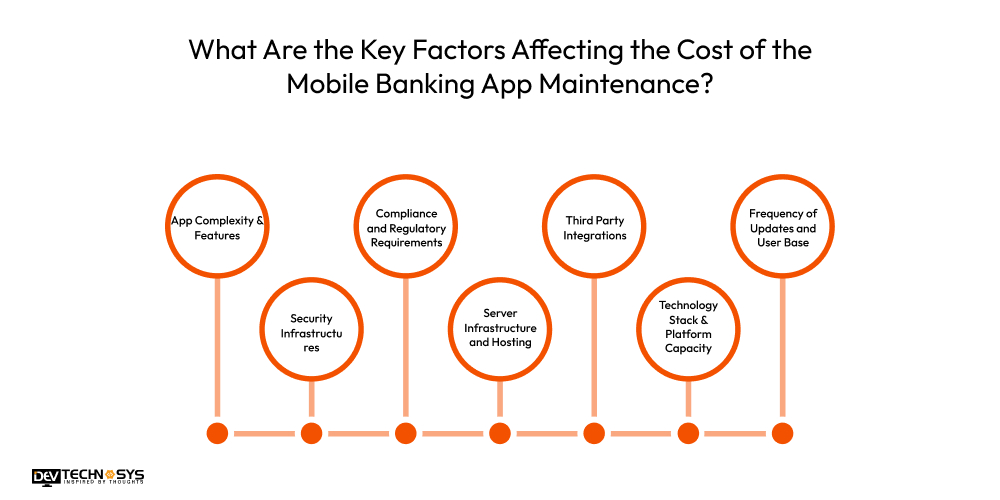
What Are the Key Factors Affecting the Cost of the Mobile Banking App Maintenance?
The cost to maintain a banking mobile app in 2026 depends on several factors. These determine how much budget and resources are required to maintain the mobile app. Understanding these factors and acting upon them helps in planning the budget effectively and achieving success in the long term.
1. App Complexity & Features
The more features and functionalities, the higher the maintenance cost. Banking apps require multiple modules like digital wallets, loan management, investment tracking, etc., which require more resources to maintain and develop.
When you integrate advanced features and functionalities, it increases the efforts for banking software support services. Features like these should be upgraded from time to time for user engagement and experience.
App Type |
Maintenance Cost Affected by Complexity |
| Basic App | $360 – $720 |
| Mid-Level App | $540 – $1,080 |
| Advanced App | $810 – $1,500 |
2. Security Infrastructures
In the banking business, security comes first. Banking apps are associated with sensitive information that requires stringent security policies. Some of the cyber threats are data breaches, phishing attacks, and malware.
In order to overcome these threats, sophisticated options, like increased encryption, multiple-factor authentication, and biometric identification, are needed.
App Type |
Maintenance Cost Affected by Security |
| Basic App | $180 – $360 |
| Mid-Level App | $270 – $540 |
| Advanced App | $405 – $750 |
3. Compliance and Regulatory Requirements
Financial laws of the government concerning banking are extremely strict, and the mobile banking apps should remain in accordance with these laws. These laws usually encompass data privacy laws, anti-money laundering rules, etc.
The next thing that follows after launching maintenance is to prevent penalties and to remain within banking laws. Otherwise, this may result in fines and even the prohibition of such apps.
App Type |
Maintenance Cost Affected by Compliance |
| Basic App | $120 – $240 |
| Mid-Level App | $180 – $360 |
| Advanced App | $270 – $500 |
4. Server Infrastructure and Hosting
High user traffic with simultaneous transactions requires robust backend systems. Regular banking app server maintenance and cloud monitoring are essential to prevent issues such as system crashes, slow processing, and downtime. Build a mobile banking app like Chime requires more budget due to a large user base. It requires scalable and reliable server solutions.
App Type |
Maintenance Cost Affected by Server/Hosting |
| Basic App | $180 – $360 |
| Mid-Level App | $270 – $540 |
| Advanced App | $405 – $750 |
5. Third Party Integrations
Banking apps need many third-party services, including payment gateways, credit bureaus, identity verification systems, and financial APIs. The importance of the banking app maintenance services of such integrations is significant since they are one of the fundamental features of the app, and they may directly influence the user experience. Banking API third-party integrations can be smoothly maintained through regular banking API maintenance.
App Type |
Maintenance Cost Affected by Integrations |
| Basic App | $120 – $240 |
| Mid-Level App | $180 – $360 |
| Advanced App | $270 – $500 |
6. Technology Stack & Platform Capacity
The cost of maintenance is affected by the long-run effects of the selection of the technological stack. Due to the ever-changing nature of mobile OS and devices, applications should remain compatible with the new versions of mobile. The selection of a scalable technology base is one of the primary factors that affect the cost of maintaining the banking apps in the future.
App Type |
Maintenance Cost Affected by Tech Stack |
| Basic App | $120 – $240 |
| Mid-Level App | $180 – $360 |
| Advanced App | $270 – $500 |
7. Frequency of Updates and User Base
The frequency of release of updates also influences maintenance costs. The maintenance cost of a mobile banking application would be higher in case of those in need of frequent feature updates, security patches, and bugs.
The maintenance cost involving software used in the banking sector is even augmented by the need to conduct more comprehensive testing and server capacity in applications that provide services to a large and active clientele.
App Type |
Maintenance Cost Affected by Updates/User Base |
| Basic App | $120 – $240 |
| Mid-Level App | $180 – $360 |
| Advanced App | $270 – $500 |
Want a chatbot demo or pricing? Fill the form and talk to our experts today.
Pick what you need below — you can select more than one — then tap Get detail to continue.
-
Chatbot demo dashboard
-
Cost to develop an app
-
Industry report
-
Case study
Types of Mobile Banking App Maintenance Services
To keep a mobile banking app safe, secure, efficient, and user-friendly, it needs to be maintained in an organized manner. The four primary types of mobile banking app maintenance services are corrective, adaptive, perfective, and preventative. Each category adds to the total cost of maintaining banking software and deals with particular facets of the app’s functionality.
1. Corrective Maintenance
Corrective maintenance is to find and resolve issues that cause problems in the functionality of an application. This maintenance ensures that any problems that arise, like account balances failing to update properly or payment transfers not working, are rectified early enough.
Challenges of bug fixes, often planned on a regular basis in financial applications, decrease downtime, enhance reliability, and maintain user confidence.
Example:
One of the mobile banking apps was crashing when users were trying to log in following the latest iOS update. There was corrective maintenance work, including troubleshooting of the problem and code patching. The fix was then published to address the problem.
2. Adaptive Maintenance
Adaptive maintenance involves the upkeep of the application to keep it compatible with new operating systems, technologies, and external services. Mobile banking applications, such as payment gateways and identity verification APIs, are usually applied to improve the performance of the apps. These integrations need to remain functional and make the performance of the apps smooth for users.
Example:
The bank switched its payment gateway in its mobile application. With adaptive maintenance, the bank will have an opportunity to make sure that the app is functioning properly with the gateway API, is able to work with new types of transactions, and all security checks are successfully passed.
3. Perfective Maintenance
Perfective maintenance is aimed at improving the overall functionality of the app and its general usability. This involves a UI/UX enhancement, optimization, and extension of new functionalities to suit the changing user needs. Preventive maintenance upgrades customer interaction and satisfaction, resulting in the success of the app.
Example:
A mobile banking app is updated and includes a budgeting option. Perfective maintenance will ensure that the feature shows the right metrics, functions well with additional existing modules, and will not disrupt the functionality of the app.
4. Preventive Maintenance
The aim of preventive maintenance is to prevent issues and eliminate them before they cause an effect on the functionality of the app. This includes optimization of databases, rework of the code, monitoring of the server, and testing of the security vulnerabilities. It will reduce the chances of system outage, data attack, or deterioration, and therefore, preventive maintenance is extremely important.
Example:
In order to ensure the mobile app is capable of handling high traffic during peak, the IT department routinely tests servers to find out how many simultaneous requests they can handle. Also, they optimize and analyze queries to improve processing performance and check the codebase against potential vulnerabilities.
What Are the Core Components of Banking App Maintenance?
In order to maintain a mobile banking app as safe, reliable, and compliant, several operating and technological processes must be adhered to. These are the pillars of maintaining a mobile banking platform, and they play a great role in determining the mobile app maintenance cost in totality.
Each component, including server monitoring and payment integrations as well as security updates, assists the financial ecosystem in operating efficiently.
1. Mobile Banking Security Updates
Security is one of the most important aspects of banking apps. These apps store sensitive customer data, including account information, transaction history, and authentication credentials.
Regular mobile banking security updates help in protecting this data by fixing vulnerabilities, enhancing encryption techniques, and fortifying authentication procedures.
2. Banking App Server Maintenance
High volumes of transactions and the integrity of data are processed through the server infrastructure. Routine maintenance of the banking app server ensures that the mobile app is running efficiently even when there is a lot of user traffic. This involves performance monitoring of the systems, cloud resource management, database optimization, and elimination of downtime.
2. Banking App Compliance Maintenance
Financial applications are subject to stringent legal frameworks, including digital security, financial transactions, and data privacy. Continuous banking app compliance maintenance is required so that the app complies with legal requirements and adjusts to new regulations implemented by financial authorities. Compliance maintenance includes modifications to identity verification systems, transaction monitoring procedures, and data protection rules.
3. Banking Software Upgrades
To maintain compatibility with evolving devices and operating systems, regular banking softwares is required. To improve the overall functionality of the mobile banking app, upgrades related to system optimizations, feature enhancements, and performance improvements are needed. Regular updates help ensure that the app continues to meet modern user expectations and technical standards.
4. Payment Gateway Maintenance
For secure transaction processing, mobile banking apps depend on external payment gateways. The efficient operation of these interfaces and their continued compatibility with the banking platform are guaranteed by payment gateway maintenance. Frequent updates and monitoring promote safe payment processing, error prevention, and transaction dependability.

How to Reduce Mobile Banking App Maintenance Cost?
Banks and fintech companies need to manage mobile banking app maintenance cost. This helps them to keep their applications high-performing without overspending on ongoing operations.
Maintenance is unavoidable, but businesses can adopt strategic approaches to optimize resources and reduce the ongoing maintenance cost of banking apps without compromising security or performance.
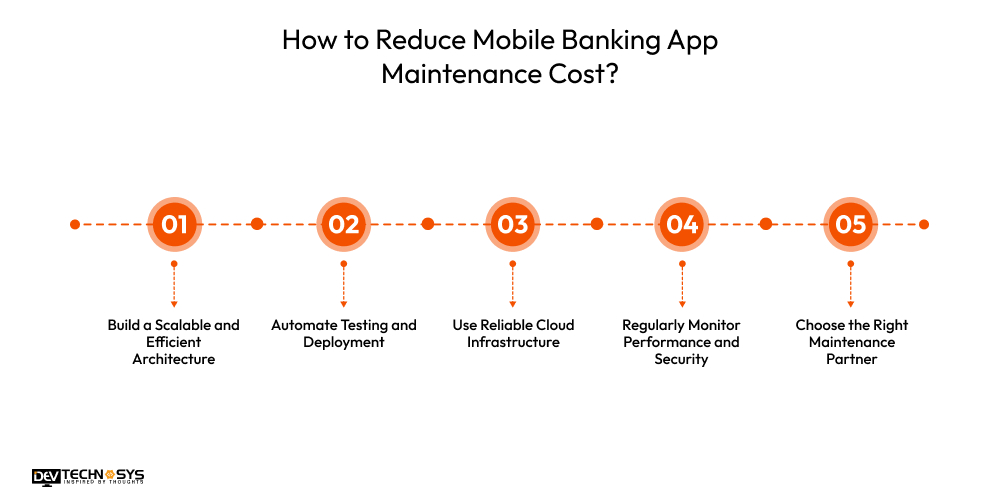
1. Build a Scalable and Efficient Architecture
Building the mobile banking app with a scalable and efficient architecture is probably one of the most useful methods of reducing the long-term costs of maintenance.
A properly designed backend permits developers to change or modify certain components without influencing the whole app. Mobile banking platform maintenance becomes easy as less time is needed to make changes and enhancements.
2. Automate Testing and Deployment
Automation significantly reduces operational costs. The bugs, vulnerabilities, and performance issues are highlighted with the help of automated testing tools during the initial stages of the development cycle.
Overall, continuous integration and deployment pipelines also allow faster updates and smoother releases. Automation of these processes helps banking organizations to minimize the banking software maintenance cost.
3. Use Reliable Cloud Infrastructure
Cloud-based infrastructure is flexible, scalable, and cost-efficient in terms of mobile banking apps. The use of cloud platforms can help banks to optimally use resources and scale services according to the demand of the users.
An efficient cloud management also minimizes the necessity of the massive banking app server maintenance, which facilitates the control of infrastructure costs.
4. Regularly Monitor Performance and Security
Active audits of the performance and security of the system assist in detecting a possible problem before it becomes a big problem. The app is secure and efficient because regular audits, vulnerability assessments, and mobile banking security features are in place. Early solution to problems saves the high costs of emergency repairs and lowers the cost to maintain a mobile banking app.
5. Choose the Right Maintenance Partner
Having a skilled development team or service provider will help to save a lot of maintenance costs. Professional banking software support offerings provide systematic maintenance programs, proactive supervision, and effective problem-solving. By hiring a mobile banking app development company, businesses are able to smooth out the mobile banking app development and maintenance.
How to Choose The Right Banking App Maintenance Services Provider?
Selecting a good and right partner to develop or maintain a mobile banking app is very critical to ensure long-term stability, security, and performance.
A reliable team with experience is required to manage sensitive data incorporated with the banking apps. By getting reliable mobile app maintenance services, you can ensure the long-term success of the mobile banking app.
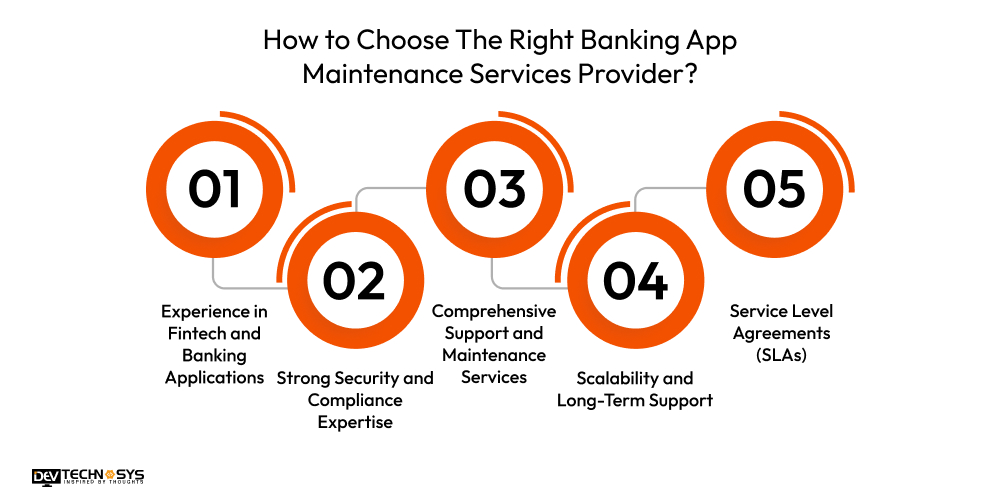
1. Experience in Fintech and Banking Applications
The most important aspect to check before choosing a partner is their experience in the fintech and banking industry. To maintain a mobile banking app, specialized knowledge of banking systems and security protocols is essential.
A company with expertise in fintech can handle complex tasks such as mobile banking platform maintenance, API integrations, and performance optimization more efficiently.
2. Strong Security and Compliance Expertise
Security is a paramount need of any banking app. The maintenance company must be skilled in the provisions of enhanced security, vulnerability testing, and routine updates of mobile banking security.
Moreover, they must be aware of financial regulations and regularly assist in banking app compliance maintenance to ensure they do not violate industry standards.
3. Comprehensive Support and Maintenance Services
An efficient partner must provide a broad scope of services, such as banking software upgrades, performance control, bug fixes, infrastructure control, and banking API maintenance.
The presence of a reserved support team also means that technical problems can be addressed in a short time, and the program keeps running without interruption.
4. Scalability and Long-Term Support
The system should be scalable as the number of users of a mobile banking app increases in the future. The maintenance company must be capable of handling the rising number of transactions, streamlining system performance, and expanding infrastructure.
Good mobile banking system maintenance will guarantee that the application will be able to keep pace with the growth of the business without a decline in performance.
5. Service Level Agreements (SLAs)
When outsourcing maintenance, clear service level agreements are important. SLAs specify the response time, support, and maintenance. These contracts are useful to make sure that the problems of system downtime, security breaches, or performance issues are resolved quickly and in a professional manner.
Conlusion
Launching a mobile banking app is just a start. To achieve long-term success, it is essential that the app remains secure, compliant, and high-performing with the help of constant maintenance. As banking apps work with very sensitive data from user information to transaction data and banking details, a small mishap can cost dearly and affect business reputation.
Evaluating the mobile banking app maintenance cost requires considering several factors, such as app complexity, security infrastructure, regulatory compliance, server management, third-party integrations, and the size of the user base.
Typically, businesses should allocate around 15-20% of the total development cost annually for maintenance to keep the platform reliable and competitive. Hire a fintech app development company to manage your banking app structurally at low costs.
Frequently Asked Questions
Find answers to the most common questions related to this article.
The average cost to maintain a mobile banking app usually lies between 15% to 20% annually of the total development cost. The cost of the maintenance depends upon several factors such as the app complexity, infrastructure, and security requirements.
Regular maintenance of the mobile banking app not only ensures that the app runs smoothly without any issues but also helps in keeping the app secure and compliant with laws. Regular updates help in fixing bugs, updating security patches, improving performance, and ensuring compatibility with new operating systems and devices.
Timeline of updates depends on the type of update. Security updates should be done monthly, and feature updates should be done every 2 to 3 months. But updates also depend on the user feedback, security needs, and regulatory changes. If any issues arise, a fix update should be imminent.
Maintenance costs for a mobile banking app can be reduced by several methods, such as building a scalable architecture, automating testing & deployment, and having a cloud-based structure. If monitored regularly, you can solve issues beforehand, so that they do not create a bigger problem.
By outsourcing maintenance to a mobile app development company, you get experienced developers, faster issue resolution, security expertise, and structured maintenance processes. This will help you in reducing operational costs and maintaining stability throughout the process.