




















As vehicles evolve into smart, connected machines, automotive embedded software has become the backbone of innovation, powering everything from infotainment systems to advanced safety features.
But with greater complexity comes a crucial question: how much does it cost to develop this software?
Understanding the development cost is essential for automakers, suppliers, and tech firms aiming to balance cutting-edge performance with budget efficiency.
Automotive embedded software development cost can vary widely, influenced by factors like software complexity, safety standards, hardware integration, and development timelines.
In this blog, we’ll explore the key cost drivers, hidden challenges, and smart strategies to manage your investment in automotive embedded software.
Whether you’re a startup or an OEM, knowing the cost landscape is vital to driving innovation forward.
Market Analysis of Automotive Embedded Software
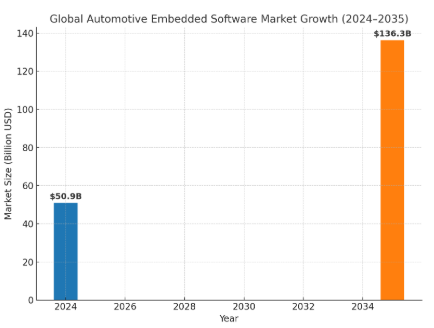
- The global automotive embedded software market is valued at around $50.9 billion in 2024, and it is expected to reach around $136.3 billion by the end of 2035.
- According to a study, the automotive embedded software is projected to grow with a compound annual growth rate of 38% from 2025 to 2035.
- North America holds the highest market revenue share of around 3% in 2024.
- Functionality-wise, the real-time embedded system held the largest share of the automotive embedded software market in 2024.
- Looking at the operating system-wise, the real-time operating system is one of the most revenue-generating segments with a 0% share in 2024.
What is Automotive Embedded Software?
Automotive embedded software is specialized code built into a vehicle’s electronic control units (ECUs) to manage functions like engine control, braking, infotainment, and advanced driver-assistance systems (ADAS).
It operates in real time, ensuring safe, efficient, and responsive vehicle performance. This software is essential for modern vehicles, enabling automation, connectivity, and compliance with industry safety and performance standards.
Why Entrepreneurs Want to Invest in Automotive Embedded Software Development?
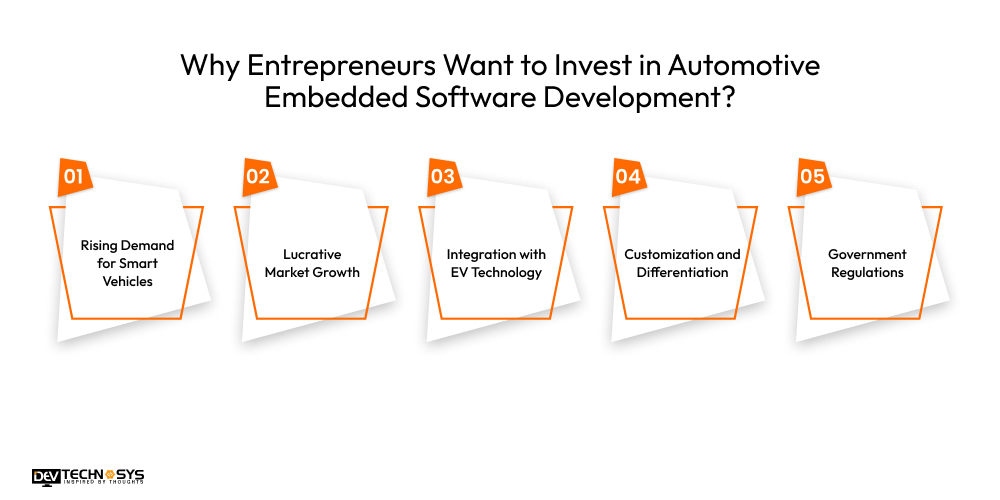
Entrepreneurs are increasingly investing in automotive embedded software development services due to rising demand for smart vehicles, booming EV adoption, regulatory compliance needs, and market growth potential. And the opportunity to offer customized solutions that differentiate brands in a rapidly evolving, software-driven automotive industry.
1. Rising Demand for Smart Vehicles
Modern consumers expect features like advanced driver-assistance systems (ADAS), autonomous capabilities, and infotainment. Automotive embedded software powers these innovations. Entrepreneurs are eager to invest in this space to meet evolving consumer expectations and to gain a competitive edge in the increasingly tech-driven automotive industry.
2. Lucrative Market Growth
The automotive embedded software market is witnessing rapid global growth, fueled by digital transformation in vehicles. This surge presents high return-on-investment opportunities for entrepreneurs who enter early. With increasing reliance on software-defined vehicles, investors see a chance to secure strong market positions and long-term profitability.
3. Integration with EV Technology
Electric vehicles (EVs) depend heavily on embedded software for core functions like battery management, powertrain control, and regenerative braking.
Entrepreneurs investing in this space can become vital contributors to the EV revolution, aligning with sustainability goals while tapping into a booming segment of the auto industry.
4. Customization and Differentiation
Automakers seek to differentiate through personalized user experiences, performance tuning, and unique digital interfaces, all powered by embedded systems.
Entrepreneurs can offer customized software solutions, creating niche products that appeal to OEMs and end-users. This differentiation drives higher margins and establishes a strong brand presence in the market.
5. Government Regulations
Stricter global regulations on safety, emissions, and cybersecurity require advanced software integration in vehicles. Entrepreneurs see this as an opportunity to develop solutions that help automakers comply with legal standards. Investing in compliant, innovative embedded software opens doors to long-term contracts and recurring business from regulatory-driven demand.
What is the Cost to Develop Automotive Embedded Software?
The automotive embedded software development cost ranges from $8,000 to $25,000 or higher. There are many key factors that can affect the actual project budget, such as features, functions, complexity, tech stacks, third-party integrations, size, and design.
The cost to build automotive embedded software can also depend on additional factors like development team, backend infrastructure, deployment platforms, and maintenance. Here we provide the table for a detailed explanation of the automotive software development cost:
| Cost Component | Estimated Cost Range (USD) | Description |
| Requirements & Planning | $1,000 – $3,000 | Gathering system specs, safety requirements, and hardware integration needs. |
| Software Architecture | $2,000 – $6,000 | Designing system structure, real-time OS decisions, and communication layers. |
| Module Development | $5,000 – $13,000 | Writing code for ECU functions, sensors, actuators, diagnostics, etc. |
| Testing & Validation | $2,000 – $5,000 | Unit testing, hardware-in-the-loop (HIL), compliance checks (e.g., ISO 26262). |
| Integration & Debugging | $1,000 – $3,000 | Integrating software with hardware, resolving timing or communication issues. |
| Documentation & Support | $500 – $2,000 | Technical documentation, maintenance guides, and initial support. |
Overall Development Cost: $8,000 – $25,000+
10 Key Factors That Can Affect the Automotive Embedded Software Development Cost
1. System Complexity
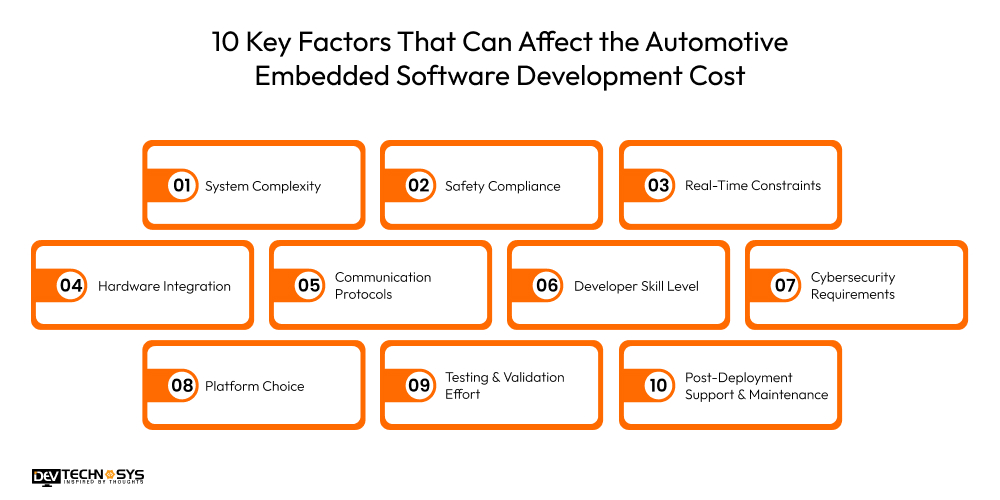
More complex systems, like ADAS, powertrain control, or infotainment, require advanced algorithms, more code, and specialized expertise. This increases development time and testing effort, raising overall software and mobile app development costs significantly compared to simpler control systems.
| Complexity Level | Description | Estimated Cost (USD) |
| Low | Simple ECU logic (e.g., window controls) | $800 – $1,500 |
| Medium | Multi-functional ECU (e.g., HVAC controller) | $2,000 – $3,500 |
| High | Advanced systems (e.g., ADAS, EV battery) | $4,000 – $6,000 |
2. Safety Compliance
Meeting functional safety standards is mandatory for critical systems like braking or steering. It requires rigorous validation, redundancy, documentation, and certification, substantially increasing development costs due to added engineering and testing demands.
| Compliance Level | Description | Estimated Cost (USD) |
| Low | Non-critical systems (e.g., infotainment) | $500 – $1,000 |
| Medium | Moderate risk systems (e.g., TPMS, cruise control) | $1,500 – $2,500 |
| High | Safety-critical systems (e.g., brakes, steering) | $3,500 – $5,000 |
3. Real-Time Constraints
Automotive systems often require deterministic, real-time responses. Developing with RTOS or time-triggered architectures increases design and debugging complexity, requiring skilled developers and sophisticated tools, which adds to the automotive embedded systems development cost.
| Real-Time Level | Description | Estimated Cost (USD) |
| Low | Loose timing (e.g., basic display update) | $500 – $1,000 |
| Medium | Moderate RT (e.g., motor control) | $1,500 – $2,500 |
| High | Hard RT (e.g., braking, engine control) | $3,000 – $4,500 |
4. Hardware Integration
Custom integration with ECUs, sensors, and actuators involves writing specific drivers and performing hardware-software compatibility testing. Each new hardware component or variant introduces additional cost due to tailored development and validation efforts.
| Integration Level | Description | Estimated Cost (USD) |
| Low | Single hardware module, standard ECU | $800 – $1,200 |
| Medium | Multiple ECUs or sensors | $2,000 – $3,000 |
| High | Custom hardware with tight integration | $4,000 – $5,500 |
5. Communication Protocols
Implementing automotive communication standards adds complexity. Ensuring protocol compliance, fault tolerance, and timing synchronization often requires specialized software stacks and tools, which add to the cost of automotive embedded software.
| Protocol Complexity | Description | Estimated Cost (USD) |
| Low | Basic CAN or LIN setup | $500 – $1,000 |
| Medium | Mixed CAN + diagnostics (UDS, OBD-II) | $1,500 – $2,500 |
| High | Complex protocol stack (CAN + FlexRay, etc.) | $3,000 – $4,500 |

6. Developer Skill Level
If businesses hire dedicated developers and domain experts who command higher salaries, they also deliver efficient, reliable code. Teams with less experience may take longer and introduce bugs, increasing long-term costs due to rework and support.
| Skill Level | Description | Estimated Cost (USD) |
| Junior Team | Less experienced developers | $1,000 – $2,000 |
| Mixed Team | A blend of junior and mid-level | $2,500 – $3,500 |
| Senior Experts | High-level specialists, domain experts | $4,000 – $5,500 |
7. Cybersecurity Requirements
Modern vehicles must guard against cyber threats. Implementing secure boot, encrypted communication, and intrusion detection requires additional development, testing, and compliance checks, resulting in significantly higher vehicle embedded software development prices.
| Security Level | Description | Estimated Cost (USD) |
| Low | Basic password or access control | $500 – $1,000 |
| Medium | Encrypted comms, secure boot | $1,500 – $2,500 |
| High | Full secure stack + threat modeling | $3,000 – $5,000 |
8. Platform Choice
Using AUTOSAR brings long-term benefits like modularity and reusability, but initial setup, configuration, and compliance are costly. Custom platforms may be faster initially, but require more effort later in scaling or integrating with OEM systems.
| Platform Type | Description | Estimated Cost (USD) |
| Custom Light | Proprietary lightweight platform | $800 – $1,500 |
| Basic AUTOSAR | AUTOSAR Classic Platform (limited modules) | $2,000 – $3,500 |
| Full AUTOSAR | Complete AUTOSAR integration | $4,000 – $6,000 |
9. Testing & Validation Effort
Thorough testing using methods like HIL, SIL, and automated regression is essential for reliability. The more critical the system, the greater the cost of tools, test benches, and labor required for comprehensive validation.
| Testing Level | Description | Estimated Cost (USD) |
| Low | Unit & integration tests | $800 – $1,500 |
| Medium | Manual + automated regression tests | $2,000 – $3,000 |
| High | HIL, SIL, fault injection, compliance testing | $4,000 – $6,000 |
10. Post-Deployment Support & Maintenance
After deployment, software may need updates, patches, or compliance adaptations. Planning for long-term automotive app maintenance services, remote diagnostics, or OTA (Over-the-Air) updates increases the total cost to develop automotive embedded software.
| Support Level | Description | Estimated Cost (USD) |
| Basic | Initial bug fixes, documentation | $500 – $1,000 |
| Medium | Updates, diagnostics, minor feature changes | $1,500 – $2,500 |
| Extensive | OTA updates, long-term support, remote services | $3,000 – $4,500 |
How to Reduce the Automotive Embedded Software Development Cost?
To reduce the automotive embedded software development cost, there are various ways that enable businesses to build projects within a fixed budget. Here is the list:
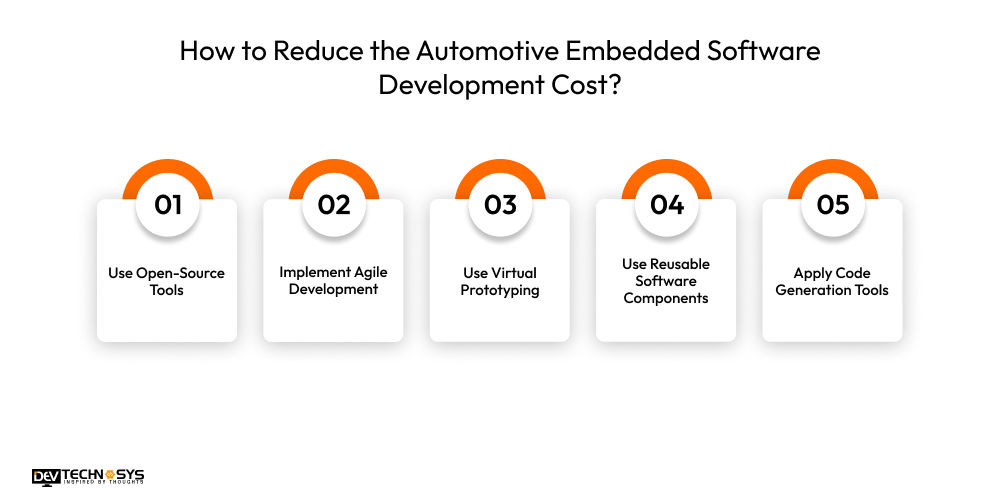
1. Use Open-Source Tools
Open-source software and tools can significantly cut licensing costs. When used strategically, these tools offer flexibility and customization while maintaining quality. However, proper evaluation and security checks are necessary to ensure compliance with automotive safety and cybersecurity standards.
2. Implement Agile Development
Implementing agile development is one of the common approaches to reducing the overall cost to build automotive garage software. It includes faster development, reliable feedback, and strong team collaboration. It offers continuous integrations, and developers can solve the early issues before publishing to the live phase.
3. Use Virtual Prototyping
Virtual prototyping enables early design validation without the need for physical hardware. Engineers can test software against simulated hardware environments, accelerating development cycles and minimizing hardware dependency. This reduces both prototyping costs and risks associated with late-stage integration failures.
4. Use Reusable Software Components
Reusing validated software modules (like AUTOSAR components) lowers automotive ECU software development cost. Standardized, reusable code reduces redundancy, improves reliability, and minimizes validation efforts. It also ensures consistency across platforms and shortens time-to-market, which is critical in the fast-moving automotive industry.
5. Apply Code Generation Tools
Automatic code generation tools translate models or high-level descriptions into executable code. This reduces manual coding errors and speeds up development. While initial setup requires effort, it ultimately lowers long-term costs by improving efficiency and ensuring consistency across software modules.
How to Make Money From Automotive Embedded Software?
Let’s explore the best money-generating techniques from automotive embedded software:
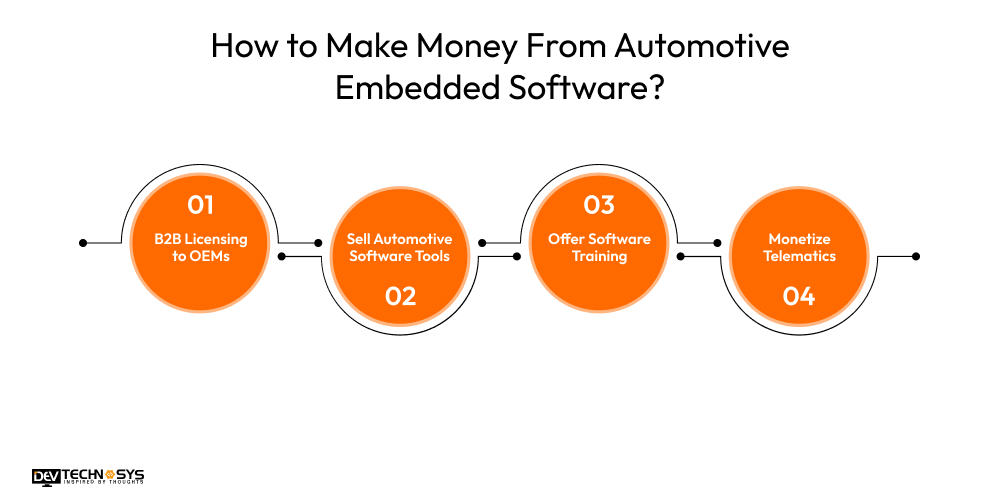
1. B2B Licensing to OEMs
Businesses can develop embedded modules, such as cybersecurity and diagnostics, and license them to automotive OEMs and suppliers. Sell them as a per-unit pricing and royalty-based models.
Mainly focused on the high-demand automotive systems that are trending, such as ADAS and EV control. Maintain the long-term contract by offering regular updates and more.
2. Sell Automotive Software Tools
It is one of the simplest and common monetization techniques for every type of software and application. Build and sell the automotive software tools like CAN analyzers, OBD-II smartphone diagnostics, and ECU flashing apps. This technique is like a freemium model, and users need to purchase the hardware and software tools within the software.
3. Offer Software Training
Businesses can package their expertise in automotive embedded software solutions and provide training as a course on online training platforms. They can also build their own platform and offer downloadable materials and sell certifications. Focus on various types of automotive software such as AUTOSAR, ISO 26262, embedded C, and RTOS usage.
4. Monetize Telematics
Create telematics software that collects and analyzes vehicle data (e.g., speed, GPS, diagnostics). Sell services to fleet operators, insurers, or logistics companies.
Provide dashboards, predictive maintenance alerts, or driver behavior reports. Use subscriptions or per-vehicle pricing. Combine mobile apps with backend analytics for recurring revenue and data-driven value.
Conclusion
In conclusion, automotive embedded software development costs vary widely depending on system complexity, safety requirements, hardware integration, and compliance with industry standards like ISO 26262 or AUTOSAR.
Factors such as development time, skilled labor, testing, and certification can significantly influence budgets. Partnering with an experienced automotive software development company helps manage these costs effectively by offering optimized solutions, reusable components, and faster time-to-market.
Frequently Asked Questions
1. How Much Does it Cost to Build Automotive Embedded Software?
The cost to develop automotive embedded system is around $8,000 to $25,000 or more. It can fluctuate due to several factors, such as project requirements, features, functions, backend infrastructure, development team, and deployment team.
2. How Long Does it Take to Create Automotive Embedded Software?
To create automotive embedded software, it normally takes around 5 to 15 weeks. The software development timeline is based on various factors such as complexity, a higher number of features, and others.
3. How Much Does it Cost to Hire Automotive Embedded Software Developers?
The cost to hire automotive embedded software developers ranges from $15 to $25 per hour. There are various key aspects that can influence the hiring cost, such as experience level, skill set, the developer’s living location, and more.
4. What Are the Factors That Can Affect the Automotive Embedded Software Development Cost?
There are various key factors that can highly impact the overall automotive embedded software development cost. Here is the list of cost-affecting factors:
- Development Team
- Platform Choice
- Project Complexity
- Tech Stacks
- Third-Party Integrations
- Maintenance and Support Services
5. How to Reduce the Automotive Embedded Software Development Cost?
Let’s explore the robust cost-reducing approaches:
- Outsource Development
- Use Open-Source Tools
- Use Virtual Prototyping
- Apply Code Generation
- Develop an MVP
- Define Clear Requirements