


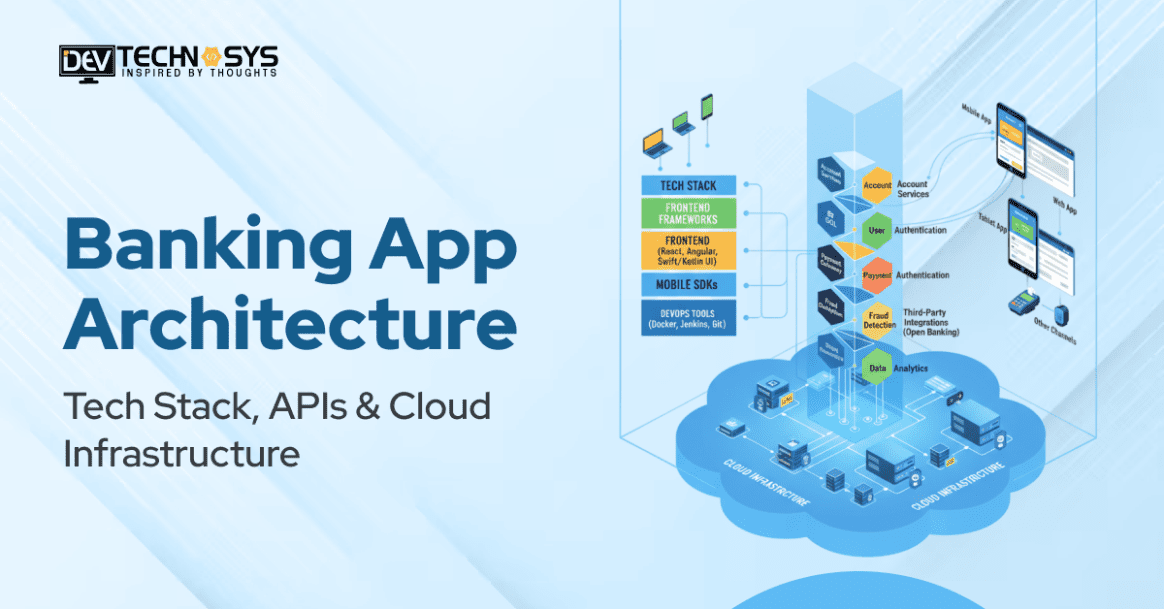
Key takeaways:
-
- Financial institutions and fintech companies are becoming modern and digitalized with the mobile-first generation.
- The architecture of a banking app is really essential for its scalability, efficiency, speed, and seamless working.
- The banking app architecture includes a combination of robust technologies, APIs, and cloud infrastructure.
- According to Statista, the global market of digital banking is expected to reach USD 2.20 trillion by 2030.
- As per the studies by McKinsey, agentic AI could lower banking operational costs by 20% or more.
Banking app architecture is something beyond just a technical blueprint for app development. It is a segment that can impact security, users’ trust, and the revenue stream of financial institutions. When the architecture is poorly designed, it can lead to system downtime and compliance failures.
That’s why developing a scalable, secure, and future-ready banking app requires the right architectural decisions. For CTOs, enterprise architects, and banking leaders, digital banking platform architecture is really essential for long-term success.
Whether making immediate transactions or receiving the money, each banking function works on a well-structured system. In this blog, we have explained the core banking system architecture and other important details.
With this guide, businesses can design a strong, compliant, and high-performing digital banking solution.
5 Core Components of Bank Architecture: From Frontend to Security Layer
The essential elements of a banking application architecture are frontend, backend, database, security, and API. Here, we will understand their key roles and how they help in improving and building banking apps’ architecture.

1. Frontend Layer (User Interface)
The frontend is the face of the banking application where users interact and get directly engaged. A mobile app development company focuses on building a seamless, responsive, perfectly designed, and intuitive frontend. When the frontend is strongly built, it helps users check balances, transfer money, and manage accounts effortlessly across devices.
2. Backend Layer (Business Logic)
The backend empowers the banking apps in transaction processing, workflow management, and implementing business rules. The main purpose of backend development in a digital banking architecture is to ensure operational accuracy. It even handles requests from users and connects different services to deliver fast and reliable banking functions.
3. Database Layer (Data Handling)
Database layering is essential to securely store and manage important customer data. It handles users’ personal and financial details, transactions, and account records.
The database also ensures fast retrieval of data while maintaining consistent trust among users. It enables a better and more reliable banking experience for users by offering real-time updates.
4. API & Integration Layer
API development is necessary to streamline and smooth banking communication between the app and external services. It includes services like payment gateways, KYC systems, UPI transactions, SMS/OTP services, and more. It is beneficial for quick feature integration that improves the functionalities of the banking app and supports real-time data exchange.
5. Security Layer
The next most essential component of banking application architecture is security. It is mandatory to protect sensitive financial data using encryption, authentication, and fraud detection systems.
In digital banking architecture, security ensures safe transactions, prevents unauthorized access, and helps banks comply with strict regulatory standards.
Digital Banking Architecture Patterns: 5 Models Compared for Banks & Fintechs
The custom banking app development today is not only fast but also seamless. What matters for their performance is the architecture behind them. Something common in each banking app architecture is that it shapes scalability, security, and user experience. So, have a look at the different types of banking apps, their architecture, and features.
1. Monolithic Architecture: The “All-in-One” Giant
Monolithic architecture builds the complete banking system in one single, large platform. It means to create a mobile app for multiple services, including loans, savings, transfers, and security.
Advantage: Simple to develop and easier to test.
Disadvantage: Slow to update and risky to change.
2. Microservices Architecture: The “Lego” Set
Microservices architecture breaks the bank into small, independent services. Here, different tasks like balance enquiry, fraud detection, and profile update are divided, and they communicate to solve any issues.
Advantage: If one service crashes, it doesn’t affect the other.
Disadvantage: A lot of APIs are needed and complex to manage.
3. Service-Oriented Architecture (SOA): The “Corporate Departments
In Service-Oriented Architecture (SOA), banking app development companies combine functions into larger services. These services share a common communication line, which is known as the Enterprise Service Bus.
Advantage: Integrates old systems with new ones in an organized and disciplined way.
Disadvantage: The central communication line is not as agile as microservices.
4. Serverless Architecture: The “On-Demand” Utility
In serverless architecture, banks or fintech companies don’t own or manage servers. Rather than that, they write code that only runs with the customer’s command. After that, the rest will be handled by cloud providers.
Advantage: It is cheap, scalable, and the system expands with the growing user base.
Disadvantage: Less control over underlying hardware, making banks’ regulators nervous.
5. Event-Driven Architecture: The “Reaction” System
The event-driven architecture in the Peer-to-Peer payment app works on events. These events include card swipes, deposits, or login attempts. In this architecture, the system doesn’t wait for the command.
Advantage: Fast fraud detection and notification system. Reacts simultaneously.
Disadvantage: Hard to track the exact issue because multiple things happen at once.
Want a chatbot demo or pricing? Fill the form and talk to our experts today.
Pick what you need below — you can select more than one — then tap Get detail to continue.
-
Chatbot demo dashboard
-
Cost to develop an app
-
Industry report
-
Case study
Banking App Tech Stack 2026: Complete Technology Map for Core Banking & Digital Platforms
A strong mobile banking app development requires a strong fintech tech stack. A robust tech stack integrates the latest tools, frameworks, and technologies.
A well-designed banking app technology stack helps financial institutions in handling real-time transactions and protecting sensitive data. Below is a comprehensive breakdown of the key components involved in the mobile banking tech stack.
Component | Description | Popular Tools/Technologies |
| Frontend Development | Handles user interface and user experience for mobile and web banking apps. | React Native, Flutter, Angular |
| Backend Development | Manages business logic, authentication, and transaction processing. | Node.js, Java, .NET |
| Database Management | Stores user data, transaction history, and financial records securely. | PostgreSQL, MongoDB, MySQL |
| API Integration | Enables communication between banking systems and third-party services. | REST APIs, GraphQL, Open Banking APIs |
| Microservices Architecture | Breaks the app into smaller, scalable services for better performance. | Docker, Kubernetes |
| Cloud Infrastructure | Provides scalability, storage, and computing power for banking apps. | AWS, Microsoft Azure, Google Cloud |
| Security Framework | Ensures data protection, encryption, and regulatory compliance. | OAuth 2.0, SSL/TLS, JWT |
| Payment Gateway Integration | Facilitates secure online transactions and digital payments. | Stripe, PayPal, Razorpay |
| DevOps & CI/CD | Automates deployment, testing, and monitoring processes. | Jenkins, GitHub Actions, GitLab CI |
| Analytics & Monitoring | Tracks user behavior, app performance, and system health. | Google Analytics, New Relic, Datadog |
Digital Banking Platform Architecture: Microservices, APIs, Cloud & Database Design
In 2026, a banking app is something beyond just checking the balance. It is a whole sophisticated financial system that works 24/7. Here, we will discuss the core components and architectural styles that are the backbone of today’s digital banks.
1. Microservices Architecture in Banking Apps
Microservices architecture banking is a method in which every single banking function works on its own mini app. It is beneficial for offering high scalability and fault isolation. In this architecture, if one service crashes, the other remains intact. It is perfect for real-time fraud detection, instant P2P payments, and modular card management.
Understand with an example:
Microservices in fintech are like a whole system where you can use a single service without interrupting the others. But if we talk about Monolith, it is a single platform that completely crashes if one thing is interrupted.
2. API Integration in Banking Applications
APIs (Application Programming Interfaces) are useful for bridging the gap between a bank’s internal data and external features. There are several types of APIs in banking applications:
- Internal: These APIs are used within the bank’s own team privately.
- External: It is used for third-party developers, developing new financial tools.
- Partner: This kinds of APIs are shared only with the trusted entities.
REST vs SOAP APIs: REST APIs are lightweight, faster, and widely used. Whereas SOAP APIs offer higher security and reliability for complex transactions.
The security and authentication of APIs depend on OAuth, tokenization, encryption, and rate limiting to protect sensitive financial data.
Usually, open banking APIs can seamlessly share data with third parties securely. While PSD2 APIs have full control over the financial data and work with transparency.
3. Cloud Infrastructure for Banking Apps
Instead of maintaining server rooms, modern banks get virtual storage power from the cloud. It is really essential to manage millions of people using a platform at the same time, without crashing.
Types of Cloud:
- Public: It includes shared resources such as AWS, Azure, or Google Cloud.
- Private: It is a cloud specifically dedicated to a single bank for privacy and security.
- Hybrid: It blends both; it integrates public cloud but keeps the sensitive data private.
Service Models:
- IaaS (Infrastructure as a Service): In this model, hardware such as servers/storage is rented out.
- PaaS (Platform as a Service): Here, tools to build and deploy apps quickly are rented.
- SaaS (Software as a Service): It allows using software through the web without installing.
4. Database Architecture for Banking Systems
The database is considered the brain where every single transaction of every single penny is recorded. Therefore, it has to be 100% accurate and secure all the time. Database architecture in banking apps ensures accuracy in transactions, speed in data retrieval, and reliability in the system.
- SQL: It is beneficial for structured data to ensure the funds don’t get lost during transfers.
- NoSQL: It is helpful for unstructured data like user chat logs, documents, or social media links.
ACID Compliance: ACID stands for Atomicity, Consistency, Isolation, Durability. It is a strict set of rules that guarantees database transaction reliability.
Real-Time Processing: It uses multiple tools and updates your balance with the exact amount within milliseconds of any payment made.
Data Security: It involves Encryption at Rest to protect stored files. Also, it includes Encryption in Transit to protect data while it travels over the internet.

Enterprise Architecture for Banking: Frameworks, Governance & Modernization Strategy
Enterprise architecture for banking matches up with IT systems, data, processes, and business strategy. It helps in enhancing the scalability, compliance, and innovation of the financial institutions. This architecture also decreases the operational risk while enabling faster digital transformation.
1. Key Frameworks Used in Banking:
- TOGAF – Enterprise Architecture developing and governing Enterprise IT Architecture
- Zachman Framework- A structured approach to identify the business to Information Technology (IT) relationship
- Banking Industry Architecture Network- It establish API driven Service Oriented Architecture (SOA)
2. Banking Enterprise Architecture Related Decisions:
- Build Vs. Buy Core Banking System – Customizing versus cost and time to Market (Build Cost Vs Customize Cost Vs Time to Market)
- Monolithic versus Microservices – To achieve agility and scalability
- Legacy integration – Connect legacy systems using modern APIs and Cloud.
3. EA Governance in Banking
Banks usually implement architecture review boards, defined technology roadmaps, and compliance standards. This helps to ensure consistency, security, and long-term scalability.
4. Traditional vs Modern Architecture
Aspect | Legacy IT Architecture | Modern Enterprise Architecture |
| Structure | Monolithic | Microservices-based |
| Integration | Point-to-point | API-driven |
| Scalability | Limited | Cloud-native |
| Innovation | Slow | Agile delivery |
| Data | Siloed | Real-time unified |
Conclusion
To build a banking app, financial institutions require a secure, scalable, and well-structured digital banking architecture. This should correspond to the business goals and regulatory demands. Whether you’re digitalizing the banking system or building a mobile banking app, the right architecture is a must.
When the banking app is developed properly, it drives resilience, performance, and innovation in the long term. Also, using microservices, API-first models, and cloud-native systems makes the banking app stay competitive.
To implement a robust and compliant solution, partner with an experienced banking app development services provider. They offer end-to-end banking app development services tailored to enterprise needs.
Frequently Asked Questions
Find answers to the most common questions related to this article.
The complete structure of a bank’s IT ecosystem is known as the bank architecture. It involves applications, data, integrations, and infrastructure. Whereas the core banking system architecture primarily focuses on the backend system. This system manages transactions, accounts, and other financial operations. Basically, we can say that core banking is the subdivision of the wider enterprise banking architecture.
Some of the top leading banking system architecture platforms of 2026 are Temenos, Finacle, Mambu, and Oracle FLEXCUBE. These systems allow banks to modernize their legacy systems by offering cloud-native, API-first architectures. They can even upgrade the app’s scalability and advance the digital transformation. These leading systems are popular for faster deployment and integration capabilities.
Digital banking platform architecture is cloud-native, API-driven, and microservice-based. It allows seamless integrations and real-time processing. On the other hand, traditional banking IT architecture heavily depended on monolithic systems, batch processing, and siloed data. Generally, modern architecture strengthens the scalability of the platform with faster innovations. Whereas a legacy system normally has limited flexibility with higher operational complexity.
The banking enterprise architecture forms an alignment between IT infrastructures, data, and business processes. It works with strategic goals that are shared throughout the organization. Banks have been using enterprise architecture frameworks like TOGAF, Zachman Framework, and Banking Industry Architecture Network (BIAN). They have standardized the enterprise architecture to improve enterprise architecture governance.
Unlike other mobile apps, enterprise mobile banking architectures must prioritize security, compliance, and real-time financial transactions. Therefore, mobile banking apps must provide end-to-end encryption, secure APIs, multi-factor authentication, and connectivity to core banking systems. They also support high-availability environments and adhere to relevant regulatory requirements. Making mobile banking app enterprise architecture development becomes more challenging.
The average cost to modernize a core banking system architecture can range between $10,000 and $30,000. This budget is highly determined by the system’s complexity, migration approach, and scale. Some factors that influence the budget, including cloud adoption, microservices transformation, legacy integration, and compliance requirements. Large-scale financial institutions usually invest more because of their data volume and regulatory constrains. But if the modernization is strategic, it helps manage the cost efficeintly.


