


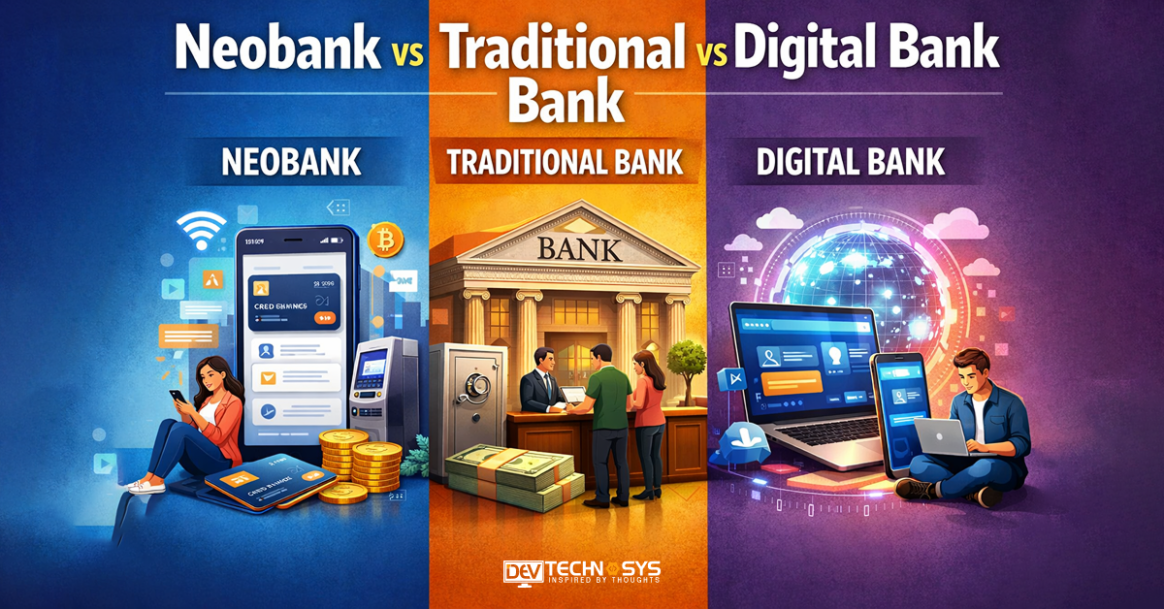
Key takeaways:
-
- Fully online, app-based banks offering low fees, fast onboarding, fintech integrations, limited physical presence, targeting tech-savvy customers seeking convenience and modern banking features.
- Established financial institutions with physical branches, full-service offerings, regulatory trust, wider product range, slower digital adoption, ideal for customers valuing personal interaction and security.
- Online-first banks are often linked to traditional institutions, providing digital banking convenience, moderate fees, robust services, and some branch support, bridging physical and fully digital banking experiences.
Managing your finances used to involve standing in long lines to receive service from a representative. You filled out piles of paperwork, and only after getting all your documents to your bank could you start using services like check writing or bill paying.
As soon as the digital revolution came into play, everything changed. The traditional banking industry is quickly catching up with the technology of today, but digital banks have rewritten all the rules of how to do business with customers.
Neobanks are throwing out the old way of doing business and totally revamping the way that they operate.
With so many types of banks available to you today, how do you determine which financial institution to bank with?
In this blog, we will identify what makes each of these banking types unique and which banking option will be able to meet your financial needs effectively.
Let’s go down to banking comparison: neobank vs traditional bank vs digital bank!
What is a Traditional Bank?
A traditional bank is a financial institution that runs or operates through a physical branch where users visit to access their financial services. Traditional banks offer various types of products, such as a current account, a savings account, a loan, credit cards, debit cards, and other investments.
These banks are fully run by government authorities and their rules and regulations. Visitors can interface with staff members to withdraw cash, deposit cash, withdraw cash via cheque, request a new cheque book, and print passbook transactions.
Industry Insights:
According to The Times of India, Traditional banks still dominate total assets but are gradually losing market share to digital players.
Features of Traditional Bank:

1. Safe Deposit Facilities
Most banks across the world offer their clients a safe place to keep their funds. Customers will have access to their funds at all times through savings accounts and will have the option of withdrawing them at any time. The client base can also be assured that they use their hometown bank as a regulated entity.
2. Loan Services
Most banks offer their customers several categories of loans, including personal, home, and business loans. Each client will have the opportunity to utilize the different types of loans that meet their needs. The loan agreements provide for scheduled repayments and regulated rates of interest.
3. Face-to-Face Customer Service
Having a physical presence in the community allows the bank to offer customers more direct interaction with its staff members. Therefore, if customers need to contact a banker about a problem, need help managing their funds, or wish to complete their routine financial transactions.
4. Regulatory Compliance
Commercial banks must be compliant with all federal and state laws concerning the operation of their bank and the services offered by the banks. Complying with all applicable laws will increase the banking institution’s ability to provide financial stability and protection to depositors’ money.
5. Wide Range of Services
Commercial banks offer many options for financial services, such as savings and checking accounts, and multiple options for customers to manage their finances to reach their long-term financial goals.
Pros:
- Physical branch access
- Established reputation
- Wide service range
- In-person support
- Regulated & secure
Cons:
- Slower processes
- Higher fees
- Limited digital features
- Less flexible hours
- Paper-heavy procedures
Real World Examples:
- Barclays
- Citibank
- JPMorgan Chase
- HSBC
What is a Digital Bank?
A digital bank is a licensed or authorized bank, but it does not depend on physical branches; it runs all its financial services online. Users can open their accounts online and receive their documents, such as a cheque book, debit card, and more, at their specific location.
Digital banks allow users to pay bills, transfer funds, and manage financial services online. These online banks also offer services like traditional banks, such as loans, credit cards, savings accounts, current accounts, and more, but faster and with lower charges.
Industry Insights:
According to the WifiTalents, digital banking users are expected to reach 3.6 billion globally, showing massive adoption.
Features of Digital Bank:
1. Online Accessibility
Digital banks offer a 24-hour, seven-day-a-week method of accessing your account via mobile devices and websites. You can check balances, make online purchases, transfer money, and conduct banking transactions whenever you want.
2. Fast Transactions
Digital banks provide quick and seamless transactions such as instantaneous money transfers, bill payments, and online purchases. As a result, there is much less of a waiting period than with traditional banks.
3. Lower Costs
Because digital banks do not have the same kind of overhead costs associated with operating physical branches, they are able to provide customers with lower fees and better interest rates than traditional banks can offer.
4. Advanced Technology
Modern digital banks utilize advanced technologies such as artificial intelligence, data analytics, and secure encryption technology to provide customers with personalized financial services, fraud detection, secure online banking, and innovative ways of conducting banking activities.
5. Easy to Manage Account
Digital Banking gives you the convenience of rolling out a new account, tracking and managing your spending and budgets, and managing your entire financial picture through an easy-to-use interface. All of these conveniences are now available through the Internet for all of your financial needs.
Pros:
- App-based banking
- Lower fees
- Faster transactions
- 24/7 online access
- Easy account setup
Cons:
- Limited in-person support
- Fewer financial products
- Dependence on the internet
- Security concerns for some users
- Less established trust than traditional banks
Real World Examples:
- Ally Bank
- Marcus by Goldman Sachs
- Capital One 360
- Chase Online
Want a chatbot demo or pricing? Fill the form and talk to our experts today.
Pick what you need below — you can select more than one — then tap Get detail to continue.
-
Chatbot demo dashboard
-
Cost to develop an app
-
Industry report
-
Case study
What is a Neobank?
Neobanks are banks that have been created and operate 100% through digital channels, meaning there is no physical location to visit. They focus their efforts on building a modern-day banking experience that speaks to tech-savvy customers via smartphone applications, website access, etc.
By providing products including savings accounts, paying bills, managing finances, etc., all from a purely digital perspective. Many of these new banks target specific groups of people and therefore offer reduced fees or no fees, quicker transaction times, and unique features.
Industry Insights:
According to the Business Research Insights, Neobanks are the fastest-growing segment, with 45-50% CAGR and projected multi-trillion-dollar valuation by 2035.
Features of Neobank:
1. Digital-Only Banking Services
Neobanks have an all-digital approach and do not have a brick-and-mortar presence. They use mobile applications and websites to provide access to various banking services. So that an individual can manage their finances, access accounts, and transfer money whenever and wherever may be convenient.
2. Fast Account Setup
Neobanks typically have a quick, paperless account setup process that allows potential customers to sign up digitally in a matter of minutes. With a limited number of documents required, making it easy for a broad range of customers to get on board.
3. Low or No Cost Fees
Neobanks generally have a low or no-fee structure in place for many types of services, such as account maintenance and transaction fees, because they have fewer costs to operate. When develop a neobank, integrate this features to make banking a much less expensive and more appealing choice for many consumers.
4. Financial Functionality and Innovation
Neobanks provide many features, including but not limited to expense tracking, budgeting features, instant notifications, and spending analysis tools. So that customers can better understand their financial situation and make better financial decisions quickly and efficiently.
5. Digital Connectivity to Services
Neobanks are made to connect easily to other digital providers and services, such as payments and e-commerce sites. Allowing for easy transactions from one provider or service to another, automating payments, and creating an improved customer experience between the different services provided.
Pros:
- Fully digital platform
- Minimal fees
- Fast transactions
- Innovative financial tools
- Easy account setup
Cons:
- No physical branches
- Limited traditional banking services
- Reliant on internet connectivity
- Less established reputation
- Customer support mainly online
Real-World Examples:
- Revolut
- N26
- Monzo
- Chime
What is the Difference Between Neobank vs Traditional Bank vs Digital Bank?
Traditional banks will allow customers to have complete service with face-to-face interaction, but typically have higher fees. Traditional banks will partner with digital banks for faster, less expensive transactions by providing their online-based services.
Neobanks are fully mobile, app-based, low-fee services that cater to tech-savvy consumers looking for convenience and real-time management of their financial situation. Take a view at the table to know the banking differences between neobank vs traditional bank vs digital bank:
Feature | Traditional Bank | Digital Bank | Neobank |
| Branches | Many physical branches for in-person services | Few or no branches; mostly online | No branches; fully app-based |
| Banking License | Holds a full banking license | Licensed under the traditional bank | Usually operates under a partner bank’s license; some have limited licenses |
| Accounts & Services | Full range: savings, checking, loans, mortgages, credit cards, investments | Core accounts: savings, checking, debit/credit cards; limited loans | Limited accounts: checking, savings, debit cards; some loans or investment products via partners |
| Fees | Higher due to branch & operational costs | Lower than traditional banks; some service fees | Very low or zero fees; revenue from premium accounts, card interchange, or partnerships |
| Technology & App | Basic online banking; legacy systems | Strong digital platform and mobile apps; convenient features | Mobile-first, highly intuitive apps; real-time notifications, budgeting, and integrations |
| Customer Support | In-person support, phone, and email | Online chat, email, and phone support | Mostly digital: chatbots, email, social media; limited phone support |
| Transaction Speed | Slower; manual processes | Faster digital transactions; some real-time payments | Instant setup, real-time transfers, fast payments |
| Target Users | General public, businesses, traditional users | Tech-savvy, online-focused customers | Millennials, Gen Z, and digital-first customers are seeking convenience and low fees |
| Examples | HSBC, JPMorgan Chase | Ally Bank, DBS digibank | Chime, N26 |

Neobank Vs Traditional Bank Vs Digital Bank: Which is Best for You?
Figure out your bank type, traditional banks, online banks, or alternative banks: look at the ways they deliver services, their fees, and how they provide service accessibility.
Once you know what type you prefer, you can narrow down a bank that meets those needs, regardless of whether you prefer a personal touch, easy access to digital banking or advanced financial services.
1. Traditional Bank
A standard bank is an institution that provides banking services to customers by offering services like checking, savings, and loans at brick-and-mortar locations.
While customers find the benefit of working with real people who have knowledge and expertise in solving problems, traditional banks may have longer lead times and higher associated fees. Thus, customers often use traditional banks to fulfill their long-term financial goals or to make complex transactions.
Key Points:
- Physical branch access
- Established reputation
- Wide service range
- Slower processes
- In-person support
2. Digital Bank
Digital banks only provide banking services through an online platform (web or mobile), allowing access to banking services 24 hours a day, 7 days a week.
Fintech app development solutions’ ability to perform online, as well as quick transaction completion and lower transaction fees than traditional banks, are key benefits of this form of banking. Digital banking is typically used for everyday banking needs.
Key Points:
- App-based banking
- Lower fees
- Faster transactions
- Limited physical presence
- 24/7 online access
3. Neobanks
Neobanks provide banking services to tech-savvy customers. Neobanks are fully digital and serve as an extension to customers’ banking services and wallets through mobile-first technology platforms.
Neobank banking has low-cost or no-fee transactions, rapid online account opening, and provides access to various budgeting and spending tools. However, since neobanks generally partner with other banks to provide banking services.
Key Points:
- Fully online platform
- Innovative features
- Minimal fees
- Niche-focused services
- Quick account setup
Conclusion
In summary, neobank vs traditional bank vs digital bank all meet the needs of different consumers by offering their services in a way that meets consumer demands based on convenience, technology, and service breadth.
In this context, traditional banks provide consumers with full-service, trusted, brick-and-mortar banks, whereas digital banks and neobanks give consumers fast, cost-effective, and innovative digital banking options. Connect with a professional mobile banking app development company to offer high-quality applications or platforms for the finance industry.
Frequently Asked Questions
Q1. What is the Difference Between Neobank and Traditional Bank?
A. A neobank can be described as a fully digital banking platform, typically using mobile apps to conduct banking activities. In most cases, neobanks partner with an established, licensed bank to provide access to FDIC-insured accounts. Traditional, physical banks offer banking through their physical branches. Therefore, they provide face-to-face customer service and a wide array of financial products.
Q2. Which Bank is Best For Daily Transactions?
A. Digital banks and neobanks are best for everyday transactions because they have instantaneous payments, provide real-time updates, and allow users to easily access their accounts using a mobile device. Digital and neobanks use user-friendly mobile applications and offer faster transaction processing than traditional banks for everyday.
Q3. Which Type of Bank Has Lower Fees?
A. Neobanks generally have lower transaction fees than digital banks. Traditional banks typically charge higher transaction fees related to maintenance and transactional services due to their reliance on physical branches and bank employees. Making both digital and neobanking have potential for more economical methods to perform everyday banking activities.
Q4. What is the Difference Between Digital Bank and Neobank?
A. While digital banks can be thought of as full-fledged banking institutions with physical locations and a significant number of branches, they operate only via the internet. Neobanks are considered online payment solutions that exist purely on mobile devices and, as such, provide a limited number of features compared to traditional banks and digital banks.
Q5. Which Option Is Best For Long-Term Financial Planning?
A. Although all three types of institutions, traditional, digital, and neo banks, can be helpful for achieving your long-term financial goals, traditional banks are usually the best choice when it comes to creating a plan for achieving certain goals because they provide more type of investment, financial planning, and retirement planning options as well as access to professional advisors than either digital or neo banks.


