



















Key Takeaways:
Neobank payment application development typically costs $30,000 to $150,000+, depending on features, security, compliance, integrations, and scalability. A basic MVP may cost $30,000–$55,000, a mid-level app around $55,000–$90,000, while an advanced, enterprise-grade neobanking platform can reach $90,000–$150,000+.
Development complexity cost analysis:
-
- Basic/MVP ($30,000–$75,000): User onboarding, KYC, account creation, money transfers, transaction history, OTP authentication, and basic admin dashboard.
- Medium ($75,000–$1,10,000): Real-time transactions, budgeting, push notifications, multi-currency payments, payment gateway APIs, and advanced financial dashboards.
- Complex ($1,10,000–$150,000+): AI-powered financial insights, fraud detection, open banking APIs, automated savings, investment modules, blockchain capabilities, and enterprise scalability.
Major Cost Drivers:
-
- Features & Functionality: AI insights, robo-advisors, predictive analytics, and automated financial services increase development complexity.
- Security & Compliance: KYC, AML, PCI DSS, GDPR, biometrics, 2FA, encryption, and fraud prevention require additional development and testing.
- Third-Party Integrations: Banking APIs, payment gateways, credit scoring platforms, financial data providers, and open banking APIs affect the overall budget.
- Platform Type: Building separate native iOS and Android apps generally costs more than using cross-platform frameworks such as Flutter or React Native.
- Cloud Infrastructure & Scalability: High transaction volumes require secure, scalable infrastructure, monitoring, backup, and performance optimization.
Development Timeline:
-
- MVP: 4–6 months
- Medium: 6–9 months
- Complex: 9–14+ months
Cost Based on Countries:
-
- USA: $80,000–$150,000+
- UK: $65,000–$120,000
- Australia: $55,000–$100,000
- India: $30,000–$75,000
Additional Cost:
Maintenance & Updates: Typically 15–25% of the initial development cost annually for bug fixes, security updates, performance optimization, and new features.
Cloud & Hosting: Ongoing costs depend on transaction volume, storage requirements, security infrastructure, monitoring, and uptime needs.
The presence of Neobanks has made opening bank accounts, money transfers, and tracking expenses in real time easier and faster. Thanks to Neobanks, you can manage every financial task through your smartphone without setting foot into the branch. Digital-only banks of today are reshaping the way the finance industry operates, making it simpler, faster, and more personalized.
According to the latest reports by Mordor Intelligence, between 2026 and 2031, the neobanking market size is forecast to reach USD 13.67 trillion by 2031 at 10.82% CAGR, showcasing strong digital adoption. It gives businesses an opportunity to enter the evolving fintech sector.
But one thing that businesses of all scales must consider before building a Neobanking app is the development cost. So, in this Ultimate guide, we will explain every crucial factor related to Neobank app development cost. Let’s dive in and explore real development cost, key features, and what it takes to bring a modern digital bank to life.
What is the Neobank App?
You can think of Neobank as a mobile-only platform for taking care of financial tasks. You can receive banking services such as checking, savings, and loans without visiting a physical branch. Neobanks are also called digital banks or challenger banks because they are application-based.
Neobank apps offer lower fees, high-interest savings, and real-time transaction tracking. Many neobanks aren’t technically banks, but they work with chartered, FDIC-insured banks to provide secure finance-related services.
What is the Average Cost to Develop a Neobank App?
Neobank app development cost in 2026 ranges from $30,000 to $1,50,000+, depending on features, platform, location, tech stack, and more. Developing a basic MVP generally costs less, while a feature-rich, secure, and compliant banking app development requires much higher investments. Before making any decision, we suggest consulting with the top banking app development companies in USA.
Average neobank development cost breakdown by development stage:
- MVP Neobank App: The neobank development cost for a basic MVP will be around $30,000 to $75,000, with basic features and functionality such as accounts, transfers, and KYC.
- Moderate Neobank App: Neobank app development cost with mid-level complexity, added budget tools, and security will range from $75,000 to $1,10,000.
- Full-Scale/Complex Neobank App: The cost to build a Neobank app using advanced features like multi-currency, lending, and advanced AI and ML will exceed $1,50,000+ (multi-currency, lending, advanced AI).
| App Type | Estimated Cost | Development Timeline |
| Basic MVP | $30,000 – $75,000 | 4 – 5 Months |
| Mid-Level App | $75,000 – $1,10,000 | 5 – 7 Months |
| Advanced Neobank App | $1,10,000 – $150,000+ | 7+ Months |
Industry Insights: According to statista, the number of neobank users worldwide is expected to exceed 395 million users by 2026, reflecting massive growth in digital-only banking platforms.
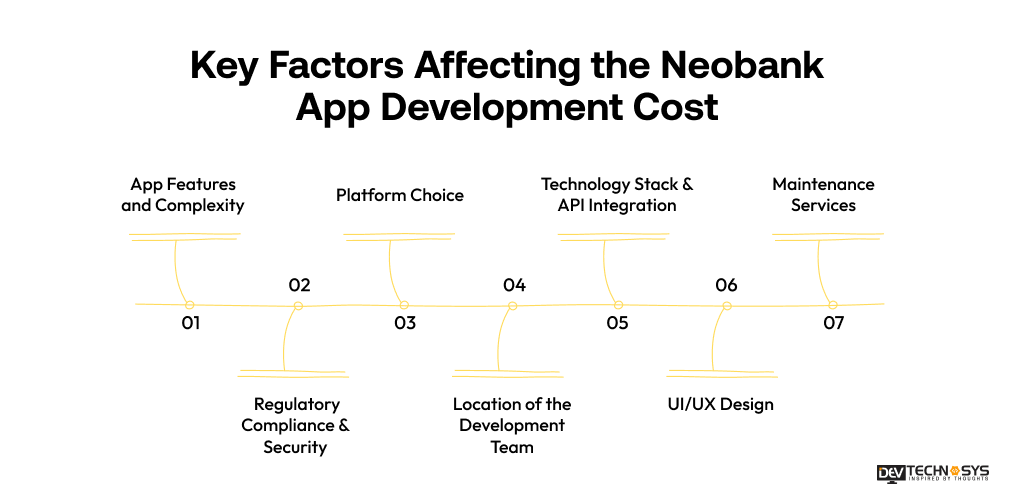
Key Factors Affecting the Neobank App Development Cost
how much does it cost to build a neobank app? Well, pinpointing the exact Neobank app development cost is difficult because it changes depending on various factors. In this section, we will examine all the major factors that impact neobank app development pricing.
1. App Features and Complexity:
The first factor affecting the neobank software development cost is the features. The complexity of neobank app features directly impacts the development cost. An MVP with basic banking app architecture, onboarding, and transactions is less. On the other hand, multi-currency support, AI analytics, investment options, and cryptocurrency features will increase the fintech banking app development.
| Complexity Level | Estimated Cost | What It Covers |
| Basic | $4,000 – $7,000 | Account creation, KYC, login, transaction history, basic transfers |
| Medium | $7,000 – $11,000 | Budgeting, notifications, multi-currency, payment integrations |
| Advanced | $11,000 – $15,000 | AI insights, fraud detection, automation, investment features |
2. Regulatory Compliance & Security:
Integrating strict compliance requirements, including KYC (Know Your Customer), AML (Anti-Money Laundering), Two-Factor Authentication (2FA), and data security standards (GDPR/PCI DSS), increases the banking app development cost and timeline. The KYC AML integration cost for neobank will typically range between $5,000 to $12,000+, depending on the level of automation, AI-based verification, and third-party API usage.
| Security & Compliance Level | Estimated Cost | What It Covers |
| Basic | $5,000 – $9,000 | OTP, encryption, basic KYC, secure authentication |
| Medium | $9,000 – $15,000 | MFA, AML checks, PCI DSS, advanced access controls |
| Advanced | $15,000 – $20,000 | Advanced fraud prevention, biometric security, compliance automation |
3. Platform Choice:
Next up in the queue is platform selection. The type of platform you choose ( iOS, Android, or cross-platform) will significantly raise the neobank MVP development cost. Native apps demand separate development, which increases cost, while cross-platform frameworks like Flutter can reduce total price but need optimization to ensure scalability and high performance.
| Platform Approach | Estimated Cost | What It Covers |
| Cross-Platform | $10,000 – $16,000 | Single codebase for iOS and Android |
| Native iOS or Android | $16,000 – $23,000 | Platform-specific development and optimization |
| Native iOS + Android | $23,000 – $30,000 | Separate native applications for both platforms |
4. Location of the Development Team:
The geographic location of the development team also impacts the hourly rates. If you hire dedicated developers from North American or Western European regions, then be ready to pay around $55 to $100 per hour. The cost to hire developers from Eastern Europe or Southeast Asia will be much lower, around $15 to $25 per hour, than those in North America. It is best to hire mobile app developers based on your project needs and budget.
| Development Location | Estimated Cost | Typical Cost Range |
| India | $10,000 – $13,000 | Lower development rates with experienced fintech teams |
| Australia | $13,000 – $18,000 | Mid-to-high development rates |
| UK | $18,000 – $21,000 | Higher rates for specialized fintech development |
| USA | $21,000 – $23,000 | Premium rates for experienced development teams |
5. Technology Stack & API Integration:
The cost to build a neobank app also relies on API integrations. Adding APIs for banking services, payment processing, and backend services requires specific skills and expertise. Advanced technology stacks that use AI or blockchain increase the fintech banking app development cost.
| Integration Complexity | Estimated Cost | What It Covers |
| Basic | $5,000 – $8,000 | Payment gateways, authentication APIs, basic banking APIs |
| Medium | $8,000 – $12,000 | Open banking, financial data APIs, KYC/AML services |
| Advanced | $12,000 – $15,000 | Multiple banking APIs, real-time processing, advanced fintech integrations |
6. UI/UX Design:
The custom Neobank app development cost depends on the UI/UX design. Compared to basic design and templates, high-level user experiences with custom animations and graphics need more time to design. Custom designs highly impact the fintech app development cost. The more customizations your mobile application development company adds to the app, the higher the price will be.
| Design Level | Estimated Cost | What It Covers |
| Basic | $5,000 – $8,000 | Standard screens, simple navigation, basic design system |
| Medium | $8,000 – $14,000 | Custom interface, interactive dashboards, user flows |
| Advanced | $14,000 – $20,000 | Premium UX, personalization, animations, complex financial dashboards |
7. Maintenance Services:
Once launched, your Neobank app will need periodic updates and optimizations to ensure it runs smoothly and is bug-free. Services after launch, such as regular updates, bug fixes, and security patches, typically add another 15% to 20% of the total cost of the initial development each year.
| Support Level | Annual Estimated Cost | What It Covers |
| Basic | $4,500 – $10,000 | Bug fixes, security patches, basic monitoring |
| Standard | $10,000 – $20,000 | Performance optimization, API updates, cloud monitoring |
| Advanced | $20,000 – $30,000 | Continuous security, compliance updates, advanced monitoring, feature enhancements |
Why Businesses Must Invest in NeoBank App Development?
There are various business benefits of investing in mobile banking application development services. For one, it doesn’t require any capital to start up, and there are no branches to maintain either. Another benefit is that they offer digital products like mobile apps, online account management platforms, and online loans.
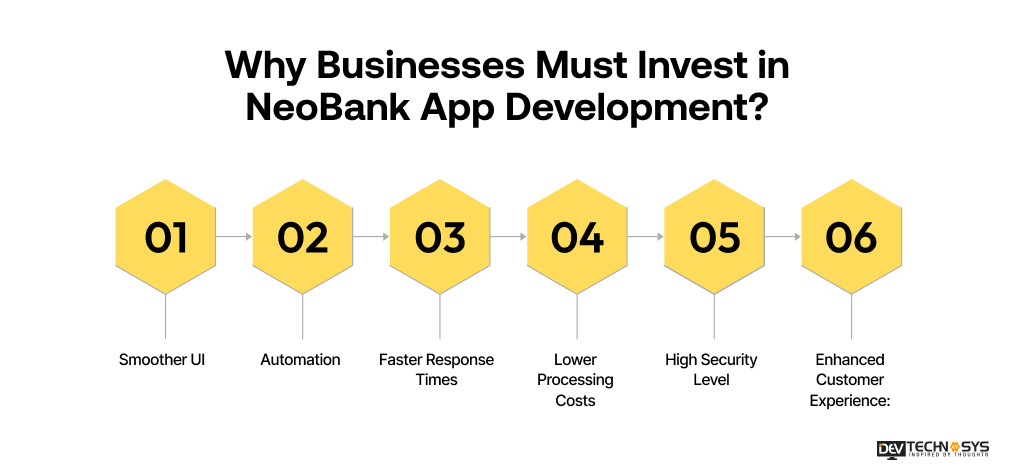
The advantages of the Neobank loan app development for businesses are:
- Smoother UI: The Neobank apps offer simple, intuitive user interfaces that make banking easier for users.
- Automation: Automation makes banking processes easier. It includes transactions and reporting, reducing manual work, and improving efficiency in operations.
- Faster Response Times: Real-time processing enables instant transactions, offering quick service, and improving customer satisfaction and reliability.
- Lower Processing Costs: Neobanks reduce operational and transaction costs specifically for businesses. It revolves around the need for physical infrastructure.
- High Security Level: The financial data needs to be protected with strong verification systems and top-notch encryption to prevent fraud effectively.
- Enhanced Customer Experience: Customizable dashboards and intuitive navigation upgrade usability and customer satisfaction.
Due to its tech-driven nature, mobile banking apps are easy to use for personal banking.
Why Budgeting for Your Neobank App Development is Crucial?
If you are planning to build a neobank app, budgeting is important. A budget helps businesses spend smartly, focus on important features, and make development smooth without any financial setbacks. A well-defined budget helps you prepare better for security measures, compliance, and scalability. There are several key reasons to budget for developing banking IT solutions.
- Cost Control: Budgeting prevents unnecessary spending in development and helps keep the project within budget.
- Feature Prioritization: Prioritizes developing key features such as KYC, payments, and security first.
- Improved Resource Utilization: Properly allocates the budget for design, development, and testing.
- Scalability Planning: Ease of future upgrades without huge redevelopment costs.
- Recurring Cost Management: Manages the cost of maintenance, cloud hosting, and API effectively.
- Risk Reduction: Lowers the risk of delays, budget overruns, and incomplete development.
Industry Insights: According to Grand View Research, the market is expanding rapidly due to smartphone penetration, digital payments, and financial inclusion initiatives worldwide.

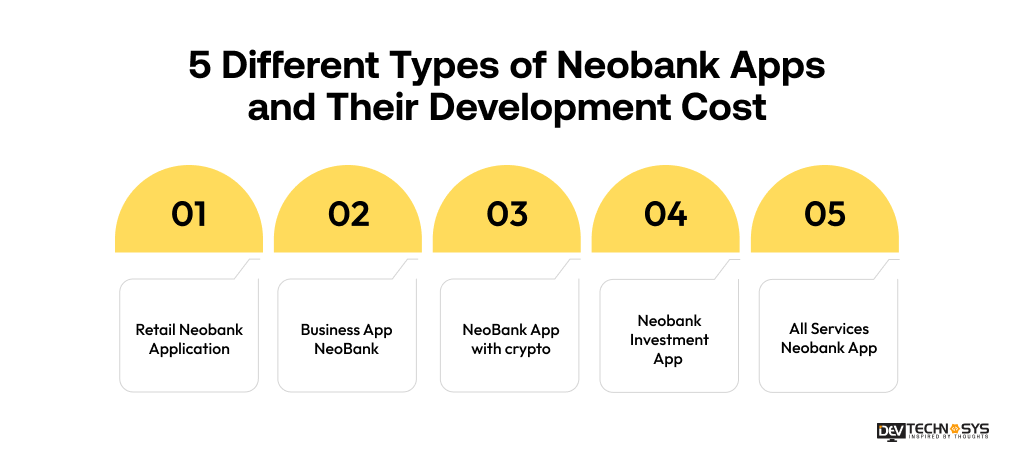
5 Different Types of Neobank Apps and Their Development Cost
There are several types of Neobank apps that target different audiences and service offers. There is no one-size-fits-all solution for the cost of developing a Neobank app. It will depend on the complexity, features, and compliance needs of each type.
1. Retail Neobank Application
Retail neobank apps offer digital-only banking services, including fast account opening, high-interest savings, quick loans, and low-fee transactions through your smartphone. A leading example is the neobank by BNC Digital (Indonesia) and Neo Financial (Canada), which are focused on user-friendly interfaces, secure payments, and features such as cashback, virtual accounts, and QRIS payments.
| Component | Estimated Cost |
| UI/UX Design | $10,000 – $15,000 |
| User Onboarding & KYC | $8,000 – $12,000 |
| Core Banking Features | $20,000 – $25,000 |
| Payment & Money Transfer | $15,000 – $20,000 |
| Backend Development | $18,000 – $22,000 |
| Security & Compliance | $12,000 – $16,000 |
| Testing & Deployment | $7,000 – $10,000 |
| Total Cost | $90,000 – $120,000 |
2. Business App NeoBank
Neobank apps for businesses are aimed at SMEs and offer services like invoicing, payroll, multi-user access, and financial reporting. The cost to build a business app for a Neobank lies between $106,000 – $141,000, depending on API integrations and scalability requirements. The cost is related to the added feature and complexity.
| Component | Estimated Cost |
| UI/UX Design | $10,000 – $15,000 |
| Business Account Management | $12,000 – $16,000 |
| Corporate Payments & Transfers | $18,000 – $23,000 |
| Accounting & Financial Integrations | $12,000 – $16,000 |
| Backend & Admin Dashboard | $20,000 – $25,000 |
| Security, KYC & AML | $15,000 – $20,000 |
| API & Banking Integrations | $12,000 – $16,000 |
| Testing & Deployment | $7,000 – $10,000 |
| Total Cost | $106,000 – $141,000 |
3. NeoBank App With Crypto
Crypto-based neobank applications include digital wallets, blockchain integration, and crypto trading features. These apps meet the complex security and backend infrastructure needs. Thus, the cost of developing a crypto Neobank app can range from $108,000 – $143,000 based on the supported assets and compliance needs.
| Component | Estimated Cost |
| UI/UX Design | $9,000 – $13,000 |
| Core Neobanking Features | $18,000 – $23,000 |
| Crypto Wallet Integration | $15,000 – $20,000 |
| Crypto Buy/Sell & Transfers | $15,000 – $20,000 |
| Blockchain & API Integration | $12,000 – $16,000 |
| Security & Compliance | $15,000 – $20,000 |
| Backend Development | $18,000 – $22,000 |
| Testing & Deployment | $6,000 – $9,000 |
| Total Cost | $108,000 – $143,000 |
4. Neobank Investment App
Neobank Investment Apps: Try stock trading, portfolio tracking, and AI-powered financial insights. Adding links to financial data sources and analytical tools will boost the development costs to between $82,000 – $113,000, depending on the features and complexity of the platform. To build an industry-leading Neobank investment app, contact top providers of ewallet app development services in USA.
| Component | Estimated Cost |
| UI/UX Design | $8,000 – $12,000 |
| User Onboarding & KYC | $7,000 – $10,000 |
| Investment Portfolio Management | $15,000 – $20,000 |
| Trading & Investment APIs | $12,000 – $16,000 |
| Financial Analytics & Dashboard | $10,000 – $14,000 |
| Backend Development | $15,000 – $19,000 |
| Security & Compliance | $10,000 – $14,000 |
| Testing & Deployment | $5,000 – $8,000 |
| Total Cost | $82,000 – $113,000 |
5. All Services Neobank App
Full-service neobanks combine banking, payments, lending, and investing capabilities in one platform. These apps are rich in features, scalable, and compliant with tight laws, and hence cost between $107,000 – $143,000 and above. They are a perfect option for organizations that are searching for complete digital banking solutions.
| Component | Estimated Cost |
| UI/UX Design | $10,000 – $15,000 |
| Core Banking & Account Management | $18,000 – $23,000 |
| Payments & Money Transfers | $15,000 – $20,000 |
| Investment & Wealth Management | $12,000 – $16,000 |
| Crypto & Digital Asset Features | $12,000 – $16,000 |
| AI Financial Insights | $10,000 – $14,000 |
| Backend & Admin Dashboard | $18,000 – $23,000 |
| Security, Compliance & Testing | $12,000 – $16,000 |
| Total Cost | $107,000 – $143,000 |
Top 5 Neobank Apps to Explore in 2026
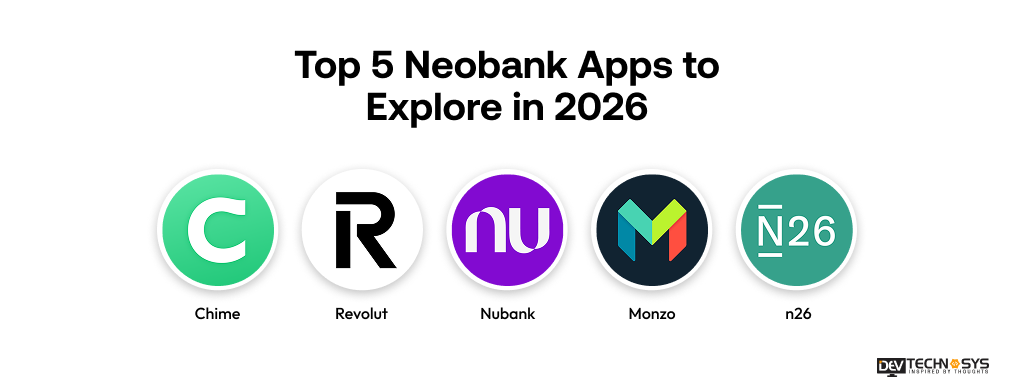
Top 5 Neobank apps to watch out for in 2026: Check out. The apps below all demonstrate how digital banking is expanding with user-friendly features and novel financial solutions. It is setting criteria for companies wanting to go into the financial area.
1. Chime
Chime is one of the largest neobanks in the U.S. It is one of the most popular banking apps with 22 million users globally, offering fee-free checking and savings accounts digitally. It offers services like early direct deposit and no-fee banking. This makes Chime a popular alternative for those who want simple, affordable digital banking.
2. Revolut
Revolut is a global financial technology app with 40 million customers. You may open multi-currency accounts, make international transfers, trade stocks, and cryptocurrencies. It is a strong all-in-one finance platform for personal and commercial customers.
3. Nubank
Nubank is the largest neobank in the world and rules the Latin American market. It is recognized for its transparent pricing structure, user-friendly credit cards, and smooth digital banking experience, serving millions of consumers across Brazil and abroad.
4. Monzo
Monzo is a UK-based neobank, known for its easy-to-use budgeting tools, including “pots,” quick transaction notifications, and a strong community-driven approach. It’s a banking experience that’s modern, interesting, and ordinary.
5. n26
Among the best European neobanks, N26 receives praise for its stylish appearance and innovative features such as “Spaces” that help customers organize savings efficiently. It’s all about simplicity, security, and a smooth mobile-first banking experience.
| Neobank App | Key Offering | Estimated Development Cost | Development Timeline |
| Chime | Digital banking, debit cards, money transfers, savings | $70,000 – $110,000 | 6 – 9 Months |
| Revolut | Multi-currency accounts, payments, cards, investments | $100,000 – $150,000 | 8 – 12 Months |
| Nubank | Digital banking, credit, payments, loans, financial services | $80,000 – $130,000 | 7 – 10 Months |
| Monzo | Digital banking, budgeting, savings, payments | $60,000 – $100,000 | 5 – 8 Months |
| N26 | Digital banking, payments, cards, savings, financial management | $75,000 – $120,000 | 6 – 9 Months |
What are the Hidden Factors Affecting the Cost to Build a Neobank App?
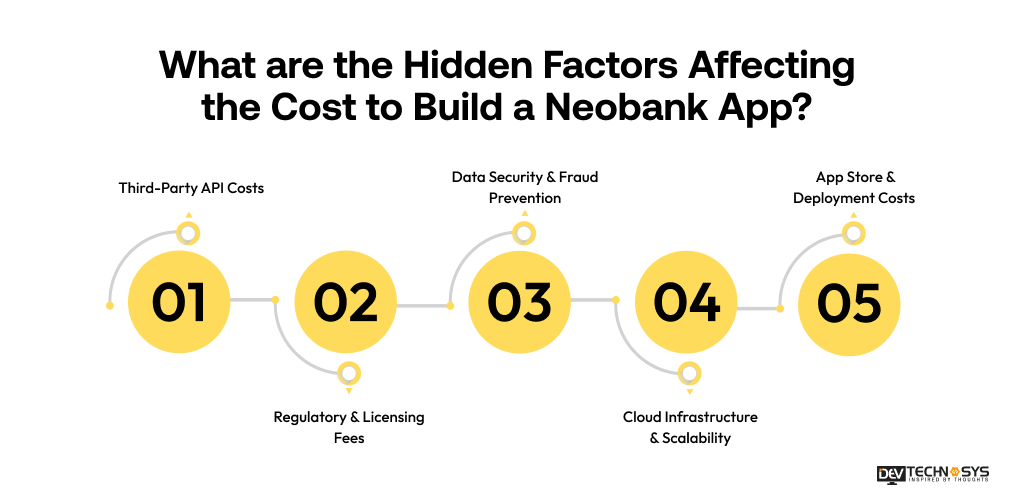
Besides the costs for development, there are several hidden cost factors that can increase your total banking app development cost. These hidden costs often arise during development or post-launch and impact the long-term scalability and compliance.
1. Third-Party API Costs
Integrating banking APIs, payment gateways, KYC services, and analytics tools often involves subscription or usage-based pricing. As user activity grows, these recurring costs increase, adding a significant long-term financial burden beyond the initial online banking app development cost.
2. Regulatory & Licensing Fees
Neobank apps must comply with financial regulations, which may require licenses, audits, and legal approvals. These costs vary by region and can add substantial expenses, especially when expanding to multiple countries with different compliance standards.
3. Data Security & Fraud Prevention
Implementing advanced security measures like encryption, biometric authentication, and fraud detection systems requires specialized tools and expertise. Continuous monitoring and updates further increase ongoing operational costs.
4. Cloud Infrastructure & Scalability
As the user base grows, cloud hosting, server scaling, and database management costs increase. Real-time transactions and high availability requirements make infrastructure a major hidden expense over time.
5. App Store & Deployment Costs
Publishing apps on platforms like Google Play and the Apple App Store involves registration fees and compliance requirements. Updates and approvals can also require additional development effort.
Security and Compliance Cost for Neobank App Development
In 2026 and beyond, security is not an option for neobank applications; it is essential for user trust. A single breach in security can destroy things at such a level, it will be unmanageable to recover. Once the user trust is broken, rebuilding that trust takes far longer than fixing the security gap upfront.
Generally, security and compliance cost for a neobank can range between $5,000 and $20,000. The final cost to integrate security and compliance depends on the depth of encryption, fraud detection, and certification needed.
The expenses is also influenced by the regulatory markets you target and the number of financial integrations. Stronger security controls and compliance frameworks can increase the initial investment but reduce long-term financial and reputational risks.
| Security Component | Estimated Cost | Details |
| Data Encryption & Secure Storage | $1,000 – $3,000 | End-to-end encryption, secure key management, encrypted databases |
| Biometric Authentication | $800 – $2,000 | Face ID, fingerprint login, device-based verification |
| Fraud Detection & Monitoring | $1,500 – $5,000 | AI-based transaction monitoring, anomaly detection, real-time alerts |
| PCI-DSS Certification | $1,200 – $4,000 | Card data security standard, required for payment processing |
| KYC/AML Automation | $1,500 – $4,000 | Identity verification, sanctions screening, ongoing monitoring |
| GDPR/Data Privacy Compliance | $1,000 – $2,500 | Data handling policies, consent management, right-to-erasure tools |
Things to Remember:
- If you skip security early often costs more later, through fines, breaches, or delayed app store approval.
- Regulators can issue heavy penalties for non-compliance, even for early-stage neobanks.
- App stores also reject fintech apps that lack proper encryption or authentication.
- Most founders find it cheaper to build security in from day one than to patch it in after launch.
Real Regulatory and Licensing Cost to Launch a Neobank in 2026-2027
Developing a secure neobank mobile app need more than encryption, secure API, and fraud detection. It includes regulatory licensing, legal support, and recurring liscence renewal fees. This can significantly influence the overall development expenses.
On average, neobanks should budget $25,000+ annually for licensing and regulatory renewal alone. The actual amount depends on the operating market, licensing model, number of jurisdictions, and level of regulatory oversight required to legally provide financial services.
| Licensing Route | Estimated Cost | Details |
| US Money Services Business (MSB) Registration | $5,000 – $10,000 | Federal FinCEN registration required before applicable state-level licensing |
| US State-by-State Licensing | $50,000 – $150,000+ | Separate licensing requirements and fees apply across states |
| Bank Partnership Model (BaaS) | $20,000 – $80,000 | Partnering with a chartered bank instead of obtaining a full banking license |
| UK E-Money License (FCA) | $40,000 – $100,000 | Includes application, legal support, and capital-related requirements |
| EU E-Money License | $50,000 – $120,000 | Requires regulatory preparation, legal support, and compliance infrastructure |
| UAE/DIFC Fintech License | $30,000 – $90,000 | Costs may include regulatory approval, legal support, and local requirements |
| Annual Licensing Renewal | Around $25,000/year | Renewal expenses vary by jurisdiction and exclude audits and legal retainers |
| Ongoing Compliance & Audit | $20,000 – $60,000/year | Covers audits, regulatory filings, compliance support, and legal services |
Neobank App Development Timeline Explained
The development time of a neobank app usually takes 3 to 6+ months. It depends on the feature set, the compliance requirements, the integrations, etc. The timeline for UPI payment app development depends on the stages, such as planning, design, development, testing, and deployment. Regulations and scalability requirements mean that complex neobank apps with AI, security layers, and multi-currency support take longer to develop.
Stage |
Time Required |
Description |
| Planning & Research | 2 to 3 Weeks | Market research, feature planning, compliance analysis |
| UI/UX Design | 3 to 5 Weeks | Wireframes, prototypes, and user experience design |
| App Development | 8 to 16 Weeks | Frontend, backend, API integrations, core features |
| Testing & QA | 3 to 6 Weeks | Bug fixing, performance testing, security validation |
| Deployment & Launch | 1 to 2 Weeks | App store release and final optimizations |
What are the Ways to Reduce Neobank App Development Cost?
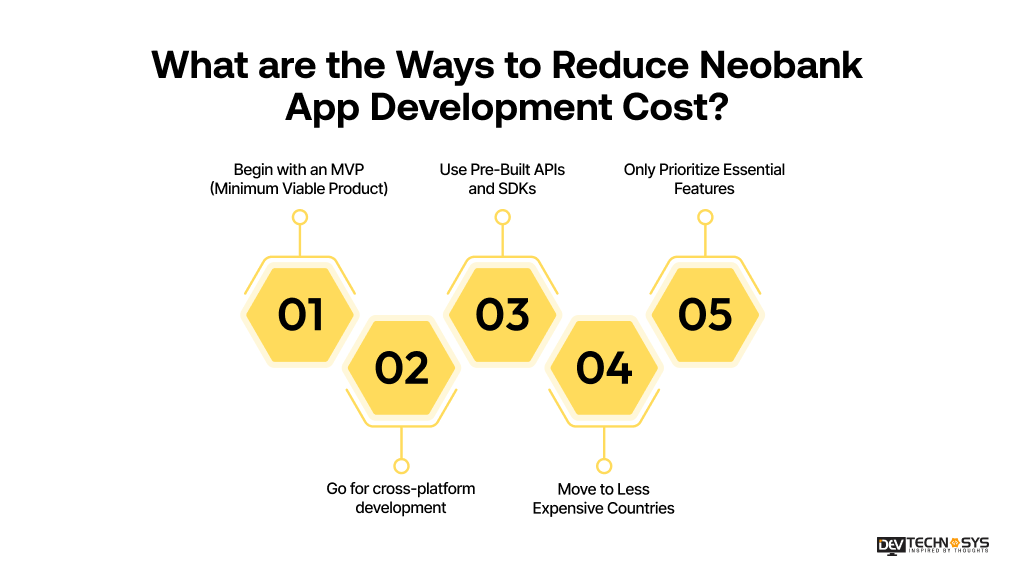
To reduce neobank app development cost, one has to plan smartly, choose technology wisely, and add only the necessary features. Through strategic decisions early in the development process, businesses can optimize budgets without sacrificing security, compliance, or performance.
1. Begin with an MVP (Minimum Viable Product)
Build an MVP with key features such as onboarding, account management, and simple transactions to quickly validate the idea. It lowers upfront investment and enables businesses to roll out features progressively based on actual user feedback and market demand.
2. Go for Cross-platform Development
If you’re using something like Flutter or React Native, you only have one codebase for both iOS and Android. Hybrid mobile app development solutions can greatly reduce the development time, effort, and cost compared to native apps that are built separately for each operating system.
3. Use Pre-Built APIs and SDKs
Third-party APIs for payments, KYC, banking, and analytics take the headache of building complex systems from scratch. It saves development time, reduces infrastructure costs, and provides reliable, tested, and secure functionality.
4. Move to Less Expensive Countries
You can get very good quality peer to peer payment app development from countries like India or Eastern Europe at a much lower hourly rate than in the US or Western Europe. This helps to cut down the overall project costs significantly while maintaining the good quality standards.
5. Only Prioritize Essential Features
In the first phase, focus only on core features to reduce complexity and cost. As your users adopt and your business grows, you can add advanced features like AI analytics, crypto support, or investment tools later on.
How to Monetize Neobank Apps?
According to a top neobank app development company, Neobank apps earn money from various sources while maintaining access to basic banking services. A balanced monetization strategy helps to secure a steady income & long term growth.
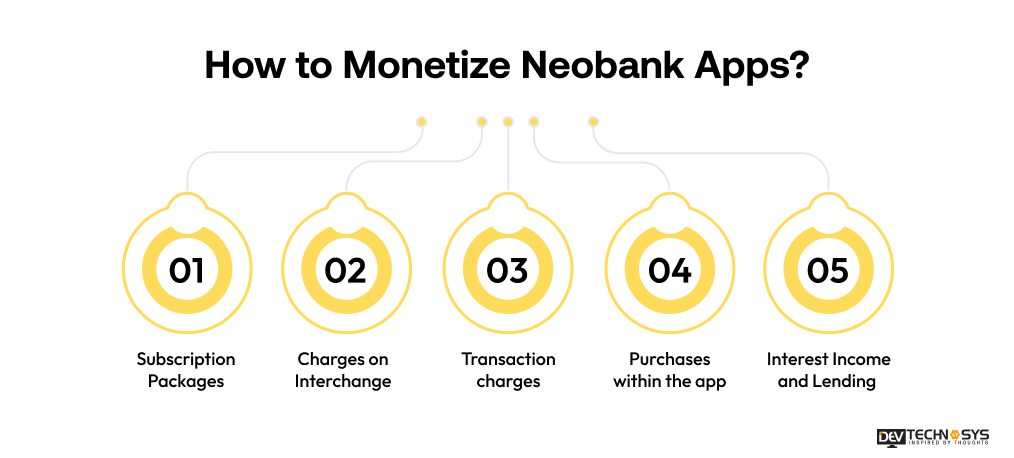
1. Subscription Packages
Neobanks offer premium plans (monthly or yearly) with additional features such as higher transaction limits, budgeting tools, analytics, and exclusive benefits. This model creates a predictable recurring revenue stream and incentivizes users to upgrade as they become more engaged with the platform.
2 . Charges on Interchange
Neobanks earn a percentage of the transaction from merchants whenever their users pay with their debit or virtual cards. This revenue model increases with the transaction volume and can serve as a steady and passive income stream as the number of users and spending increase over time.
3. Transaction Charges
International transfers, ATM withdrawals, or currency exchanges have small associated fees. These tiny fees can create a steady stream of income without impacting the user experience very much, particularly when applied to high-value or premium financial transactions.
4. Purchases Within the App
Users can buy one-time services like premium cards, faster money transfers, or advanced financial tools. This model allows neobanks to build another revenue stream without long-term subscriptions, adding flexibility to users.
5. Interest Income and Lending
Neobanks offer personal loans, credit lines, or buy-now-pay-later services and earn interest on repayments. This is one of the more lucrative revenue streams, especially when supported by robust risk assessment and credit management systems.
Neobank vs Traditional Bank vs Digital Bank: Which One is More Cost-Effective?
Want to know which one among Neobank vs Traditional Bank vs Digital Bank is more cost-effective for your business? Well, it depends on operational costs, scalability, and customer experience. Neobanks are the most cost-effective option due to low infrastructure costs, faster deployment, and high scalability, while traditional banks require heavy investment. Digital banks fall in between, offering a balance of cost and functionality. Here’s a clear comparison table to help you better understand which option is more cost-effective:
| Factor | Neobank | Digital Bank | Traditional Bank |
| Setup Cost | $30,000 – $1,50,000 | $1,20,000 – $250,000 | $250,000+ |
| Operational Cost | Low (Fully digital operations) | Moderate (Digital + physical infrastructure) | High (Branches, staff, and physical infrastructure) |
| Infrastructure | Fully cloud-based | Hybrid digital infrastructure | Physical branches + legacy systems |
| Scalability | High (Cloud-native and easy to scale) | Moderate to High | Limited and expensive |
| Maintenance Cost | 15% to 20% annually | 20% to 25% annually | 25% to 40% annually |
| Compliance Cost | Moderate to High | High | Very High |
| User Experience | Modern, app-first | Good, but less flexible | Often outdated |
| Time to Launch | 4 to 7+ months | 6 to 12 months | 1 to 3+ years |
| Technology Stack | Modern (AI, APIs, cloud) | Mixed (Modern + legacy) | Mostly legacy systems |
| Overall Cost-Effectiveness | Most Cost-Effective | Balanced | Least Cost-Effective |
Industry Insights: According to Business of Apps , Neobanks operate with significantly lower operational costs due to zero physical branches.
You can reach out anytime; we are available 24/7. Our team provides a quick response.
Conclusion
Neobank app development is a smart business move to enter the rapidly evolving digital banking space. With costs varying from $8,000 to $30,000+, the final cost to develop a Neobank
Relies heavily on features, compliance requirements, tech stack, and scalability goals. Before jumping into development, contact a top fintech app development company in USA to get real cost estimates of your project.
At Dev Technosys, we build your neobank apps using cutting-edge technology, robust security, and full regulatory compliance. With 15+ years of expertise and over 200+ skilled developers, we deliver scalable, high-performance solutions while maintaining cost efficiency and faster time-to-market.
Frequently Asked Questions
Find answers to the most common questions related to this article.
The cost typically ranges from $8,000 to $30,000+, depending on features, complexity, compliance requirements, and scalability. Basic MVP apps are more affordable, while advanced platforms with AI, security layers, and integrations require higher investment.
Development usually takes 3 to 7+ months. A basic MVP can be built faster, while feature-rich apps with compliance, security, and third-party integrations require more time for development and testing.
Core features include user onboarding, KYC verification, account management, fund transfers, notifications, and security systems. Advanced features may include AI insights, budgeting tools, multi-currency support, and investment options.
Key factors include feature complexity, compliance requirements, platform choice, development team location, tech stack, UI/UX design, and maintenance. Each of these elements directly impacts the overall budget and timeline.
Neobank apps generate revenue through subscriptions, transaction fees, interchange fees, lending services, investments, and partnerships. A diversified monetization strategy ensures consistent income and long-term growth.
White label neobank app development costs less because the base architecture, features, and infrastructure are already developed. Businesses only need to customize branding, UI, and specific functionalities, saving both development time and overall investment.