














Key Takeways:
The MVP-based RWA tokenization platform development cost is $10,000 to $14,000, while a mid-complex platform ranges from $15,000 to $25,000. A fully-featured enterprise RWA tokenization ecosystem costs $28,000 or higher, depending on compliance modules, integrations, blockchain architecture, and scalability requirements.
Cost Impacted by Project or Development Complexity:
-
- Simple/MVP-Based Platforms ($10,000 – $14,000): Include features like asset tokenization, wallet integration, basic investor dashboard, KYC setup, and simple smart contracts for ownership representation and transfers.
- Mid-Complex Platforms ($15,000 – $20,000): Features include multi-asset support, compliance modules, investor verification systems, reporting dashboards, and limited cross-chain compatibility for enhanced scalability.
- Complex/Enterprise Platforms ($28,000+): Involve advanced functionalities such as fractional ownership, secondary trading markets, institutional dashboards, full regulatory compliance, multi-chain interoperability, and high-level security architecture.
Cost Based on RWA Platform Types:
-
- Real Estate Tokenization Platform: $8,000 to $15,000
- Commodity Tokenization Platform: $15,000 to $20,000
- Debt/Bond Tokenization Platform: $20,000 to $25,000
- Art & Collectibles Tokenization Platform: $18,000 to $24,000
- Hybrid RWA Investment Platform: $10,000 to $30,000
Cost Based on Different Regions/Countries:
-
- The RWA tokenization platform development cost in the USA ranges from $20,000 to $30,000+, depending on compliance and security requirements.
- The cost in the UK is around $18,000 to $28,000 based on regulatory frameworks and integrations.
- In India, RWA tokenization platform development costs range between $10,000 to $22,000 due to lower development rates and scalable tech expertise.
Additional Cost:
- Maintenance Services: Ongoing maintenance costs are typically 15% to 25% of the initial development cost, covering updates, scaling, and security monitoring.
- Security & Compliance Measures: Implementing on-chain KYC/AML systems, smart contract audits, legal compliance, and data protection increases costs but is essential for secure and legally compliant RWA operations.
Tokenization of real-world assets (RWA) is revolutionizing the movement of value worldwide through the conversion of physical goods into digital representations, or tokens, on a blockchain.
This change is attracting considerable interest from startups, banks, and Web3 pioneers, all looking to tap into liquidity and fractional ownership at large volumes. However, creating an RWA tokenization platform requires much more than just smart contracts. It necessitates a fully integrated ecosystem that includes regulatory compliance, secure asset onboarding, blockchain infrastructure, identity verification, and investor dashboards.
As demand continues to increase, so does the difficulty and expense of developing a comprehensive RWA tokenization platform. The design of the architecture, legal framework, and security audit must be carefully considered for each aspect of the total RWA platform development budget.
In this blog, we provide an overview of the total RWA tokenization platform development cost in 2026, in addition to the critical capabilities, technology stack, and team-based structure required for scalable, compliant, and secure blockchain solutions.
What is the RWA Tokenization Platform?
A platform for tokenizing real-world assets (RWAs) is a blockchain-based system that converts physical items like real property, gold, bonds, or invoices into digital tokens representing the underlying asset’s ownership or fractional shares.
A tokenized real estate market makes it possible for investors to trade, buy, and sell physical assets on a secure platform while maintaining an accurate record of ownership and using a global marketplace for decentralized or regulated trading.
How Much Does it Cost to Build an RWA Tokenization Platform?
A typical cost to develop an RWA tokenization platform by 2026 will vary from $8,000 – $28,000 depending on various factors like the complexity of the platform. The cost to build an RWA tokenization platform will also vary based upon what type of platform you are creating, basic asset tokenization & investor dashboard vs. advanced solution, e.g., KYC/AML integration, legal compliance module, multi-chain support, security audits, etc.
Additionally, RWA tokenization smart contract cost, UI/UX design costs, back-end infrastructure configuration costs, and continuing maintenance expenses in the areas of scalability & compliance updates will add to the overall RWA tokenization platform development cost.
Complexity Level |
Key Features |
Estimated Cost (USD) |
| Basic Platform | Asset tokenization, basic investor dashboard, wallet integration | $8,000 – $14,000 |
| Intermediate Platform | KYC/AML, multiple asset classes, reporting dashboard, limited multi-chain support | $15,000 – $20,000 |
| Advanced Platform | Fractional ownership, secondary trading, audit systems, role-based access, multi-chain integration | $20,000 – $24,000 |
| Enterprise Platform | Full regulatory compliance, banking integration, advanced security, cross-border settlements, and high scalability | $24,000 – $28,000+ |
5 Different Types of RWA Tokenization Platforms: Cost Breakdown
Various asset types can be represented on RWA tokenization platforms, which have varying types of RWA tokenization platform development costs, from complexity to compliance requirements. Through blockchain integration, determine whether the platform has features such as fractional ownership, trading systems, and investor management tools.
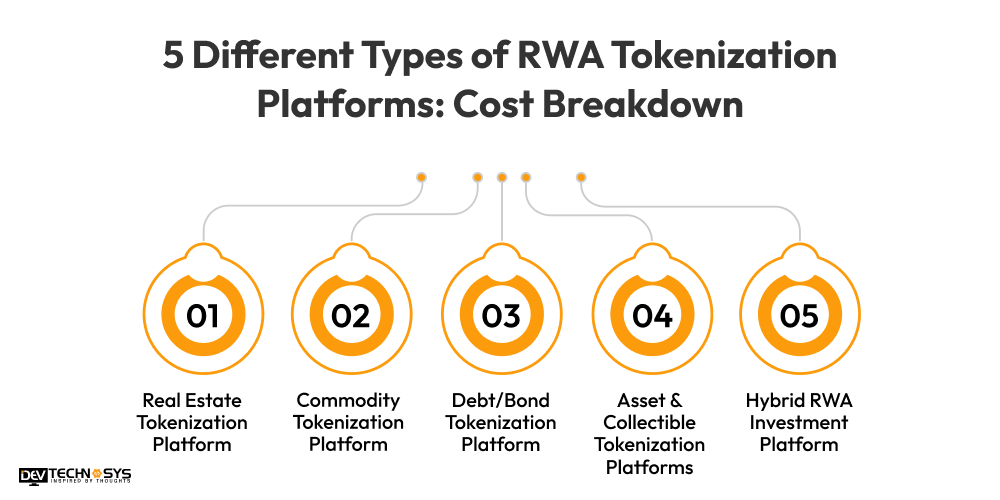
1. Real Estate Tokenization Platform
The process of turning physical assets into digital tokens so that they can be owned, traded, and invested in is known as tokenization. This type of platform can also provide property listings, a system to value properties, dashboards for users to see their investments as well as smart contracts and compliance tools. Allowing for a more efficient way for people all over the world to invest in real estate.
2. Commodity Tokenization Platform
The commodity tokenization platform allows for the digitization of physical assets, such as gold, oil, grains, or other produce grown on farms, turning them into blockchain tokens.
Tokenizing these assets gives buyers and sellers visibility and real-time pricing; it also tracks who owns these assets. This allows for commodities to be traded throughout the world, providing better access to the market and reducing entry costs to enter the market.
3. Debt/Bond Tokenization Platform
The debt/bond tokenization platform creates a tokenized version of traditional financial assets based on loans and bonds. Using this technology to turn these assets into tokens will improve the transparency of asset ownership, help to automate the process of distributing interest payments, improve liquidity, and provide fractional ownership to more people. Thus, there will be more possibilities for investors to participate in fixed-income markets around the world.
4. Asset & Collectible Tokenization Platforms
An asset and collectible tokenization platform provides a way to convert high-value assets into digital assets. Thus enabling fractional ownership and global trading opportunities by creating provenance and authenticity, disassociated smart contracts, and a marketplace for rare assets. Ultimately, making rare assets more liquid, accessible, and secure for investors on a global scale.
5. Hybrid RWA Investment Platform
A hybrid RWA investment platform serves as a supporting multiple asset classes to deliver diversified investment options, deliver access to a multitude of advanced portfolio management systems, support cross-asset trading, and allow for aggregated compliance. Thereby creating an all-in-one ecosystem in the form of a platform for institutional and retail investors.
RWA Tokenization Platform Type |
Estimated Cost (USD) |
| Real Estate Tokenization Platform | $8,000 – $15,000 |
| Commodity Tokenization Platform | $15,000 – $20,000 |
| Debt/Bond Tokenization Platform | $20,000 – $25,000 |
| Asset & Collectible Tokenization Platform | $18,000 – $24,000 |
| Hybrid RWA Investment Platform | $15,000 – $30,000+ |
What Type of Factors Can Impact the RWA Tokenization Platform Development Cost?
There are multiple important factors that will affect the cost to develop an RWA tokenization platform. All of these factors will also affect scalability, the amount of effort to develop each aspect of your RWA tokenization platform, and the total amount of capital required to establish a secure, compliant, and effective ecosystem for your RWA tokenization.
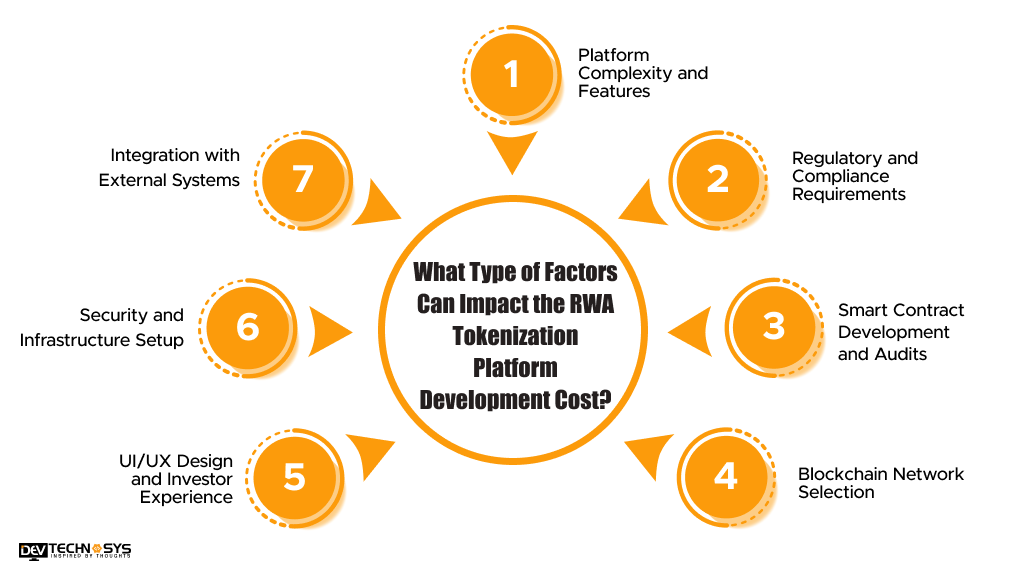
1. Platform Complexity and Features
The RWA tokenization platform development cost is reliant on the level of complexity of the type of tokenization system being developed. Basic tokenization systems are generally less expensive; whereas, more complex tokenization systems with features like fractional ownership, secondary trading, compliance (KYC/AML), and multi-chain support, will generally require more development time, require more skilled blockchain developers to complete, and incur higher CEX development services costs.
Level |
Description |
Cost Impact |
| Basic MVP Platform | Single asset tokenization with a simple dashboard | Low |
| Multi-Asset Platform | Supports real estate, bonds, and commodities | Medium |
| Advanced Ecosystem | Fractional ownership + secondary trading features | High |
2. Regulatory and Compliance Requirements
There are multiple regulations that exist that outline the legal requirements necessary for creating a compliant financial system (KYC, AML, Securitize). Depending upon which region the RWA platform is developed, there could be varying levels of complexity or overlapping regulatory requirements.
Building compliant RWA platforms requires extensive legal consultations, multiple verification systems, and the ability to perform continuous updates, significantly increasing the overall RWA tokenization platform development cost.
Level |
Description |
Cost Impact |
| Basic KYC Setup | Simple identity verification system | Medium |
| AML & Reporting Integration | Transaction monitoring and regulatory reports | High |
| Full Legal Compliance Suite | Multi-country compliance with legal audits | Very High |
3. Smart Contract Development and Audits
Smart contracts provide the entire ecosystem for RWA tokenization by automating the tokenization, ownership, and transaction processes. As smart contract development services become more complex, they take longer to develop and increase the overall cost of development.
In addition, security vulnerability testing and third-party certifications of a smart contract must be completed to ensure the safety and to prevent any potential exploits of these smart contracts, therefore representing a significant portion of the overall tokenized real estate platform cost.
Level |
Description |
Cost Impact |
| Basic Token Contracts | Simple asset token creation logic | Medium |
| Advanced Smart Contracts | Ownership transfer + revenue distribution logic | High |
| Fully Audited Contracts | Third-party audits + penetration testing | Very High |

4. Blockchain Network Selection
The cost of a project will be affected by which blockchain platform (Ethereum, Polygon, or Avalanche) is chosen, as they all have different issues associated with scalability, gas fees, ease of integration, etc.
If a developer is building a multi-chain solution, they will have additional work to do because they will have multiple APIs, interfaces for interoperability, as well as infrastructure to create when building or deploying a project, which increases the overall cost of Ethereum development services.
Level |
Description |
Cost Impact |
| Single Blockchain | Ethereum or Polygon integration only | Medium |
| Dual-Chain Support | Two blockchain interoperability setups | High |
| Multi-Chain Ecosystem | Cross-chain bridges and full interoperability | Very High |
5. UI/UX Design and Investor Experience
A quality UI will help instill confidence in the investor and allow for better use of the platform. The types of requirements needed to build the project include developing dashboards, asset lists, transactional flows, and reporting capabilities; therefore, they require highly skilled UI/UX professionals. The more complex and interactive a design is, the greater the development time and the increased out-of-pocket cost for designers will be.
Level |
Description |
Cost Impact |
| Basic Dashboard | Simple investor and admin interface | Low |
| Advanced UI Design | Interactive analytics and asset tracking | Medium |
| Premium Experience | Real-time data visualization + mobile apps | High |
6. Security and Infrastructure Setup
Security is very important for RWA platforms due to the value of the digital assets involved. The added costs of implementing encryption, penetration tests, cloud solutions, and continuous monitoring will increase the total investment.
In addition, to protect against fraud, hacking, and data breaches, advanced security systems and audited firms must be in place, which raises the total cost of DeFi development services.
Level |
Description |
Cost Impact |
| Basic Cloud Hosting | Standard server setup and encryption | Medium |
| Advanced Security Layer | DDoS protection + encryption protocols | High |
| Enterprise Security System | Continuous monitoring + audits + backups | Very High |
7. Integration with External Systems
Banking APIs, payment gateways, oracles, and identity verification systems create additional complexity to your overall RWA tokenization platform development cost. Custom integrations take additional time to develop, test, and maintain. Raising your total upfront cost as well as your long-term operational cost for your entire Platform.
Level |
Description |
Cost Impact |
| Basic Wallet Integration | MetaMask or similar wallet support | Medium |
| Payment & API Integration | Fiat gateways and banking APIs | High |
| Full Ecosystem Integration | Oracles, exchanges, and Ondo finance systems | Very High |
What are the Hidden Costs of RWA Tokenization Platform Development?
RWA tokenization platforms also incur several hidden costs that businesses can sometimes miss when estimating a real world asset tokenization cost in 2026, including but not limited to the following: legal compliance fees, ongoing security auditing fees, ongoing infrastructure scalability expenses, and other ongoing costs associated with 3rd party integrations.
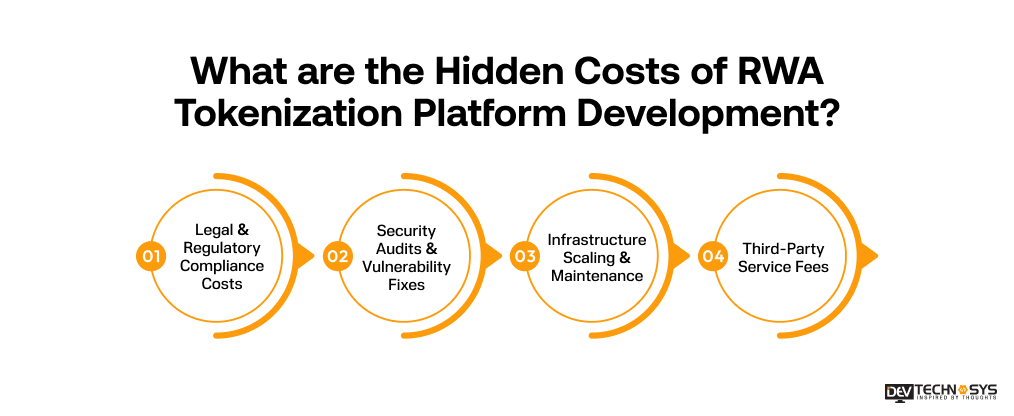
1. Legal & Regulatory Compliance Costs
Many hidden costs exist in the legal area due to the ever-changing nature of regulations, ongoing updates to licensing, jurisdictional approvals, and legal consultations. RWA can start its operations with compliance costs being one of the largest ongoing expenses. This compliance cost continues to grow as regulations change at local, state, and national levels, and is especially compounded.
2. Security Audits & Vulnerability Fixes
In addition to initial development, RWA incurs many other hidden costs throughout the ongoing process of performing continuous audits, security penetration testing on smart contracts, and fixing bugs.
As technology advances by way of new threats, additional costs associated with repeating audits, as well as conducting emergency patching and obtaining third-party audit reviews, will continue.
3. Infrastructure Scaling & Maintenance
As demand for services grows, RWA will need to provide its customers with scalable solutions such as cloud-based infrastructure, upgraded nodes, expanded storage, and performance improvements.
There are many ongoing operational costs associated with providing available scalable solutions for customers; however, initial budgeting does not account for these types of expenses.
4. Third-Party Service Fees
The hidden costs of integrating Know Your Customer (KYC) and Anti-Money Laundering (AML) vendors, payment processors, oracle services, and banking Application Programming Interfaces (APIs) add significantly to the long-term operating cost of RWA Platforms because most of these will require recurring fees, API usage fees, or licensing fees.
RWA Platform Development Team Structure
The individuals who will work together for web3 development services will include: Blockchain developers, smart contract engineers, backend and frontend developers, UI/UX designers, QA testers, and compliance professionals.
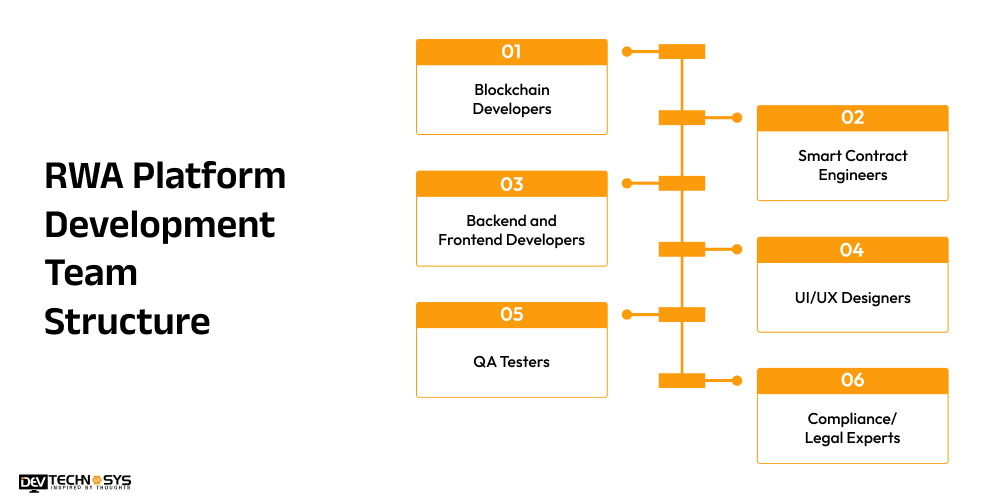
1. Blockchain Developers
The RWA platform’s blockchain developers create the basic blockchain infrastructure of RWA. The developers are responsible for integrating the blockchain with the node setup, interacting with the consensus mechanism to verify and validate transactions, and communicating through the network of nodes in the blockchain.
2. Smart Contract Engineers
Smart contract engineers develop and implement the underlying logic that drives the tokenization of an asset, the transfer of ownership of the asset, and the automated execution of transactions. Engineers must verify that their code for the smart contracts is free of errors or inefficiencies to help facilitate fractional ownership.
3. Backend and Frontend Developers
Backend developers create and manage the servers, application programming interfaces (APIs), databases, and system architecture, while frontend developers create the interface that users will see when they access the platform. Collaboratively, both groups of developers ensure that the platform runs efficiently and that the data flows within the platform.
4. UI/UX Designers
User interface and user experience designers design visually appealing, user-friendly interfaces for financial agents and owners. They are concerned with how a user travels through the interface, how the user will access data dashboards, and how users will navigate through the platform effectively using accessibility features.
5. QA Testers
Quality Assurance testers are responsible for ensuring that the platform functions correctly and does not contain any bugs or security vulnerabilities. The QA testers perform functional, security, and usability tests on the platform.
6. Compliance/Legal Experts
Compliance and legal specialists are responsible for ensuring that the platform complies with all applicable financial regulations, including the KYC, AML, and securities laws. The Compliance and Legal Specialists also guide the platform’s licensing, jurisdiction, and documentation.
Team Role |
Responsibility |
Estimated Cost (USD) |
| Blockchain Developers | Build blockchain integration, network setup, and decentralized infrastructure | $15,000 – $20,000 |
| Smart Contract Engineers | Develop secure tokenization logic, ownership rules, and transaction automation | $8,000 – $15,000 |
| Backend & Frontend Developers | Develop APIs, databases, UI systems, and user-facing platform features | $7,000 – $12,000 |
| UI/UX Designers | Design dashboards, investor interfaces, and user-friendly navigation systems | $5,000 – $10,000 |
| QA Testers | Perform functional, performance, and security testing of platform components | $5,000 – $8,000 |
| Compliance/Legal Experts | Handle KYC/AML, regulatory compliance, licensing, and legal documentation | $6,000 – $11,000 |
Want a chatbot demo or pricing? Fill the form and talk to our experts today.
Pick what you need below — you can select more than one — then tap Get detail to continue.
-
Chatbot demo dashboard
-
Cost to develop an app
-
Industry report
-
Case study
Security and Compliance for an RWA Tokenization Platform
The basis of a trustworthy RWA tokenization platform is formed by security and compliance. Verification of assets, auditing of smart contracts, KYC and AML checks, safe custody of assets, encryption of data, compliance assessments, and a transparent audit trail contribute to the protection of tokenized assets, transactions, and investors.
1. Verification and Ownership of Assets
Any RWA platform should be able to authenticate any real-world asset associated with it, as well as ownership documentation, appraisal data, and other relevant documents before initiating the tokenization process. Efficient verification operations eliminate financial fraud, duplication of claims, incorrect estimation, and illegal issuance of tokens.
2. Security of Smart Contracts
Tokenization uses smart contracts for token issuance and transfer, tracking ownership, making distributions, and redeeming tokens. Using expert auditing, automated testing, access control techniques, and vulnerability assessment helps remove the risk of unauthorized minting, unwanted reentrancy, logic mistakes, and hacked administration functions.
3. KYC and AML Compliance
Depending on the assets they are managing, some RWA platforms may require their clients to use KYC and AML methods. Verification of personal identities, screening for any sanctions, checking if investors are eligible, monitoring transactions, and conducting risk evaluations should help RWA platforms comply with any financial crime prevention requirements for the jurisdictions where they work.
4. Privacy And Protection of Information
Tokenization solutions can use personal and financial details of the investor, such as identity, financial details, transaction history, and ownership information. Certain tools such as encryption and secure authentication, role-based access, data minimization, and retention measures work to secure information and comply with privacy rules.
5. Compliance In Regulations And Securities
The legal nature of tokenized assets can change in accordance with the type of asset and government policies. It is important to study all regulations relating to securities, financial services, property laws, taxes, consumer protections, and rules on digital assets prior to launching tokenization.
6. Safe Custody Of Digital Assets
Digital assets that are tied to real ownership should use a safe custody mechanism. For example, it is possible to protect the tokens by means of multi-signature wallets, hardware protection, rules and limits on transactions, and roles of people involved in transactions.
How to Reduce the RWA Tokenization Platform Development Cost in 2026?
To reduce the real world asset tokenization cost 2026, it will be necessary to effectively plan ahead by creating an MVP. Choosing the lowest cost blockchain technology, utilizing pre-built smart contracts, engaging with a team of experienced and knowledgeable experts, and using available third-party APIs.
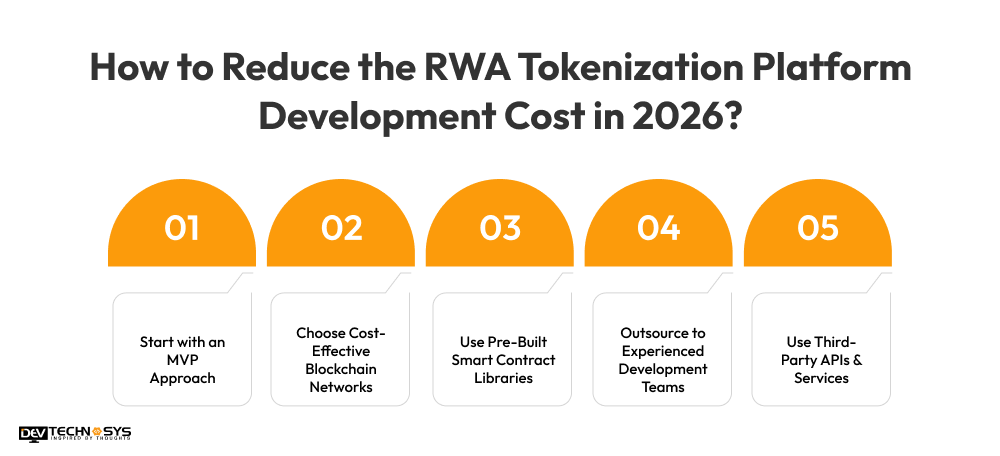
1. Start with an MVP Approach
You can save real-world assets platform development time by building a Minimum Viable Product (MVP). When creating an MVP, you are only using your core or fundamental tokenization capabilities.
Although you may have to start out with basic functionalities. The RWA tokenization MVP cost breakdown will enable businesses to test the market and grow with additional functionalities based on what people actually want, rather than just building everything at once.
2. Choose Cost-Effective Blockchain Networks
To reduce your real-world asset tokenization cost in 2026, you should look for low-cost/blockchain platforms that offer scalability, low transaction fees, and low infrastructure costs.
If you choose to avoid high-cost blockchain platforms initially, you can maximize the value of your development budget. While developing a viable tokenization platform with performance, security, and interoperability capabilities.
3. Use Pre-Built Smart Contract Libraries
Third, pre-built smart contract libraries, such as OpenZeppelin, help reduce coding time, the amount of work needed to develop your smart contract, and the potential risk associated with coding errors. By using pre-built frameworks, you will not only reduce the amount of time and effort needed to code your RWA tokenization development solution.
4. Outsource to Experienced Development Teams
If you work with an experienced company or hire experienced teams to work on the project, the costs for hiring, training, and building a new system will be greatly reduced.
Experts can produce faster development cycles, with lower numbers of errors, and better-designed architectures than a new company would. This means your overall costs and efficiency associated with the project will be reduced.
5. Use Third-Party APIs & Services
By using ready-made APIs for all of your KYC, AML, wallets, and payments, you will need to perform less custom RWA tokenization platform development. The use of third-party services will provide the ability to implement immediately, lower the ongoing costs of maintaining those services, and provide a means of meeting financial regulations without building everything from scratch.
How Long Does It Take to Launch a RWA Platform?
The RWA development timeline 2026 can vary by complexity, but typically takes 3-6 months to complete. The phases of launching include planning, UI/UX development, smart contract coding, backend development, security auditing, and ultimately deployment.
If the platform contains any advanced features, additional compliance requirements, or requires a custom-built blockchain to function (private vs public in nature), etc., the timeline can extend well beyond the 3-6 month window.
Development Stage |
Estimated Timeline |
Key Activities |
| Planning & Research | 1–2 Weeks | Business model, compliance analysis, feature planning |
| UI/UX Design | 2–3 Weeks | Wireframes, platform design, user experience creation |
| Smart Contract Development | 3–5 Weeks | Asset tokenization logic, staking, transaction contracts |
| Backend & Frontend Development | 4–8 Weeks | Dashboard, APIs, wallet integration, admin panel |
| Security Testing & Audit | 2–4 Weeks | Bug fixing, penetration testing, smart contract audits |
| Deployment & Launch | 1–2 Weeks | Mainnet deployment, optimization, final release |
| Total Estimated Time | 3–6 Months | Depends on platform complexity and customization level |
5 Monetization Model of RWA Tokenization Platforms
Through the various monetization models, NFT token development services generate multiple forms of revenue to produce consistent income while supporting scalability, liquidity and ongoing long-term growth of the platform’s overall ecosystem.
As a result, RWA tokenization platforms are expected to be highly lucrative businesses in the current and future development of the blockchain-based marketplace.
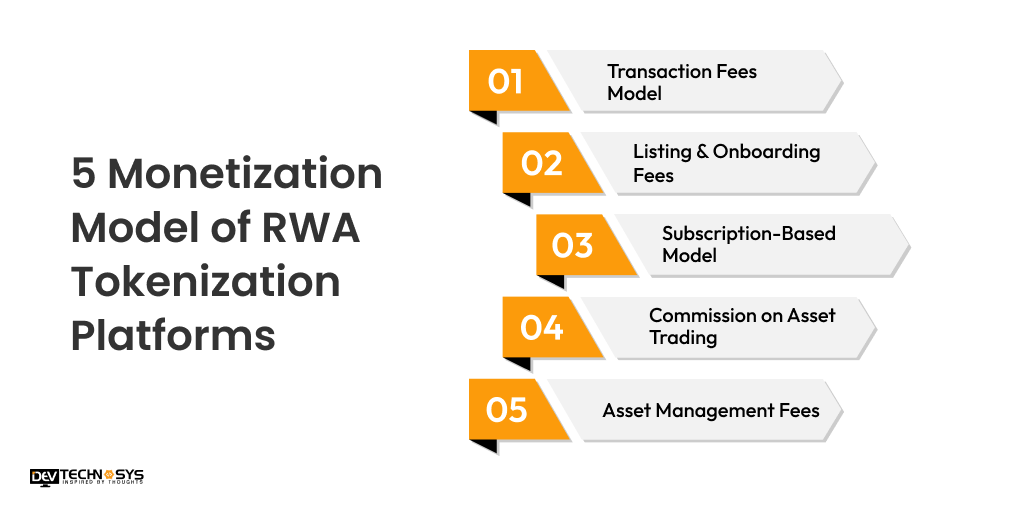
1. Transaction Fees Model
A company or organization can earn money through a variety of revenue models associated with RWA. They will charge a small fee for the tokenization of assets, as well as for transferring or trading those assets.
Those transaction fees will be charged to buyers and sellers and act as a consistent stream of income for RWA platforms as more people use the platform to buy and sell assets and as trading volumes and activity on the platform increase.
2. Listing & Onboarding Fees
For asset owners or businesses wishing to list their real-world assets on the platform, they will also incur a fee to do so. That fee is used to verify the asset and create the necessary documentation to process the asset for listing, as well as to set up the smart contract.
As a result, listing real-world assets becomes a strong source of revenue for RWA platforms, especially when the asset has a high value and can be tokenized.
3. Subscription-Based Model
Another method for generating revenue for AI token development solutions is to offer premium subscription plans to their users. These premium subscription plans can include many additional features, such as advanced analytics, outstanding priority support, upgraded dashboards, and early access to new investment opportunities.
4. Commission on Asset Trading
RWA platforms receive commission on transactions of tokenized assets made in a secondary market. Thus, RWA platforms establish a consistent, ongoing source of revenue through daily asset trading, while enhancing the ecosystem with secondary market liquidity, customer activity, etc.
5. Asset Management Fees
Similar to traditional financial firms, each platform maintains custody partnerships with third-party service providers for securely managing the physical assets underpinning each tokenized asset and rendering custody services. According to the DEX development company, these services typically include storage, legal handling, audit services, and compliance services.
White-Label vs Custom Build: Which Fits Your Budget?
Deciding between a white-label solution or a custom build will depend on several factors, like budget, speed, and long-term goals. White-labeling is an inexpensive way to quickly launch your platform using these pre-built features.
However, building a platform from scratch usually requires a higher investment but provides complete flexibility, scalability, and unique capabilities when compared to pre-built solutions. By selecting the correct model, you can align your platform strategy with your organization’s growth and technical needs.
Factor |
White-Label Build |
Custom Build |
| Initial Cost | Lower upfront investment | High development cost |
| Development Time | Fast launch | Longer timeline |
| Maintenance Cost | Included/low | Ongoing higher cost |
| Customization | Limited flexibility | Fully customizable |
| Features | Pre-built features | Tailor-made features |
| Scalability | Moderate growth support | High scalability potential |
| Best For | Startups, quick entry | Enterprises, long-term vision |
How Does Dev Technosys Help to Develop an RWA Tokenization Platform?
Through our end-to-end blockchain development service, Dev Technosys builds next-generation RWA and BlackRock tokenization platforms. We include the design and implementation of blockchain solutions as well as the integration of smart contracts, KYC and AML compliance, fractional ownership systems, and secure up-to-date infrastructure.
Dev Technosys is an RWA tokenization development company that has over 15 years of experience with more than 1500 completed projects and has an experienced team consisting of over 180 developers. We work with companies worldwide to provide scalable, compliant, and high-performance RWA tokenization solutions.
Final Words!
To build a successful RWA Tokenization Platform by 2026, careful planning will take place throughout development, compliance, security, and infrastructure, so that the processes are established for longevity.
The expected costs of a tokenization platform will also vary according to the complexity of the solution built, from MVPs to full enterprise solutions with regulatory compliance and multi-chain capabilities. All components, from smart contracts to investor dashboards, contribute to the cost of the final build.
The relationship with a trusted blockchain development company helps streamline development and minimize risks associated with launching a compliant, scalable, and secure solution.
Frequently Asked Questions
Find answers to the most common questions related to this article.
The cost typically ranges from $8,000 to $28,000+, depending on features, compliance, and complexity. Basic platforms are cheaper, while enterprise-grade solutions with multi-chain support, KYC/AML systems, and advanced security require significantly higher investment and long-term maintenance budgets.
Key factors include platform complexity, blockchain selection, regulatory compliance, smart contract development, UI/UX design, security audits, and third-party integrations. Each factor influences development time, required expertise, infrastructure needs, and overall project scalability and operational cost structure.
Development typically takes 3 to 6 months, depending on complexity. MVP platforms take less time, while enterprise-grade systems with compliance, multi-chain integration, and advanced features require longer timelines due to development, testing, and regulatory approval processes.
Smart contract audit cost for tokenization lies between $10,000 and $15,000+, depending on complexity. Audits ensure security, identify vulnerabilities, and prevent exploits, making them essential for trust and regulatory compliance in RWA platforms.
Hidden costs include legal updates, compliance changes, security audits, infrastructure scaling, and third-party API fees. These ongoing expenses often exceed initial budgets if not properly planned during development and deployment phases.