





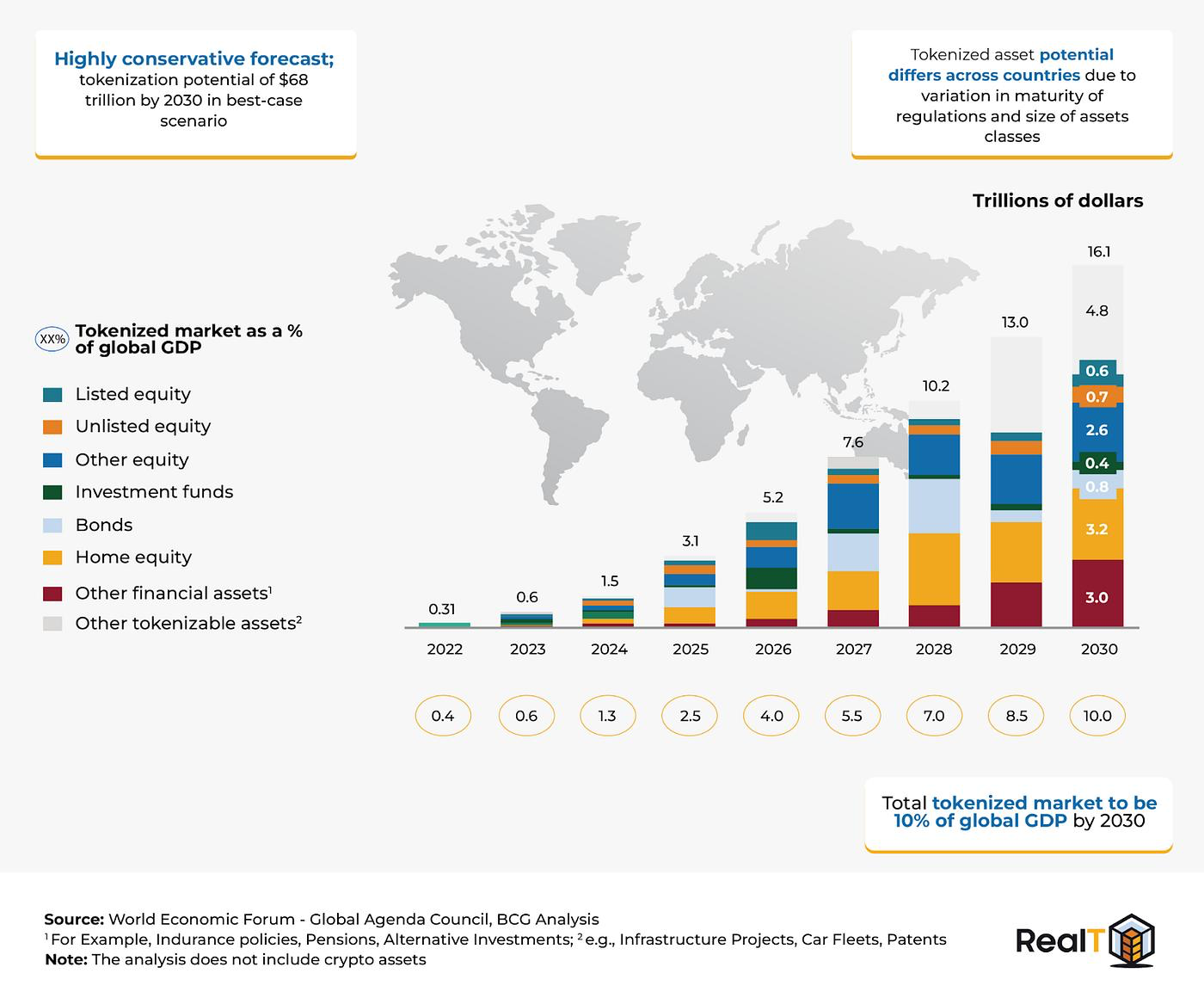
Building a platform to turn physical things into digital tokens that can be bought, sold, and used like money is changing how we think about owning and trading assets. From buildings to gold to expensive jewelry and stocks, more and more companies are using tokenization technology to make these things easier to sell, see, and even own a piece of. By 2030, it’s estimated that this market will be worth more than $16 trillion, showing how popular and important secure digital asset systems are becoming.
In this we’ll give you the definitive guide to building an RWA tokenization platform in 2026; including what it’s made of, what to look out for, how it should be developed and how to launch it. From small business owners to large institutions, whether you’re a techie at heart or a financial institution, this guide will equip you with the technicalities, the legislation and business models to build an RWA tokenization platform.
What is RWA Tokenization Platform?
An RWA tokenization Platform services uses blockchain to convert physical or tangible items like land, gold, art, or other goods into digital tokens. These platforms make it easy to pass ownership of assets, buy tiny fractions of them, increase how easy they are to buy and sell, and ensure that transactions are clear and available to anyone in the world. It’s made even simpler by using smart contract technology for asset management and trading.
Market Stats of RWA Tokenization Platform
- The total value of the RWA tokenization market globally is predicted to reach $16 trillion by 2030, thanks to increased adoption by major companies and growing interest in digital assets.
- The market for on-chain RWAs was nearly $27.7 billion in 2026, an increase of over 300% from 2025.
- Industry experts expect the tokenized asset market to expand from $10 trillion to $30 trillion globally by 2030.
- It’s anticipated that real estate will become the largest industry for RWA tokenization, leading to significant opportunities for investment and liquidity.
- With institutional acceptance rising, over 500,000 investors worldwide are now actively involved in tokenized real-world asset platforms.
Why Entrepreneurs Won’t Build an RWA Tokenization Platform?
The rapid proliferation of blockchain and digital investments is prompting the entrepreneurial space to develop new RWA tokenization platforms providing more liquidity, transparency, global accessibility, and business opportunities to a multitude of industries.
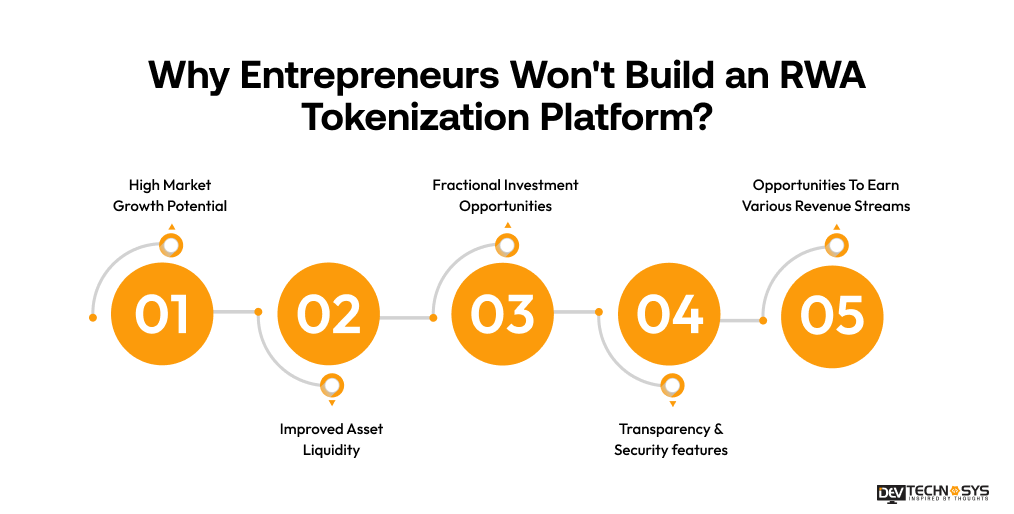
1. High Market Growth Potential
Entrepreneurs are investing in AI token development solutions because the booming blockchain market presents abundant possibilities for digital asset trading, fractional ownership, and worldwide investor participation.
2. Improved Asset Liquidity
Digital securities platforms digitize illiquid physical assets and are ideal for making these assets more translatable, increasing their liquidity, and offering new opportunities to companies and investors across the globe.
3. Fractional Investment Opportunities
Solidity development solutions are also providing a medium for users to invest in fractional assets, providing an opportunity to own parts of valuable assets to the globe.
4. Transparency & Security features
Blockchain helps enable an immutable ledger, transparent transaction flow, and secure smart contracts. According to the enterprise blockchain development company, which enables entrepreneurs to establish investor trust while eliminating the potential for fraud.
5. Opportunities To Earn Various Revenue Streams
As entrepreneurs, one can generate revenue through transaction fees, listing charges, asset management services, subscriptions and/or commissions earned on the secondary market transactions.
5 Steps to Build an RWA Tokenization Platform in 2026
For creating well-structured fintech tokenization solutions, it is vital to understand the right approach and also focus on security, legal compliance, and infrastructure required to create a secure and transparent RWA tokenization platform in 2026. Here is a list of the essential steps to consider while developing a RWA tokenization platform:
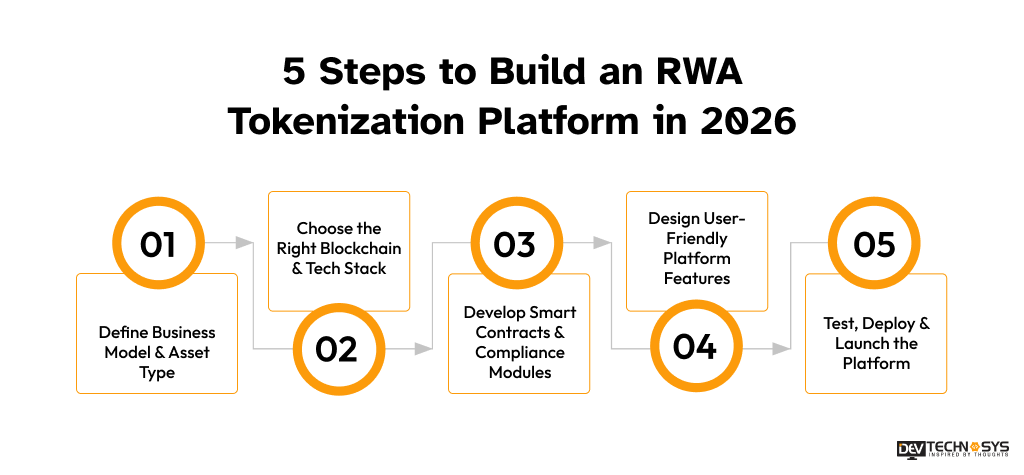
- Define Business Model & Asset Type
In the first place, hiring a reliable RWA tokenization platform development company is very essential to work out a sound business model, define the target users and know which kind of assets you are willing to tokenize. Whether it be real estate, commodities, art, or securities you want to tokenize, the development partner will help you choose between legal entities, types of ownerships, monetization strategies as well as the blockchain network needed.
- Choose the Right Blockchain & Tech Stack
The right RWA tokenization development company would recommend a specific blockchain network like Ethereum, Polygon or Solana among many others depending upon scalability, transaction speed and security offered. Additionally, the development company can define the smart contracts, APIs, wallet integrations, database technologies and backend structure required to efficiently manage and issue tokenized assets.
- Develop Smart Contracts & Compliance Modules
The RWA tokenization development company will code secure smart contracts which can help in asset tokenization, handling asset ownership, issuing dividends, and automating transactions, and so on. Additionally, KYC/AML verification, identity management systems, regulatory compliance modules, and legal documentation components can be integrated to comply with financial regulations. These modules help in providing a sense of security and fraud protection to the investors and the entire platform.
- Design User-Friendly Platform Features
A professional and experienced RWA tokenization platform development company will focus on designing user-friendly and intuitive user interfaces for administrators, investors, and asset owners that simplify the usage of the platform. The features of the RWA tokenization platform development may include user onboarding, digital wallets, real-time asset tracking, token trading dashboards, payment gateways, portfolio management, analytics, and a number of other functionalities that are required to increase user trust and loyalty over time.
- Test, Deploy & Launch the Platform
After RWA tokenization platform development, the development company should thoroughly perform tests such as smart contract testing, cybersecurity tests, performance analysis, compliance, and fraud detection tests to ensure the platform is up to standards before launch. Once all these bugs are fixed and the platform’s security and scalability have been upgraded, the platform will be ready to be launched on the specified blockchain network. Maintenance, support, and updates are some services provided by the development company that help to improve the platform’s growth in the long term.
MVP vs Custom Development: Which Is the Best Method to Develop an RWA Tokenization Platform Like RealT?
| Aspect | MVP Development | Custom Development |
| Development Cost | Lower initial investment with essential features and faster deployment. | Higher cost due to advanced customization, scalability, and enterprise-grade integrations. |
| Time to Market | Faster launch, usually within a few months for market testing. | Longer development timeline because of complex architecture and tailored functionalities. |
| Features & Functionality | Includes basic tokenization, wallets, KYC/AML, and marketplace features. | Supports advanced features like AI analytics, DAO governance, cross-chain compatibility, and automation. |
| Scalability | Limited scalability suitable for startups and initial users. | Highly scalable infrastructure for handling large investor bases and multi-asset ecosystems. |
| Customization Level | Minimal customization with predefined workflows and templates. | Fully customizable design, business logic, smart contracts, and user experience. |
| Security & Compliance | Basic security measures and standard compliance integrations. | Enterprise-level security, advanced audits, legal frameworks, and regulatory compliance modules. |
| Maintenance & Upgrades | Easier and cheaper to maintain initially. | Requires dedicated technical support and ongoing infrastructure management. |
| Best For | Startups validating business ideas with limited budgets and faster market entry. | Enterprises seeking long-term growth, competitive advantage, and complete platform ownership. |
| User Experience | Simple interface with limited advanced functionalities. | Personalized and feature-rich experience for investors, administrators, and asset owners. |
| Revenue Potential | Moderate revenue opportunities during early-stage operations. | Higher long-term revenue potential through advanced monetization and premium investment services. |
How Much Does It Cost to Build an RWA Tokenization Platform in 2026?
The development costs to create an RWA tokenization platform in 2026 can range from $8,000 to $30,000+, depending on the platform features, blockchain network chosen, security requirements, regulatory features, and level of customization. A more complex enterprise-grade platform, that includes features like smart contracts, A.I. Analytics and multi-asset capabilities would carry a higher cost to develop an RWA tokenization platform.
| Cost Factor | Estimated Cost Range |
| Platform Complexity & Features | $2,000 – $8,000 |
| Blockchain Network Selection | $1,500 – $5,000 |
| Smart Contract Development | $2,000 – $6,000 |
| Compliance & Security Requirements | $1,500 – $5,500 |
| UI/UX Design & Third-Party Integrations | $1,000 – $5,500 |
| Overall Estimated Cost | $8,000 – $30,000 |
- Complexity & Features
The number of features you opt to integrate on the platform heavily influences the RWA tokenization platform development cost. The cost of building basic platforms capable of token issuance and wallet integration will be significantly lower than creating complex solutions with multi-asset support, AI analytics, staking and trading dashboards, investor management tools, and other services. The richer the functionalities on your platform, the more you can expect to spend in development hours and resources.
- Blockchain Network Selection
The blockchain network chosen impacts your RWA platform’s transaction costs, efficiency, and ultimately, development expenses. While the Ethereum development network offers more robust tooling, its gas fees and smart contract costs can be high, compared to Polygon and Solana, which have lower transaction fees. Integrating with multi-chains, private chains, and other networks may further increase complexity and associated infrastructure expenses.
- Smart Contract Development
Proper smart contract development is necessary in order to facilitate token generation, manage ownership, enable transactions, and ensure compliance with the rules governing the smart contract, such as dividend payment. It is necessary to hire expert blockchain developers and security professionals to code the custom smart contracts. The more advanced the smart contract is with its functions and automations, the higher the RWA tokenization platform development cost.
- Compliance & Security Requirements
Including KYC/AML verification, data encryption, identity verification systems, and features that ensure compliance with regulations adds high costs to development. Investor protection, regulatory approval, and system security rely heavily on multiple security protocols such as penetration testing, anti-fraud mechanisms, multi-factor authentication, smart contract audits, and the implementation of various defensive measures, which add to the overall price.
- UI/UX Design & Third-Party Integrations
An intuitive and user-friendly platform interface will increase adoption and engagement among users. The integration of advanced dashboards, payment gateways, crypto wallets, APIs, cloud storage, analytics tools, and other complex third-party services will only increase the asset tokenization platform development cost. Customized UI/UX design and seamless third-party integration demand more design, development and testing.
10 Features of RWA Tokenization Platform
Any RWA tokenization platform that aims to be a market success needs to be built upon a set of essential features capable of supporting in a secure way the digitization of assets, providing a frictionless user experience for investors, keeping track of compliance management, and making ownership operations transparent for both businesses and users on a global level.
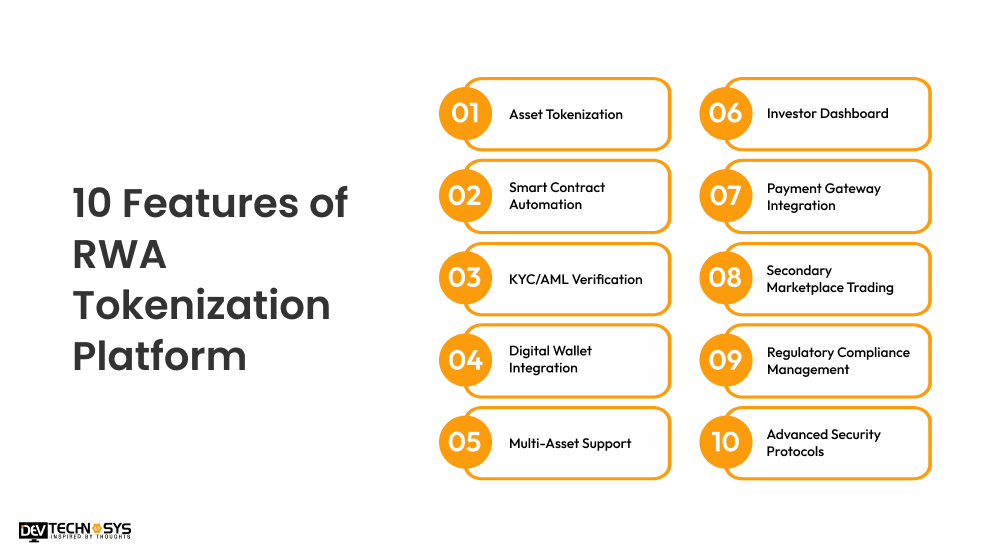
1. Asset Tokenization
Turns physical assets such as real estate, gold or art into digital tokens operating on a blockchain that facilitates fractional ownership and trading.
2. Smart Contract Automation:
Facilitates secure transactions, changes in ownership, profit distribution, and compliance operations on the blockchain without human intervention.
3. KYC/AML Verification:
Creates a secured registration for all users by authenticating the individuals and bypassing payment fraud or unauthorized transactions.
4. Digital Wallet Integration:
Tokenized real-world assets let users safely send, receive, and manage tokenized assets by providing a crypto wallet.
5. Multi-Asset Support:
Makes possible the tokenization of any type of assets that include real estate, bonds, luxury goods, and IPR, among others.
6. Investor Dashboard:
NFT asset tokenization offers real-time access to portfolios, performance, past transactions, token worth, and the recorded ownership records of assets.
7. Payment Gateway Integration:
Decentralized asset trading enables secure fiat and cryptocurrency payments to buy, sell, or trade real world asset tokenization at ease.

8. Secondary Marketplace Trading:
Facilitates a worldwide secondary marketplace to buy and sell tokens improving the liquidity in investment.
9. Regulatory Compliance Management:
Blockchain based asset management builds legal compliance tools and tax assistance alongside automatic reporting features to fulfill financial regulatory obligations in a country-wide system.
10. Advanced Security Protocols:
Ensures the safety of digital assets and users by implementing data protection through cryptography, multifactor authentication, and blockchain technology as well as regular audits of the smart contracts.
10 Advance Features Of Rwa Tokenization Platform
Key capabilities for scaling the platform intelligence and security include Artificial intelligence in smart contracts, automatic transactions and operations with smart contracts and smart tokens, blockchain based infrastructure and security, and other decentralized mechanisms that enhance decision making of the investors and their asset management processes. Let’s explore RWA tokenization platform features:
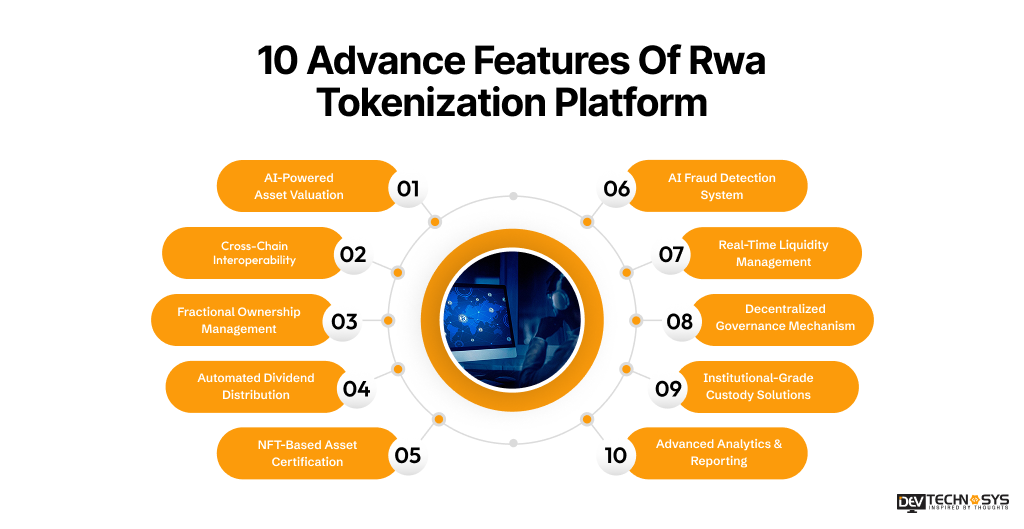
1. AI-Powered Asset Valuation
Asset digitization solutions provide real-time estimations on token value using machine learning algorithms and identifying market trends, thereby increasing the potential return on investment.
2. Cross-Chain Interoperability
Provides the capability for cross-chain compatible solutions and smart contract compatibility on multiple blockchains that enhance global accessibility and security.
3. Fractional Ownership Management
Polygon tokenization platform enables micro-ownership of high value assets by distributing small fractions of them to many investors through secure tokens on the blockchain.
4. Automated Dividend Distribution
Automatically distribute profits or returns to the token holder based on the pre-defined criteria in the smart contract.
5. NFT-Based Asset Certification
Offers the capability to manage Non-Fungible Tokens for authentic digital verification of the ownership right and the uniqueness of an asset with immutable immutability on the blockchain.
6. AI Fraud Detection System
Detects any fraudulent activity with an automated machine learning based system that checks for unusual transactions and actions and flags them for security checks.
7. Real-Time Liquidity Management
Monitors asset liquidity and demand on the platform in real time for optimized trading on the secondary market and better investment strategies.
8. Decentralized Governance Mechanism
Ensures the investors and stakeholders can vote on important platform policy decisions, upgrades and governance rules through a secure DAO system.
9. Institutional-Grade Custody Solutions
Ensures a fully compliant and secure custody of tokenized assets through secure and institutionally approved infrastructure and protections against cyber threats.
10. Advanced Analytics & Reporting
Offers comprehensive reports for investors to manage their portfolios including asset tracking, risk analysis and investment reporting.
5 RWA Tokenization Platform in 2026
There are a number of companies that are at the forefront in leading the RWA tokenization in 2026 and are able to offer scalable, compliant, and secure platforms on the blockchain for digitizing RWAs and for global investments in diverse industries with transparency.
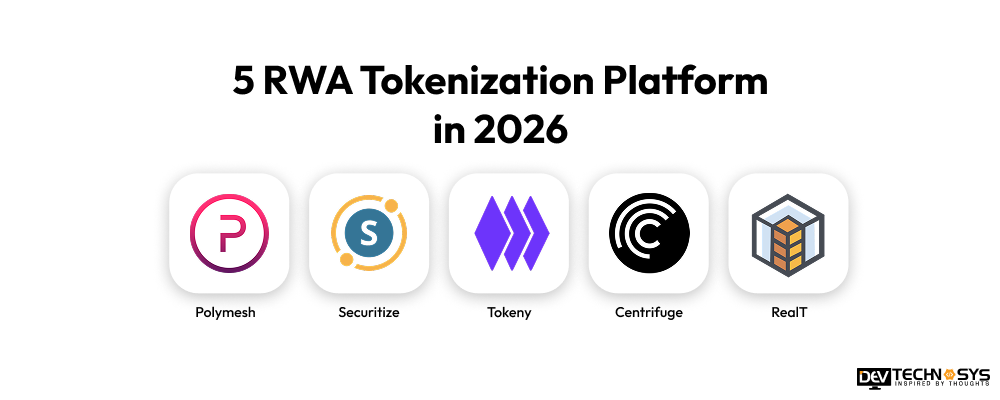
1. Securitize
Securitize is leading with the enterprise-grade RWA tokenization that it offers for private equity and investment funds, with its strong ability to be compliant and for the investors to own part of their investments by providing robust securities issuance infrastructure on the blockchain.
2. Polymesh
Polymesh has its unique advantage as a purpose built blockchain platform that is meant specifically for regulated RWAs and securities issuance, and has robust controls on compliance and security, and supports management of all financial assets through its efficient smart contracts.
3. Tokeny
Tokeny offers businesses the ability to issue their RWAs on the blockchain, with all regulatory features such as compliance and smart contract issuance services along with robust investor onboarding and management facilities for issuing securities on the blockchain.
4. Centrifuge
Centrifuge helps link RWAs to decentralized finance with its offering for businesses to tokenize various invoices and financial instruments such as real estate for leveraging financial opportunities through secured digital tokens that can be borrowed against.
5. RealT
RealT specializes in fractional ownership of tokenized real estate with its ability to divide a rental property into smaller portions that can be sold to investors on the blockchain as digital tokens.
Architecture of RWA Tokenization Platform
The RWA tokenization platform architecture comprises a multi-layered setup for secure asset digitization and management, encompassing an interface for investors and administrators, a blockchain layer for smart contracts and token creation, and a storage layer for records and documents.
The platform is also enhanced by the integration of KYC/AML verification, payment gateways, wallet services, and compliance modules to adhere to global regulations. APIs and security protocols further optimize data security, multi-chain interoperability, and seamless global trading of real-world assets.
Compliance of RWA Tokenization Platforms
In order to guarantee that all transactions of digital assets comply with the legal and financial regulations, compliance is an integral part of an RWA tokenization platform. The platform not only embeds KYC (Know Your Customer) and AML (Anti-Money Laundering) processes to check the identity of users and to prevent fraud but it also complies with data privacy laws, securities regulations, taxation policies, and smart contract auditing ensuring that operations are secure.
Regulation compliance, on the one hand, helps to maintain transparency, investor protection, and trust and on the other hand, it allows cross-border trading of assets. Besides, continuous monitoring and reporting systems guarantee that the platform remains within changing global legal frameworks.
Scope of RWA Tokenization in 2026
The dimension of RWA tokenization is projected to grow further in 2026 and impact many industries including real estate, healthcare, commodities, art, supply chain, and financial services. More and more companies adopt blockchain technology to transform physical assets into digital ones, increase liquidity of assets, permit fractional ownership, and access global investors.
The demand for decentralized finance, transparent transactions, and secure smart contracts is inevitably contributing to the growth of the market. Besides this, governments and enterprises are looking into regulated tokenized ecosystems which will open up new doors for startups, financial institutions, and investors in the changing digital asset economy.
How RWAs Differ From Crypto Native Tokens?
RWAs (Real-World Assets) are totally different from crypto-native tokens in that these tokens are backed by physical or tangible assets such as real estate, gold, commodities, or securities. Apart from their association with the ownership of tangible assets and regulated financial systems, they can also be thought of as Real World Assets (RWAs).
By contrast, crypto-native tokens such as utility or governance tokens are entirely decentralized on blockchain networks as they are not backed by any physical assets. While RWAs are oriented towards stability, regulatory compliance, and asset representation, crypto-native tokens are primarily used to facilitate decentralized applications, governance, trading, or other blockchain ecosystem-related operations.
5 Core Design Principles of a Modern RWA Architecture
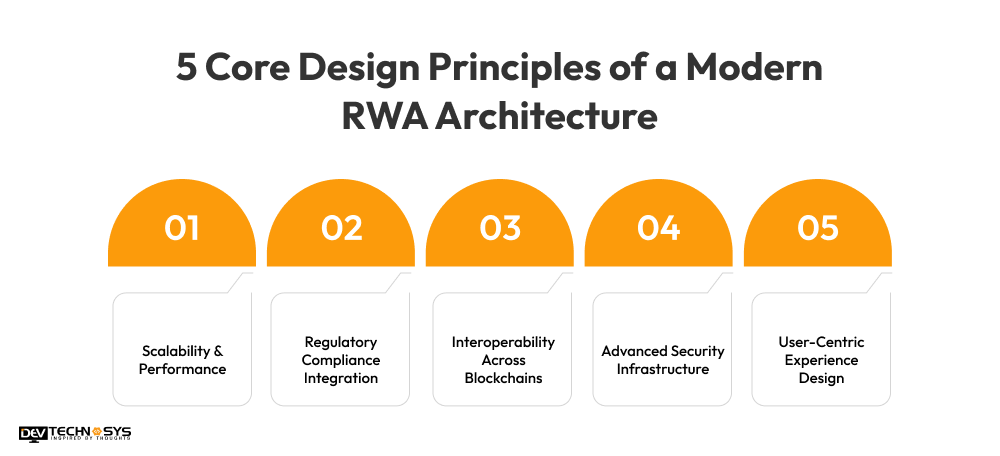
1. Scalability & Performance
Some of the features of a new RWA system include ability to handle large numbers of transactions, multi-asset management, and user interaction without compromising the speed of platform or blockchain performance.
2. Regulatory Compliance Integration
The system has to be able to accommodate the introduction of KYC/AML verification, legal documentation, taxation support, and automated compliance systems that are in line with the changing global financial regulations.
3. Interoperability Across Blockchains
Through its infrastructure, an RWA system of today should allow cross-chain compatibility for asset transfers without hiccups, offer a wider range of markets, be able to connect with multiple blockchain ecosystems as well as DeFi protocols.
4. Advanced Security Infrastructure
This involves strong encryption, smart contract code reviews, implementation of multi-factor authentication, and good management of wallets, which are key to securing tokenized assets and investors’ information against cyber attacks.
5. User-Centric Experience Design
A RWA system of today is expected to use understandable dashboards, step-by-step onboarding, asset tracking in a transparent manner, and offer transaction experiences that are smooth for investors, administrators, and asset owners.
How to Choose the Right Token Model for RWAs?
To develop a thriving RWA platform, it is a very important step to select the right token model. The chosen model should be able to support meeting regulatory requirements, secure ownership representation, scalability, liquidity, and facilitate on-chain asset management without any barriers for investors and businesses.
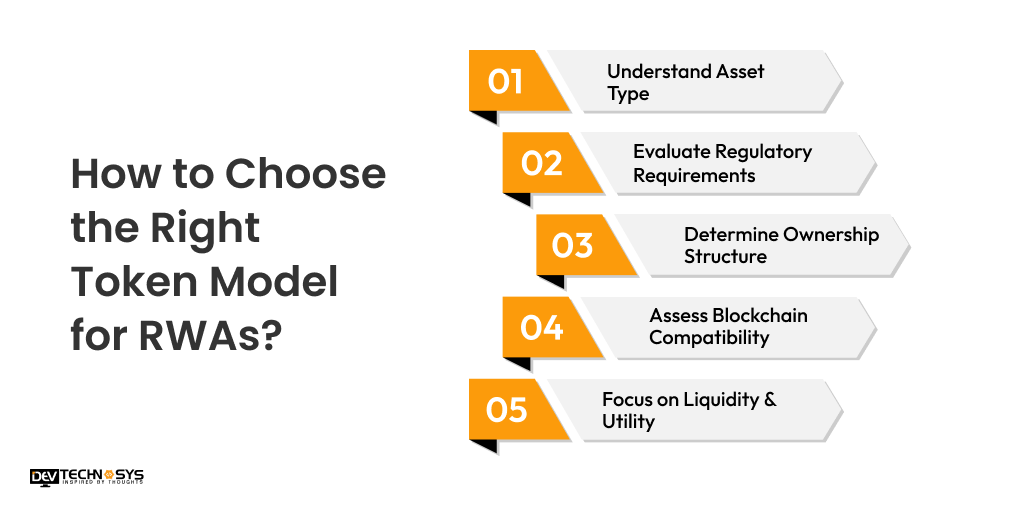
1. Understand Asset Type
Pick a token model based on the type of asset (real estate, commodities, securities, or intellectual property) to ensure accurate representation and regulatory compliance.
2. Evaluate Regulatory Requirements
Research the financial and securities laws of the regions to be operated in to ensure that the token model and operations are legally compliant.
3. Determine Ownership Structure
Choose the appropriate representation model for the token such as full ownership, fractional ownership, revenue share, or governance based on business goals and investor needs.
4. Assess Blockchain Compatibility
Use a standard compatible with the chosen blockchain platform, such as ERC-20, ERC-721, or ERC-1400 for interoperability and scalability.
5. Focus on Liquidity & Utility
The token model should facilitate ease of trading, investment mobility, staking, rewards or governance functions.
Custody, Oracles, and Data Infrastructure
- Custody Infrastructure
Custody infrastructure safely stores the tokens, private keys, and investors’ funds through robust security systems, institutional-grade security, multisig wallets, and encrypted storage. - Oracle Integration
Oracles enable blockchains to interact with real-world information by retrieving data such as market prices or asset valuations for the smart contracts to use. - Data Infrastructure
Data infrastructure securely stores and manages asset information, transaction histories, analytics and other blockchain-related information for optimal platform scalability, transparency and performance.
Governance, Risk, and Operational Controls
Governance, risk, and operational controls are crucial for any RWA tokenization platform’s security, transparency, and reliability. Governance frameworks provide decision-making processes and user roles, while risk management systems help to identify and mitigate various risks like fraud, cybersecurity threats, market fluctuations, or legal and compliance challenges.
Operational controls such as auditing, monitoring, and robust data protection mechanisms further ensure smooth platform performance and protect investor confidence. Together, these controls foster accountability and support the long-term growth of tokenized asset ecosystems.
Business Models Enabled by RWA Tokenization Platform
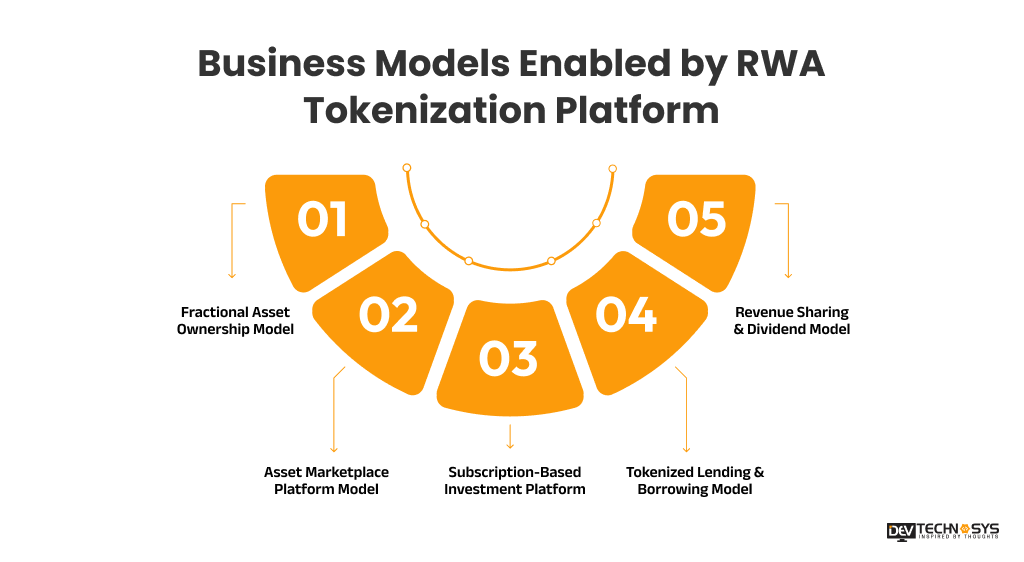
- Fractional Asset Ownership Model
RWA tokenization business model enables the purchase of fractional ownership of high-value assets like real estate, making these investment opportunities accessible to more individuals and increasing overall market liquidity. - Asset Marketplace Platform Model
Users can buy and sell tokenized assets through secured and transparent marketplaces powered by smart contracts and blockchain technology. - Subscription-Based Investment Platform
Provides premium investment services such as sophisticated trading tools, advanced analytics, personalized portfolio management and advanced trading options via a subscription model (monthly or annually). - Tokenized Lending & Borrowing Model
Enables the use of tokenized assets as collateral to secure loans, facilitating decentralized lending opportunities for businesses and individuals. - Revenue Sharing & Dividend Model
Investors gain income through rental yield or profit share through automatic smart contract distributions based on predetermined payment systems.
4 Common Pitfalls to Avoid in RWA Tokenization Platform Development
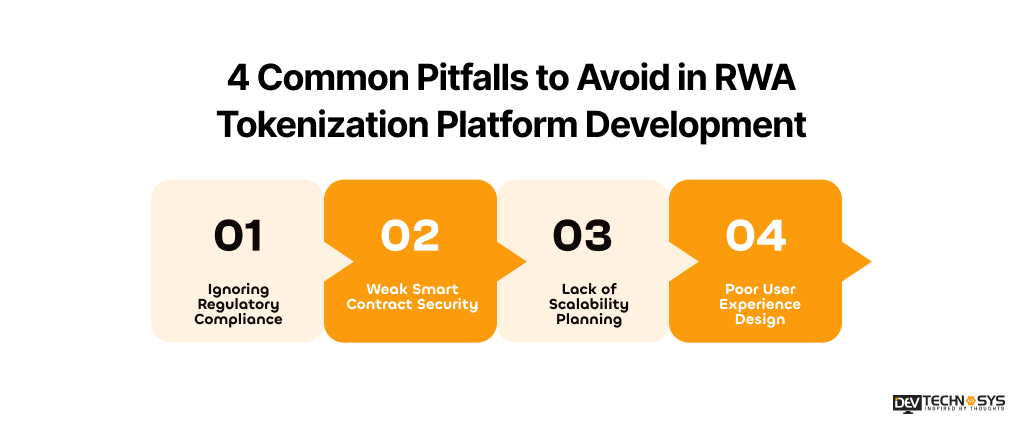
- Ignoring Regulatory Compliance
Lack of compliance with KYC, AML, and securities regulations can lead to legal ramifications, operational hindrances, and a loss of investor trust. - Weak Smart Contract Security
Weaknesses in the design or a lack of security audits can compromise smart contracts, leaving them vulnerable to hacks, theft of assets, and fraudulent activities. - Lack of Scalability Planning
A non-scalable platform can slow down transaction processing and negatively impact platform performance due to the inability to effectively handle an increasing number of users, assets, and blockchain interactions. - Poor User Experience Design
A confusing user experience, complex onboarding, and poor investment flow will inevitably deter investors and lower user adoption rates in a crowded marketplace.
How Long Does It Take to Create an RWA Tokenization Platform?
The entire cryptocurrency wallet development services cycle will generally take anywhere from 3 to 12 months, based on how many features the platform is intended to have, how many blockchains it will be integrating with, how much smart contract work is involved, and the extent to which compliance regulations need to be adhered to.
A rudimentary Minimum Viable Product for a tokenization platform with basic wallet integration and core tokenization capabilities will take approximately 3 to 5 months to complete. An advanced solution intended for use in enterprise environments that utilizes smart contracts extensively, includes smart contract features for advanced analytics, and has cross-chain compatibility and top-level security functions, can take anywhere from 9 to 12 months or more, depending on testing requirements and any required compliance procedures.
Technology Stack Required to Develop an RWA Tokenization Platform
| Technology Layer | Tools & Technologies |
| Frontend Development | React.js, Angular, Vue.js |
| Backend Development | Node.js, Python, Java, PHP |
| Blockchain Platforms | Ethereum, Polygon, Solana, Binance Smart Chain |
| Smart Contract Development | Solidity, Rust, Vyper |
| Database Management | PostgreSQL, MongoDB, MySQL |
| Wallet Integration | MetaMask, WalletConnect, Coinbase Wallet |
| KYC/AML Compliance | Jumio, Onfido, Trulioo |
| Cloud Infrastructure | AWS, Microsoft Azure, Google Cloud |
| Payment Gateway Integration | Stripe, PayPal, MoonPay |
| Security Solutions | Fireblocks, CertiK, OpenZeppelin |
| API & Integration Tools | REST APIs, GraphQL, Web3.js |
| Analytics & Monitoring | Google Analytics, Tableau, Power BI |
Revenue Model of a RWA Tokenization Platform
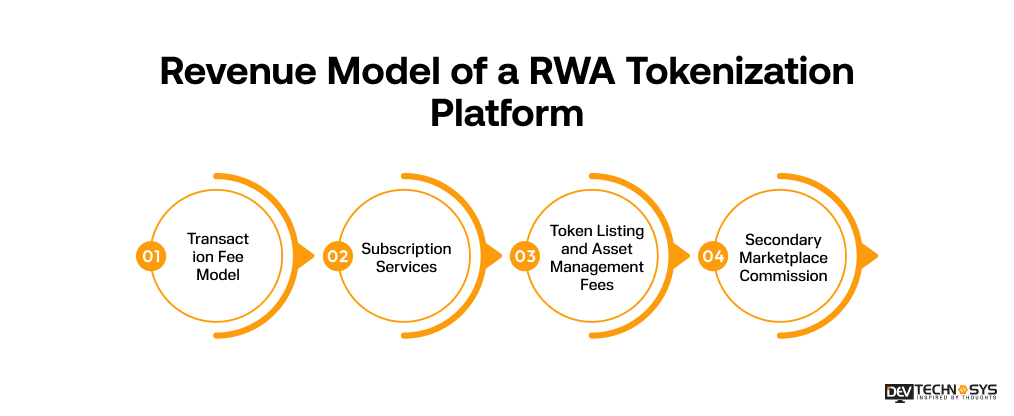
1. Transaction Fee Model
Fees on tokenization of assets, token trading, transferring ownership, and transactions happening on a marketplace by both investors and companies.
2. Subscription Services
Premium subscription service to businesses, where businesses pay a monthly or annual fee for better analytics, portfolio management, investment intelligence, better platform functionalities etc.
3. Token Listing and Asset Management Fees
Companies earn from RWA platforms in the form of token listing fee, charges for asset on-boarding, compliance processing, and services offered for the tokenized asset’s management.
4. Secondary Marketplace Commission
The company earns commission on trading that happens between individuals and on the secondary marketplace through tokenized assets. It depends on the trading volume and liquidity.
Final Thoughts!
By allowing for transparent, secure, and fractional investment ownership of physical and digital assets using blockchain, RWA tokenization platforms are changing the traditional investment landscape forever. Each layer and piece of technology plays an indispensable role in building such a platform successfully in 2026 architecture, compliance, smart contracts, scalability and more.
When implementing RWA tokenization strategies businesses benefit from access to global markets, increased liquidity, new investment opportunities, and more. Dev Technosys is a cryptocurrency exchange development company that can assist to build an RWA tokenization platform for your business needs, a secure, scalable platform built by expert blockchain developers to integrate compliance and develop secure smart contracts, smart wallet, full platform deployment, etc., for all future business requirements.
Frequently Asked Questions
Find answers to the most common questions related to this article.
Improving the liquidity of the asset being tokenized, enabling fractional ownership, allowing access to global markets and investors, and maintaining a high level of transparency are the major benefits to realizing real-world asset tokenization; on the downside, paperwork can be cut down, transactions can be automatized through smart contracts and security can be improved for both physical and financial assets when managing tokenized real-world assets.
The cost to build an RWA tokenization platform is around $8,000 - $30,000 and more depending on its overall complexity, the blockchain used, smart contract development, integration of various features, security aspects, and more.
For the implementation of RWA tokenization, common blockchain platforms are Ethereum, Polygon, Solana and BSC. A specific blockchain to choose is the one that is considered ideal for each unique situation based on various factors, such as smart contract support, security, transaction costs, transaction speeds and scalability of a platform to allow investors access to tokenized real-world assets, etc.
The implementation of compliance features throughout a platform is necessary as they dictate that any given platform abides by specific financial regulations, securities laws and adheres to both KYC/AML laws and to the specific investment requirements of investors in tokenized real-world assets. Compliance is a vital tool for investor protection, fraud prevention, reducing legal risks, enabling cross-border tokenized real-world asset trading worldwide, and for ensuring that investors feel at ease investing.
The development time of a RWA tokenization platform is generally estimated at 3 to 12 months, depending on how complex it is to build an RWA tokenization platform, as well as the types of smart contracts and security features that need to be developed to support all the features necessary for a secure RWA platform. The development for large companies is also usually lengthier.