




















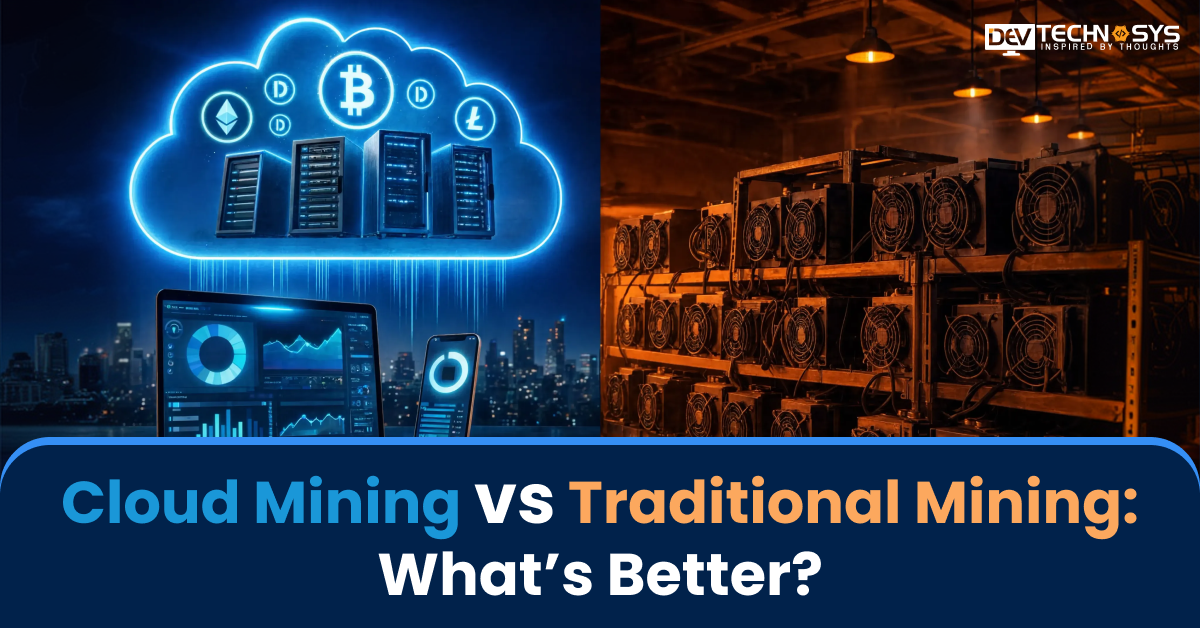
A choice between cloud mining vs traditional mining has to be made according to technical knowledge, cost, and long-term business goals. While both of these mining methods allow businesses to generate digital assets, understanding the differences supports an informed decision by miners.
Cloud mining allows users to rent computing devices without the need to pay for hardware, electricity, or related management. This is perfect for small businesses that are looking for cost-effective solutions. This cloud mining guide will help businesses make an ideal choice for successful business growth.
Traditional mining, on the other hand, allows organizations to build their own system for cryptocurrency. They have made a higher upfront investment for setup and other operational tasks, but the end result is productive in terms of financial return. Traditional mining is suitable for enterprises or large organizations that are seeking long-term business and financial growth.
What is Cryptocurrency Mining?
This is a process of recording and validating transactions over a blockchain network. Cryptocurrency mining methods are used by individuals, businesses, and enterprises based on their specific needs and financial goals. Users receive rewards after performing mining.
The basic difference between blockchain and cryptocurrency is that blockchain secures digital transactions, while cryptocurrency is a digital asset that serves as a medium of exchange. Another misunderstood concept is coin vs token. A coin is used as a digital currency, whereas a token is used for utilities.
What is Cloud Mining?
Cloud Mining allows users to mine digital currencies on a rented computer. This is popular because it reduces technical complexity.
Pros |
Cons |
| Low Initial Investment | Lower Profit Margins |
| No Technical Expertise Required | Limited Control |
What is Traditional Mining?
Blockchain transactions are validated using specialized equipment such as ASIC miners. Users get complete control over functionalities, but require significant investments.
Pros |
Cons |
| Full Ownership and Control | High Upfront Costs |
| Greater Transparency | Technical Complexity |
Industry Insight:
According to Precedence Research, the global cryptocurrency market is expected to grow to $31.76 billion in 2026, expanding at a CAGR of 7.77% by 2035. This statistic indicates the widespread adoption of mining practices to achieve long-term profits.
Cloud Mining vs Traditional Mining: Key Differences Explained
The effective answer to “Is cloud mining better than traditional mining?” relies on understanding the key differences. Cloud mining offers a simple way to participate in mining activities, while traditional mining providers offer greater control. Selecting a model should be based on its operational capabilities.
Factor |
Cloud Mining |
Traditional Mining |
| Initial Investment Costs | In terms of cloud mining investment comparison, this has a low cost. The purchase is usually based on a contract or subscription plan | Enterprises have to pay more for implementing sustainable crypto mining practices, mining rigs, and infrastructure |
| Hardware Ownership | Offers flexibility to simply access the mining activities rather than managing the hardware | Users receive ownership and control of mining hardware and supporting infrastructure |
| Technical Expertise Required | This is the best cloud mining for beginners and startups. It only requires basic technical knowledge | Users should have detailed knowledge and expertise in managing hardware |
| Electricity and Maintenance Expenses | This is a pay-as-you-go model | Miners have to be responsible for managing bills and maintenance costs |
| Cloud mining vs traditional mining profitability | Moderate profits due to provider fees and shared resources | Higher profit potential because miners keep most rewards after operating expenses |
| Scalability | Easy to scale by upgrading or purchasing additional mining contracts | Scaling requires purchasing more hardware, power capacity, and physical space |
| Security and Control | Limited control over mining operations and security measures | Complete control over hardware, software, security, and mining strategies |
| Risk Factors | Miners do not have control over cryptocurrency mining, which most of the time leads to fraudulent activities | Enterprises might face compliance risk and more related to cost if proper financial planning is avoided |
| Return on Investment (ROI) | A miner receives ROI as per the terms mentioned in the contract | In traditional mining, ROI is generated after deducting maintenance and other costs |
Understanding the Risks and Limitations of Cloud Mining
Cloud mining is the best for businesses that prefer to spend less time managing hardware. But it comes with a price that needs to be paid in the form of risks. Let’s understand these in detail:
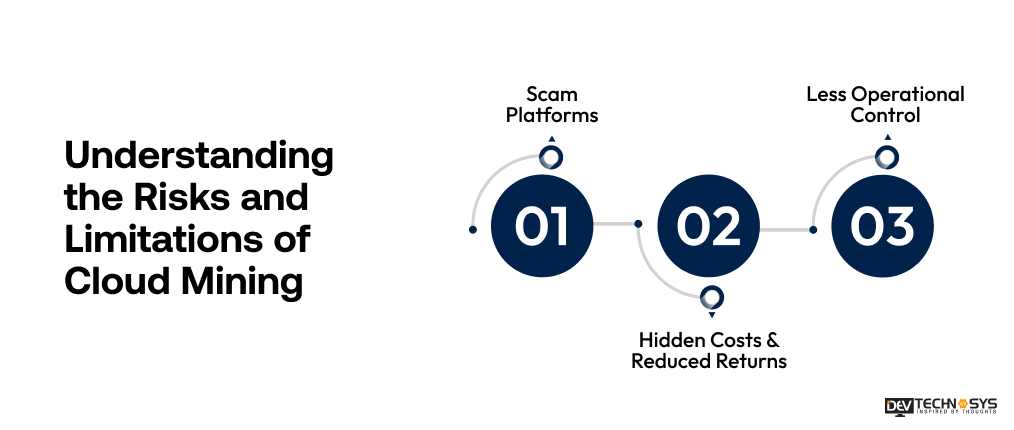
1. Scam Platforms
Some cloud mining platforms are created temporarily to take advantage of the users. Because users are unaware of the physical mining rings, founders disappear or close their data centers. If a platform guarantees extraordinarily high returns with zero risk, then consider it a red flag.
2. Hidden Costs & Reduced Returns
The cost that you pay initially includes maintenance fees, and when a user experiences frequent network difficulty. The trap is when a user stops receiving profits.
3. Less Operational Control
A user does not have asset ownership after buying a cloud mining contract. If the company goes bankrupt, then a user does not have physical assets to liquidate. Also, it is challenging to verify the exact amount a user gets after the contract.
Industry Insight:
According to Coin Law, the U.S. accounts for 37.8% global Bitcoin hash rate. The mining power is utilized from renewable energy sources. This data indicates that the U.S. is a leading market for traditional mining while following regulatory compliance.
Key Risks and Operational Challenges of Traditional Cryptocurrency Mining
Traditional mining ultimately converts you into a data center manager. There are always financial and operational risks. If you are ready to work with this mining, then understanding its challenges is crucial first.
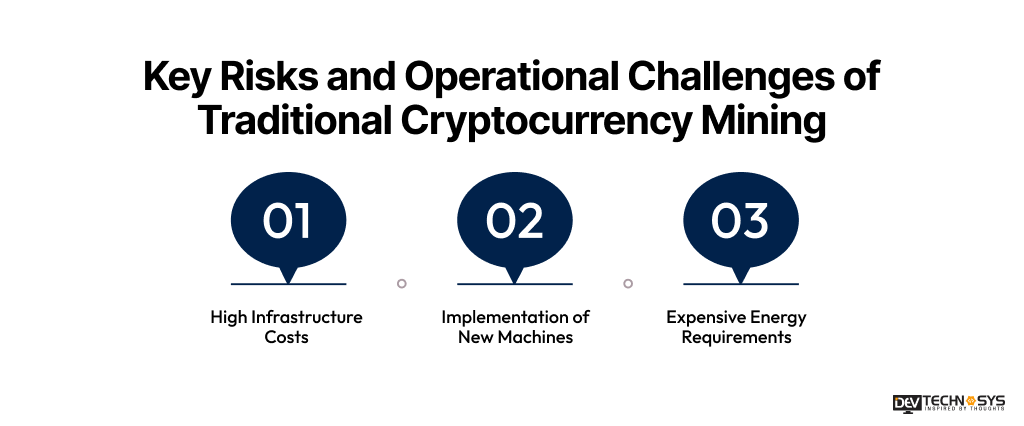
1. High Infrastructure Costs
For some time, businesses will not experience a profit because the budget will be invested in mining hardware, choosing a location, cooling setup, and power systems. In short, traditional mining requires a significant financial commitment.
2. Implementation of New Machines
This is a not-to-be-ignored fact that mining machines get outdated really early. New machines have to be replaced in the setup to manage energy consumption levels. A mining rig that is highly profitable today can become completely obsolete and unprofitable within 12 to 24 months. Always remember this can reduce the value of the cryptocurrency.
3. Expensive Energy Requirements
Traditional mining rigs are notorious power hogs, running 24/7 at maximum capacity. In the regions where energy prices are high, enterprises might face challenges in coping with the budget.
Cloud Mining vs Traditional Mining: Which is Better for Different Users?
When comparing cloud mining vs traditional mining, the right choice depends on technical expertise and financial investment planning. While cloud mining offers convenience, traditional mining aligns with a smarter investment for businesses or enterprises.
-
Best for Beginners
Users with less technical knowledge must understand the difference between traditional mining and cloud mining. Both of these concepts are effective for cryptocurrency. But choosing cloud mining is profitable for beginners. They can skip the part of software configuration, mining hardware, or maintenance concerns. They can keep traditional mining as a profitable option for the future when they plan to scale their digital assets.
-
Best for Experienced Miners
Such miners need to have complete control over the mining activities. They prefer to choose their own hardware/software, want to optimize mining settings, and increase profitability. Experienced miners choose blockchain platform to ensure security while performing mining activities. They typically have a good technical expertise to manage the mining setup.
-
Best for Passive Investor
When evaluating traditional mining vs cloud mining, passive investors find cloud mining to be a feasible solution. It removes the complexity of managing hardware and mining setup or configuring software while allowing them to earn cryptocurrency mining rewards. The cloud mining provider handles overall mining performance, offering better accessibility to the passive investors. If you are an individual or a business that is looking for a passive income, then cloud mining is a good option.
-
Best for Long-Term Profitability
Owning mining equipment creates opportunities to achieve better returns over time. Companies that are seeking a strong revenue generation solution must choose traditional mining. Traditional miners have the flexibility to upgrade equipment, mine different cryptocurrencies, or sell their hardware if market conditions change. These factors can improve return on investment (ROI) over time.
You can reach out anytime; we are available 24/7. Our team provides a quick response.

-
Best for Businesses and Enterprises
Traditional mining is best suited for enterprises looking to scale their mining operations. Many businesses partner with a cryptocurrency development company to evaluate mining opportunities. They receive support from experts who conduct a feasibility study to develop custom blockchain-based mining solutions. Owing to the mining infrastructure gives control and flexibility to maximize efficiency.
Real-World Cloud Mining and Traditional Mining Examples
Understanding real-world examples helps organizations develop a better investment strategy while investing in cryptocurrency mining. Enterprises that already understand the difference between blockchain and cryptocurrency must gain insight into use cases so they can effectively plan whether to choose cloud or traditional mining.
1. Entering the Cryptocurrency Market with Minimal Investment
First-time investors, such as startups, skip utilizing a budget for ASIC miners, setting up a data center, or managing electricity consumption. Businesses have to monitor their digital assets. They simply rent mining power to explore cryptocurrency opportunities. This approach allows small businesses to evaluate profitability without making significant investments. They can scale mining opportunities or upgrade to traditional mining once they experience a stable financial condition, according to market trends.
2. Generating Cryptocurrency as a Business Asset
Companies that prefer a hands-off approach can choose Bitcoin cloud mining to eliminate the complexities of hardware management. By outsourcing mining operations, businesses can focus on gathering digital assets. They will get complete freedom from operational responsibilities with the adoption of a subscription-based model. This approach is usually preferred by an investment group or a startup to build a stable digital asset portfolio.
3. Building a Large-Scale Mining Operation
Enterprises seeking long-term revenue growth must switch to traditional mining to get complete ownership of hardware, infrastructure, and rewards. They can customize and update the setup on a timely basis. This model facilitates the deployment of thousands of mining rigs with the adoption of solar energy. By doing this, organizations can improve revenue streams while maintaining regulatory compliance.
Planning a Cryptocurrency Project?
Get a tailored development cost estimate in a few simple steps.
- 3 quick steps
- 100% free
- Reply in 1 business day
2 Minutes Read
7 Costly Crypto Mining Mistakes Businesses Should Avoid
Organizations often look for potential rewards only from cryptocurrency mining while considering the risk. Businesses have to understand that a flawed strategy can lead to compliance issues and inefficiency in the mining model. Understanding common mistakes can help businesses to make profitable business decisions.
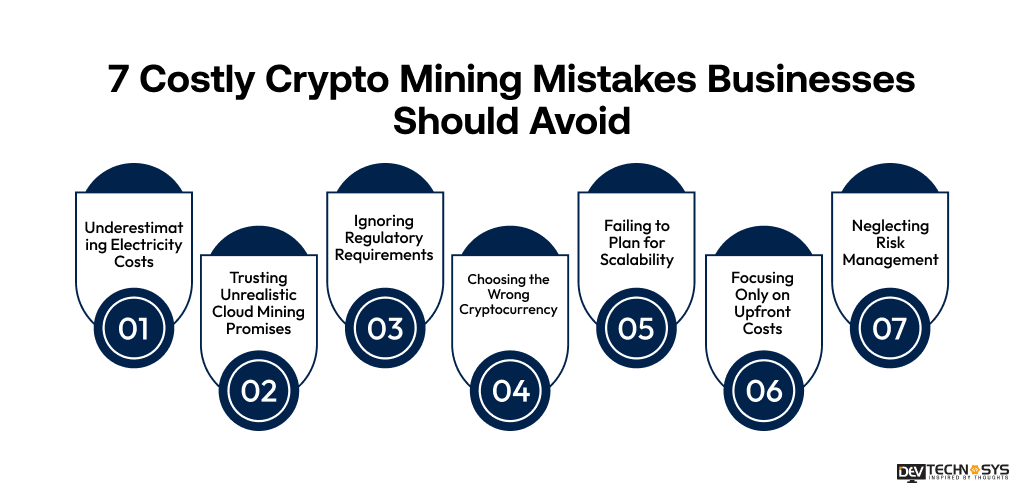
1. Underestimating Electricity Costs
Many organizations fail to identify electricity costs while focusing solely on the mining setup expense. Rising energy prices can affect the average profit margin. Therefore, businesses should conduct a detailed energy cost analysis to plan for future energy price fluctuations.
2. Trusting Unrealistic Cloud Mining Promises
Trusting providers for cloud mining sounds convenient, but to gain long-term profits, businesses require complete control of the mining setup. Businesses are often unaware of mining rewards and do not have direct control over the mining infrastructure. Organizations should review reputable cloud mining providers that properly align with their investment objectives.
3. Ignoring Regulatory Requirements
Legal considerations are different according to regions. At fewer locations, it is restricted, while others consider it as taxable income. Organizations often avoid checking the regulatory compliance, which creates a list of risks later. Organizations must consult tax professionals to establish a strong compliance framework. This assures long-term operational stability for businesses.
4. Choosing the Wrong Cryptocurrency
Users often select a trending cryptocurrency, avoiding the mining profitability. They have no idea about the profit margin they will be missing. Factors such as market demand, mining difficulty, and transaction fees influence earnings. Businesses have to evaluate long-term viability to improve risk management.
5. Failing to Plan for Scalability
Startups planning for a small mining setup might find that effective, but large organizations have to properly plan for scalability. It is because mining setups require frequent upgradation that they require sophisticated infrastructure planning. Organizations should develop a long-term scalability plan to anticipate future requirements.
6. Focusing Only on Upfront Costs
Many businesses avoid reviewing the infrastructure cost in depth. They skip an understanding of a detailed financial schema. The total cost of ownership has to be evaluated, which includes contract fees, energy consumption, hardware costs, and more related to the setup. Looking beyond the initial investment is helpful for the organizations to get better profits.
7. Neglecting Risk Management
Many businesses follow the trend of starting a cryptocurrency without understanding the risks. They neglect the potential losses in an urgency to choose between traditional mining vs cloud mining. Businesses that have a vision of protecting their investment must understand the potential risks associated with cryptocurrency mining.
Industry Insight:
At Dev Technosys, we have worked on multiple cloud mining projects and understood the potential risks. Based on our experience, many miners and enterprises continue to prefer traditional mining because it offers greater operational control and stronger long-term ROI potential.
Legal and Regulatory Considerations for Crypto Mining
Before choosing the best mining method for cryptocurrency, businesses or large organizations must pay attention to the legal and regulatory landscape. Failure to comply with laws might result in reputational damage. Understanding the legal framework reduces risk and leverages better cloud mining profitability in 2026 and beyond.
1.Tax Implications
In most jurisdictions, cryptocurrency obtained through mining is considered to be taxable income. This taxable income is usually calculated according to the fair market value. Organizations should work with certified tax professionals and maintain proper records of accurate transactions to ensure compliance.
2. Energy Regulations
Energy authorities often look for Bitcoin that acts as proof of work. When investing in the data center infrastructure, businesses should assess local energy policies and electricity pricing structures. Failure to comply with these regulations may result in penalties or service discontinuation. Enterprises that proactively switch to sustainable practices build strong relationships with regulators.
3. Environmental Concerns
Governments are consistently implementing strict environmental standards to promote responsible resource usage. Many enterprises have started using renewable energy sources such as solar, wind, hydroelectric, and geothermal power to manage electricity concerns. Green crypto mining strategies are a beneficial step that every organization should take to gain maximum profits.

4. State-level Crypto Policies
A regulatory assessment is mandatory before partnering with a cryptocurrency development company; understanding restrictions and acceptance of cryptocurrency according to regions is important. Experts can assess risk factors and accordingly generate solutions. Also, businesses should regularly monitor crypto policies to avoid legal complications. This is essential for businesses that are willing to choose traditional mining.
5. Reporting Requirements
Submission of detailed cryptocurrency records maintains transparency among the regulatory authorities and businesses. Developing a strong compliance framework is helpful to build trust among investors, customers, and concerned authorities. Most enterprises use enterprise reporting software or blockchain analytics to streamline compliance processes.
Future of Crypto Mining: What to Expect in 2026 and Beyond
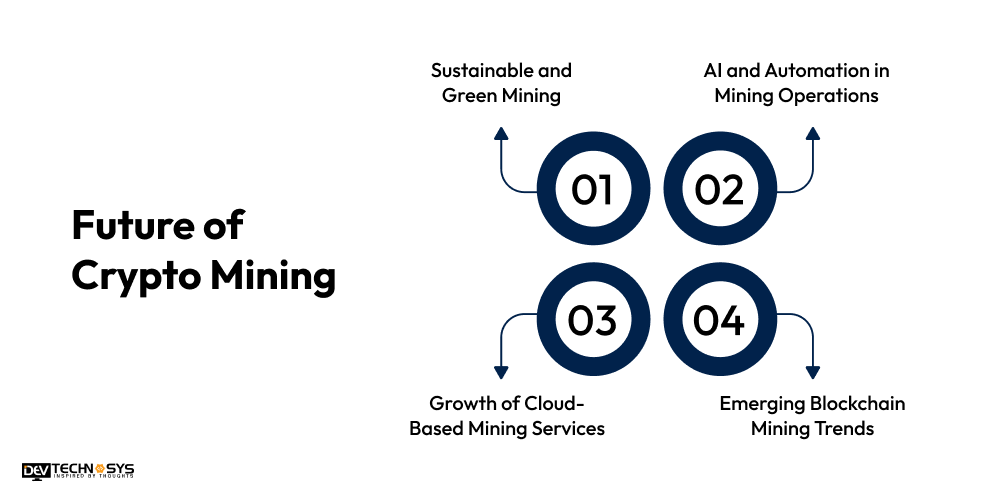
Rapid advances in technology are increasing the demand for digital asset generation. In 2026 and beyond, mining will be driven by artificial intelligence and innovative blockchain technologies. Businesses and enterprises must understand trends to stay competitive in the cryptomining industry.
-
Sustainable and Green Mining
Businesses are prioritizing sustainable crypto mining practices to reduce dependency on fossil fuels. They are increasingly investing in renewable energy sources to reduce carbon emissions. Organizations are implementing energy-efficient ASIC mining hardware and better heat recovery systems, and planning to develop a green blockchain platform to maintain regulatory compliance. Solar-powered mining farms are on trend to easily meet regulatory compliance while managing overall mining costs.
-
AI and Automation in Mining Operations
Due to the complexity of mining environments, enterprises are choosing AI development solutions to improve operational efficiency. For example, AI-powered mining dashboards monitor mining performance and easily detect equipment issues without requiring human effort. These allow organizations to perform predictive maintenance for mining machines and optimize electricity consumption.
-
Growth of Cloud-Based Mining Services
The popularity of Bitcoin cloud mining is expected to grow significantly in the coming years as it offers a pay-as-you-go model. This flexibility creates an opportunity for SMEs and startups to enter the cryptocurrency market. Another impactful factor for cloud-based mining is accessibility. Businesses with less capital expenditure can earn profits by avoiding the technical complexities.
-
Emerging Blockchain Mining Trends
The evolving blockchain ecosystem is creating opportunities and challenges for the miners. One of the major trends is decentralized mining pools, followed by next-generation ASIC miners to improve security and processing capabilities. Additionally, layer-2 scaling solutions and tokenized mining infrastructure are being adopted by enterprises to create new revenue generation opportunities.
Conclusion
When comparing cloud mining vs traditional mining, the right choice depends on a business goal, budget, and long-term cryptocurrency strategy. The simple answer is that traditional mining is better if the enterprise is thinking of investing in the long-term success of cryptocurrency.
Businesses can hire a dedicated developers team to build the entire setup. The experts will plan the energy efficiency, required hardware, and cooling systems based on the investment. Cloud mining is a good option for startups and small businesses that simply want exposure in cryptocurrency mining.
Frequently Asked Questions
Find answers to the most common questions related to this article.
Yes, cloud mining is safer and beginner-friendly. There are no financial or operational risks as compared to traditional mining. Cloud mining relies on third parties for managing cryptocurrency without giving any control to the users.
Cloud mining profitability in 2026 accounts for the risks. With hidden costs and Ponzi schemes, users might lose benefits. Business Crypto Mining Solutions should be based on a partnership with the authorized third party.
For a low-cost setup, cloud mining is effective but also includes a high risk of scams. On the other hand, Traditional mining is a good fit to get real control, asset ownership, and to gain long-term profit.
1. Bitcoin: Known to be an expensive but secure cryptocurrency.
2. Dogecoin: Dogecoin can be an excellent choice for scrypt algorithm ASIC miners.
3. Kaspa: Kaspa is highly recommended for retail miners and utilizes GPU-based setups.
1. The greatest risk is of scams, as the users are unaware of the profit system shared by the owner.
2. Users have to pay maintenance and other hidden fees.
3. Cloud mining users are locked under a contract and cannot proceed with the discontinuation of services.