











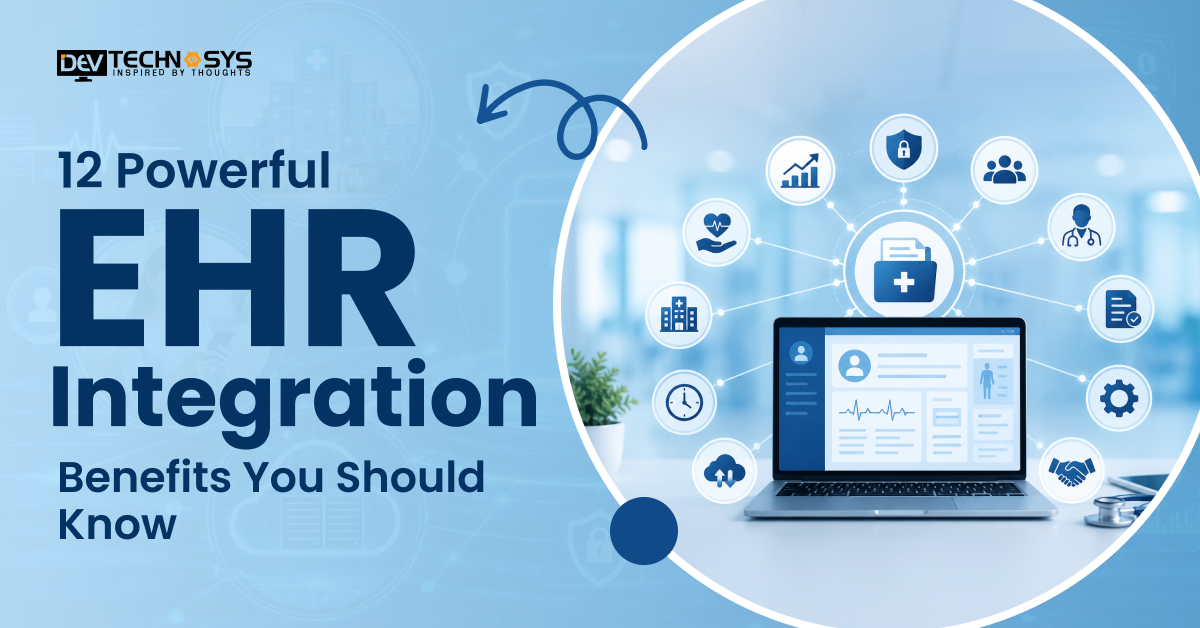
Did you know that over 96% of hospitals in the USA currently operate with a certified EHR system? Many facilities still face challenges where information remains trapped in separate software tools. This is where EHR integration serves as the technical bridge that allows patient data to move between clinical platforms and external applications. In this blog, we will take a look at what integration with EHR means and the 12 powerful EHR integration benefits you should absolutely know.
What Is EHR Integration and How Does It Work?
EHR integration involves the programmed exchange of patient information between a central record system and other digital tools. Developers build these connections using an API, which acts as a set of rules for software communication.
Modern platforms typically utilize HL7 FHIR standards to ensure that clinical data remains readable across different systems. These standards treat medical details as modular resources like “Patient” or “Observation” to simplify data fetching.
Integration layers often include middleware that translates messages between legacy and modern software. Central EHR is the main data source containing all visit information. Links to labs, pharmacies, and billing software increase the record’s functionality from simply charting data.
OAuth 2.0 and other such security measures help ensure patient confidentiality during data transfers. These protocols act as electronic keys to verify that a user has the legal right to see a file.
Integration Component |
Technical Role |
Benefit to System |
| API Endpoint | Specific URL for data requests | allows targeted access to patient details |
| FHIR Resource | Modular data block | ensures consistency across different vendors |
| OAuth 2.0 | Security protocol | protects records from unauthorized access |
| JSON Payload | Lightweight data format | speeds up the transfer of information |
Middleware Flow in EHR
Middleware acts as the translator between disparate healthcare systems. Disparate means software programs that cannot normally communicate with each other. The process begins with data ingestion from a source like a lab analyzer. Scripts then parse and transform the message into standard formats. Routing rules deliver this data to specific clinical or billing applications.
API Gateways for Security
API gateways serve as central managers for all network traffic. They function as a reverse proxy: a server that sits in front of other servers to handle requests. The gateway performs authentication by checking digital tokens to confirm trusted sources. It also manages performance through rate limiting to protect servers from being overwhelmed.
Normalization for Consistency
Data normalization standardizes information from various sources into a unified language. This layer maps local codes to international terminologies like LOINC or SNOMED CT: standard dictionaries for lab and clinical results. Such mapping verifies that clinical concepts remain recognizable across different systems. This process turns fragmented details into a high-quality dataset for accurate analysis.
Event-Driven Real-Time Systems
Event-driven architecture reacts to specific triggers called events the moment they occur. A doctor signing a new prescription is a typical event. Brokers receive these messages from producers and deliver them to subscribers instantly. This design eliminates the need for manual polling. It confirms that clinical staff always have the most current information available.
12 Powerful EHR Integration Benefits
1: Unified Patient Data Across All Care Settings
Fragmented medical records may result in fragmented medical care for patients attending more than one facility. Unified records mean that there is only one set of records that is accessible from various institutions. This complete picture helps care teams avoid redundant testing and medication conflicts.
Health Information Exchanges (HIEs) facilitate this data unification by linking various health networks together. Developers use FHIR-based patient data networks to pull historical results into the current clinical view. Clinicians who see a full medical history can make safer choices for their patients. Real-time data access ensures that every specialist has the same information during a consultation.
2: Significant Reduction in Administrative Burden
Manual data entry consumes a massive portion of healthcare resources in the United States. EHR integration solutions automate the movement of information between scheduling, clinical, and insurance systems. This automation removes the need for staff to type the same demographics into multiple programs.
Software features like real-time eligibility checks and automated prior authorization save hours for office staff. Superbills and discharge summaries can be routed automatically to the correct departments without human intervention.
ROI for healthcare CFOs becomes clear when administrative overhead drops and staff efficiency increases. Automated workflows allow providers to focus on clinical tasks instead of paperwork.
3: Faster and More Accurate Clinical Decision-Making
EHR integration benefits deliver laboratory and radiology results directly to the provider at the point of care. Clinicians receive immediate alerts when a lab result falls outside of a normal range.
These systems also include Clinical Decision Support (CDS) tools that provide evidence-based guidelines. A CDS tool can check for drug-drug interactions as a doctor writes a prescription.
Hospitals using integrated environments report a reduction in serious medication errors. Evidence-based order sets help clinicians follow the best practices for specific conditions. Faster turnaround times for diagnostic data lead to quicker treatments for patients.
Reducing these delays minimizes the risk of medical liability for health systems.
4: Streamlined Revenue Cycle and Billing Accuracy
Disconnected clinical and billing systems are a leading cause of insurance claim denials. EHR-to-RCM integration ensures that clinical notes map directly to the correct billing codes. This technical link reduces the occurrence of upcoding or downcoding errors in ICD-10 and CPT standards. Accuracy at the source leads to a higher rate of clean claims submitted to payers.
Medical practices with integrated financial systems achieve higher net collection rates. Real-time eligibility verification prevents services from being rendered to patients without active coverage. Charge capture automation ensures that every procedure performed is recorded for reimbursement. Automated denial management workflows help billing teams resolve issues faster.
5: Enhanced Patient Engagement Through Connected Apps
There is much more value in patient portals and wellness applications when they are integrated and get information directly from the EHR system. The patient would then be able to check their test results and medication list through their mobile phone. Such an approach stimulates user engagement and promotes patient adherence.
Connected apps also allow patients to upload data from fitness trackers into their clinical files.
FHIR APIs can be used by developers to enable communication between the two platforms in terms of information exchange. The relationship creates an improved understanding of the activities undertaken by the individual when it comes to their health activities. Individuals who are motivated tend to take their medication on time in case of chronic illnesses.
6: Seamless Integration With Epic and Major EHR Platforms
Health tech vendors must prioritize Epic connectivity to reach enterprise-level clients. This process usually requires a listed status in the Epic Showroom marketplace. Developers must follow Epic-specific integration patterns like MyChart Open APIs and FHIR R4 specifications.
Certification for these platforms involves a deep technical review and security validation. SMART on FHIR allows external applications to launch directly within the Epic Hyperspace workspace. Expertise in these major platforms is a critical factor when choosing an integration partner. Successful deployments require a thorough understanding of the vendor’s sandbox testing environment.
7: Improved Regulatory Compliance and Audit Readiness
Integrated systems maintain an unchangeable audit trail of every person who accesses patient data. This record-keeping is a mandatory part of HIPAA and the 21st Century Cures Act. EMR software development solutions automate these logs to track the origin and movement of all sensitive information. Automated compliance reporting saves time during internal and external audits.
Manual data transfers leave holes in security that are frequently penalized by regulations. Effective integration layers allow for data to be transferred using encryption to ensure data is safe from any breach. Provenance of the data is essential for clinicians to understand where the data was received from.
8: Accelerated Clinical Trials and Research Through EDC Integration
Electronic Data Capture (EDC) systems are the primary tool for managing clinical research data. Research staff historically had to manually retype patient data from the EHR into the EDC. EHR-to-EDC integration enables the automated transfer of this information in real-time.
Automation reduces the workload for research coordinators and eliminates human transcription errors. This technical link helps pharmaceutical sponsors lock their study data much faster. Academic medical centers in the USA use these integrations to support decentralized clinical trials. Faster data collection leads to life-saving treatments reaching the market sooner.
9: Real-Time Population Health Management
Population health platforms analyze large data sets to find healthcare trends across a community. Integrated EHRs feed these platforms with the clinical data needed to identify high-risk patients.
Organizations can use this information to close care gaps before they lead to emergency visits. Analytics tools help providers track quality measures for value-based care contracts.Risk stratification models depend on the ability to normalize data from various EHR vendors.
Integrated solutions connect records across a network to create a single database for analysis. Clinicians receive alerts when specific groups of patients need preventive screenings. This proactive approach improves health outcomes for entire populations.
10: Reduced Physician Burnout Through Smarter Workflows
Physician burnout is a significant crisis for the American medical workforce. The number of physicians reporting feeling burned out at least once a week is increasing day by day. Documentation burden is often cited as the top reason for this emotional exhaustion. EHR integration reduces this stress by allowing doctors to use automated tools for note-taking.
Ambient clinical intelligence tools listen to patient visits and generate draft SOAP notes automatically. This feature eliminates “pajama time,” where doctors spend hours charting after their shift ends.
Smarter workflows allow providers to give more attention to their patients during the visit. Reducing clerical work significantly helps health systems retain their medical staff.
11: Better Telehealth and Remote Care Delivery
Telemedicine applications that lack connectivity with the EHR can result in the formation of documentation holes. The healthcare app development solutions enable all notes from virtual appointments to be directly recorded in the primary patient record.
The outcome of the telemedicine session can be seen by the clinicians just as in any other appointment. Prescription orders go straight to the pharmacist’s email account.
Remote patient monitoring devices send blood pressure or glucose readings directly to the EHR for review. Healthcare providers can intervene early if the data shows a potential health risk. This unified approach ensures care continuity across virtual and physical settings.
12: Scalable Foundation for Future Digital Health Innovation
A technical architecture built on APIs allows a healthcare facility to adopt new tools quickly. AI diagnostics and predictive analytics require a steady flow of standardized data to function. Organizations with a robust integration layer can add new software without rebuilding their IT systems. This readiness is a strategic asset for health systems competing in a digital market.
Developers focus on building modular systems that can scale as the organization grows. Investors in the health tech space prioritize companies with an interoperable data foundation. Strategic infrastructure investments make adding new care modalities faster and cheaper. This technical framework future-proofs operations against rapidly evolving industry paradigms.

Why Dev Technosys Is the EHR Integration Partner Healthcare Teams Trust?
Dev Technosys provides the technical depth required to manage complex clinical data exchange. Our team has over 15 years of experience building medical software that meets HIPAA and GDPR standards. We deliver custom EHR integration solutions that connect EHRs with financial, research, and patient engagement tools.
Our developers have deep expertise in HL7 & FHIR Integration used by major US health systems. We engineer advanced technical solutions that modernize clinical infrastructure and streamline healthcare delivery systems
Conclusion
EHR integration benefits serve as the essential connective tissue for modern healthcare organizations. Medical facilities that invest in these technical connections can lower their costs while providing safer care. Integrating with EHR is a strategic necessity for any organization looking to survive in a connected ecosystem. Dev Technosys is ready to help your team build these vital digital bridges. Get a Quote today to begin your transformation.
Frequently Asked Questions
Find answers to the most common questions related to this article.
The process of EHR integration involves connecting various applications and clinical systems to each other via APIs and interoperable data layers. Standards used include HL7 for messaging integration, FHIR for modern API-based integration, and DICOM for imaging.
Yes, wellness applications and other digital health technologies can integrate into an EHR via FHIR APIs. In this case, the user data related to activity, vitals, and reports can be integrated depending on permissions.
This will depend upon the complexity of the solution, its compliance requirements, and the number of integrations involved. Complex solutions that require integration with various EHRs, data transfer between different sources, and compliance with regulations take more effort than API integration.
Several well-known EHRs facilitate third-party application integration using the FHIR protocol. The platform provides developers with access to their API for integrating their applications within the platform.