



















Planning on developing a mobile app in UAE or Saudi Arabia or Qatar or Israel? One of the first questions every founder asks is: ‘How much does it cost?’ The short answer is that it can cost you anywhere between AED 25,000 for a basic MVP and AED 300,000 for a full-blown sophisticated solution. However, that simple range of values hides a lot of complications.
It is worth keeping in mind the factors that contribute to the final price; the country where you develop the app, the type of app you want to build, and the company you choose for your development project will have a significant influence on the costs.
In this guide, we provide you a detailed breakdown of mobile app development cost in Middle East, additional fees that other companies usually do not mention, and inventory management for your app project in one of the Middle Eastern countries.
What is Mobile App Development?
Mobile application development is the process of creating software for mobile devices, such as smartphones and tablets. This process consists of writing code, creating designs, and connecting the application to servers.
What is the Average Cost to Develop a Mobile App in Middle East?
The average mobile app development cost in Middle East ranges from AED 25,000 to AED 300,000, depending on various factors. The factors that impact the cost significantly include features, project complexity, compliance needs, development team expertise, maintenance, and more.
The mobile application development cost in Middle East with basic features, simple design, and limited to no integrations ranges from AED 25,000 to AED 60,000.
On the other hand, the cost to develop a Mobile app in Middle East with advanced features like AI-powered personalization, video & voice calling, biometric authentication, AI chatbots & virtual assistants, and custom designs can exceed AED 300,000+
App Type |
Estimated Cost (AED) |
Development Timeline |
| Basic App / MVP | AED 25,000 – AED 60,000 | 1–3 Months |
| Mid-Level App | AED 60,000 – AED 150,000 | 3–6 Months |
| Complex / Enterprise App | AED 150,000 – AED 300,000+ | 6–12+ Months |
What Affects Mobile App Development Cost in the Middle East?
Multiple factors contribute to determining the overall cost of developing a mobile application in the Middle East. Knowing these factors enables businesses to create budgets and timely determine the cost according to their expectations.
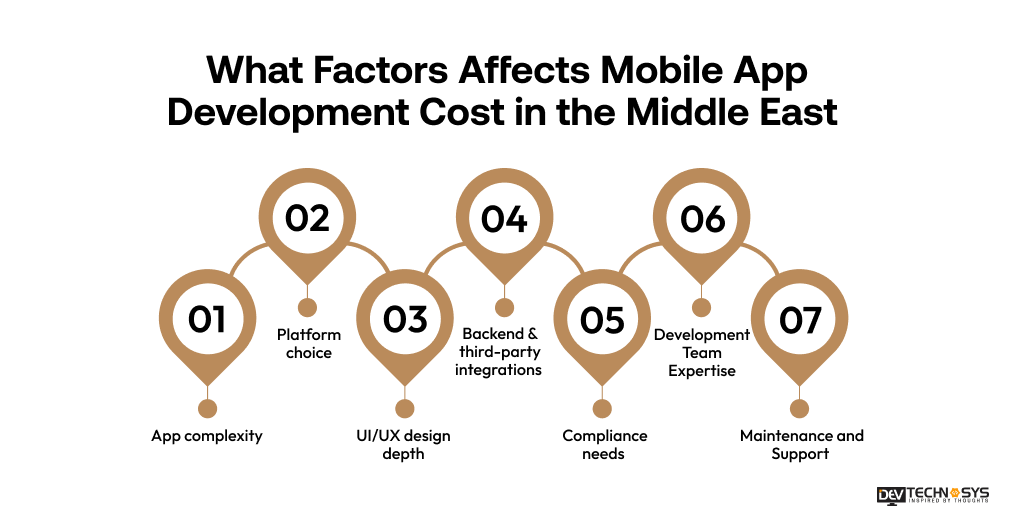
1. Complexity of the Application
Complexity is one of the major components affecting the overall mobile app development pricing in Middle East. Simple applications are less expensive than complicated enterprise applications that utilize AI, include real-time communication, or feature unique workflows.
Cost Impact: 20% to 30%
2. Selection of the platform
Mobile app development cost in Middle East for a single platform (iOS or Android) will be less than developing the application for both platforms separately. A custom Android app development company uses cross-platform tools like Flutter or React Native to save a lot of money while delivering the same performance.
Cost Impact: 10% to 15%
3. UI/UX design complexity
The more attractive and convenient the application is, the more time is going to be put into designing it. Additional animations, moving parts, providing accessibility, and creating localized versions will affect the overall Android and iOS app development cost in Middle East.
Cost Impact: 8% to 12%
4. Backend and integration of third-party solutions
Features including payment systems (like Apple Pay and Tabby), CRM centers, cloud storage, GPS, chatting, analytics functions, and appealing API increases the cost to develop a mobile app in Middle East. It makes backend development and integration more complex, adding to the total mobile app development cost in Middle East
Cost Impact: 15% to 20%
5. Compliance Needs
Applications developed in industries such as healthcare, fintech, or eCommerce have to conform to various regulations, including UAE PDPL, Saudi PDPL, VAT, and payment security regulations. The process of meeting compliance requirements includes extra costs associated with development, as well as with legal procedures.
Cost Impact: 15%–20%
6. Development Team Expertise
All experienced developers, UI/UX specialists, QA engineers, and solution architects from a top custom iPhone app development company will likely charge higher rates due to their competencies in terms of code quality and security. Moreover, the higher rate will help to save on future costs connected with maintenance of the finished project.
Cost Impact: 8% to 12%
7. Maintenance and Support
Launching the mobile application is only the beginning of the journey. Ongoing maintenance, security upgrades, performance optimization, bug fixing, cloud hosting, and the improvement of the application will incur a lot of expenses in the future and should be included in the budget.
Cost Impact: 10% to 20%
Cost Factor |
Estimated Cost Impact (AED) |
Timeline Impact |
| App Complexity | AED 15,000 – AED 120,000+ | +2–6 Months |
| Platform Choice | AED 8,000 – AED 45,000 | +2–8 Weeks |
| UI/UX Design Depth | AED 5,000 – AED 30,000 | +2–5 Weeks |
| Backend & Third-Party Integrations | AED 10,000 – AED 60,000 | +3–8 Weeks |
| Compliance & Security Requirements | AED 8,000 – AED 35,000 | +2–6 Weeks |
| Development Team Expertise | AED 10,000 – AED 50,000 | 10%–20% development time reduction |
| Maintenance & Post-Launch Support | AED 5,000 – AED 60,000/year | Ongoing |
Industry Insights
According to Statista, Smartphone subscriptions across MENA are expected to grow from approximately 540 million in 2024 to around 710 million by 2030, creating significant opportunities for businesses investing in mobile applications.
Mobile App Development Cost Breakdown by App Type
According to a top mobile app development company in Middle East, the expenses in mobile app development significantly depend on the type of mobile app, its features, and technical complexity. Here, we highlight the estimated cost of developing different mobile applications that are trending in the Middle East.
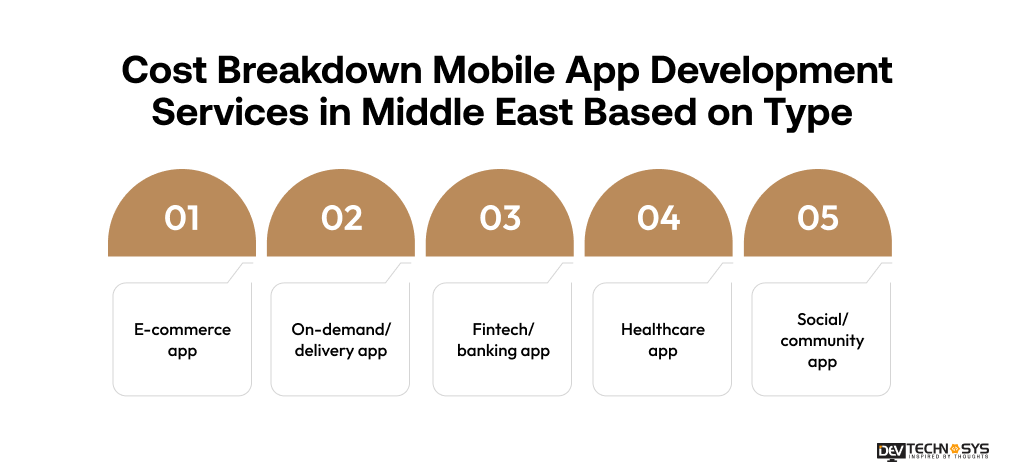
1. E-commerce Applications
E-commerce apps contain features like product catalogs, a shopping cart, a secure payment gateway, an inventory management system, and an order tracking system. The cost of a simple online store is low, whereas the cost of a multi-vendor marketplace with AI recommendations and loyalty programs is high.
2. On-Demand/Delivery App
Delivery apps have features like a customer panel, driver panel, admin panel, GPS tracking, route optimization, live order tracking, and payment integration. The higher the number of real-time functionalities and third-party services integration, the higher the cost of the delivery app.
3. Fintech/Banking App
Custom mobile app development cost in Middle East for the fintech industry is around AED 100,000–300,000+. These platforms are among the most expensive to develop, as they integrate advanced security, regulatory compliance, KYC verification, payments, and a fraud detection system. It is best to hire dedicated developers from a top company to make the development process seamless.
4. Healthcare App
Healthcare applications encompass features such as appointment scheduling, telemedicine, electronic medical records (EMR), wearable technology integration, and secure medical data storage and usage. There may be additional compliance measures, which would incur costs.
5. Social/Community App
Social media applications need functionalities, such as user profile creation, messaging, media sharing, notifications, live streaming, and content moderation. The costs increase if one needs to provide advanced features, such as AI-driven feeds, video calls, and creator payments. If you are considering building an app like this, then hire dedicated mobile app developers from a reputable firm.
App Type |
Estimated Development Cost (AED) |
Estimated Timeline |
| E-commerce App | AED 40,000–180,000+ | 3–6 Months |
| On-Demand/Delivery App | AED 60,000–250,000+ | 4–8 Months |
| Fintech/Banking App | AED 100,000–300,000+ | 6–10 Months |
| Healthcare App | AED 70,000–250,000+ | 4–8 Months |
| Social/Community App | AED 50,000–220,000+ | 4–7 Months |
Mobile App Development Cost Comparison by Country
The iOS and Android app development cost in Middle East varies across the Middle East based on developer expertise, labor costs, regulatory requirements, and market demand. While the UAE offers a strong balance of quality and innovation, Saudi Arabia and Qatar provide competitive pricing, whereas Israel commands premium rates for advanced technology projects.
Country |
Average Developer Rate (AED/Hour) |
Estimated App Development Cost (AED) |
Best For |
| UAE | 150–370 | 25,000–300,000+ | Startups, enterprise apps, fintech, eCommerce |
| Saudi Arabia | 130–330 | 22,000–280,000+ | Government projects, enterprise solutions |
| Qatar | 130–310 | 20,000–260,000+ | Healthcare, education, corporate apps |
| Israel | 220–550 | 40,000–400,000+ | AI, cybersecurity, SaaS, deep-tech apps |
According to various industry experts, UAE remains the preferred destination for businesses wanting to hire Android app developers or high-quality mobile app development services in Middle East, with access to experienced developers and modern digital infrastructure.
Industry Insights:
According to GSMA, the mobile internet subscribers in MENA are projected to reach 378 million by 2030, representing 52% of the region’s population, driven by increasing smartphone adoption and expanding 5G networks.
Legal and Compliance Requirements in Mobile App Development in Middle East
Businesses creating mobile applications in the Middle East need to abide by local laws and regulations to provide safety and security to consumers and to ensure their operations are legal. Some major requirements are:
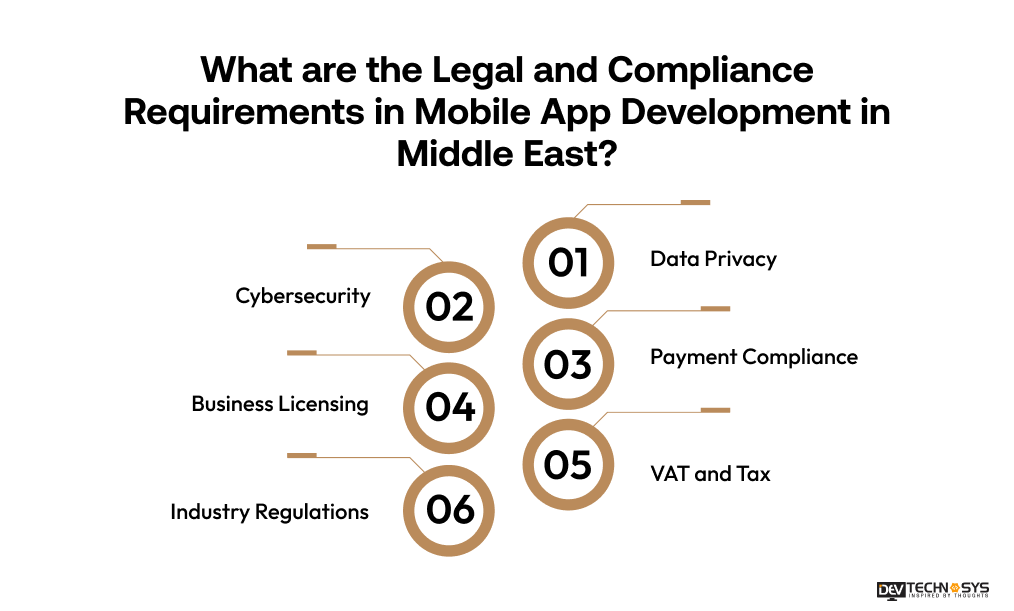
- Data protection: Comply with country-specific data privacy laws and obtain user approval before collecting personal data.
- Cybersecurity: Protect user data by applying encryption, implementing safe authentication procedures, and conducting regular security evaluations.
- Payment compliance: Ensure that you use licensed payment gateways and comply with other relevant international and local laws, including PCI DSS.
- Business licenses: Make sure that you have registered your business and obtained necessary commercial or digital service licenses.
- Taxes: Follow the appropriate laws relating to VAT registration, and keep accurate accounting records.
- Industry regulations: Financial services, healthcare, and educational applications should comply with even more specific laws and regulations.
This way, businesses can avoid legal problems, build trust with their clients, and successfully create apps that operate legally in this region. However, keep in mind that adding these requirements increases the enterprise mobile app development cost in Middle East significantly.
Compliance Area |
Purpose |
Applicable Countries |
| Data Privacy | Protect user data and ensure lawful data collection | UAE, Saudi Arabia, Qatar, Israel |
| Cybersecurity | Prevent cyber threats through secure app infrastructure | All Middle Eastern countries |
| Business Licensing | Legally operate and publish commercial mobile apps | UAE, Saudi Arabia, Qatar |
| Payment Compliance | Secure online transactions and financial data | UAE, Saudi Arabia, Qatar, Israel |
| VAT & Tax Compliance | Meet tax obligations for digital products and services | UAE, Saudi Arabia, Qatar |
| Industry Regulations | Comply with sector-specific laws (fintech, healthcare, education) | All Middle Eastern countries |
In-House vs Agency vs Freelancer vs Offshore: Which Option Is Most Cost-Effective for Businesses?
The development model you choose often affects your budget more than the app’s actual features. Here’s how the four main options stack up in the Middle East market:
Factor |
In-House Team |
Development Agency |
Freelancer |
Offshore Development |
| Cost | High | Medium–High | Low | Low–Medium |
| Project Size | Large, Long-Term | SMEs & Enterprise | Small Projects, MVPs | Startups to Enterprise |
| Expertise | High | High | Varies | High |
| Scalability | Moderate | High | Low | High |
| Project Management | Internal | Managed by Agency | Self-Managed | Managed by Offshore Partner |
| Time to Hire | Slow | Fast | Very Fast | Fast |
| Best For | Enterprises | End-to-End Development | Budget Projects | Cost-Effective, Scalable Development |
- In-House Teams become the right choice when it is critical to iterate continuously after the MVP stage, but wages and costs in places such as Dubai mean that real expenditure is many times higher than what is shown on the poster.
- Agencies in the region have higher costs. However, they have a thorough understanding of local regulations and payment mechanisms to deal with serious problems if a mistake is made due to a lack of knowledge of local practices.
- Freelancers can provide the cheapest alternative for the development of an MVP, but it is you who will have to ensure that the quality matches the deadline.
- Offshore teams from countries such as Egypt, Jordan, and South Asia offer the best balance between quality and price because they can follow clear specifications provided by clients, whereas ambiguity is a major driver of high service costs.
Which Should You Choose?
- First app, tight budget, simple scope: Freelancer or offshore team.
- Handling payments, health data, or regulated industries: Local agency.
- Building a long-term product with frequent updates: In-house team once you’ve validated demand.
- Hybrid approach: Local agency for initial architecture and compliance, offshore team for ongoing maintenance, lower long-term cost with reduced regulatory risk.
Frequently Asked Questions
Find answers to the most common questions related to this article.
In the Middle East, mobile application development costs may vary. The cost of a simple application can go as low as AED 25,000, while enterprises with sophisticated applications and advanced features may pay up to AED 300,000 or more.
A simple mobile application will take approximately 2 to 4 months to develop, while a medium-level complex application might take anywhere between 4 to 6 months. But large enterprises with applications that have Artificial Intelligence, real-time features, and many integrations may have to wait for 6 to 12 months.
Native mobile applications work best since they work perfectly on the respective platform. Cross-platform mobile applications, developed using advanced frameworks like Flutter and React Native, cut down development time and costs by using a single codebase for Android and iOS.
Some of the popular technologies used in the development of mobile applications include Flutter, React Native, Swift, Kotlin, Node.js, Laravel, Firebase, AWS, or Microsoft Azure, depending on the project.
The development cost and timeframe increase significantly if a company opts for advanced features such as AI, real-time chat, payment gateways, GPS tracking, cloud infrastructure, and integration with third-party API services.