


















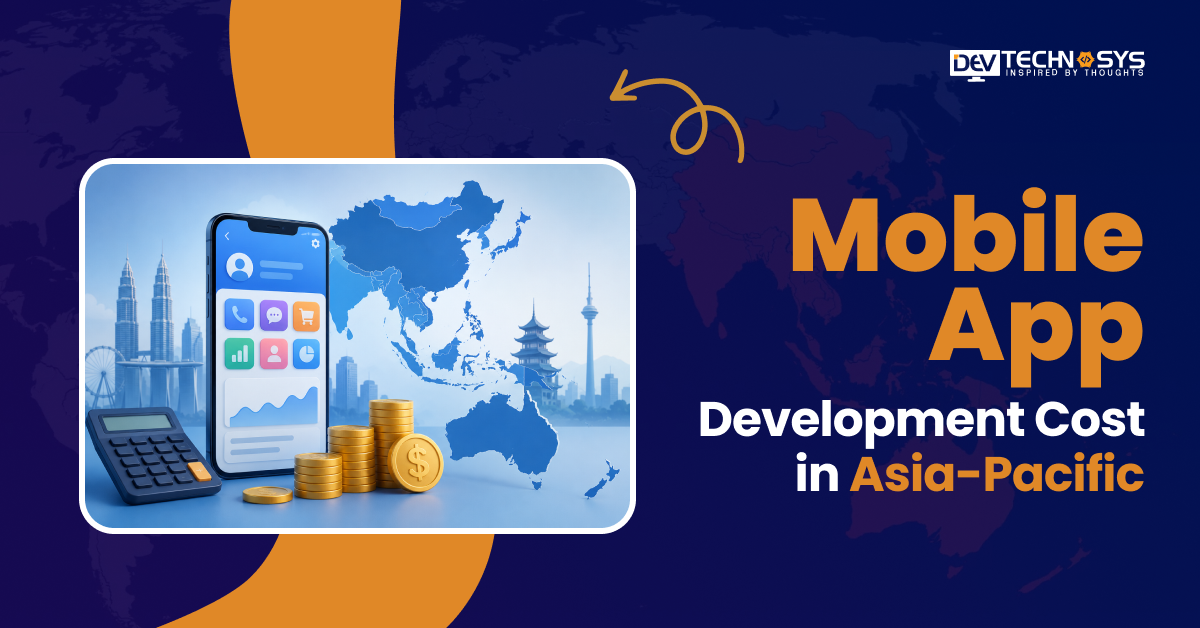
The biggest challenge for businesses today is not about developing a mobile app but determining its cost. They encounter unexpected expenses and hidden costs associated with the development.
Countries such as Japan, Singapore, and South Korea offer different labor costs, data privacy, and feature requirements. Therefore, understanding mobile app development cost in Asia-Pacific allows businesses to create a long-term investment plan.
This guide provides a detailed breakdown of mobile app development pricing in Asia-Pacific with hidden costs, which technology hub to choose, and ways to reduce the overall project budget.
Quick Comparison Table of Mobile App Development Costs in Asia-Pacific
| Asia-Pacific Country | Estimated Hourly Rate (USD) | Basic Blockchain App Development Cost | Mid-Level Blockchain App | Enterprise Blockchain Platform |
| Japan | $90–$180/hr | $30,000–$65,000 | $65,000–$170,000 | $170,000–$400,000+ |
| Singapore | $120–$220/hr | $40,000–$80,000 | $80,000–$200,000 | $200,000–$500,000+ |
| South Korea | $100–$190/hr | $35,000–$70,000 | $70,000–$180,000 | $180,000–$450,000+ |
Mobile App Development Cost in Asia-Pacific’s Leading Technology Hubs
This is the fastest-growing destination for mobile application development across the globe. Businesses gain access to experienced and skilled developers who cater to the budget, industry, and specific project requirements.
1. Mobile App Development Cost in Japan
Japan holds 70% of Apple iOS market share, making it an ideal destination for iPhone application development. Businesses will find high-standard developers, gamers, and designers who adhere to compliance and security. This tech hub is well suited for businesses that want to build enterprise-grade or large-scale digital transformation applications specific to manufacturing, healthcare, or automotive applications. Japan is expensive because of its deep technical expertise in robotics and mobile app development.
Average Rate: $60,000–$250,000+
Best Choice if: Businesses need advanced mobile applications with AI-integrated features.
2. Mobile App Development Cost in Singapore
Singapore is a fintech hub, making it an excellent choice for businesses to develop sophisticated mobile applications. Finance industry-based businesses require strong compliance capabilities, cybersecurity, and integration of the mobile with the latest technology. Businesses that are looking to build SaaS applications, AI-powered mobile apps, or digital banking platforms must choose this tech hub. Singapore can be a choice for startups, mid-level companies, or enterprises to build innovative mobile apps.
Average Rate: $45,000–$180,000+
Best Choice if: Businesses want to build an enterprise-grade application with strong compliance standards.
3. Mobile App Development Cost in South Korea
South Korea is the top mobile app development company in Asia-Pacific, known for developing next-generation mobile applications. Businesses that prefer consumer apps, gaming, AI, eCommerce, and 5G-enabled technology-based applications can choose this region. The quality is that the developers build feature-rich mobile experiences once the requirements are clear. The country is popular for 5G adoption, AR/VR, and building consumer-focused mobile applications with lower development costs than Japan and Singapore.
Average Rate: $40,000–$170,000+
Best Choice if: Businesses prefer to provide a personalized user experience while maintaining mobile app quality.
Factors Affecting Mobile App Development Cost in Asia-Pacific
The cost of mobile application development is affected by multiple factors such as technology stack, security requirements, and app complexity. Determining these factors allows businesses to create a long-term secure budget plan.
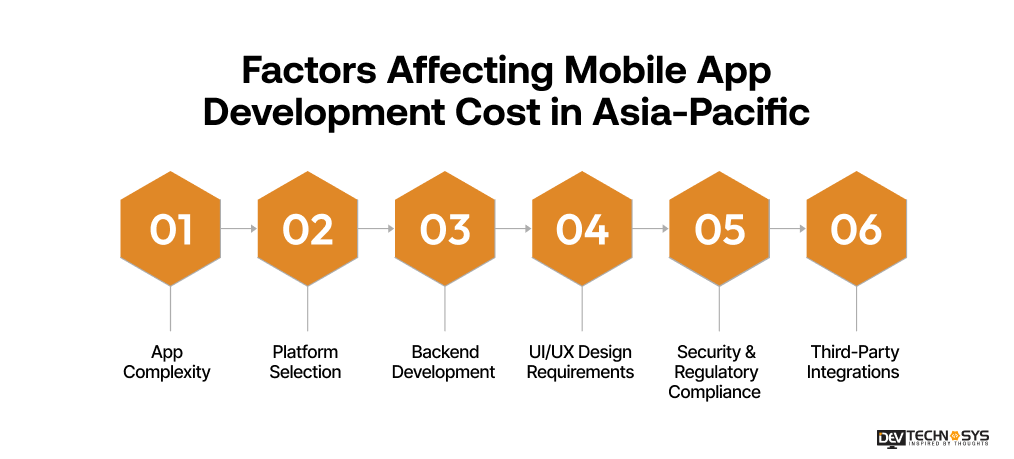
1. App Complexity
Whether it is a mid-level or an enterprise app, app complexity differs from user interface to AI integration. These are the direct cost drivers because it takes sufficient time to develop them.
| Cost Driver | Estimated Custom Mobile App Development Cost in Asia-Pacific |
| User Registration & Login | $2,000–$5,000 |
| Push Notifications | $2,000–$5,000 |
| Payment Gateway Integration | $4,000–$12,000 |
| Real-Time Chat & Messaging | $8,000–$20,000 |
| AI Features & Chatbots | $10,000–$40,000 |
| Live Video Streaming | $15,000–$50,000 |
2. Platform Selection
Choosing cross-platform frameworks reduces development time and cost for iOS or Android application development. Businesses most often spend budget on platform selection, as they must specify the requirement prior to development.
| Development Approach | Estimated Cost to Develop a Mobile App in Asia-Pacific |
| Android App Development Cost in Asia-Pacific | $20,000–$80,000 |
| iOS App Development Cost in Asia-Pacific | $25,000–$90,000 |
| Cross-Platform App | $30,000–$100,000 |
| Native Apps (Android + iOS) | $50,000–$180,000 |
3. Backend Development
Modern users are proactively preferring mobile apps only to purchase, travel, or any other activity. This creates a significant load on the backend. Experienced developers require more advanced cloud infrastructure, APIs, and business logic to manage the data.
| Backend Component | Estimated Cost (USD) |
| API Development | $5,000–$15,000 |
| Database Architecture | $5,000–$12,000 |
| Admin Dashboard | $8,000–$20,000 |
| Cloud Infrastructure Setup | $8,000–$25,000 |
| Enterprise Backend | $25,000–$60,000 |
4. UI/UX Design Requirements
An interactive and responsive interface requires custom UI/UX design to improve user engagement. Businesses often incur high development costs due to including animations, prototypes, or accessibility features.
| Design Component | Estimated Cost (USD) |
| Wireframes & User Flow | $2,000–$5,000 |
| Custom UI Design | $5,000–$15,000 |
| Interactive Animations | $5,000–$15,000 |
| Complete Design System | $15,000–$40,000 |
5. Security & Regulatory Compliance
Businesses should be ready to add security costs if their industry is finance, healthcare, logistics, retail, or ecommerce. Additional security and regulatory compliance are integrated to secure sensitive information.
| Security Requirement | Estimated Mobile Application Development Cost in Asia-Pacific |
| SSL & Data Encryption | $2,000–$5,000 |
| Multi-Factor Authentication | $3,000–$8,000 |
| Penetration Testing | $5,000–$12,000 |
| Regulatory Compliance (PDPA, APPI, PIPA) | $8,000–$25,000 |
| Enterprise Security Framework | $20,000–$50,000 |
6. Third-Party Integrations
Most mobile apps use integrated payments, maps, CRM systems, and more to improve operational efficiency. These are external services but add to the overall mobile app development cost.
| Integration | Estimated Mobile App Development Cost in Asia-Pacific |
| Payment Gateway | $4,000–$10,000 |
| Google Maps API | $2,000–$5,000 |
| Firebase Integration | $2,000–$6,000 |
| CRM Integration | $8,000–$20,000 |
| AI API Integration | $10,000–$30,000 |
Planning a Mobile App?
Get a tailored development cost estimate in 3 simple steps — app basics, features, timeline, and your contact details.
- 3 quick steps
- 100% free
- Reply in 1 business day
2 Minutes Read
Industry-wise Mobile App Development Cost in Asia-Pacific
Industries associated with financial services need security compliance, while the retail industry needs mobile applications with better user experience. Businesses must understand industry-wise mobile app development costs to create a strategic investment plan.
| Industry | Common Mobile App Features | Estimated Enterprise Mobile App Development Cost in Asia-Pacific |
| Healthcare | Patient monitoring, HIPAA-compliant security, appointment scheduling | $60,000–$250,000+ |
| FinTech | Digital payments, KYC verification, banking APIs, fraud detection | $70,000–$300,000+ |
| Retail & eCommerce | Product catalog, shopping cart, payment gateway, AI recommendations | $40,000–$180,000+ |
| Logistics & Supply Chain | Real-time GPS tracking, route optimization, delivery notifications | $50,000–$200,000+ |
| Education (EdTech) | Online learning, live classes, student dashboards | $35,000–$150,000+ |
| Travel & Hospitality | Maps, payment integration, multilingual support | $45,000–$180,000+ |
Which Asia-Pacific Country Should You Choose for Mobile App Development?
Businesses must select a country according to their industry, business size, and feature/functionality requirements. They must also analyze the overall budget in advance to avoid extra expenses.
| Country | Best For | Average App Development Cost (USD) | Why Choose It? |
| Japan | Enterprise, Healthcare, Manufacturing, Automotive | $60,000–$250,000+ | High-quality engineering, strong security, enterprise expertise, and advanced AI capabilities |
| Singapore | FinTech, SaaS, Logistics, Enterprise Apps | $50,000–$220,000+ | Cloud-first development, innovation-driven ecosystem, excellent project management, and business-friendly regulations |
| South Korea | AI, Gaming, eCommerce, Consumer Apps | $40,000–$180,000+ | Expertise in AI, mobile technologies, high-performance apps, and exceptional UI/UX design |
How Tax and Compliance Regulations Affect Mobile App Development Costs in Asia-Pacific?
Though Asia-Pacific is known for its competitive mobile app development rates, tax policies and regulatory compliance often add to the project budget. These costs can be managed when considered before the development begins.
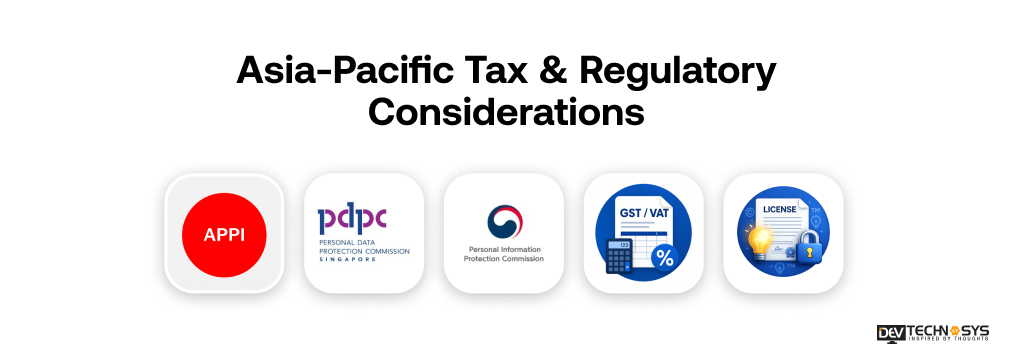
1. Data Privacy & User Protection Laws
Each Asia-Pacific country has its own regulations to collect, store, process, and transfer user information.
- Act on the Protection of Personal Information (APPI) – Japan
- Personal Data Protection Act (PDPA) – Singapore
- Personal Information Protection Act (PIPA) – South Korea
Estimated Cost: $5,000- $20,000
2. Digital Tax & GST/VAT Compliance
Mobile apps that offer in-app purchases, digital services, or allow subscriptions or downloads may be required to follow local compliance. The data needs to be submitted with governance to avoid tax-related issues. Businesses that hire Android app developers often build mobile apps with the required compliance.
Estimated Cost: $2,000 – $10,000
3. App Store & Local Distribution Requirements
Businesses should consider the App Store and Google Play Store guidelines to meet consumer protection and payment requirements (if applicable). These directly affect mobile application development cost in Asia-Pacific.
Estimated Cost: $1,000 – $5,000
Hidden Mobile App Development Costs Businesses Often Overlook in Asia-Pacific
Businesses need to consider all expenses before and after the mobile app launch, even if they hire dedicated developers. Identifying these costs helps to create a realistic budget, ensuring that the app is secure, scalable, and reliable even if the business grows.
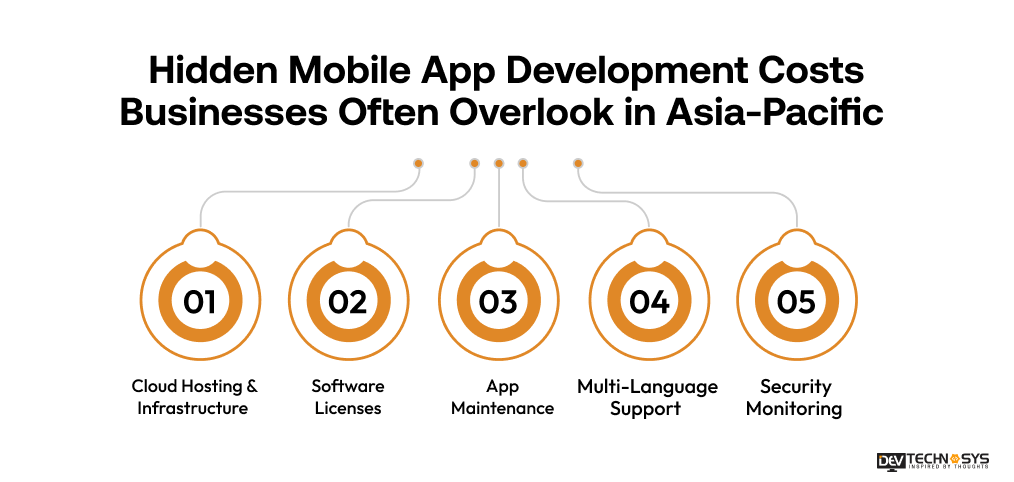
1. Cloud Hosting & Infrastructure
Modern mobile applications rely on cloud infrastructure to manage APIs and support real-time services. These can cost up to $2000 per month due to specific database requirements.
2. Software Licenses
Integration of external services usually operates on a subscription-based pricing model that is a hidden cost driver. Businesses might have to invest $3000 per month.
3. App Maintenance
Businesses often overlook these costs, but it affects approximately 12% of the total budget. App maintenance is essential for performance optimization, managing updates, and improving security features.
4. Multi-Language Support
Developers and mobile app development companies of this region often deal with diverse clients across the globe. Thus, multi-language support is important considering language, currencies, and cultural preferences. The cost usually ranges from $2000 to $15000.
5. Security Monitoring
Mobile apps for finance, healthcare, or industry that access a large amount of information have to conduct security audits and vulnerability assessments. The estimated cost varies from $3,000 to $15,000 annually.

How to Reduce Mobile App Development Costs in Asia-Pacific?
Businesses that want to improve performance and mobile app quality but also need to manage cost must consider these ways to reduce the overall development cost. They must choose mobile app development services in Asia-Pacific that offer scalable solutions.
1. Prioritize Features Based on Business Value
Businesses wondering about the cost to build mobile application must prioritize must-have, should-have, and future enhancements regarding the features. This allows businesses to launch an app faster without overspending.
2. Select a Development Partner with Regional Expertise
Mobile app development companies with regional expertise are aware of the local regulations, compliance, UI/UX features needed by the users, and suitable technology stack. The dedicated developers also share multilingual support that is effective for businesses to coordinate with clients.
3. Leverage Pre-Built APIs and Third-Party Integrations
Businesses can hire dedicated mobile app developers to integrate third-party services as needed. Developers in the Asia-Pacific region have proven experience in updating functionality while maintaining the budget.
Conclusion
Asia-Pacific has become one of the innovation-driven regions for mobile application development. Businesses are partnering with the top companies of Japan, South Korea, and Singapore to either build an MVP or an AI-powered enterprise-grade solution.
However, it is crucial for businesses to understand the mobile app development cost and the factors affecting it to build a secure and scalable solution. Businesses that properly plan for the development are capable of receiving a better ROI.
Frequently Asked Questions
Find answers to the most common questions related to this article.
Businesses evaluate ROI according to measurable outcomes such as operational efficiency, reduced manual processes, customer acquisition, and increased revenue. Businesses define clear KPIs to ensure that the development is financially viable.
Businesses that prefer advanced and custom mobile app development often choose technologies such as AI, machine learning, AR/VR, Real-time analytics, and Generative AI. These contribute to increased development costs due to external services and third-party integrations.
Businesses often avoid the app maintenance cost, which typically costs 15% per year for server monitoring, API updates, bug fixes, cloud infrastructure management, and related maintenance. These are the mandatory activities that businesses should look out for after the mobile app is deployed.
Businesses can take an informed decision to partner with a mobile app development company or find out the accurate mobile app development cost according to the following.
Compliance
Mobile App Features
Third-party integrations
UI/UX requirements
Development Timeline
Post-launch support
Businesses can incur higher mobile app development costs when using cross-platform frameworks such as React Native and Flutter. The code can easily run on both iOS and Android operating systems, saving up to 10% of the overall development cost. This strategic decision also contributes to improving return on investment.