





Key Takeaways:
-
-
- RAG retrieves trusted information; Agentic AI plans, decides, and acts across connected business systems.
- RAG fits knowledge-heavy workflows, while Agentic AI fits multi-step tasks requiring tools and actions.
- Agentic AI can use RAG as a knowledge retrieval tool instead of replacing it.
- RAG is generally simpler to implement, while agents require more integrations, controls, and testing
- Start with RAG, then add agentic capabilities where your workflow actually needs action.
-
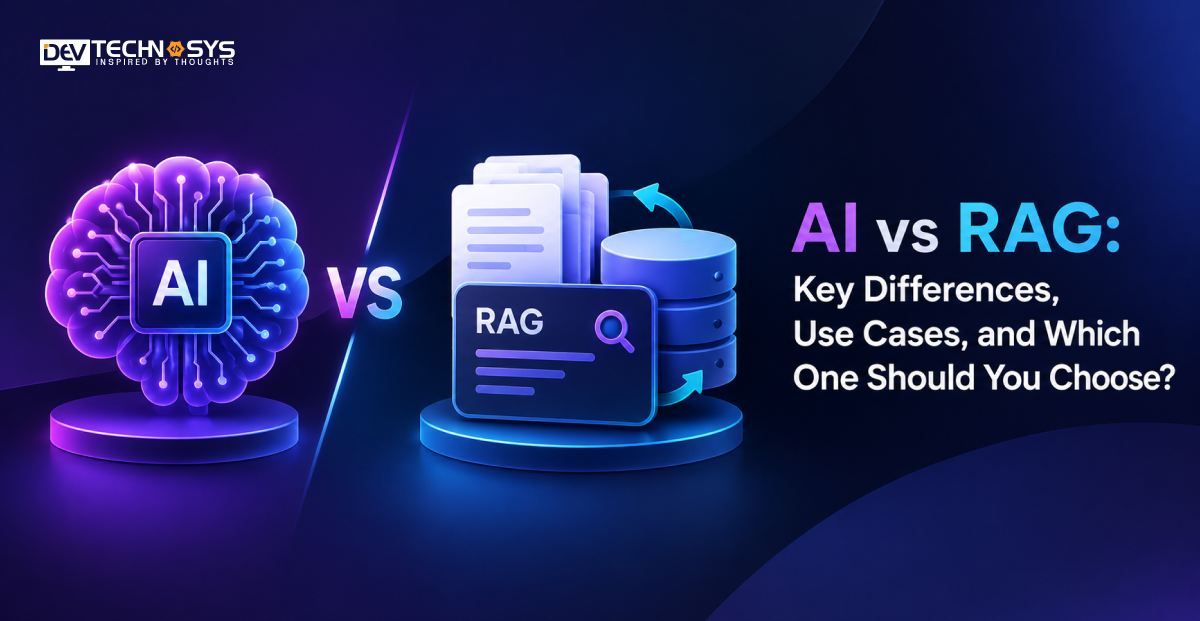
Agentic AI vs RAG is a question most enterprise teams face the moment a pilot leaves the demo stage. Both work with large language models, yet they solve different problems. Retrieval Augmented Generation (RAG) finds trusted information and grounds an answer in it. Agentic AI goes further: it plans a task, uses tools, and takes action across business systems.
Picking the wrong one leaves you with an assistant that only talks or an agent that acts without enough guardrails. This guide explains how each works, where each fits, what each costs in effort, and how to choose. It also shows why the strongest designs often combine the two in production.
What is Agentic AI?
Agentic AI systems take a goal and work toward it; they do not stop at an answer.
Give an agent this job: “Handle this damaged delivery complaint.“
Here is what it does:
- Reads the ticket and plans the steps
- Looks up the order in your ERP
- Finds it missing, so searches the older system
- Confirms the refund policy
- Asks a manager to approve, then issues the refund
Step three is the point. When something breaks, the agent adjusts.
Retrieval is one of its tools.
A typical Agentic AI architecture has four parts: a reasoning model, a planner, tool connections to APIs and databases, and memory that carries context between steps. Around them, Agentic AI architecture adds approval gates for risky actions. Agentic AI development services teams design both.
Planning to Build an AI Development Project?
Get a quick cost estimate based on your AI features, integrations, and development scope.
- 3 Quick Steps
- 100% FREE
- Hear Back Within 1 Business Day
2 Minutes Read
What is RAG?
Retrieval-Augmented Generation AI looks things up before it answers; it pulls passages from your documents, then writes the answer from them.
Ask it: “What is our refund window for damaged deliveries?“
Here is what it does:
- Turns your question into a search
- Pulls the closest policy passages from your knowledge base
- Hands those passages to the model
- Answers with a source you can check
Policy changed? Update the document and the next answer follows. The catch: wrong retrieval means a wrong answer. That flow is the RAG pipeline.
The RAG architecture behind it is a retriever, a vector store, and a model. Connecting all three to your data is where RAG development services come in.
RAG reads and answers. It does not act.
Industry Insight
According to Microsoft, 46% of leaders say their organizations use AI agents to fully automate workstreams or business processes.
Agentic AI vs RAG: Differences At a Glance
The difference between Agentic AI and RAG comes down to one verb.
Ask about a refund, and RAG explains the policy. An agent issues the refund.
So RAG vs Agentic AI is not like-for-like. RAG is a technique. Agentic AI is a system that can use it.
- AI agents vs RAG: taking actions versus giving answers.
- Agentic AI vs RAG: a goal versus a question.
- Generative AI vs RAG: training versus your documents.
A plain generative model answers from its training data, which is why companies working with generative AI development services often add RAG for their data.
Aspect |
RAG |
Agentic AI |
| Purpose | Answer questions from trusted sources | Complete goals across several steps |
| Method | Retrieve, then generate | Plan, act, check, adjust |
| Data access | Reads approved documents only | Reads and writes across systems |
| Autonomy | Low, follows one fixed path | High, chooses its own steps |
| Output | A grounded answer with sources | A finished task or decision |
| Main risk | Wrong or poisoned retrieval | Wrong actions, misused tool access |
| Human role | Reviews the answer | Approves risky actions |
| Relative cost | Lower and predictable: one bounded path | Higher and variable: many calls, tools, and testing |
| Memory | Stateless per question | Keeps context across many steps |
Agentic AI Use Cases and Applications
Agentic AI use cases share one trait: a repeated workflow with clear rules and a few judgment calls. AI Agent Development Services usually begin by finding that workflow.
Five Agentic AI applications to know:
- Finance: matches invoices to purchase orders and sends mismatches to a person
- IT support: resets access, reads logs, and escalates only what it cannot fix
- Supply chain: watches stock, reorders when levels dip, and reroutes a late shipment
- Sales operations: updates the CRM, drafts follow-ups, and books the next meeting
- Healthcare admin: checks insurance details, fills forms, and flags missing records for staff
Enterprise Agentic AI, in practice, is software that does the routine work inside the limits people set.
AI agent vs chatbot: a chatbot answers and stops. An agent keeps going until the job is done.
Many teams start with AI chatbot development services for the answering layer, then add an agent behind it.
RAG use cases and applications
RAG use cases work best when employees or customers need accurate answers from a changing body of business information. Common RAG applications include:
- Customer support: Answers product, warranty, refund, and troubleshooting questions using approved knowledge sources.
- Legal operations: Finds relevant clauses, policies, and case documents without searching through large repositories manually.
- HR: Answers questions about benefits, leave policies, employee guidelines, and internal procedures.
- Healthcare: Retrieves approved clinical information, administrative policies, and patient-related records based on access permissions.
- Finance: Helps teams find financial policies, reporting rules, investment documents, and internal procedures.
Enterprise RAG is especially useful when information changes often and answers need traceable sources. RAG solutions can connect business knowledge to an LLM without retraining the model whenever a document changes.
These Agentic AI vs RAG use cases show the core distinction: RAG strengthens information access, while agents extend that information into multi-step action.
Agentic AI vs RAG: Benefits for Business Workflows
The Agentic AI benefits become clear when a business needs software to complete work, not just provide information. Agents can:
- Automate multi-step workflows across connected systems
- Make decisions within defined business rules
- Reduce repetitive manual tasks
- Continue a task until a defined outcome is reached
The main RAG benefits are different. RAG can:
- Ground answers in approved business information
- Keep responses aligned with updated documents
- Provide sources that users can verify
- Reduce the need to retrain a model when knowledge changes
RAG is usually easier to control because its role is focused on retrieval and response generation. Agentic AI offers broader workflow automation but requires stronger tool controls and monitoring. Businesses can also combine both through AI copilot development services, using RAG for reliable knowledge and agents for controlled actions.
Where Agentic AI and RAG Can Go Wrong
Both approaches can fail when their underlying data, controls, or workflows are not designed carefully. The risks are different:
- RAG retrieval failures: Poor indexing, outdated documents, missing permissions, or irrelevant search results can give the model weak context and produce unreliable answers.
- RAG data quality: Even a well-designed RAG pipeline cannot fix incomplete, conflicting, or inaccurate business information. Strong AI data engineering RAG services can help improve data preparation, retrieval quality, and access controls.
- Agentic AI tool misuse: An agent can call the wrong API, use incorrect information, or trigger an action that does not match the business goal.
- Workflow drift: Agents working across multiple steps can enter unnecessary loops, repeat actions, or move beyond their intended scope without proper limits.
- Control gaps: Both systems need monitoring, permission controls, testing, and human approval for sensitive decisions or actions.
The practical lesson is simple: better capabilities require equally strong controls.
Can Agentic AI and RAG Work Together?
Yes, Agentic AI and RAG together can handle workflows that need both reliable knowledge and controlled action. The agent decides what the task requires, while RAG supplies the information needed to make the next decision.
For example, a customer service agent could:
- Read a customer’s complaint and identify the issue.
- Use RAG to retrieve the latest refund policy.
- Check the customer’s order and payment details through connected systems.
- Ask for approval if the refund exceeds a defined limit.
- Issue the approved refund and update the support ticket.
This is how agentic AI works with RAG in a production workflow. AI Integration Services can connect the agent with knowledge bases, APIs, databases, and business applications.
So, can agentic AI replace RAG? Not necessarily. An agent can use RAG as a knowledge retrieval tool. They solve different layers of the workflow and often work better together.
Industry Insight
According to McKinsey, 62% of surveyed organizations are at least experimenting with AI agents, although enterprise-wide scaling remains early.
Free App Idea Reality Check: Let's Stress-Test Your Concept
Share your app idea with us. Within 3 business days, we'll uncover UX gaps, feature opportunities, and potential development challenges, so you can build with confidence. No strings attached.
When to Use Agentic AI vs RAG for Your Business
Choosing between the two starts with the workflow, not the model. Use RAG when employees or customers mainly need accurate answers from business knowledge. Choose Agentic AI when the system must plan steps, use tools, make decisions, and complete an outcome.
For agentic AI vs RAG for business, consider the data, workflow complexity, risk, and technical readiness.
AI consulting services can help map those requirements before implementation. This keeps the architecture aligned with the actual business process from the start instead of adding unnecessary agent capabilities.
Decision factor |
RAG |
Agentic AI |
| Primary task | Retrieve and explain knowledge | Complete a workflow |
| Data need | Documents and knowledge bases | Multiple systems, APIs, and tools |
| Workflow | Mostly bounded | Multi-step and dynamic |
| Risk tolerance | Lower operational risk | Stronger controls required |
| Team readiness | LLM and data expertise | AI, integration, and monitoring expertise |
| Cost tolerance | Lower complexity is preferred | Higher complexity can be justified for automation |
For RAG vs. agentic AI for enterprise AI, the deciding question is simple: does the business need better access to information, or software that can act on that information? If it needs both, a combined architecture may be the practical choice.
Cost and Effort: Which Costs More, Agentic AI or RAG?
RAG is generally cheaper to build because its workflow is more focused. Agentic AI requires additional components that increase development, testing, integration, and ongoing monitoring effort.
Why RAG AI usually costs less
A RAG implementation for businesses mainly requires:
- Data preparation: Cleaning, chunking, indexing, and securing business documents.
- Retrieval: Setting up embeddings, search, reranking, and relevant context selection.
- Model integration: Connecting the retrieved information to the LLM and evaluating answer quality.
- Access control: Ensuring users retrieve only information they are permitted to see.
Why Agentic AI requires more effort
An agentic AI development company may need to build:
- Tool integrations: Connecting APIs, databases, CRMs, ERPs, and other business systems.
- Planning and memory: Managing multi-step reasoning, context, and workflow state.
- Controls: Adding permissions, approval gates, monitoring, and recovery paths.
- Testing: Evaluating not only answers but also decisions, tool calls, and actions.
That makes RAG vs agentic AI a question of complexity as much as technology. A practical approach is to start with RAG and add an agent only for the step that actually needs action.
Agentic AI vs RAG AI: Choosing the Right Approach
Agentic AI vs RAG is not a choice between two competing versions of the same technology. RAG retrieves trusted business information and grounds the response, while Agentic AI uses goals, tools, and multi-step workflows to complete tasks.
For businesses, the practical starting point is the workflow. If the main need is reliable access to changing knowledge, RAG can provide the required foundation. If the workflow also requires decisions, system updates, or other actions, an agent can extend that capability.
In many production environments, the two work together. Start with RAG where knowledge retrieval is the main need, then add agentic capabilities only where the workflow needs action.
Frequently Asked Questions
Find answers to the most common questions related to this article.
Neither is universally better. RAG fits workflows that need accurate information from trusted sources, while Agentic AI fits tasks that require planning, tool use, and actions. The right choice depends on whether your business needs knowledge retrieval, workflow automation, or a combination of both.
The main difference is what each system is designed to do. RAG retrieves relevant information and uses it to generate a grounded response. Agentic AI can plan multiple steps, use connected tools, make decisions, and complete tasks toward a defined goal.
Agentic AI does not necessarily replace RAG. An agent can use RAG as one of its tools when it needs information from company documents or knowledge bases. RAG handles the retrieval layer, while the agent uses that information to determine what action should happen next.
Yes. An agent can retrieve current business information through RAG, use that context to determine the next step, and then interact with connected systems. This combined approach works well for workflows that require both reliable knowledge and controlled actions
Agentic AI is generally more expensive and complex to implement because it requires additional integrations, planning, memory, permissions, monitoring, and workflow testing. RAG usually has a more bounded architecture focused on data preparation, retrieval, model integration, evaluation, and access control.