













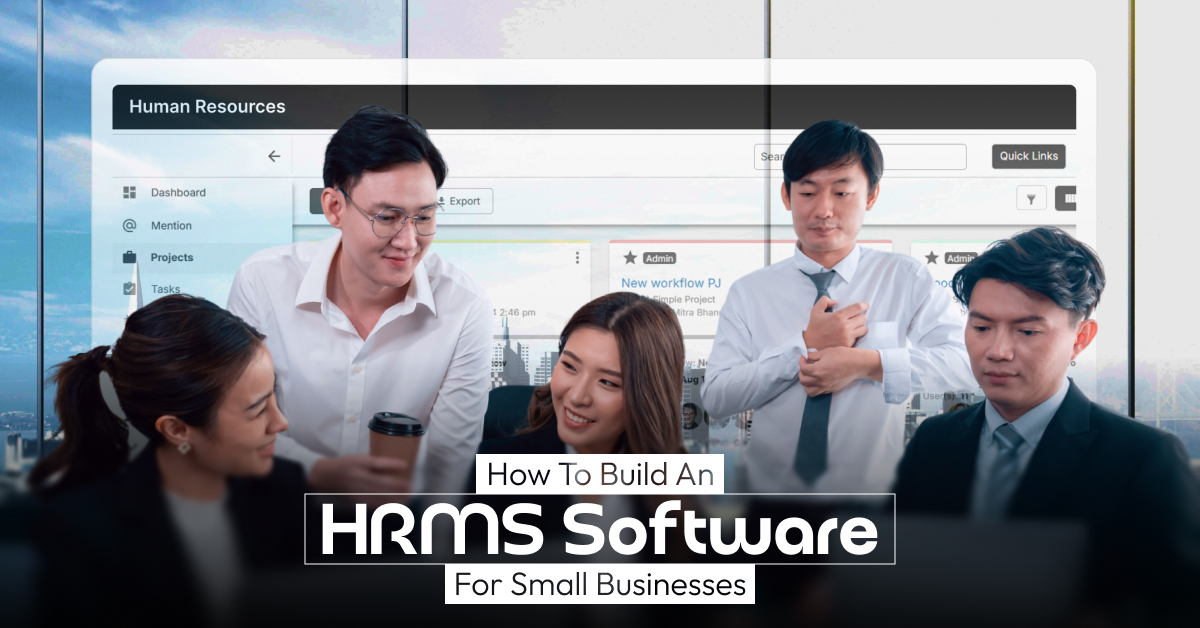
For small or even big enterprises, managing employees’ payroll, attendance, performance, and compliance manually can be stressful. That’s when human resource management software development comes in and becomes a game-changer.
Here, we are specifically referring small businesses because they operate with limited staff, tighter budgets, and manual processes. When employee management tasks are automated, it protects the firm from minor errors and saves time while offering efficiency.
So, in this blog, you will learn the steps to Build an HRMS For Small Businesses. From the statistical data of HRM softwares to go-to-market & adoption tips for small businesses, it covers every important section.
In short, investing in HRM software for small businesses can be a smart move to streamline HR processes and boost productivity.
What Market Predictions Say About Human Resource Management Software?
When we go through the market statistics, it becomes easy to understand the growing demand and rapid digital shift. Similarly, we will review the market stats by Frand View Research for HRM software.
- The market size of HR software was priced at USD 16.43 billion globally in 2023.
- This statistics are expected to reach USD 36.62 billion by 2030, with a growing CAGR of 12.2% from 2024 to 2030.
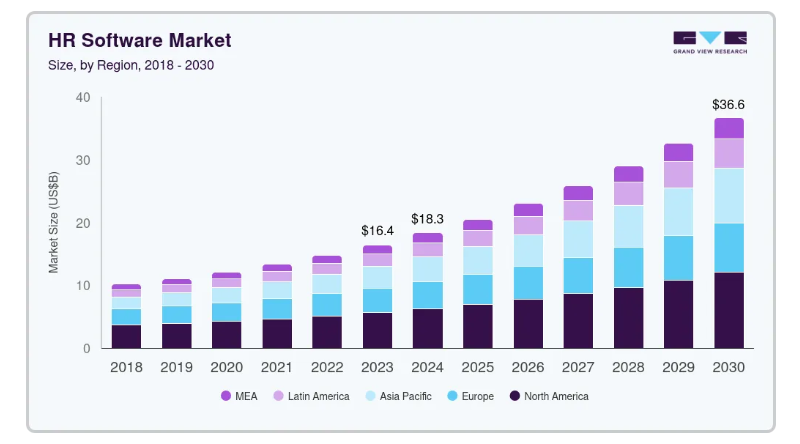
- In 2023, North America dominated the HR software market with a significant share of more than 34% of total revenue.
- Specifically, the HR software market of the US is predicted to expand at a CAGR of over 11% from 2024 to 2030.
What is Human Resource Management Software?
Human Resource Management Software, also known as HRMS or HCM, is a digital platform where businesses can control employee-related tasks. It includes supervising payroll, attendance, onboarding, and performance of employees in an organized system.
This helps businesses in terminating the struggle of maintaining spreadsheets and the hassle of paperwork. Investing in building HR automation software for small companies aims to save time and reduce errors.
Basically, HRM software makes it easier, efficient, and scalable to manage the workforce in a growing small business. If you want to build human resources management software for small business , you can reach out to a software development company.
What Are The Benefits Of Human Resource Management Software In Small Businesses?
Human resource management software helps businesses reduce manual workload, improve accuracy, and enhance employee productivity. Let us elaborate on some of the key benefits of HRM software in small businesses.
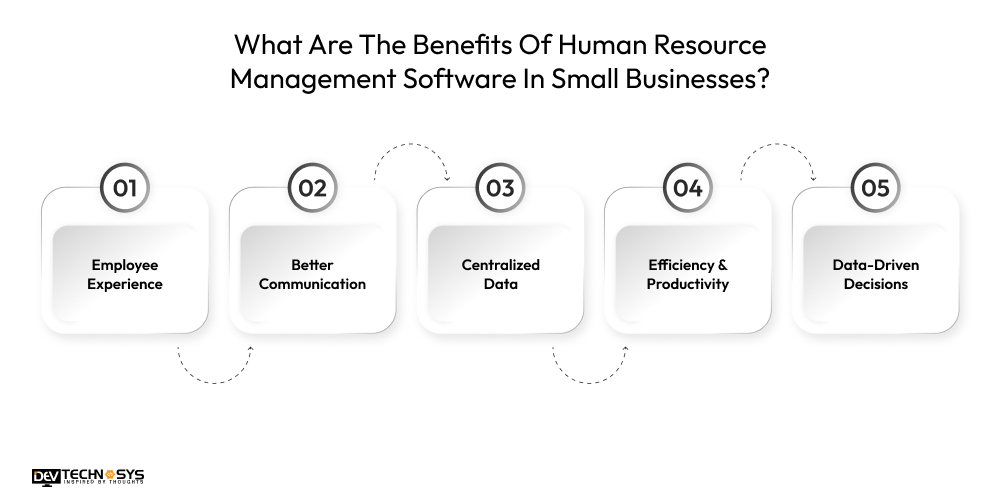
1. Employee Experience
Creating HR management apps can bring ease to employee onboarding, self-service, and daily interactions. With this, employees can feel supported and valued in the company. Also, their experience, satisfaction, and trust in the company will increase.
2. Better Communication
An attendance and leave management system can keep transparency and prevent confusion, while strengthening communication between employees and managers. It keeps teams aligned with real-time updates on leave schedules, approvals, and the availability of employees.
3. Centralized Data
It is really necessary to keep all salary, tax, and compensation details in one secure place. So, a payroll management software for a small business is perfect to keep the data centralized. This ensures accurate payroll every month.
4. Efficiency & Productivity
When you build an HR service delivery model for any organization, it will bring productivity and efficiency among the employees. It is because such developments can automate every work by reducing human efforts.
5. Data-Driven Decisions
The HR onboarding software development offers small businesses an understanding of employee hiring, performance, and retention. This helps leaders and managers make smart decisions to support the growth of the business with strong workforce management.
Want a chatbot demo or pricing? Fill the form and talk to our experts today.
Pick what you need below — you can select more than one — then tap Get detail to continue.
-
Chatbot demo dashboard
-
Cost to develop an app
-
Industry report
-
Case study
How To Build an HRMS For Small Businesses?
To Build an HRMS For Small Businesses, you have to start with market research and continue with regular updates. Here are the steps to develop HR software for small businesses that one must follow to build a scalable, user-friendly system.
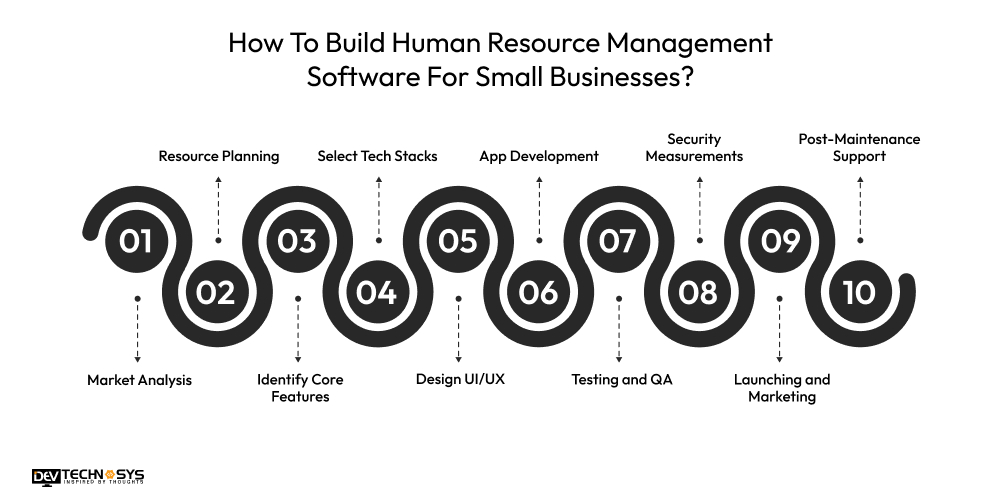
Step 1: Market Analysis
The first step in the HRMS development guide is to conduct thorough research on market needs. This research will let you understand your targeted audience, market trends, and the pain points you have to cover. You will study what your competitors are bringing to the table and create human resource management software for small businesses more uniquely.
Step 2: Resource Planning
Now, you have to plan for the resources before you Build an HRMS For Small Businesses. It includes resources such as your budget, development time, and development team. For custom HR software development or using HR workflow automation tools, having a clear resource allocation plan is essential.
Step 3: Identify Core Features
In this step to develop human resource management software for small businesses, you have to determine the features you want in your app. It includes essential features such as employee records, payroll, attendance, and performance management.
Also Read: The Impact of Automation on Human Resources and Hiring
These features are one of the main elements to make your app scalable. While selecting features, focus on what’s important for your business.
Step 4: Select Tech Stacks
Selecting the right tech stack is also mandatory to make your app stand out. A perfect tech stack becomes the reason for your app’s scalability and performance in the long run. Whether you are creating a cloud-based HR management platform or integrating AI in HR software, the right technology makes the app future-ready.
Step 5: Design UI/UX
If you are making an HR system development for startups, you have to prioritize clean and intuitive UI/UX. When UI/UX design is structured and easy to use, it allows employees to navigate through the app easily. A well-designed app helps in the fast completion of HR-related tasks with efficiency and improves employee satisfaction.
Step 6: App Development
As your features and technologies are selected, it is time for small business HR software development. In this stage, you have to write the code, construct databases, and integrate APIs to make the system functional. After this phase, your planned features and technology are transformed into HR and performance management software development.
Step 7: Testing and QA
Building HR tech solutions for small enterprises also involves deep testing of the app and ensuring quality assurance. In this step, your app will become a platform that meets all the quality standards. Here, bugs, compatibility issues, and performance flaws are identified and resolved. It helps in delivering a reliable and seamless ServiceNow for HR.
Step 8: Security Measurements
To build human resource management software for small businesses, the next concern is security. For utmost security, incorporate features like data encryption, two-factor authentication, and secure cloud storage. Develop HR document management systems with robust security that protects against potential breaches.
Step 9: Launching and Marketing
This is the time to launch your app on app stores with a strong hold on App Store Optimization (ASO). To make your app reach its targeted audiences, you have to promote its features and functionalities. For this, you can implement marketing strategies such as social media & influencer marketing, paid ads, referral programs, and so on.
Step 10: Post-Maintenance Support
Even after launch, you have to provide ongoing support, such as regular bug fixes and updates. As your software expands, offer continuous improvements like adding new features and the latest functionalities. HRMS software development cost also includes not just building but supporting the software long-term after release.

Why Should You Choose Dev Technosys For HRM Software Development?
By the end of this blog, you must have got the answer to how to create HR software. Along with the process to Build an HRMS For Small Businesses, it explains the benefits of the development. But now the question arises, who to choose for your employee management system development?
The answer is one and only Dev Technosys, the most trusted HR management software development company. It has been delivering web and mobile app development services to big and small enterprises for more than 15 years. With such a long run in this field, Dev Technosys guarantees delivering seamless, scalable products with its expertise.
Frequently Asked Questions
Find answers to the most common questions related to this article.
To build HR management software from scratch, one has to follow the steps mentioned below:
Step 1: Market Analysis
Step 2: Resource Planning
Step 3: Identify Core Features
Step 4: Select Tech Stacks
Step 5: Design UI/UX
Step 6: App Development
Step 7: Testing and QA
Step 8: Security Measurements
Step 9: Launching and Marketing
Step 10: Post-Maintenance Support
The cost to develop an HR management software can range somewhere between $8,000-$30,000. However, the final cost also depends on the complexity, features, platform choice, backend, API integration, security, and other factors.
Some of the most important features a small business HR software must incorporate are:
Employee data management
Payroll processing
Time & attendance tracking
Onboarding
Performance management
Employee self-service (ESS)
The list of the best tech stacks that can be utilized for HR software development includes:
Frontend: React.js, Vue.js, or Angular
Backend: Node.js, Python (Django/FastAPI), Ruby on Rails, or Java Spring Boot.
Mobile App: React Native or Flutter for cross-platform; Swift or Kotlin for native apps
Database: PostgreSQL, MySQL, MongoDB, or Firebase
Cloud Services: AWS, Microsoft Azure, or Google Cloud
DevOps & CI/CD: Docker, Kubernetes, Jenkins, & GitHub Actions
Integrations: REST APIs, GraphQL, & OAuth
Here are the most trusted and preferred HR analytics tools for small businesses:
BambooHR
HiBob
Personio
Zoho People
Gusto
Microsoft Power BI/Tableau