


















Quick Insights on Medical Device Software Development Cost:
The medical device software development cost in 2026-2027 typically ranges from $30,000 to $1,50,000+. It depends on software complexity, device integration, features, security, and regulatory requirements.
Cost Breakdown by Development Complexity:
-
- Basic Software: $30,000–$50,000 — Core monitoring, user access, data collection, and reporting.
-
- Mid-Level Software: $50,000–$90,000 — Device connectivity, real-time monitoring, alerts, dashboards, and APIs.
-
- Advanced Software: $90,000–$1,50,000+ — AI capabilities, advanced analytics, IoT integration, interoperability, and compliance.
Key Cost Factors:
-
- Software complexity, medical device integration, cybersecurity, compliance, UI/UX, cloud infrastructure, APIs, testing, and validation.
Development Timeline:
-
- A medical device software solution typically takes 4 to 7+ months to develop, depending on complexity and regulatory requirements.
Regional Cost Rates:
-
- Development in India can be 40–60% more cost-effective than the US, UK, and Western Europe without compromising quality.
Additional Costs:
-
- Budget for maintenance, cloud hosting, security updates, compliance, validation, and third-party services after launch.
Introduction
It is evident that technologies are evolving across industries, and the healthcare industry is no exception. Medical device software is among the technologies that have revolutionized how healthcare professionals, patients, and clinical researchers work.
This makes entrepreneurs, hospitals, and healthcare businesses ask: How much does medical device software development cost? The medical device software development budget is $30,000 – $1,50,000, driven by complexity, integrations, security, backend, and other factors.
In this guide, we will explain key cost drivers, development timelines, essential features, and additional expenses. This will help businesses and startups strategically plan the development with accurate budgeting.
Medical Device Software Market Size and Growth Statistics
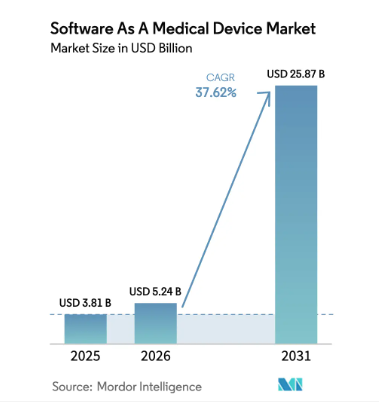
Modern healthcare providers are adopting connected devices, remote monitoring, AI, and data-driven clinical solutions. This is driving the medical device software market at a rapid pace. Have a look at the market analysis on medical device software by Mordor Intelligence.
- The medical device software market was valued at USD 3.81 billion in 2025.
- It is USD 5.24 billion in 2026 and is expected to reach USD 25.87 billion by 2031.
- This growth can be measured at a 37.62% CAGR during the forecast period between 2026 and 2031.
- Hospitals and clinics, as end users, have earned 41.05% of overall revenue in 2025.
- According to the region, North America has contributed 41.30% of the total profit share in 2025.
What Is Medical Device Software?
Medical device software is a custom software made specifically for medical purposes, either on its own or as a part of a physical medical device. Medical device software plays a crucial role in shaping today’s healthcare. It helps medical professionals diagnose, treat, monitor, or prevent health conditions and diseases.
Key Characteristics:
- Purpose-driven: Created for medical use like analysis, diagnosis, or therapy.
- Regulated: A medical software must adhere to regulatory standards like FDA, MDR, or IEC 62304.
- Safety-critical: Must operate reliably, as failures could impact patient health.
How Much Does it Cost to Build Medical Device Software in 2026–2027?
The average medical device software development cost can be estimated between $30,000 and $1,50,000. The final development budget is determined by the platform’s complexity. The level of complexity, whether high, moderate, or low, is due to security requirements, features, and other integrations. We will understand the medical device software development expenses in this way:
- Basic App: A basic app with an MVP strategy has limited but essential features and integrations. This makes it easier and less complex to build.
A basic medical device software cost: $30,000 – $70,000
- Moderate App: An app that combines both basic and advanced integrations is a mid-level app. It is neither too easy nor too complex to develop.
A moderate medical device software development price: $70,000 – $1,15,000
- Advanced App: An application with the latest technologies, AI, modern integrations, and more is highly complex to create.
An advanced medical device software cost: $1,15,000 – $1,50,000
| Complexity | Best For | Typical Features | Estimated Cost |
| Basic / MVP | Testing a core medical software idea | User login, device data, basic dashboard, reports, alerts | $30,000–$70,000 |
| Moderate | Growing healthcare businesses | Real-time monitoring, cloud integration, analytics, APIs, notifications | $70,000–$1,15,000 |
| Advanced | Enterprise & connected medical solutions | AI, IoT connectivity, predictive analytics, interoperability, advanced security | $1,15,000–$1,50,000+ |
Medical Device Software Development Cost by Device Type
Patient monitoring, diagnostic devices, and medical imaging are among the most common types of medical device software. The development cost not only depends on the complexity of software but also on what the device does. We will now understand medical device software development pricing based on its types.
1. Patient Monitoring Software (ECG, blood pressure, SpO2):
Patient monitoring platforms include real-time data handling and continuous sync. This can significantly raise the patient portal development expenses. To process readings instantly, such device monitoring software requires reliable, low-latency data pipelines.
2. Diagnostic Device Software (Imaging, Lab Systems)
Imaging, laboratory systems, and other clinical workflows require supreme accuracy; this is where diagnostic device software support. Additional integrations and validations are needed when it is connected with medical device middleware or healthcare systems.
3. Medical Imaging Software (MRI, CT, Ultrasound, X-ray)
Medical imaging software usually handles diagnostic data at larger volumes. Due to this, storage, processing, and secure transfers are important cost factors. DICOM support and PACS integration are also needed to manage medical images throughout clinical environments.
4. Wearable Medical Device Software (Smartwatches, Biosensors)
Wearable medical device software must support continuous data collection. This is done while maintaining battery efficiency and reliable connectivity. Additional engineering is required for embedded medical software to synchronize in the background and handle data offline.
5. Therapeutic Device Software (Insulin Pumps, Neurostimulation)
A single software error can affect the patient’s treatment; therefore, therapeutic device software is safety-critical. Its solutions include medical device firmware and an RTOS that support precise device operations. Also, extensive risk assessment, verification, validation, and fail-safe mechanisms are involved.
We will now understand the medical device software development cost estimate based on types through a table:
| Medical Device Software Type | Main Cost Driver | Technical Complexity | Estimated Development Cost |
| Patient Monitoring Software | Real-time readings, continuous synchronization, instant alerts | High | $40,000–$95,000 |
| Diagnostic Device Software | Accuracy, validation, clinical algorithms, system integration | High | $50,000–$1,00,000 |
| Medical Imaging Software | DICOM, PACS, large image files, processing and storage | Very High | $70,000–$1,30,000 |
| Wearable Medical Device Software | Continuous sync, battery optimization, device connectivity | High | $30,000–$85,000 |
| Therapeutic Device Software | Safety-critical controls, firmware, risk management, validation | Very High | $90,000–$1,40,000+ |
Factors Affecting the Cost to Build a Medical Device Software
There are many factors that can affect the healthcare software development cost. It may include app complexity, features, regulatory requirements, and more. Here are the factors that can affect the medical device software validation cost:
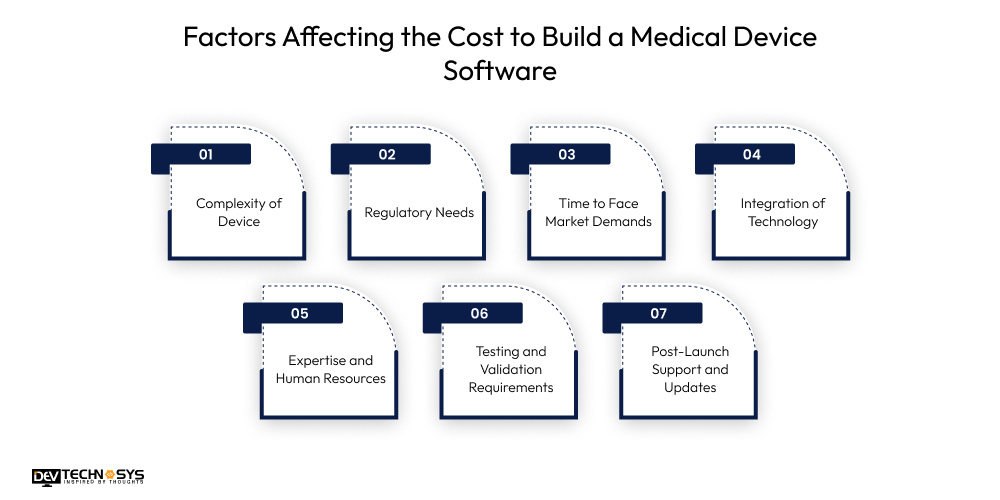
1. Complexity of the Device
The cost to create medical device software rises with the complexity of the medical device. A basic diagnostic tool may require less functionality, while a life-supporting device demands advanced technology. The special components, validation, and testing efforts add to the total medical device software development cost.
| Device Complexity | What Increases the Cost | Cost Impact |
| Basic | Single-device connectivity and limited data processing | $8,000–$12,000 |
| Moderate | Multiple sensors, real-time data, and cloud connectivity | $12,000–$18,000 |
| High | Complex devices, advanced algorithms, and real-time processing | $18,000–$25,000 |
2. Regulatory Requirements
Ensuring compliance with global healthcare regulations can increase the medical device software development cost. Regulatory standards like the FDA, EMA, and MHRA impose strict standards. Complex devices may require Premarket Approval (PMA) or 510(k) submissions, which involve detailed documentation, clinical trials, and a lengthy review period. It can significantly increase the cost to create medical device software.
| Compliance Scope | What Drives the Cost | Cost Impact |
| Basic Compliance | Documentation, security controls, and initial compliance checks | $5,000–$8,000 |
| Multi-Standard Compliance | Multiple standards, audits, and detailed documentation | $8,000–$12,000 |
| Extensive Compliance | Comprehensive validation, risk management, and regulatory preparation | $12,000–$15,000 |
3. Time to Meet Market Demands
Speed to market can influence the total cost. Faster health insurance software development timelines may require a larger team or outsourcing, all of which raise costs. On the other hand, delays in launch can result in lost market opportunities and increased regulatory overhead.
| Development Approach | What Drives the Cost | Cost Impact |
| Standard Timeline | Planned development with regular testing | $6,000–$8,000 |
| Faster Launch | Additional resources and parallel development | $8,000–$10,000 |
| Accelerated Launch | Larger team and faster development cycles | $10,000–$12,000 |
4. Integration of Advanced Technologies
Adding technologies like Artificial Intelligence (AI), cloud connectivity, and real-time data processing can increase the complexity and healthcare software development cost. These features often require additional security, validation, and infrastructure to ensure proper functioning.
| Technology Level | Examples | Cost Impact |
| Essential | APIs, Bluetooth, and basic cloud connectivity | $4,000–$7,000 |
| Advanced | IoT, real-time analytics, and interoperability | $7,000–$12,000 |
| Next-Gen | AI/ML, predictive analytics, and intelligent automation | $12,000–$16,000 |
5. Expertise and Human Resources
Skilled professionals including medical domain experts, software engineers, data scientists, and regulatory consultants, are crucial for successful development, but hiring can then impact the cost to build medical device software. Hiring or outsourcing such expertise often represents a significant portion of the custom software development budget, especially when dealing with critical and sensitive applications.
| Team Requirement | Expertise Needed | Cost Impact |
| Core Team | Developers, UI/UX designer, and QA engineer | $3,500–$5,500 |
| Specialized Team | Medical software, security, and compliance expertise | $5,500–$8,000 |
| Multidisciplinary Team | Medical, regulatory, AI, security, and software specialists | $8,000–$11,000 |
6. Testing and Validation Requirements
Testing and validation are critical components of medical device software development, especially to ensure compliance and performance. The medical software architecture cost for basic testing that includes manual testing, unit tests is around $5,000 to $9,000. Whereas, regulatory validation including compliance with FDA, CE, etc. can cost up to $15,000 to $20,000.
| Validation Level | Testing Scope | Cost Impact |
| Standard Testing | Functional, usability, and performance testing | $4,500–$7,000 |
| Advanced Validation | Security, compatibility, and integration testing | $7,000–$11,000 |
| Medical-Grade Validation | Verification, validation, and safety testing | $11,000–$15,000 |
7. Post-Launch Support and Updates
Post-launch support ensures that the medical device software continues to function efficiently, stays compliant with evolving regulations, and remains competitive in the market. This phase may involve addressing bugs or technical issues that emerge in real-world use and providing regular updates to maintain device compatibility.
| Support Level | What It Covers | Cost Impact |
| Essential Maintenance | Bug fixes, monitoring, and security patches | $2,500–$3,500 |
| Continuous Support | Performance updates, API maintenance, and improvements | $3,500–$5,000 |
| Dedicated Support | Security upgrades, major updates, and ongoing monitoring | $5,000–$6,000 |
Medical Device Software Development Security and Compliance Costs
Security and compliance are highly recommended and important for medical device software. The cost to integrate them can range from $5,000 to $20,000. This is because these systems can handle sensitive health information and influence clinical decisions.
Security and compliance are not afterthoughts but are considered throughout, from architecture to maintenance. Here are the globally recognized security and compliance standards our platform aligns with.
| Compliance Standard | Focus Area | Estimated Implementation Cost |
| ISO 27001 (ISMS) | Information security management system for structured risk control and data protection | $7,000 – $15,000 |
| SOC 1 | Controls related to financial reporting accuracy and operational integrity | $6,000 – $12,000 |
| SOC 2 (Type I/II) | Security, availability, confidentiality, and privacy controls for service systems | $8,000 – $18,000 |
| GDPR | Data privacy, consent management, and user rights protection in the EU | $5,000 – $14,000 |
| CCPA | Privacy rights and data protection for California residents | $5,000 – $12,000 |
| HIPAA | Protection of patient health information (PHI) in healthcare systems | $8,000 – $20,000 |
| FDA 21 CFR Part 820 | Quality system requirements relevant to medical device development and validation | $10,000 – $20,000 |
| IEC 62304 | Software lifecycle processes for medical device software safety and reliability | $9,000 – $18,000 |
| ISO 13485 | Quality management system for medical device design and manufacturing | $8,000 – $16,000 |
Despite the security and compliance standards mentioned above, several other important integrations include:
- HL7
- HL7 FHIR
- FHIR API
- Healthcare Information Exchange
These standards support structured medical data interoperability and clinical data exchange seamlessly.
Note: For the security and compliance certifications given above, we are certified for them and work according to these certifications.
Medical Device Software Cost Breakdown by Development Stage
The medical device software development price is not a single upfront expense. It is a strategically balanced investment across development steps, from market analysis and UI/UX to testing and after-launch support. The overall budget is carefully allocated according to the device’s complexity, security, API integrations, and other factors. We will now explain the medical device software development cost breakdown by development process.
| Development Stage | What the Budget Covers | Approx. Cost Share |
| Requirement Analysis | Functional requirements, user needs, technical specifications | 5–8% |
| Risk Assessment | Risk identification, mitigation planning, safety analysis | 5–8% |
| Software Architecture | System architecture, database design, security planning | 5–8% |
| UI/UX Design | Medical workflows, interfaces, accessibility, prototypes | 8–12% |
| Prototype Development | Proof of concept, device communication, workflow validation | 5–10% |
| Software Development | Frontend, backend, core functionality, APIs | 25–35% |
| Hardware & Device Integration | Sensors, medical devices, Bluetooth/BLE, device protocols | 10–18% |
| Testing & Verification | Functional, security, performance, compatibility testing | 12–20% |
| Validation & Compliance Documentation | Verification records, validation evidence, regulatory documentation | 10–18% |
| Deployment | Production setup, configuration, release, monitoring | 3–7% |
| Post-Market Maintenance | Updates, bug fixes, security patches, performance monitoring | 5–10% |
Planning a Healthcare App Project?
Get a tailored development cost estimate in a few simple steps.
- 3 quick steps
- 100% free
- Reply in 1 business day
2 Minutes Read
Medical Device Software Development Tech Stack: Cost, Tools & Technologies
The selection of supreme technologies impacts medical device and telehealth software development expenses. It even influences the platform’s performance, security, scalability, and device compatibility. The average cost of a tech stack in medical device software is estimated at $5,000 – $15,000. The right combination of technologies depends on:
- Mobile application
- Web platform
- Connected device system
- Software as a Medical Device (SaMD)
| Technology Layer | Recommended Technologies | Where It Fits | Estimated Cost |
| Mobile Development | Swift, Kotlin, Flutter, React Native | Patient and device companion applications | $5,000–$9,000 |
| Web Development | React, Angular, Vue | Provider dashboards and admin portals | $5,000–$8,000 |
| Backend Development | Node.js, Python, Java, .NET | Data processing, business logic, APIs | $7,000–$12,000 |
| Database | PostgreSQL, MySQL, MongoDB | Patient and device data management | $5,000–$8,000 |
| Cloud Infrastructure | AWS, Azure, Google Cloud | Storage, scalability, backup, monitoring | $6,000–$10,000 |
| Healthcare APIs | REST, GraphQL, FHIR API | Data exchange and system integration | $5,000–$10,000 |
| Interoperability | HL7, HL7 FHIR | Clinical data exchange | $7,000–$12,000 |
| Medical Imaging | DICOM, PACS Integration | Medical image storage and exchange | $8,000–$14,000 |
| Device Connectivity | Bluetooth/BLE, Wi-Fi, NFC | Device-to-app communication | $6,000–$10,000 |
| AI/ML | Python, TensorFlow, PyTorch | Diagnostics, prediction, data analysis | $9,000–$16,000 |
Many healthcare applications require EHR integration or EMR integration. For them, interoperability should be prioritized while planning the tech stack. This way, businesses can save redevelopment costs and support smooth healthcare information exchange between connected systems.
Note: The cost for security & compliance and the tech stack is included in our overall development cost. Don’t confuse it and think that it is an additional expense.
Best Medical Device Software Examples and What They Cost to Build
Whether glucose monitoring, cardiac tracking, or remote patient monitoring, medical device software is used throughout the healthcare sector. We have mentioned some real-world examples of medical device software widely used worldwide. Dexcom CLARITY, EpiMonitor, Medtronic CareLink, and other devices can be useful benchmarks for estimating development costs.
| Medical Device Software | Best For | Key Features | Estimated Build Cost |
| Dexcom CLARITY | Diabetes data management | Glucose trends, reports, data sharing, clinical insights | $70,000–$1,30,000 |
| Abbott LibreView | Glucose data management | Cloud data storage, glucose reports, trend analysis, provider sharing | $60,000–$1,20,000 |
| Dexcom Follow | Remote glucose monitoring | Real-time glucose sharing, alerts, caregiver monitoring | $45,000–$90,000 |
| FreeStyle LibreLink | Continuous glucose monitoring | Sensor connectivity, glucose readings, alerts, history tracking | $60,000–$1,20,000 |
| Medtronic CareLink | Diabetes device management | Device data, reports, trend analysis, remote monitoring | $80,000–$1,40,000 |
| Empatica Health Monitoring Platform | Wearable health monitoring | Sensor data, physiological monitoring, cloud analytics, alerts | $80,000–$1,50,000+ |
| BodyGuardian Remote Monitoring System | Cardiac monitoring | Wearable monitoring, ECG data, remote transmission, analytics | $90,000–$1,50,000+ |
| Withings ECG App | ECG monitoring | ECG recording, rhythm analysis, health data tracking | $60,000–$1,20,000 |
| EpiMonitor | Seizure monitoring | Wearable sensing, seizure detection, alerts, health data | $80,000–$1,40,000 |
| Onera SleepMap | Sleep monitoring | Sleep data collection, physiological monitoring, analysis | $80,000–$1,50,000+ |
Hidden Medical Device Software Development Costs Every Business Should Know
Every medical device software or healthcare app development firm’s cost structure covers design, development, and testing. But do you know what hidden costs come once you sign the contract? Common hidden costs include regulatory rework, security patching, recertification, and validation rework.
It doesn’t mean that the development company hides something from businesses. Some costs appear as the business grows and requirements change. These can push the average cost of medical device software development 20-25% higher. We have also identified some hidden costs that everyone should know before it’s too late.
1. The Cost of Regulatory Documentation and Compliance (10%-18%)
The developers’ main focus is to build medical device software. But they are liable to prove that the platform is safe. For that, risk records and safety files are created throughout the development. If this is skipped, the QA team has to rebuild it at a higher expense.
2. The Ongoing Cost of Cybersecurity (5%-10%)
Thinking that cybersecurity ends with the app launch is the biggest mistake. Continuous monitoring of new threats, fixing vulnerabilities, updating software components, and maintaining security documentation is necessary. These ongoing efforts can increase the medical device HIPAA-compliant software development cost.
3. Post-Launch Maintenance and Recertification (15%-20%)
With changing devices, operating systems, browsers, and third-party services, the medical device software needs updates after launch. Some of these changes might demand additional testing and regulatory reviews. This can potentially raise the cost to develop medical device software.
4. The Cost of Repeating Clinical and Usability Testing (10%-20%)
When you give the app to doctors and nurses for usability testing, they may discover issues. At these times, fixing such problems requires redesigns, updated documentation, risk assessments, and repeat testing. This can lead to elevated medical device or doctor-on-demand app development expenses.
How to Actual Ways to Reduce Medical Device Software Development Costs?
Planning for compliance early, professional testing, and building an MVP can help businesses reduce development costs. A reliable medical device and EMR software development company will present you with smart strategies for cost reduction. We will now discuss some of the most common ways to lower the cost to develop medical device software.
1. Build Compliance in From Day One
The first thing every business must understand is that safety, regulatory, and compliance requirements are not an afterthought. It is mandatory to address them from the very beginning. When you include regulatory compliance from planning to development, it prevents costly redevelopments.
2. Design a Modular and Update-Friendly Architecture
It is always better not to build the entire system as one tightly connected block. If the architecture is modular, it becomes easier to upgrade a single component without affecting the complete software. This helps reduce the medical device or medicine delivery app development cost.
3. Run Usability Testing Early
It is a bad idea to wait till the final development stage for usability testing. Testing should be started at early stages with real users and even with prototypes. Early feedback is beneficial to avoid expensive redesigns, development rework, and repeated validation later.
4. Use Open Standards and Avoid Vendor Lock-In
Businesses must support standards and technologies that work with different tools and vendors. You should ensure that your contract clearly mentions who owns the code and integrations. It is an easier and cheaper way to switch vendors and expand your software later.
Testimonial
Client Review on Clutch:
Dev Technosys has significantly improved our operational efficiency and patient experience. Our medical staff could access patient records instantly, reducing administrative workload and enhancing decision-making. The telemedicine platform increased patient engagement, allowing us to provide remote consultations seamlessly.
Monetization Strategies for Medical Device Software
Congrats! You made it till here. We hope your doubts regarding the cost to build medical device software are cleared by now. So, in this section, let’s discuss some revenue-generating strategies for medical software in detail:
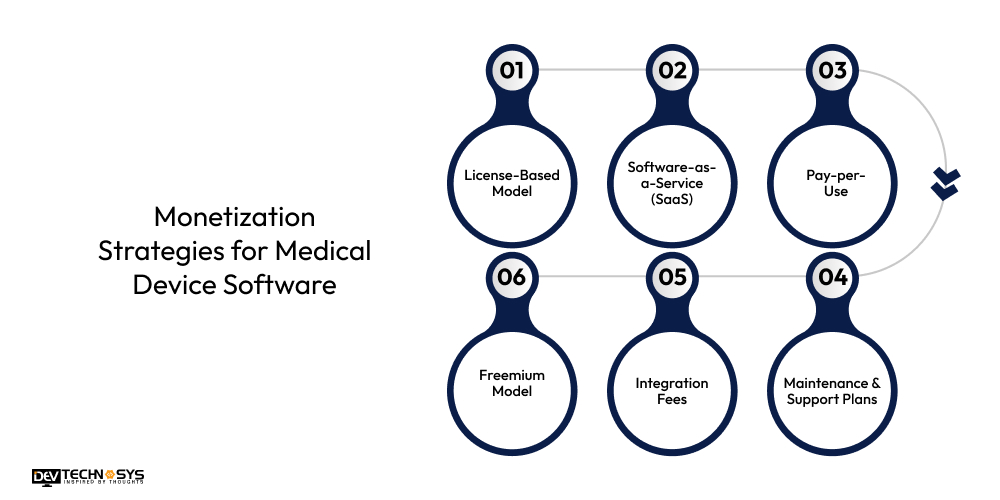
1. License-Based Model
This monetization model charges healthcare providers or institutions a one-time or recurring license fee for using the embedded software in medical devices. It offers predictable revenue and suits software that does not require frequent updates or cloud connectivity.
Example: Hospitals pay annually for surgical robot software or diagnostic tools.
2. Software-as-a-Service (SaaS)
Subscription-based pricing models for software as a medical device are often tiered based on features or usage. It helps with recurring revenue streams with flexibility for users. Subscriptions can be monthly or yearly and often come in tiers based on features, storage, number of patients, or usage limits
Example: Remote patient monitoring software with monthly or yearly subscriptions.
3. Pay-per-Use
Software in medical devices is charged based on actual usage of features or services. This monetization model is ideal for imaging analysis tools, pathology software, or diagnostics-as-a-service. It’s particularly suitable for high-end, computation-intensive applications like AI-based diagnostics
Example: A cloud-based AI radiology tool that analyzes MRI scans and provides diagnostic reports.
4. Maintenance & Support Plans
Maintenance and support monetization models for medical device software offer ongoing technical support, updates, or compliance checks as paid services. This ensures long-term functionality, reliability, and regulatory compliance for critical medical applications.
Example: Annual service contracts for critical medical equipment software
5. Integration Fees
This model involves charging additional fees for integrating the software with existing Electronic Health Records (EHRs), cloud services, or hospital systems. Since integration often requires customization and validation, this fee covers the additional development and regulatory work.
Example: A remote patient monitoring software that integrates with a hospital’s Electronic Health Records system.
6. Freemium Model
This revenue-generating model offers a basic version for free and charges for advanced features or enterprise usage. It’s an effective monetization strategy for encouraging initial adoption and upselling premium features once users are engaged.
Example: A mobile app for patient monitoring offering basic vitals tracking for free and advanced analytics as paid upgrades.
How Does AI Impact the Cost to Build a Medical Device Software?
AI has a major impact on the medical device software development cost, both by increasing the initial investment and reducing ongoing costs. Integrating AI in medical device softwares accelerates development processes, enhances automation, and enhances the accuracy of diagnosis, but it also entails higher upfront expenditures and specialized expertise.
Reduced human error, faster regulatory compliance, and less manual testing ultimately lead to cost savings.
AI impacts medical device software development by:
- Increased initial development expenditures as a result of intricate algorithms
- AI automation for quicker testing and validation
- Reduce expenses for ongoing upkeep and compliance
- Better accuracy in diagnosis reduces failures and rework.
- Improves ROI through real-time insights and clever data processing
Conclusion
Once, a founder told us that he planned app development that appeared to be developed in 6 months and for $70,000. But in reality, it took 14 months to build, and the final cost came to $140,000. This is because he didn’t see compliance documentation, security work, and validation steps coming. That’s why the development time increased by 6 weeks.
The medical device software development pricing model is $30,000-$150,000, not only because it is complex to build. There are some real expenses hidden behind compliance, testing, development, and after launch.
This is why it is important to plan the cost like development. To get your budget planning right, you can contact a trusted medical device or pharmacy management software development company.
Frequently Asked Questions
Find answers to the most common questions related to this article.
The average cost to create medical device software can range between $30,000 and $1,50,000. The final development expenses are determined by the platform complexity and several other factors. The factors include platform complexity, UI/UX, security & compliance, backend infrastructure, and others. A simple MVP app is less expensive than a fully-featured, modern app with the latest technologies.
Yes, adding AI and machine learning to medical device software increases the final development budget. Integrating AI features requires extra engineering, risk documentation, and ongoing performance monitoring. Along with that, it also needs planning for what happens when the model changes. A single model upgrade with AI, machine learning, and other technologies can significantly increase the development cost.
Usually, it takes 4 to 7+ months to make medical device software in 2026-2027. The development timeline is affected by the platform’s complexity, number of features, API integration, and security requirements. A simple app, built with an MVP strategy, can be developed within 4 to 6 months. While an advanced app with the latest integrations and high security takes 7+ months.
The three main things that are considerably driving the final medical device development cost include:
● Stricter cybersecurity requirements at submission
● Notified bodies in Europe taking longer and charging more
● Regulators now expecting a clear plan for AI-enabled features
None of these levels of classification existed even 5 years ago. That is the reason why the older cost benchmarks are outdated for modern development.
Generally, the compliance, security, and validation work roughly gets 20-25% over budget. But the quote we have given, $30,000-$1,50,000, includes the security and compliance cost. This makes it easier for businesses to plan their budget accurately from the beginning. This is why there will be no hidden or instant cost surprises.