



















Key Takeaways
- The cost to develop a language learning app generally varies between $5,000 and $35,000, depending on parameters such as functionalities required, difficulty level, adaptations needed, and price.
- The least complex projects will be comprised of general vocabulary exercises, tests, flashcards, and student interfaces.
- Complex applications necessitate the development of tutorial programs based on advanced technology, speech recognition, personalized learning, and real-time communication.
- The AI language learning app development cost depends substantially on the choices made in user-interface design, platform selection, content creation, and external integration.
- Therefore, making the right choices regarding development technologies used can result in more scalable solutions.
With the spread of mobile apps and online educational platforms, it has become easier to learn new languages. Students do not need to rely solely on traditional classrooms and physical resources anymore. Now they can study vocabulary, train pronunciation, learn grammar, and develop conversational skills using mobile phones.
A language learning application is a platform that allows users to study through interactive lessons, do exercises, partake in speaking practice sessions, and monitor their learning achievements. The most advanced applications rely on artificial intelligence technology.
In terms of education and business, investing in language-learning app development gives companies the ability to reach a wide foreign audience.
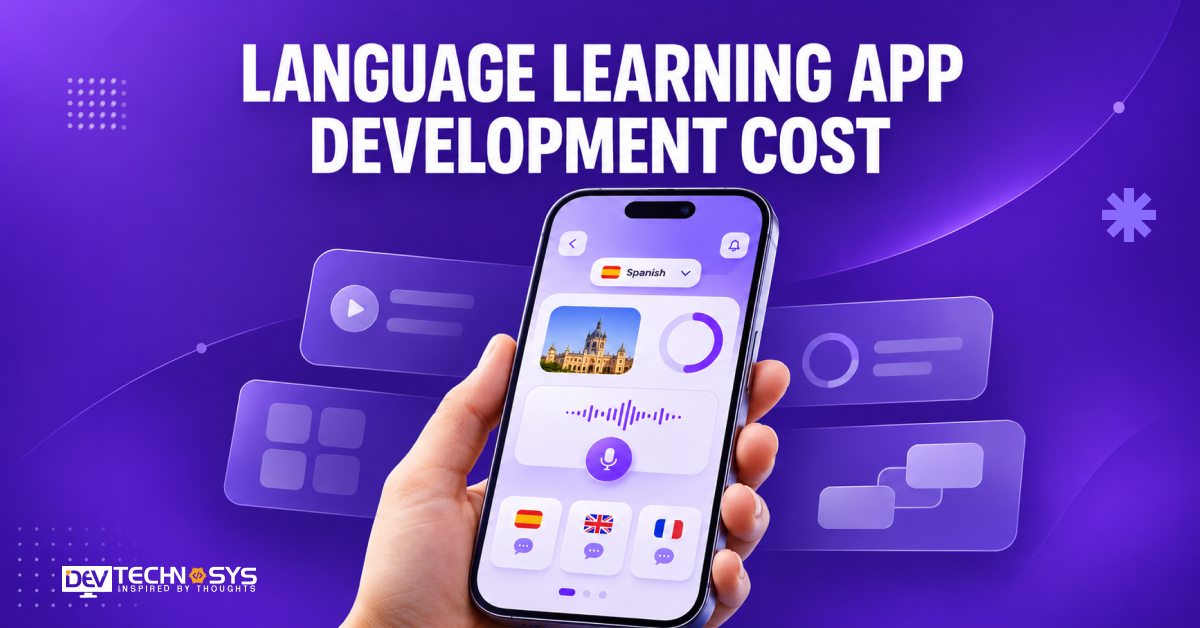
However, knowing how much app development costs is important before starting a project. The language learning app development cost varies from $5,000 to $35,000, which will depend on the complexity of an app and the features needed.
Let’s take a look at the main components of costs and the important features of mobile applications.
How Much Does It Cost to Develop a Language Learning App?
The language learning mobile app development cost ranges from $5,000 to $35,000. However, the total outlay depends on the features of the app, individual customizations needed, and the estimated number of users.
Here is an estimated cost breakdown based on application complexity:
Language Learning App Type |
Estimated Development Cost |
Key Features |
| Basic Language Learning App | 5,000–10,000 | Registration, vocabulary lessons, flashcards, quizzes |
| Mid-Level Language Learning App | 10,000–20,000 | Audio lessons, pronunciation practice, gamification, progress tracking |
| Advanced Language Learning App | 20,000–35,000 | AI tutoring, speech recognition, personalized learning, conversational practice |
Let’s understand what each category offers.
-
Basic Language Learning App
A simple app meets the needs of startups and education firms planning to provide basic language-learning solutions. The app comprises features such as user registration, vocabulary building, flashcards, grammar exercises, and other functionalities for tracking progress.
-
Mid-Level Language Learning App
A mid-level app provides more advanced learning solutions and can have features like audio lessons, pronunciation exercises, gamification, learning streaks, personal dashboards, subscription management, etc. It’s primarily designed for growing educational technology firms.
-
Advanced Language Learning App
An advanced app provides personalized learning experiences and can include features like AI tutoring, speech recognition technology, conversation practice, adaptive learning paths, and pronunciation feedback.
These estimates are indicative and may vary depending on the development team’s location, project scope, design complexity, and integration requirements.
Language Learning App Development Cost Breakdown
Developing a language learning app through education AI development companies involves multiple stages, from initial requirement analysis to final deployment. Each stage requires different technical resources and contributes to the overall development budget.
The following table provides an estimated cost breakdown:
Development Stage |
Estimated Cost ($) |
| Requirement Analysis and Planning | 500–1,200 |
| UI/UX Design | 500–1,500 |
| Frontend Development | 1,000–4,000 |
| Backend Development | 1,200–5,000 |
| Database Development | 400–1,500 |
| Feature Development | 1,000–8,000 |
| Third-Party Integrations | 400–3,000 |
| Testing and Quality Assurance | 500–2,000 |
| Deployment and Launch | 300–800 |
Let’s understand the major development stages:
- Requirement Analysis and Planning: Developers work out who the target users are and what features the application should have. It is also necessary to prepare the schedule and outline the technical requirements of the project.
- UI/UX Design: Designers make wireframes, prototypes, and the user interface. The purpose of this stage is to make the lessons, exercises, and navigation easy and enjoyable for users.
- Frontend Development: This stage includes the development of user-side elements such as users’ dashboards, vocabulary exercises, lesson screens, quizzes, and gaming exercises.
- Backend Development: Backend developers create server-side architecture, authentication systems, business logic, and application functions.
- Database Development: The system supplies a structured database, storing user profiles, progress records, vocabulary, and courses during learning.
- Feature Development: The learning functions, assessment, gamification, and communication systems are implemented according to the requirements of the project.
- Third-Party Integrations: The system connects to other systems like speech recognition, text-to-speech, payment systems, analytics, and notification systems.
- Testing and Deployment: The application goes through functional testing, security testing, compatibility testing, and performance testing before launching.
Factors Influencing Language Learning App Development Costs
Apart from the selected features, several technical and operational factors determine the final exam preparation app development cost.
1. Application Complexity
An elementary application for vocabulary learning uses fewer resources than a sophisticated platform equipped with artificial intelligence, real-time communication, and dynamic learning.
2. Platform Selection
The platform on which the application is to be developed, e.g., Android or IOS, affects the overall budget as well. Cross-platform development can reduce the duplication of development efforts, while the choice of separate native applications can lead to extra costs.
3. UI/UX Design
The cost of design can be raised by custom dashboards, gamified lessons, animation use, and personalized user journeys. Moreover, a user-friendly interface can help boost user engagement and learning retention.
4. AI and Speech Recognition
The technical complexities of developing speech recognition, conversational AI, pronunciation, and personalized recommendations will increase. It may also result in extra API charges since these functionalities may require using APIs permanently.
5. Content Development and Localization
When it comes to producing foreign language lesson plans, exercises on grammar themes, audio materials, and language tools, the process is time-consuming and labor-intensive. Content management of multilingual lessons implies additional work.
6. Third-Party Integrations
Using payment systems, voice synthesizers, text-to-speech programs, analytic tools, and virtual platforms results in costs added to the installation and testing.
7. Security and Scalability
Ensuring user safety, protection of transactions, and growth of the audience means that a brand must ensure that the systems used are reliable, including the authentication systems, encryption-at-rest programs, and performing regular security check-ups.
How to Optimize Language Learning App Development Costs
Businesses can manage their development budgets through a strategic approach without compromising essential application quality.
- Begin with Developing an MVP: Create an MVP by using MVP development services incorporating must-have elements such as user sign-up, language-oriented training lessons, quizzes, and tracking functionality.
- Utilize Cross-Platform Development: Apply different frameworks that allow minimizing coding efforts.
- Make Use of APIs: Integrate services available in the market instead of developing technologies from the very beginning.
- Work with AI Gradually: Start with the simplest AI-based recommendations and continue enhancing applications towards AI-based conversation capabilities based on its growth.
- Use Reusable Interfaces and Development Frameworks: Taking advantage of reusable interfaces and software development frameworks allows minimizing coding efforts.
- Make Provision for Scalability: Select an infrastructure that would enable development without major changes in the system architecture.
- Work with Professional Developers: A professional company will take care of fulfilling requirements, choosing technologies, and timing.
How Do Language Learning Apps Make Money?
Various monetization models can be adopted by language learning applications to generate revenue according to the target users as well as the pedagogical content provided.
1. Freemium Model
The freemium approach gives users access to elementary course lessons and academic materials without charge while implementing a fee for using more advanced features. Students can take advantage of free introductory lessons and proceed to the next steps of the learning process after paying for them.
2. Subscription Plans
The app can provide a subscription-based sales model with monthly, quarterly, or yearly subscription plans, allowing users access to premium lessons.
3. In-App Purchases
Another way to generate income is by selling different course lessons, packs of vocabulary, grammar classes, and other materials.
4. Paid Courses
Platforms aimed at learning languages are capable of providing structured courses for attaining different levels of competence in different dialects. The courses may be created in order to follow specific levels of competence or for attaining some language certificates.
5. Advertising Revenue
Apps that are used by many people may generate profits through advertisements. Nevertheless, ads should be displayed in such a way that they do not disturb the educational process.
6. Live Tutoring
It is also possible for companies to make people pay for different kinds of educational services such as personal consultations with language tutors, group learning, and practicing conversational skills. In order to maximize profits, companies can combine subscriptions, premium educational courses, and in-app purchasing options.
Conclusion
One of the promising opportunities for businesses willing to enter the expanding digital education market is the development of a language-learning application. The cost to develop a language learning app generally varies between $5,000 and $35,000 based on the complexity of the application, the features it encompasses, any integration needed, and customization.
The process is much more straightforward when working with an experienced partner. Dev Technosys provides language learning app development services that help design the application using the latest technologies that meet the needs of the clients in the most effective manner.
Planning a Mobile App?
Get a tailored development cost estimate in 3 simple steps — app basics, features, timeline, and your contact details.
- 3 quick steps
- 100% free
- Reply in 1 business day
2 Minutes Read
Frequently Asked Questions
Find answers to the most common questions related to this article.
The price for making a language learning app is usually between $5,000 and $35,000. The final cost will depend on the complexity of the app, the functions it performs, which app development platforms it uses, whether AI is added, what data is produced, and what other services are needed.
The time frames needed for building a language learning app are usually 2-6 months. A basic version may take less time than a more sophisticated application with AI tutoring, speech recognition, and conversational skill development.
The main features of language learning software should include signing up and logging in, interactive lessons, vocabulary activities, grammar tests, audio-based learning, pronunciation skills development, monitoring learning progress, and notifications.
The monetization strategy of language-learning apps encompasses subscriptions, premium courses, in-app purchases, advertising revenue, and live tutoring. Some language-learning platforms use multiple business models to achieve a sustainable monetization strategy.
The cost of integrating AI varies based on the needed AI features, which include personalized recommendations, conversation practice, and pronunciation evaluation. Using third-party AI APIs can help minimize the initial development costs but will also involve recurring usage fees.