




















The use of crypto wallets is now becoming a major part of the digital asset ecosystem and as they grow in use so do the many security risks such as hacking, phishing, malware, and private key theft. Historically, most traditional wallet systems utilize one single private key which creates a huge risk if that private key gets compromised. With the increasing adoption of cryptocurrencies and more sophisticated attacks in 2026, it is critical that new and advanced methods to protect the assets are necessary.
In this regard, MPC (Multi-Party Computation) technology has an important role to play. MPC wallet security allows for secure cryptographic operations without ever exposing the complete private key.
MPC also allows for the distribution of the key shares across each of the parties involved in the transaction in turn substantially reducing the potential for risk. Due to the increasing values of digital assets and rising levels of cyber risk, it is now necessary to utilize advanced forms of threshold cryptography to support the completion of secure transactions, provide institutional-level custody, and comply with applicable regulatory requirements.
This creates a strong and resilient digital asset infrastructure for modern crypto wallet solutions through the use of MPC-based security.
What is MPC (Multi-Party Computation)?
Multi-party computation wallet is a type of cryptographic methodology that enables a number of parties to jointly complete operations in a secure manner while simultaneously keeping their inputs and the results confidential.
The use of MPC in securing Private Keys on MPC crypto wallets involves providing people with one or more Private Key Shares instead of storing the actual Private Keys.
Each party will hold one or more Private Key Shares and a transaction will be completed by combining all the Private Key Shares to sign for the transaction but the actual Private Key will never be reconstructed.
Unlike traditional methods of air-gapped key storage, in which one key is stored in a single cloud storage location or device (physical or virtual), an MPC solution prevents this Single Point of Failure (SPoF). If only one share is stolen or otherwise compromised, all of the other shares are still required to reconstruct the original shared master private key
How MPC Enhances Enterprise Crypto Wallet Security?
MPC enhances the security of crypto wallet development solutions by distributed key management across multiple independent entities, removing the single point of failure, while ensuring private keys are never fully reconstructed or exposed during a transaction or storage procedure.
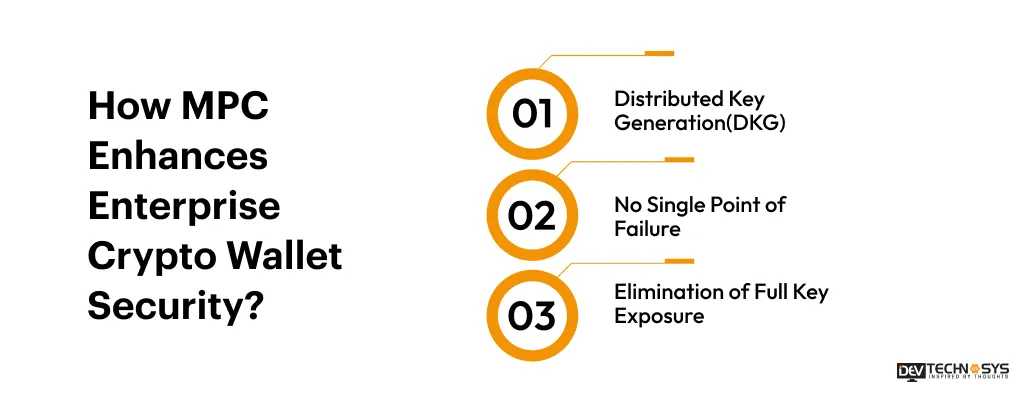
1. Distributed Key Generation(DKG)
MPC creates cryptographic key shares at multiple independent parties creating a situation where the shares are never reconstructed. Therefore, the probability of compromised information (the key(s)) is greatly reduced and minimizes the possibility of theft, compromise, and/or unauthorized access.
2. No Single Point of Failure
MPC removes the reliance on a single private key entity to control the funds. Even if one system or device is successfully attacked by an adversary, the adversary will not have access to the funds without successfully attacking all the distributed private key shares simultaneously.
3. Elimination of Full Key Exposure
Under MPC, the complete private key is never fully reconstructed or exposed to anyone at any point in time. All parties to the transaction will cooperatively sign the transaction digitally; thus, the private key will remain secure and confidential and no sensitive cryptographic information will be disclosed.
Technical Architecture of MPC-Based Wallets
MPC wallets utilize a Distributed Crypto Architecture, which means that the complete private key is never stored by a single entity. Security operations take place collaboratively across multiple parties in a secure framework by utilizing secure protocols.
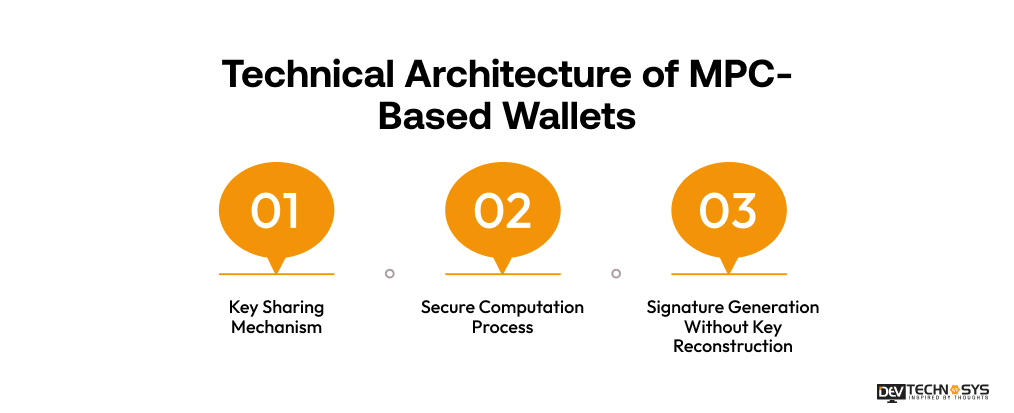
1. Key Sharing Mechanism
With MPC wallet app development solutions, the overall private key is divided into multiple cryptographic shares using secret sharing techniques with multiple participants holding only fragments. Thereby ensuring that with each participant holding only one fragment, there is no single share that would provide any meaningful information about the overall key.
2. Secure Computation Process
During the initiation of the transaction, each of the involved nodes performs encrypted computations on its individual key share; these computations happen securely without exposing raw data and hence preserving privacy and the risk to the key throughout the process.
3. Signature Generation Without Key Reconstruction
RWA tokenization development solutions enable the formation of digital signatures through collaboration without the use of a private key. Every person involved in forming the digital signature adds their share and provides their/whoever’s shared key thus providing for a digital signature with the maximum amount of security without having the risk of centralised administration exposure.
Key Security Benefits of MPC Technology
MPC technology provides an adequate level of private key security by distributing cryptographic control and therefore eliminating reliance on a single private key, thereby creating an effective means for developing trust, safety, and operational resilience crypto in managing digital assets.
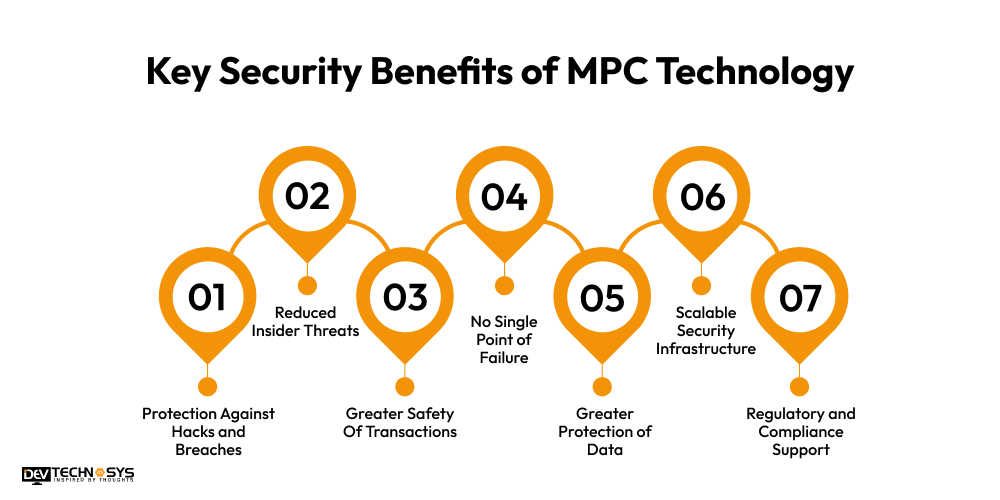
1. Protection Against Hacks and Breaches
Cryptocurrency wallet development services remove the ability to store private keys centrally, thus making it nearly impossible for hackers to steal complete private keys from hackers. In the case that one of the systems is breached, attackers may not be able to steal the funds from any of the other keys.
2. Reduced Insider Threats
MPC reduces the risk of abuse, fraud, or unauthorised movement of funds since it does not allow any single individual to access the entire solution (i.e., no employee and/or system).
3. Greater Safety Of Transactions
All transactions must be approved by multiple parties which means that each transaction must be verified and signed without exposing any sensitive data related to elliptic curve cryptography.
4. No Single Point of Failure
The key information is distributed across many nodes. No one node can compromise the integrity of the total system(enabling the robustness of the total solution).
5. Greater Protection of Data
No private key is ever fully reconstructed or kept at one location. Therefore, all sensitive data related to cryptography is protected for the entire life of the transaction.
6. Scalable Security Infrastructure
The MPC will allow for a seamless scaling up of security for enterprise users who are managing higher transaction volumes while maintaining strong overall security and no impact on performance and/or operational efficiency.
7. Regulatory and Compliance Support
The Multi-Party Control (MPC) wallets have been designed to be compliant to help enterprises meet the requirements of all regulatory and compliance organizations.
Limited to the ability to provide multi-approval workflows, audit trails and controlled access, thereby assisting any organization meet the global compliance and regulatory requirements more effectively.

Real-World Use Cases of MPC Wallets
As a result of the heightened security wallet architecture, scalability, and compliance-friendly design of MPC wallets, these wallets are being implemented by more organizations in an increasing number of sectors in order to provide better security for their digital assets across the crypto and blockchain ecosystem.
With MPC wallet security to distribute private key control to multiple participants, they effectively remove any single points of vulnerability, making them applicable to environments that are both high-value and high-risk in nature.
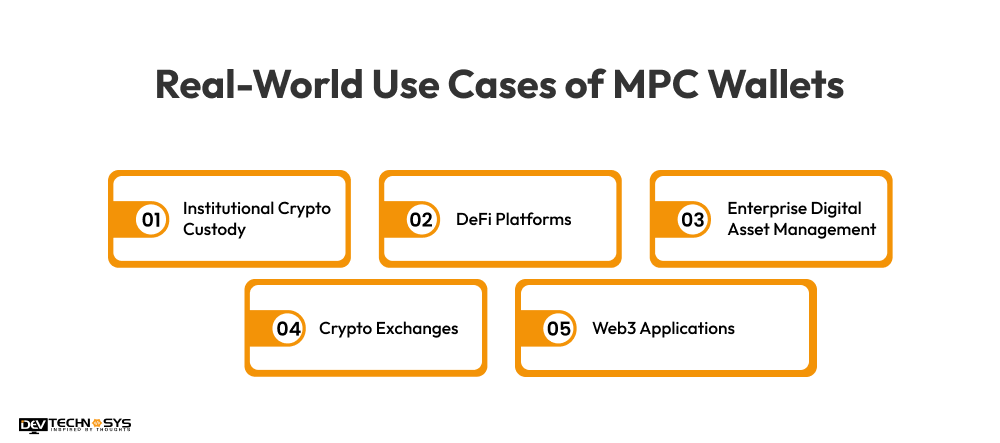
1. Institutional Crypto Custody
Institutional crypto custody solutions are commonly managed with multi-party computation (MPC) wallets by financial institutions, asset managers, and custodians. Using MPC eliminates the single private key of today’s custodians and enhances security against theft, insider abuse, and loss.
In addition, through the implementation of Secure crypto custody with MPC workflows, all asset movements are verified through several authorized parties while meeting compliance with rigorous regulatory requirements.
2. DeFi Platforms
Decentralized finance (DeFi) platforms use MPC wallet security to secure user funds and execute blockchain transactions without exposing users to risks associated with having their private keys compromised. This allows users to trust DeFi development services more while minimizing their vulnerability to hackers.
Furthermore, MPC provides greater security when using smart contracts because their operations will stay secure even in a decentralized environment.
3. Enterprise Digital Asset Management
MPC wallets are increasingly being used by businesses to support their treasury departments, payroll systems (for large organizations), cross-border payments, and inter-company payments.
Because of the hardware security module, enterprises can implement strict controls over access and approval while achieving efficient operations and maintaining transparency.
4. Crypto Exchanges
The P2P crypto exchange development market is also a target for cybercriminals due to the high volume of transactions conducted daily and the target-rich environment created as a result. As a result, cybercriminals have attempted to compromise cryptocurrency exchanges frequently.
To help secure their hot wallet infrastructures, cryptocurrency exchanges are implementing MPC wallet security that distributes the cryptographic key signing of transactions across multiple nodes.
5. Web3 Applications
In the Web3 development solutions economy, Multi-signature Protection wallets are used for secure user authentication, decentralised identity management, and wallet creation, among other things.
By providing seamless onboarding and registration processes without revealing private keys, MPC enables users to have a better on-ramp to interact with Blockchain-based applications.
MPC vs Traditional Wallet Security Models
The section below compares Multi-Signature Protection wallets against Hot and Hardware wallets for purposes of understanding how these different types of wallets differ with regard to security, Secure key management for crypto wallets, and usability. This analysis will help explain why MPC provides such a strong institutional crypto wallet security solution.
Security Aspect |
Hot Wallets |
Hardware Wallets |
MPC Wallets |
Key Storage |
Stored online on connected devices | Stored offline in physical device | Split into multiple encrypted shares |
| Security Level | Low (highly exposed to hacks) | High (offline protection) | Very High (no full key exposure) |
| Risk of Theft | High due to internet connectivity | Moderate (physical theft possible) | Very Low (distributed security model) |
| Single Point of Failure | Yes | Yes | No |
| Transaction Signing | Online private key used | Requires device confirmation | Collaborative signing without key reconstruction |
| User Convenience | High | Moderate | High |
| Recovery Options | Easy but less secure | Limited recovery options | Secure multi-party recovery possible |
| Best Use Case | Small transactions, trading | Long-term storage | Institutional & enterprise-grade security |
Limitations and Challenges of MPC Technology
While the MPC wallet security benefits can be pronounced in terms of providing a high level of security, there can be some limitations associated with the performance, implementation complexity and network reliability of any given Multi-Signature Protection Technology that needs to be examined carefully before adopting ECDSA signature aggregation technologies.
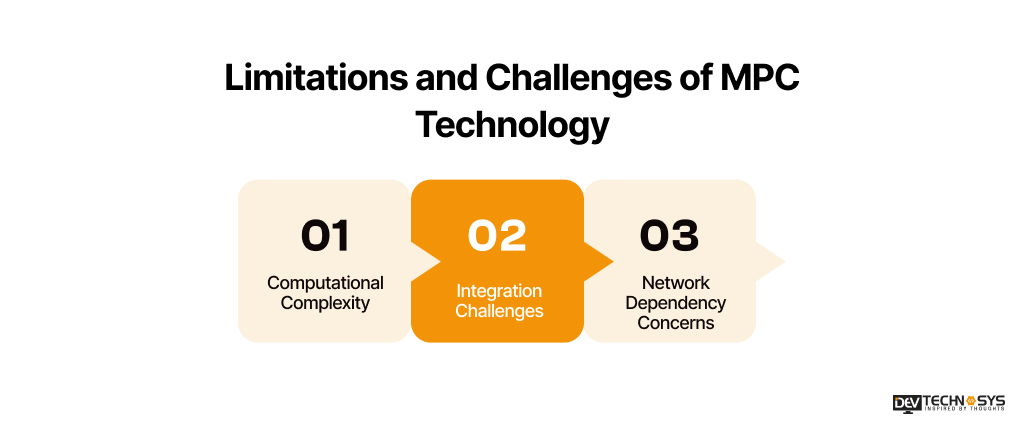
1. Computational Complexity
MPC Technologies require a significant amount of cryptographic computations amongst collaborating parties; therefore, using a private key protection Technology may result in longer processing times and higher resource overhead than with traditional wallets, which may affect transaction speed and system operational efficiency.
2. Integration Challenges
Utilizing Secure Multi-Party Computation (SMPC) in current blockchain networks and pre-existing systems is not straightforward due to the complexity of developing specialized systems, establishing alignment with protocols, and providing appropriate security design. Many companies will be impeded from adopting MPC due to the complexity involved with implementing this type of system.
3. Network Dependency Concerns
MPC wallets rely on reliable communication among multiple parties; any interruptions in the communication (e.g., network latency, outage, connection issues) can interrupt secure computing and delay the multi-party signing of transactions—something critical in times of need.
Compliance & Regulatory Advantages of MPC
MPC technology aligns strongly with worldwide cryptocurrency development services by providing an environment where digital assets can be securely controlled and managed according to established policies without being governed by one individual holding private keys.
As such, it supports compliance requirements established by government regulatory bodies, such as multi-signature processes, access control processes, and custodial requirements; further, through the use of distributed approving authority and transparent cryptographic processes, it offers enhanced auditability and governance of all financial transactions, thereby rendering all regulatory reporting and audits much more reliable and structured.
Finally, it develops and establishes institutional trust by offering security commensurate to the enterprise level, thereby reducing operational risk and ensuring full authority and accountability for all cryptocurrency operations while meeting the constantly evolving regulatory compliance frameworks being instituted worldwide.
Future of MPC in Crypto Security
The future of MPC in crypto security will develop hand in hand with the rise of Decentralized Key Management. In Decentralized Key Management, crypto private key management will no longer be held and owned by one single private party, rather, they will be managed in a dynamic distribution across trusted environments.
Such a key share distribution will increase resilience against cyber attacks even further, as well as enabling scalability for global crypto usage. With the expansion of blockchain development solutions, MPC will have an increasingly important role in providing easy authentication, interoperability of wallets and trustless transactions.
Moreover, future MPC integration with AI based security layers, will enhance threat detection, monitor anomalies and offer protection against risks in real-time. The combination of MPC, Web3 and AI will define a safe, intelligent and decentralized framework for the protection of digital assets for next-generation blockchain apps.
Why Should Businesses Use MPC-Based Wallets?
Businesses should use MPC-based wallets, due to the superior security of eliminating single private key storage, and decreasing chances of a hack. Furthermore, they provide operational safety in that there are no points of single failure, as keys will be stored in a distributed manner, thus providing regulatory compliance, qualified custody, as well as transaction signing workflow.
As an addition, the security features allow greater trust, scalability and control of the digital assets and are thus, excellent for businesses dealing with large amounts of cryptocurrencies in current settings.
Conclusion
With MPC technology, the security of cryptocurrencies is greatly improved because the risk is mitigated by removing single-point vulnerabilities and distributing private key shares to multiple parties.
This process minimizes the chance of hacking, insider threats, and asset loss; therefore, increasing both the safety of transactions and confidence in them. MPC also enables institutions and enterprises to manage their digital assets in a secure manner.
With the help of a cryptocurrency wallet development company, an entirely new generation of cryptographic security is offered, offering scalable, compliant, and highly resilient protection for all modern blockchain and cryptocurrency ecosystems.
Frequently Asked Questions
Find answers to the most common questions related to this article.
How does MPC work to enhance MPC wallet security? MPC works by dividing the private key into multiple shards and sending each shard to different entities. This means that one single party will never possess the complete private key.
Unlike typical wallets that hold the complete private key, MPC wallet security divides up key fragments on different devices or servers, therefore eliminating a single point of failure, thus decreasing the risks associated with being hacked
Yes, MPC wallets are arguably very secure. This is because with MPC, the complete private key is never held on a single device or server. Hardware wallets are generally secure, but it is extremely easy to have them stolen, lost or to compromise them.
In order to hack an MPC wallet, the hacker would need to compromise a large number of different parties at the same time. Hence, MPC wallets are difficult to hack compared to single key wallets.
MPC wallets are used by crypto exchanges, institutional custodians, De-Fi applications and large businesses with a need for sophisticated and compliance with security requirements.