




















Choosing between offshore and nearshore dedicated developers is a critical decision for businesses aiming to balance cost, quality, and collaboration efficiency. Agile Offshore development offers significant cost advantages by hiring talent from distant regions.
Nearshore development, on the other hand, focuses on closer geographic locations, enabling better communication, cultural alignment, and time-zone overlap. For startups hiring offshore developers, each model has its own strengths depending on project complexity, budget constraints, and delivery timelines.
In this blog, we will do a country-wise analysis of offshore vs nearshore dedicated developers to help businesses understand how factors such as developer rates, technical expertise, infrastructure,Language proficiency in development teams, and legal frameworks vary across regions. Now, without wasting any more time, let’s dive straight into them!
Who Are Nearshore Developers?
Nearshore developers are software professionals or development teams located in countries that are geographically close to a client’s home country, usually within the same or a nearby time zone. These Hybrid app development professionals offer a balance between cost savings and collaboration benefits by enabling easier communication, overlapping work hours, and cultural alignment. Nearshore software teams near US time zones offer faster coordination compared to offshore teams, while still being more affordable than hiring fully local (onshore) developers.
Key Characteristics of Nearshore Developers:
- Located in geographically close countries
- Minimal time-zone difference
- Strong cultural and language compatibility
- Easier project management and collaboration
- Faster feedback cycles and reduced delays
Who Are Offshore Developers?
Offshore developers are software professionals or dedicated development teams located in distant countries, hired by companies to work remotely, often across significant time-zone differences, to deliver development, testing, or support services. They are commonly chosen for their cost efficiency, low code development, large talent pools, and scalability, especially for long-term or budget-sensitive projects.
Key Characteristics of Offshore Developers
- Located in far-off countries from the client’s region
- Significant time-zone differences
- Access to highly skilled yet cost-effective talent
- Suitable for round-the-clock development cycles
- Well-established outsourcing ecosystems
What are the Offshore Dedicated Developer Destinations?
Offshore dedicated developers destinations are countries known for providing skilled software professionals at cost-effective rates. The offshore software teams from these regions help businesses scale faster by accessing global talent, flexible hiring models, and advanced offshore project management and technical expertise across diverse technologies.
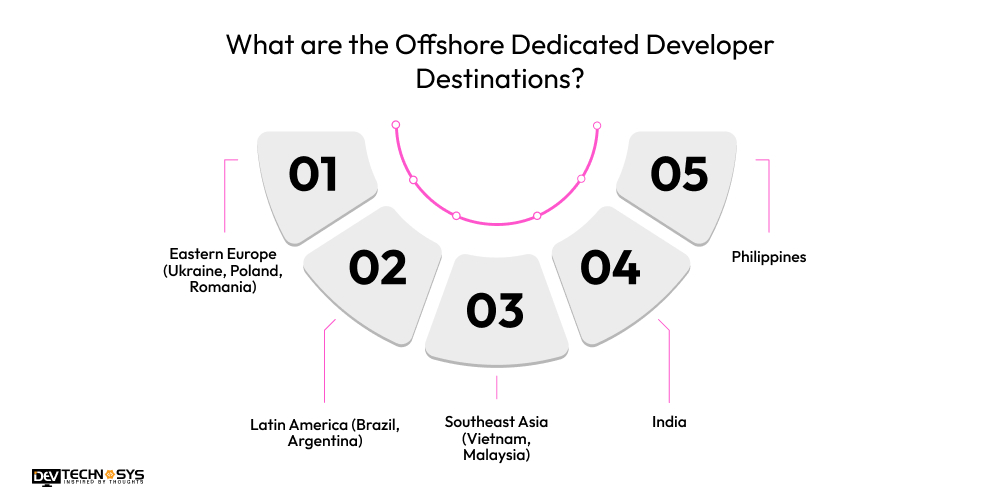
1. Eastern Europe (Ukraine, Poland, Romania)
Eastern Europe developers (Poland, Ukraine, Romania) are one of the top choice for businesses. Eastern Europe is among the best countries for offshore development. delivers highly skilled developers with strong engineering education. The Ukraine offshore developers offer advanced problem-solving abilities, solid data security standards, and expertise in mobile app design services, complex software, fintech, AI, and enterprise-grade application development projects.
2. Latin America (Brazil, Argentina)
Latin America offers skilled offshore developers with modern tech stack expertise including backend and frontend development, growing startup ecosystems, competitive pricing, and strong collaboration capabilities.
Amazing Brazilian software outsourcing and Argentina nearshore tech talent make both these regions suitable for IoT application development, full-stack development, scalable software development, and long-term digital transformation initiatives. And if you look at the tech hiring trends by region, then The U.S. faces one of the most competitive tech labor markets globally.
3. Southeast Asia (Vietnam, Malaysia)
Offshore developers in India and overall Southeast Asia are skilled in engineering, manufacturing-driven technologies, and digital platforms with API development & integration. Dedicated developer outsourcing from Vietnam and Malaysia enables access to cost-effective services, expanding tech ecosystems, and strong government support for software innovation and IT outsourcing.
4. India
India is one of the top destinations for dedicated developer outsourcing. With a massive talent pool, competitive pricing, strong English communication, it is one of the best destinations for startups hiring offshore developers.
India offshore developers offer expertise in web, mobile, AI, blockchain, application maintenance and support, and enterprise software across startups, SMEs, and global enterprises. As a language & culture outsourcing destination, India is one of the best choices for businesses.
5. Philippines
The Philippines is a preferred offshore destination for businesses. Philippines offshore developers are known for excellent English proficiency and cultural compatibility with Western markets. The Philippines developers offer excellent offshore development quality, cost-effective development services, and reliable teams for Android app development, software development, maintenance, testing, and long-term technical support.
| Destination | Countries | Average Hourly Cost (USD) | Talent Pool | Best Suited For |
| Eastern Europe | Ukraine, Poland, Romania | $18 to $35
|
High | Complex & enterprise-grade solutions |
| Latin America | Brazil, Argentina | $20 to $40 | Moderate | Scalable and innovation-focused projects |
| Southeast Asia | Vietnam, Malaysia | $12 to $28
|
Large | Large-scale & system-level development |
| India | India | $10 to $20 | Very Large | Startups, SMEs, long-term projects |
| Philippines | Philippines | $12 to $22 | Large | Support-driven & customer-focused apps |
What are the Nearshore Dedicated Developer Destinations?
Nearshore dedicated developer destinations are neighboring or nearby countries that offer skilled software professionals with minimal time-zone differences and strong cultural alignment. These are the top nearshore developer destinations for tech startups.
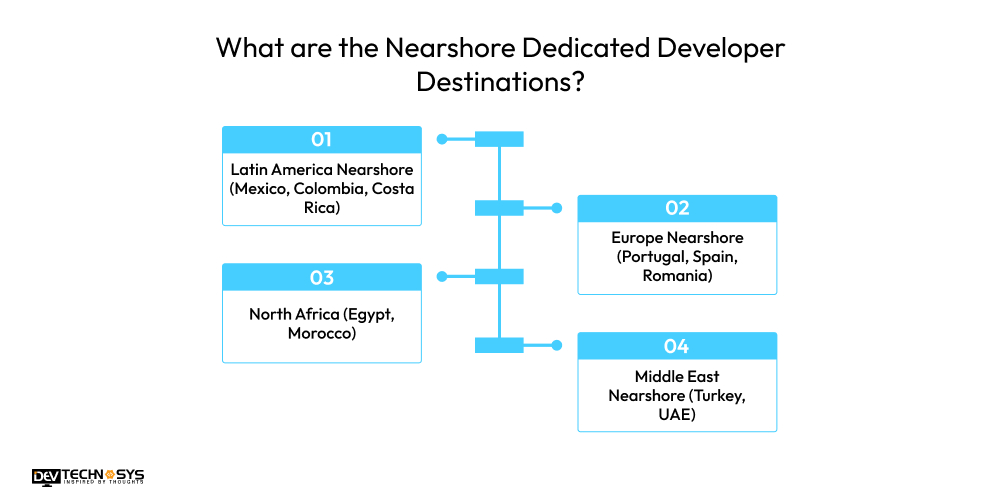
1. Latin America Nearshore (Mexico, Colombia, Costa Rica)
Latin America is a top nearshore destination offering close time-zone alignment with North America. Latin America offers strong cultural compatibility, skilled developers, competitive pricing, and smooth collaboration for agile development, Nearshore software teams near US time zones, and long-term software projects. Nearshore developers Latin America software development outsourcing provide cultural compatibility, progressive web apps development, competitive development costs, and seamless collaboration.
2. Europe Nearshore (Portugal, Spain, Romania)
While comparing offshore vs nearshore dedicated developers, the Nearshore developers Eastern Europe provide high-quality developers, minimal time-zone differences, and strong data protection standards.
Nearshore software outsourcing teams offer multilingual capabilities and excellent native mobile app development and other technical expertise, making them ideal for Western European businesses seeking seamless collaboration and regulatory compliance.
3. North Africa (Egypt, Morocco)
North Africa is an emerging nearshore hub offering skilled Egypt and Morocco nearshore development teams, cost-effective pricing, growing tech ecosystems, and convenient time-zone alignment with Europe. It makes Egypt and Morocco suitable for scalable development and long-term outsourcing partnerships.
4. Middle East Nearshore (Turkey, UAE)
Turkey and the UAE are the best countries for offshore development. They serve as strategic nearshore destinations with advanced infrastructure, strong technical talent, overlapping time zones with Europe, and business-friendly environments. From mobile app prototyping to ideal for enterprise software development and region-focused digital transformation initiatives.
| Destination | Countries | Talent Pool | Best Suited For | Hourly Cost (USD) |
| Latin America Nearshore | Mexico, Colombia | Large | North America-focused projects, long-term software development | $25 to $45 |
| Europe Nearshore | Portugal, Spain, Romania | High | Western Europe-focused businesses, enterprise software | $30 to $55 |
| North Africa | Egypt, Morocco | Medium | Scalable software projects, outsourcing partnerships | $20 to $40 |
| Middle East Nearshore | Turkey, UAE | Medium | Enterprise solutions, regional digital transformation initiatives | $30 to $50 |
Cost-Based Analysis of Offshore vs Nearshore Dedicated Developers
Now that we have seen destinations for nearshore vs offshore dedicated developers., les move on to the next topic, the cost. In this section, we will analyze the cost difference of offshore vs nearshore dedicated developers, depending on various parameters and factors. This cost analysis will help you in choosing the right developers for your project.
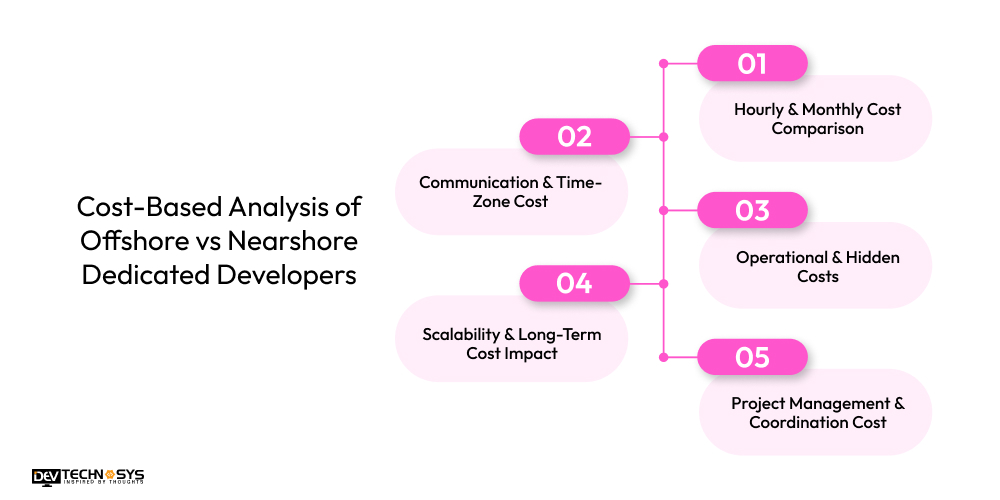
1. Hourly & Monthly Cost Comparison
Offshore dedicated developers usually offer significantly lower hourly and monthly rates because of reduced labor costs, lower infrastructure expenses, and favorable economic conditions in offshore regions. Nearshore dedicated developers generally charge higher rates than offshore teams, but they are still far more affordable than onshore hiring while delivering better collaboration, faster turnaround times, and improved workflow efficiency.
| Model | Hourly Cost (USD) | Monthly Cost (USD) | Cost Advantage |
| Offshore | $10 to $35 | $8,000 to $18,000 | Very High |
| Nearshore | $25 to $55 | $15,000 to $25,000 | Medium |
2. Communication & Time-Zone Cost
Global software development teams for offshore services come with limited working-hour overlap, which can slow decision-making, delay feedback loops, cause problems with enterprise mobility solution providing, and increase the number of meetings required for alignment.
Finding dedicated developers nearshore to operate in similar or overlapping time zones enables real-time communication, quicker approvals, fewer misunderstandings, and smoother collaboration throughout the development lifecycle.
| Cost Factor | Offshore | Nearshore |
| Time-zone overlap | Low | High |
| Meeting scheduling cost | High | Low |
| Delay-related cost | Medium–High | Low |
| Real-time collaboration cost | High | Low |
3. Operational & Hidden Costs
While outsourcing developer hiring reduces upfront costs, it may involve hidden operational expenses, including longer onboarding periods, additional quality assurance cycles, cultural training, and increased reliance on collaboration and monitoring tools.
Whether wearable app development or software development, nearshore development minimizes these hidden costs by offering better process alignment, shared work culture, and easier team integration, resulting in more predictable operational spending.
| Hidden Cost Area | Offshore | Nearshore |
| Onboarding & training | Medium–High | Low |
| Rework due to miscommunication | Medium | Low |
| Collaboration tools & systems | Medium | Low |
| Process alignment | Medium | Low |
4. Scalability & Long-Term Cost Impact
Among Nearshore vs Offshore dedicated developers, the cost-effective, dedicated developers offshore are highly suitable for large-scale and long-term projects, as they allow businesses to scale development resources quickly.
Nearshore business Intelligence Development teams typically scale at a steadier pace, but their higher productivity per hour and stronger collaboration often reduce rework, delays, and inefficiencies, lowering the overall cost over extended project timelines.
| Cost Aspect | Offshore | Nearshore |
| Speed of scaling | Very High | Medium |
| Cost of scaling | Low | Medium |
| Long-term productivity | Medium | High |
| Retention cost | Medium | Low |
5. Project Management & Coordination Cost
Offshore projects usually require dedicated project managers, detailed documentation, and frequent status reporting to manage time-zone and communication challenges in offshore teams. Hire offshore programmers can increase coordination costs.
Between offshore vs nearshore dedicated developers, the Nearshore teams benefit from cultural familiarity and synchronized working hours, requiring less supervision and simpler governance structures, thereby reducing project management and coordination expenses.
| Cost Element | Offshore | Nearshore |
| Dedicated project manager | Required | Optional |
| Oversight & governance | High | Low |
| Reporting & tracking effort | High | Low |
| Coordination cost | Medium–High | Low |

How to Hire Offshore vs Nearshore Developers?
In this CTO guide to offshore vs nearshore, we will find out how to hire offshore vs nearshore dedicated developers. If you want to hire best offshore or nearshore developers, consider the following factors:
To Hire Offshore Dedicated Developers:
1. Define Detailed Project Requirements
Between offshore vs nearshore dedicated developers, select the right ones by clearly outlining project scope, technical requirements, timelines, expected deliverables, and success metrics before hiring offshore developers. Well-documented requirements reduce misunderstandings and ensure smooth execution despite time-zone gaps and distributed team collaboration challenges.
2. Select Cost-Effective Offshore Regions
Choose destinations with offshore talent pools such as India, the Philippines, Eastern Europe, or Southeast Asia depending on the skill, availability, technology expertise, language proficiency, and budget. Selecting the right region for offshore project management helps balance development cost, quality, scalability, and long-term team stability.
3. Choose A Long-Term Engagement Model
There are various Offshore development benefits you can get by choosing dedicated offshore developers. Offshore regions work best with dedicated developers or time-and-material models. These models offer predictable costs, stable teams, and better productivity for large-scale or long-term projects requiring continuous development, maintenance, and feature enhancements.
4. Plan Communication And Time-Zone Overlap
Establish clear communication processes, fixed meeting schedules, collaboration tools, and partially overlapping work hours. Proper planning minimizes delays, improves transparency, and ensures consistent progress tracking despite significant time-zone differences.
5. Ensure Security, Compliance, And IP Protection
Verify the offshore vendor’s data security policies, legal compliance, NDAs, and intellectual property protection measures. Strong governance safeguards sensitive business information and reduces legal, operational, and security risks associated with offshore development.
Want a chatbot demo or pricing? Fill the form and talk to our experts today.
Pick what you need below — you can select more than one — then tap Get detail to continue.
-
Chatbot demo dashboard
-
Cost to develop an app
-
Industry report
-
Case study
To Hire Nearshore Developers:
1. Focus On Collaboration And Agility Needs
Nearshore developers are ideal for projects requiring frequent communication, rapid iterations, and agile workflows, improving the Nearshore software development quality. Similar time zones enable real-time discussions, faster decision-making, and closer collaboration between internal teams and external developers.
2. Select Geographically Close Regions
Nearshore vs Offshore dedicated developers, wondering which one is ideal for you? Well, one clear method is to choose nearshore destinations such as Latin America, Eastern Europe, North Africa, or the Middle East. Geographic proximity improves cultural alignment, language compatibility, travel convenience, and overall coordination efficiency for distributed development teams.
3. Use Flexible Hiring And Engagement Models
Nearshore teams support dedicated, short-term, or hybrid engagement models. This flexibility allows businesses to scale teams quickly, adjust project scope, and respond efficiently to changing requirements without long-term contractual constraints.
4. Enable Real-Time Communication And Meetings
Take advantage of overlapping working hours for daily stand-ups, sprint planning, reviews, and problem-solving sessions. Real-time collaboration tools improves productivity, reduces rework, and accelerates delivery timelines in agile development environments.
5. Reduce Management And Coordination Overhead
Cultural similarity, aligned work hours, and shared business practices reduce the need for heavy project management. Nearshore development simplifies governance, shortens onboarding time, and lowers hidden coordination costs over the project lifecycle.
Conclusion
We hope this blog will help you understand more about offshore vs nearshore dedicated developers. Choosing between offshore and nearshore dedicated developers ultimately depends on your business priorities, project complexity, budget, and collaboration requirements.
Through country-wide analysis of strengths, costs, and operational factors, businesses can select the most suitable development model to achieve efficiency, quality, and sustainable growth. If you are a business looking for offshore vs nearshore developers to hire, contact Dev Technosys, a leading mobile application development company. And stay tuned for more updates.
Frequently Asked Questions
Find answers to the most common questions related to this article.
The main difference between Nearshore vs Offshore dedicated developers, the offshore developers are located in distant countries with major time-zone differences, offering lower costs and larger talent pools, while nearshore developers work in nearby regions, enabling better communication, faster collaboration, and smoother project coordination.
Among the top Nearshore vs Offshore dedicated developers destinations, the most popular offshore destinations include India, the Philippines, Vietnam, Malaysia, China, and Eastern European countries such as Ukraine, Poland, and Romania, known for cost efficiency, technical expertise, and scalable development resources.
Nearshore regions typically include Latin America for North America, European countries like Portugal and Spain for EU businesses, North Africa such as Egypt and Morocco, and Middle Eastern countries like Turkey and the UAE.
Yes, offshore development generally offers lower hourly rates and operational costs, while nearshore development costs slightly more but provides improved communication efficiency, reduced delays, and better overall productivity for collaboration-heavy projects.
Nearshore dedicated developers are better suited for agile and time-sensitive projects due to overlapping working hours, quicker feedback loops, and real-time collaboration, whereas offshore teams are ideal for stable, long-term development work.