











Being a founder of your own tech startup can be both exciting and daunting for many non-technical individuals who are trying to find the right pre-vetted software developers. Finding trusted software development partners can be overwhelming if you have a great concept for a product but are not sure how to actually build/apply it through a web application or mobile application.
Many non-technical founders have been able to successfully create fantastic products by hiring experienced startup developers who understand their company’s goals through effective communication, strategic planning, and hiring individuals who have a passion for what they do.
When a non-technical startup founder uses the right strategy to hire developers, it is often less stressful for them, and they feel more comfortable about having their company’s product developed.
This article will show non-tech founders hire dedicated developers, as well as avoid the common pitfalls that many startup founders make; as a result, you will feel confident that you will be able to successfully build a great team of developers.
Who Are Dedicated Developers and Why Do They Matter?
Skilled users are professionals who are assigned to a single project, acting as a part of your internal team. They give better alignment with business goals, long-term commitment, and focused attention.
For non-tech founders, top dedicated development teams lessen management complexity and improve communication, and ensure constant product development without needing to build an in-house team.
What are the Benefits of Hire Dedicated Developers For Non-Tech Founders?
There are various benefits to hiring reliable dedicated developers for non-tech founders; they can transform the existing product into a digital product. Let’s explore the profitable benefits one by one:
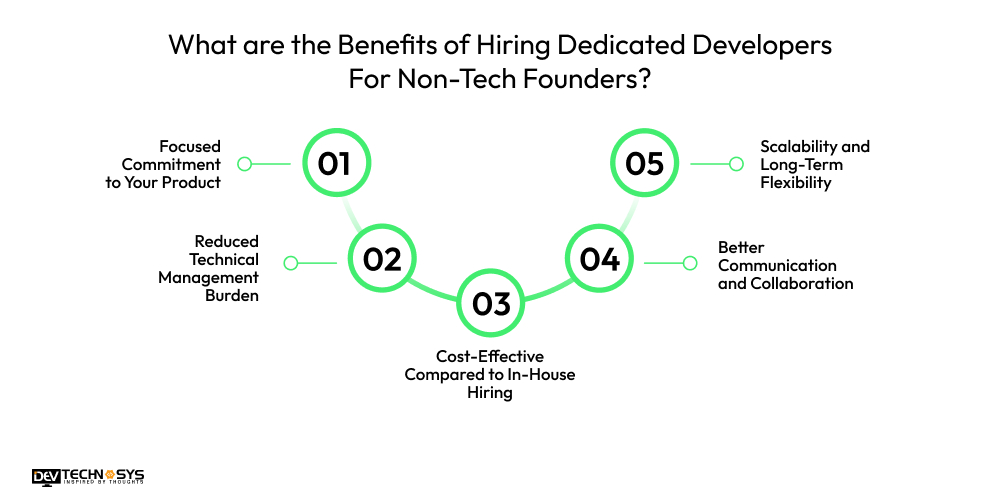
1. Focused Commitment to Your Product
Developers who work on the project being developed are fully committed to your project. Unlike the freelancers who have other clients to attend to, these developers will be aligned with your requirements, priorities, and deadlines. This equates to accelerated progress, fewer distractions, and consistency of mobile application development.
2. Reduced Technical Management Burden
Non-tech founders won’t have to supervise the code or make complicated technical decisions. These dedicated developers come to the teams with their own structures, processes, and team leads. So founders do not have to handle development issues or technical execution and can concentrate on their strategies, growth, and business operational development.
3. Cost-Effective Compared to In-House Hiring
Engaging with these dedicated developers relieves founders of the expenses that come with hiring, such as recruitment, onboarding, infrastructure, and the employee benefits that come with the founding team. Non-tech founders stand to gain from these developers’ skills, which helps with budgeting while still maintaining quality Android app development.
4. Better Communication and Collaboration
These dedicated developers act as part of your team, maintaining flexible schedules for meetings and using collaborative software. This helps the founders of software companies to communicate their business vision clearly, manage their time, and solve problems that may arise on the project, and allows for smoother and quicker project delivery.
5. Scalability and Long-Term Flexibility
Having dedicated developers enables non-tech founders to easily adjust the size of their teams according to their Hybrid app development. This sort of flexibility will guarantee you the right knowledge at the right time without the liabilities of overhiring or underutilizing resources when launching a minimum viable project or when enhancing additional features.
Preparing Before You Hire: What Non-Tech Founders Must Do First
Before beginning to hire developers, non-tech founders must do this first for a successful hiring process. There are various points that must be observed and understood. Let’s take a look at the points below:
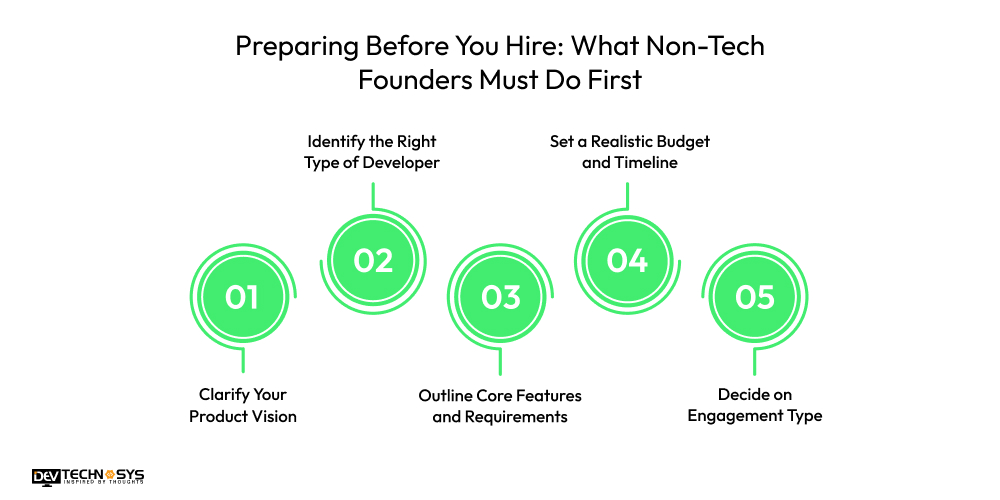
1. Clarify Your Product Vision
Non-tech founders must identify their project requirements, needs, and demand. Also, reveal what your product does, serves, and what its scope is. This clarification helps developers to easily understand what they do without the need for any technical explanation.
2. Identify the Right Type of Developer
In this second stage, non-tech founders must identify the right type of developer who fits their project requirements and demands. You can consider various developers of a react native development company, such as full-stack developers, front-end developers, backend developers, mobile app developers, and DevOps engineers.
3. Outline Core Features and Requirements
Make a clear and structured list of features, functions, and services. This helps developers to set realistic expectations without needing any technical knowledge. It can also reduce data redundancy and no need to rewrite the code.
4. Set a Realistic Budget and Timeline
Estimate costs, considering developer rates, project complexity, and potential revisions. A clear budget and timeline help avoid surprises, manage expectations, and enable informed hiring decisions without compromising the quality of progressive web apps development.
5. Decide on Engagement Type
After that, all understanding, non-tech founders must select the engagement hiring model that is best for them. There are various types of models available, such as part-time, full-time, contract-based, and on an hourly basis.
Where Non-Tech Founders Can Find Dedicated Developers?
Non-tech founders have no idea where they can find dedicated developers. There are many platforms and ways available to hire offshore dedicated developers and start their project seamlessly. So, let’s explore where to get the dedicated development team for startups:
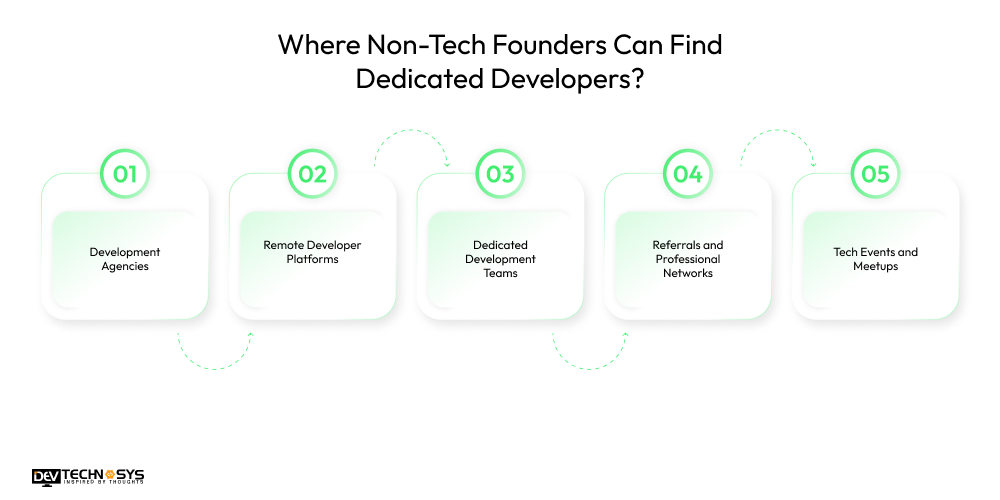
1. Development Agencies
One of the best and reliable options is native mobile app development agencies, they provide professional developers with strong expertise in technical. These companies handle the management, project timelines, quality control, and many more, making them ideal for non-tech founders.
2. Remote Developer Platforms
There are many verified platforms available in the market, such as Upwork, Toptal, Fiverr, and more. They can connect non-tech founders with vetted developers for startups globally, and non-tech founders can use the filtering based on developer type, cost, and expertise.
3. Dedicated Development Teams
Some of the professional or verified companies offer a separate iPhone app development team to handle the entire project for non-tech founders. This can streamline clear communication, focus on high-quality work, long-term commitment, and make it easy to manage projects.
4. Referrals and Professional Networks
Non-tech founders can use professional networks such as LinkedIn, startup communities, and more to make trusted connections that can lead to a vetted developer. The referrals can also bring a proven track record, and this can eliminate the risk of hiring mistakes.
5. Tech Events and Meetups
Conferences, Hackathons, and tech meetups can allow non-tech founders to meet with professional developers in person. It enables long-term collaborations, and professionals can share their vision and streamline the operations of low-code development.
How to Evaluate Dedicated Developers Without Technical Knowledge?
Observing the technical skills of dedicated developers is necessary before hiring them for your mobile app design services. But you don’t have the kind of technical knowledge? Not an issue. We provide the various points that help non-tech founders evaluate dedicated developers:
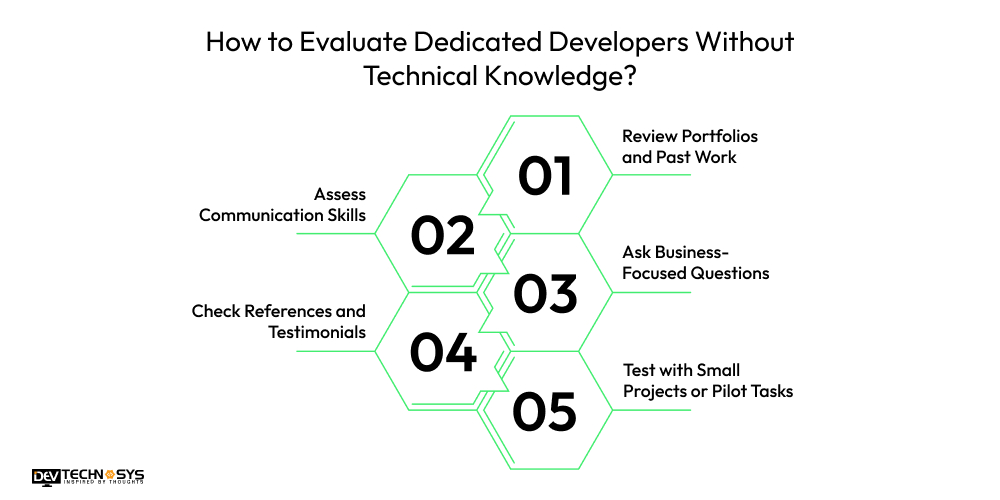
1. Review Portfolios and Past Work
Non-tech founders examine or observe the previous projects, problem-solving skills, developers’ experience level, and more. Reviewing portfolios helps non-tech founders gauge whether the developer can deliver solutions aligned with business goals and project requirements consistently.
2. Assess Communication Skills
For non-technical founders, having effective communication with developers enables them to convey their achievements and areas in which they are struggling. And any options they have available to them in ways that non-technical founders will easily be able to understand the Xamarin app development process.
3. Ask Business-Focused Questions
Rather than inquiring about code, find out from a developer how they have addressed specific business challenges in the past (for example, how they met tight deadlines or increased their customers’ experience). Developers’ responses to these types of questions should clearly demonstrate their ability to solve problems, adapt to situations, and understand the larger scope of how their contributions will help their businesses.

4. Check References and Testimonials
To identify a reliable and professional developer, non-technical founders should examine the referrals received from prior clients, read online reviews, and/or check a developer’s references. Resources such as these provide information regarding the quality of work produced by a developer for enterprise mobility solutions.
5. Test with Small Projects or Pilot Tasks
Assign a short trial project or specific task to observe performance, problem-solving, and communication. Pilot tasks allow founders to evaluate how developers approach requirements, follow instructions, and handle feedback. This hands-on experience reduces risk, ensuring the developer is a good fit for long-term collaboration before committing to a full-scale project.
Structuring the Hiring and Onboarding Process
After evaluating the remote dedicated developers for startups’ technical skills, it’s time for non-technical founders hiring developers with a smooth process. It’s very important to understand the steps to hire dedicated developers, as it can increase the trust between non-tech founders and developers. Let’s explore the hiring and onboarding process for your IoT application development services:
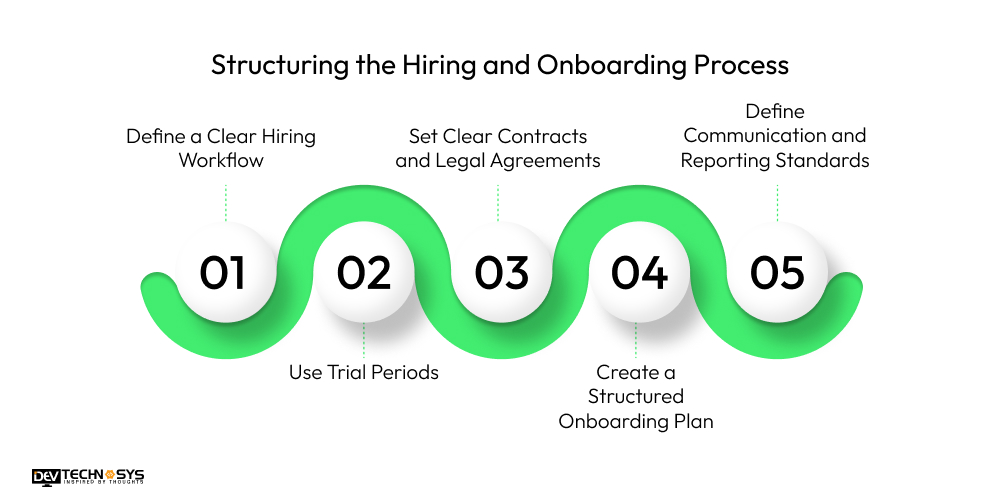
1. Define a Clear Hiring Workflow
In this stage, non-tech founders set a clear hiring process, which includes screening, interviews, and final selection. Clearly outline the various processes, such as decision criteria, timeliness, and responsibilities. This defined hiring workflow helps non-tech founders to compare each candidate fairly and avoid rushed decisions.
2. Use Trial Periods
After non-technical founders hiring developers from an iPad app development company, have them work for a trial period to assess their work quality, communication style, and reliability in real-time situations. These trial periods eliminate the risk and offer the practical insights of developers.
3. Set Clear Contracts and Legal Agreements
Establish contracts covering scope, timelines, payment terms, intellectual property ownership, and confidentiality. Clear legal agreements protect business interests and prevent future disputes. For non-tech founders, this step ensures transparency, accountability, and professional boundaries from the beginning.
Want a chatbot demo or pricing? Fill the form and talk to our experts today.
Pick what you need below — you can select more than one — then tap Get detail to continue.
-
Chatbot demo dashboard
-
Cost to develop an app
-
Industry report
-
Case study
4. Create a Structured Onboarding Plan
Now the step comes to onboard the developer, provide them proper documentation, product overview, access to paid tools, and mobile app prototyping. This structured onboarding plan helps developers to quickly understand the project expectations and enables them to contribute effectively.
5. Define Communication and Reporting Standards
After successfully onboarding developers, set the communication tools for daily meetings, conferences, reporting formats, and progress updates. The daily communication builds trust with the developer and the non-tech founder, and it helps to track project progress without micromanaging.
Real-World Examples: How Non-Tech Founders Got It Right
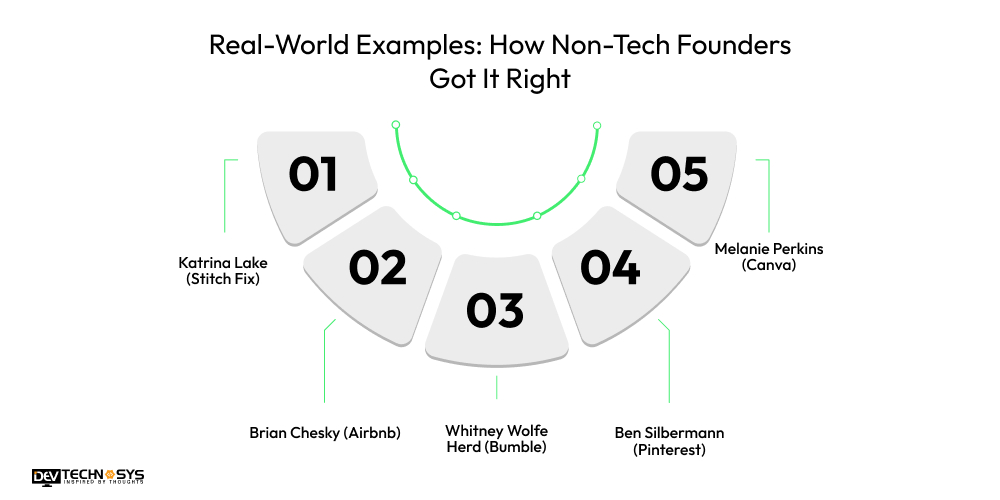
Do you still think that it is impossible for non-tech founders to hire dedicated developers? You need to observe these real-world examples that motivate non-tech founders to easily hire dedicated developers for their business. So, let’s take a look at the real-world examples:
1. Katrina Lake (Stitch Fix)
Katrina Lake, a non-tech founder of Stitch Fix, hired a professional data science and engineering team. She mainly focused on defining the project problems and relied on the dedicated developers to build a scalable and reliable solution. Now, Stitch Fix is one of the successful systems without having any deep expertise in technical knowledge.
2. Brian Chesky (Airbnb)
Brian Chesky graduated with a design background and limited skills in technical. After that, he partnered with technical co-founders. To scale up the Airbnb, he hired a dedicated development team to focus on the product vision, clear communication, and Brian Chesky allowed programmers to handle the execution.
3. Whitney Wolfe Herd (Bumble)
Bumble is one of the most famous and popular dating applications. Whitney Wolfe Herd was not a developer when she launched the app. She hired a dedicated development team to build and scale the app when she increased the branding and focused on the growth strategy.
4. Ben Silbermann (Pinterest)
Ben Silbermann initially struggled to find the perfect development team and implement technical expertise. After that, one dedicated developer believed in the product vision, and at that time, Pinterest gained momentum. His main focus is on the clarity and user value that help developers execute platform processes.
5. Melanie Perkins (Canva)
Melanie Perkins has no technical background and struggled for years to find the perfect developers to build a reliable platform. After that, she hired a dedicated development team for long-term commitment, and now Canva is a global design platform and is used by millions of users.
Conclusion
In this blog, we explored every step that non-tech founders hire dedicated developers for their existing and new projects. We hope that you have solved all your issues and problems, so that how non-tech founders hire dedicated developers.
Do you want to hire dedicated developers for application maintenance and support services? Then you can directly connect with a professional mobile app development company to get verified developers at a lower cost.
Frequently Asked Questions
Find answers to the most common questions related to this article.
When hiring dedicated developers, you must look at the developers' experience level, past work portfolio, problem-solving ability, communication skills, cultural fit, reliability, coding standards, and past results. These factors must be observed when hiring dedicated developers for your project.
Basically, non-tech founders do not need a CTO to hire dedicated developers, but sometimes, technical guidance helps to hire the perfect development team. CTO evaluates the developer's technical expertise, hiring standards, proper architecture, and code quality.
Non-technical founders can hire developers by defining clear goals, using referrals and platforms, hiring advisors for interviews, starting with small paid trials, assessing communication skills, and prioritizing cultural fit over buzzwords and long-term collaboration success.
Non-technical founders can manage developers by setting clear goals, focusing on outcomes not code, using simple metrics, maintaining open communication, trusting expertise, asking clarifying questions, prioritizing documentation, and aligning technical work with business priorities.
Non-tech founders can avoid bad developers by using referrals, screening communication skills, running paid trial tasks, checking past work and references, involving a technical advisor, setting clear expectations, and avoiding rushed hiring decisions early on.
Common mistakes include hiring based on cost alone, unclear requirements, skipping technical vetting, poor communication expectations, ignoring cultural fit, lacking project oversight, underestimating timelines, and not planning for scalability, maintenance, or long-term technical ownership.