



















“Swiss Precision Banking Comes With a Smart Price Tag”
Banking is a prominent sector that advances the economic landscape of Switzerland. Financial standards and technology-driven services form a profitable market for businesses considering banking app development.
Thanks to digital progress, more people are using banking applications to manage their finance-related tasks and money transactions. Due to the increased demand, several fintech companies are investing heavily in apps.
But there’s one big question mark that stands in the way of digital banking app development: the cost. How much does it cost to develop a banking app in Switzerland? Typically, the cost to build a banking app in Switzerland depends on project type, features, design customization, and other crucial factors.
In this blog, we will decode the true banking app development cost in Switzerland, including cost drivers, tips to reduce development cost, and more important factors. So, buckle up for an informative dive into the cost breakdown of fintech software development in Switzerland.
Current and Future Statistics of the Digital Banking App Market in Switzerland
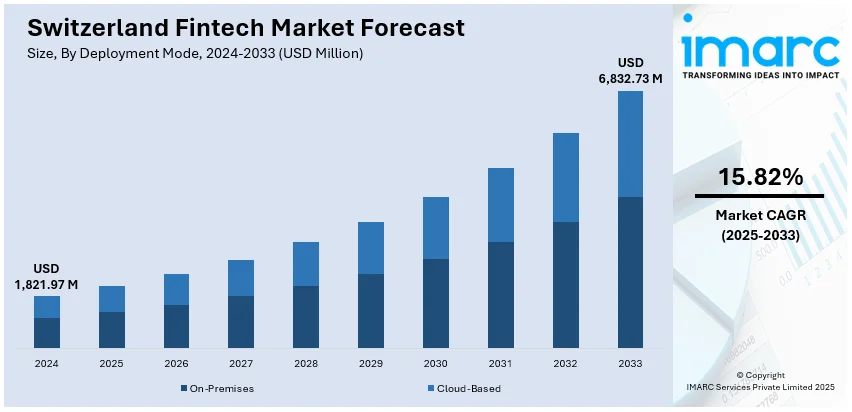
- The Swiss fintech market size reached USD 1,821.97 Million in 2024. The market is projected to reach USD 6,832.73 million by 2033,
- The fintech market of Switzerland is exhibiting a growth rate (CAGR) of 15.82% during 2025–2033.
- In March 2025, an authoritative survey confirmed that most Swiss fintechs now prioritize B2B over consumer offerings.
- The penetration of neobanking services among the Swiss population is expected to reach 17.90% in 2024, with forecasts indicating a rise to 22.88% by 2028.
What is the Cost to Develop a Banking App in Switzerland?
The mobile banking app development cost in Switzerland largely depends on factors such as project complexity, features, and platform choice. But to give you a generic estimate, the Cost of fintech and banking software development in Switzerland ranges from 6359.14 CHF to 19873.25 CHF.
A basic app with essential features, including navigation, user login, and simple UI design, can cost 6359.14 CHF to 9539.16 CHF with a development timeline of 2 to 4 months.
However, Custom banking app development Switzerland with advanced features like biometric authentication, AI/ML capabilities, and complex backend systems can exceed 19873.25 CHF and require a 6 to 12-month development period. Here’s the table that displays the cost to develop a banking app in Switzerland.
App Type |
Estimated Cost (CHF) |
Development Timeline |
| Basic Banking App | CHF 6,350 to CHF 9,540 | 6 to 8 weeks |
| Med-Level Banking App | CHF 9,540 to CHF 14,310 | 8 to 12 weeks |
| Advanced Banking App | CHF 14,310 to CHF 19,875 | 12 to16 weeks |
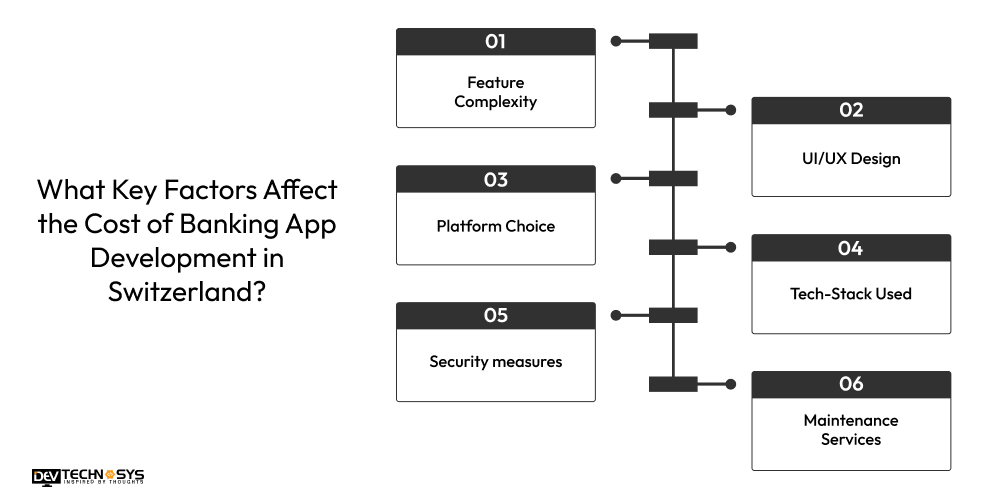
What Key Factors Affect the Cost of Banking App Development in Switzerland?
Do you know that there are various factors affecting banking app development cost in Switzerland? This section will dissect every factor that plays a vital role in influencing the online banking application development pricing in Switzerland. Take a look:
1. Feature Complexity
Features are one of the crucial factors that heavily influence the banking app development cost in Switzerland. According to a banking software development company, a basic banking app with essential features costs around CHF 9,540. But the advanced mobile banking app development cost Switzerland with complex features and multi-platform support may exceed CHF 19,875.
Complexity Level |
Features Included |
Cost Range (CHF) |
| Basic | Login, balance view, transaction history, | CHF 6,360 – CHF 9,540 |
| Medium | Secure transfers, bill payments, alerts | CHF 9,540 – CHF 14,310 |
| Advanced | Biometric login, multi-currency support | CHF 14,310 – CHF 19,875 |
2. UI/UX Design
User interface design can also impact the cost to build a banking app in Switzerland. The basic interface may not cost much. But a custom UI with complex layout, animation, and graphics can raise the custom banking app development Switzerland.
The more customizations you add, the higher the development cost will be. We suggest keeping customization to a minimum to avoid unnecessary spending.
Design Level |
Scope |
Cost Range (CHF) |
| Basic UI | Standard layouts, minimal branding | CHF 1,190 – CHF 2,385 |
| Custom UI | Branded design, improved usability | CHF 2,385 – CHF 4,770 |
| Advanced UI | Animations, personalization | CHF 4,770 – CHF 6,360 |
3. Platform Choice
Your platform choice, whether Android, iOS, or both, will impact the cost to create a banking app in Switzerland. Native banking mobile app development cost In Switzerland will be under CHF 14,310, while building a cross-platform banking app increases the final development costs significantly, but allows a broader reach and lower long-term maintenance.
Platform |
Development Scope |
Cost Range (CHF) |
| Android Only | Single-platform | CHF 6,360 – CHF 11,130 |
| iOS Only | Single-platform | CHF 6,360 – CHF 11,130 |
| Cross-Platform | Android + iOS | CHF 11,130 – CHF 19,875 |
4. Tech-Stack Used
Selecting the best technology stack is crucial to ensure the long-term success of the app; however, this decision also influences the cost to create a banking app in Switzerland.
According to companies that provide Blockchain-based banking solutions Switzerland, there’s a wide range of technologies to incorporate in banking apps. It includes cloud storage, a database, and frontend and backend frameworks.
Platform |
Development Scope |
Cost Range (CHF) |
| Android Only | Single-platform | CHF 6,360 – CHF 11,130 |
| iOS Only | Single-platform | CHF 6,360 – CHF 11,130 |
| Cross-Platform | Android + iOS | CHF 11,130 – CHF 19,875 |
5. Security measures
We all know the crucial role of mobile app development in banking Sector, so it’s crucial to make the app secure and protected. Adding security measures like biometrics, firewalls, authentication, and encryption is necessary to keep user data secure, but it impacts the final Fintech software development Switzerland. Here’s the table showing the cost to create a banking app in Switzerland based on security level.
Security Level |
Inclusions |
Cost Range (CHF) |
| Basic Security | SSL, encryption, secure login | CHF 1,590 – CHF 3,180 |
| Standard Security | 2FA, secure APIs | CHF 3,180 – CHF 5,565 |
| Advanced Security | Biometrics, fraud detection | CHF 5,565 – CHF 7,950 |
6. Maintenance Services
Maintenance services include regular updates, security patches, bug fixes, and OS optimization. These services are time-consuming and can affect the cost to build a banking app in Switzerland to some extent. However, neglecting maintenance can lead to security vulnerabilities and a poor user experience.
Maintenance Type |
Coverage |
Cost Range (CHF/year) |
| Basic | Bug fixes, minor updates | CHF 795 – CHF 1,990 |
| Standard | OS updates, security patches | CHF 1,990 – CHF 3,975 |
| Advanced | Monitoring & upgrades | CHF 3,975 – CHF 6,360 |
Want a chatbot demo or pricing? Fill the form and talk to our experts today.
Pick what you need below — you can select more than one — then tap Get detail to continue.
-
Chatbot demo dashboard
-
Cost to develop an app
-
Industry report
-
Case study
3 Real-World Case Studies on Pricing Strategies
Are you looking for some real-time PSD2 compliant banking app development projects with estimated cost? Take a look at these case studies we have mentioned below and see how they are used during the secure finance app development process. Let’s explore these case studies in detail:
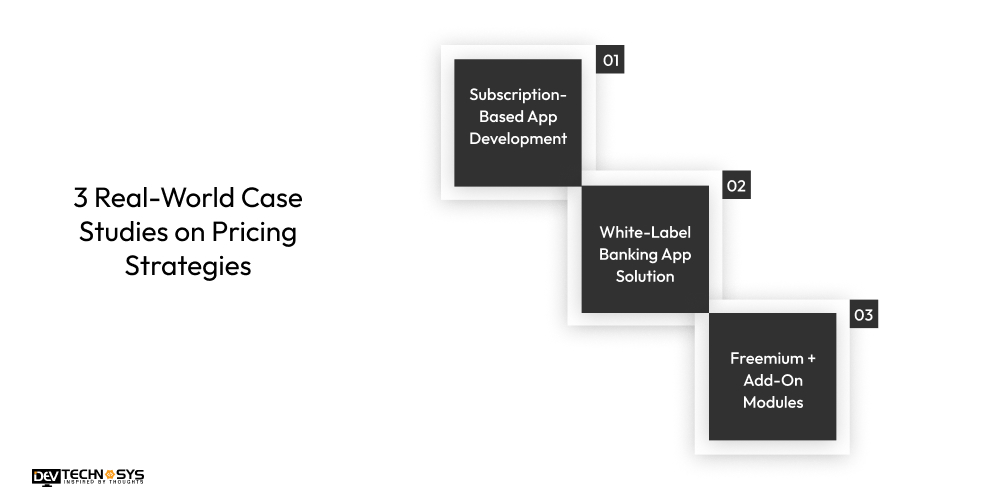
1. Subscription-Based App Development
A banking app development company Switzerland adopted a subscription model to generate recurring revenue. Users accessed basic banking services for free, while premium tools and technologies were unlocked through monthly or yearly subscription plans, ensuring faster ROI and scalable growth.
Component |
Estimated Cost (CHF) |
Timeline |
| Core App | CHF 7,200 – CHF 9,600 | 6–7 weeks |
| Subscription Features | CHF 2,400 – CHF 4,000 | 3–4 weeks |
| Backend & Payments | CHF 1,600 – CHF 2,400 | 2–3 weeks |
| Total | CHF 11,200 – CHF 16,000 | 10–14 weeks |
2. White-Label Banking App Solution
A small financial institution responsible for Blockchain-based banking solutions Switzerland opted for a white-label banking app to reduce time-to-market and development expenses.
Instead of building everything from scratch, the team customized an existing secure framework with branding, compliance updates, and essential banking features.
Component |
Estimated Cost (CHF) |
Timeline |
| White-Label Core | CHF 6,000 – CHF 8,000 | 3–4 weeks |
| Customization | CHF 2,400 – CHF 4,000 | 2–3 weeks |
| Compliance & Security | CHF 3,200 – CHF 4,800 | 3–4 weeks |
| Total | CHF 11,600 – CHF 16,800 | 8–11 weeks |
3. Freemium + Add-On Modules
A digital banking platform adopted a freemium model to attract users instantly. Core banking app features were free, while access to advanced modules required a paid subscription; these paid add-ons allow users to customize their experience and increase long-term revenue.
Module |
Estimated Cost (CHF) |
Timeline |
| Free Core App | CHF 8,000 – CHF 10,400 | 7–8 weeks |
| Paid Add-Ons | CHF 4,000 – CHF 6,400 | 4–6 weeks |
| Integration & Testing | CHF 1,600 – CHF 2,400 | 2–3 weeks |
| Total | CHF 12,000 – CHF 16,800 | 13–17 weeks |
How to Reduce the Banking App Development Cost in Switzerland?
Want to know how to reduce the RegTech and banking compliance app development cost Switzerland? Easy! In this section, we have presented some strategies or factors that can help reduce the cost of banking app development. Take a look:
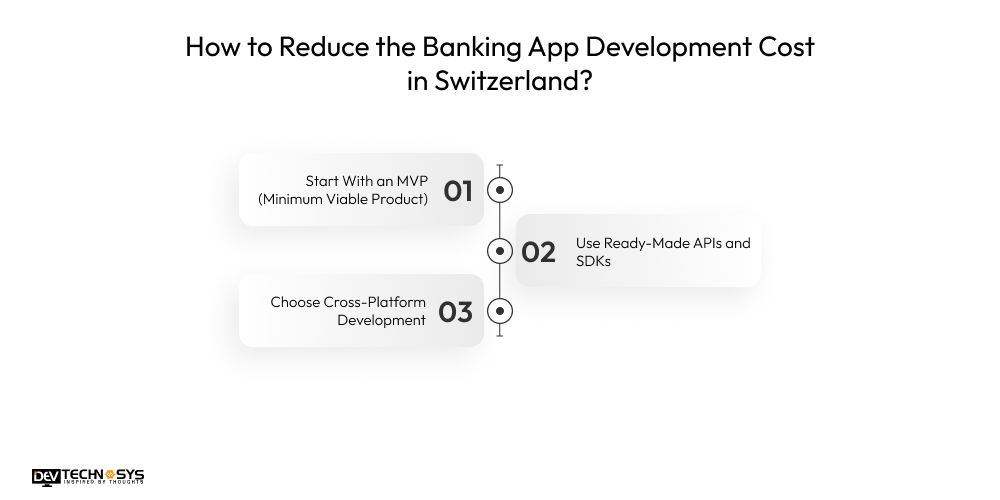
1. Start With an MVP (Minimum Viable Product)
According to experts who develop an app like Capital One Mobile, you should focus on essential features such as user authentication, account overview, transaction history, and basic transfers. Launching an MVP helps validate the app idea early, reduces upfront investment, and avoids unnecessary development costs.
2. Use Ready-Made APIs and SDKs
Another method to reduce fintech app development cost in Switzerland is to integrate prebuilt APIs for payments, authentication, analytics, and notifications rather than creating custom solutions. Using ready-made APIs and SDKs reduces development effort, speeds up delivery, and ensures reliability with proven tools.
3. Choose Cross-Platform Development
Using frameworks like Flutter or React Native allows you to build a single codebase for both iOS and Android. This significantly cuts development time, testing efforts, and long-term maintenance expenses. Hire dedicated developers with exceptional skills to add these frameworks to your app.

How Dev Technosys Will Help?
This blog concludes the banking app development cost breakdown in Switzerland and the factors that affect the total development cost. We hope it will help businesses plan a budget for banking mobile app development more effectively.
If you are a business looking to develop an innovative banking application, then contact a top mobile banking app development company such as Dev Technosys. Their experts will offer high-quality banking app development services at a lower budget range. For more information, stay tuned.
Frequently Asked Questions
Find answers to the most common questions related to this article.
The average cost to develop a banking app in Switzerland ranges from 6359.14 CHF to 19873.25 CHF. The total cost of creating a banking app depends on app complexity, required security features, platform selection, compliance needs, and overall development scope.
Major cost factors include feature complexity, UI/UX design quality, platform choice, technology stack, security, compliance requirements, third-party integrations, and long-term maintenance and support needs.
Yes, implementing advanced security such as biometric authentication, encryption, fraud detection, and regulatory compliance significantly increases development costs. Still, it is essential to meet Swiss banking standards and build long-term user trust.
Cross-platform development helps reduce costs by using a single codebase for iOS and Android, lowering development time, testing efforts, and maintenance expenses while still delivering consistent performance and user experience.