




















These days, being able to manage one’s finances is critical, especially with the broader changes happening in the world.
Imagine a smart app that analyzes your spending habits, sends real-time transaction alerts when your bills are due, assists you in saving money, and even forecasts how much you will spend in the future.
That is the tool we provide. Smart budgeting apps save users money and make the experience enjoyable.
But how do you develop a financial assistant app that will succeed in a crowded marketplace?
From identifying which key functionalities to focus on to incorporating advanced AI and machine learning, building a financial assistant app is a blend of creativity and careful planning. Building the financial app you envision requires us to develop a digital product that our users will find powerful and easy to use.
Market Statistics of Financial Assistant Applications
- The global financial assistant apps market is valued at around $1.21 billion in 2024; it is expected to increase to around $6.6 billion by the end of 2034.
- As a segment-wise, the mobile app segment of financial assistant apps holds the highest share of around 72.6% share in 2024.
- In the recent news, North America recorded the highest market revenue share at around 36.4% and generated $0.4 billion in revenue.
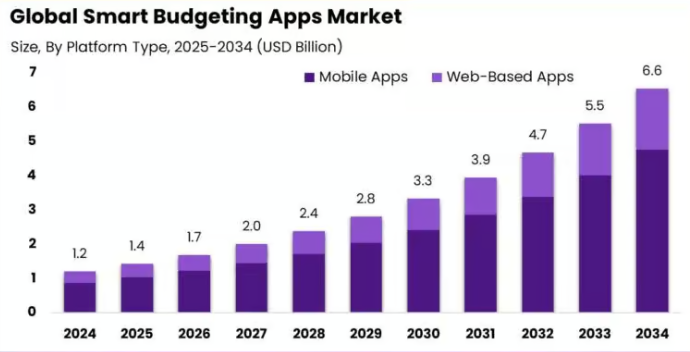
- The financial assistant applications are expected to grow with a CAGR of 18.40% during the forecast period from 2025 to 2034.
- The survey found that around 80% of financial assistant app users engage with them at least weekly, and 20% of them use them daily.
What is the Financial Assistant App?
The financial assistant app is a digital platform to manage personal finance and use AI to offer tools for expense tracking, budgeting, expense monitoring accounts, and more.
With the help of these financial planning apps like Experian, users can achieve their financial goals and learn financial literacy. AI analyzes users’ spending and offers personalized advice to help them maintain their budget.
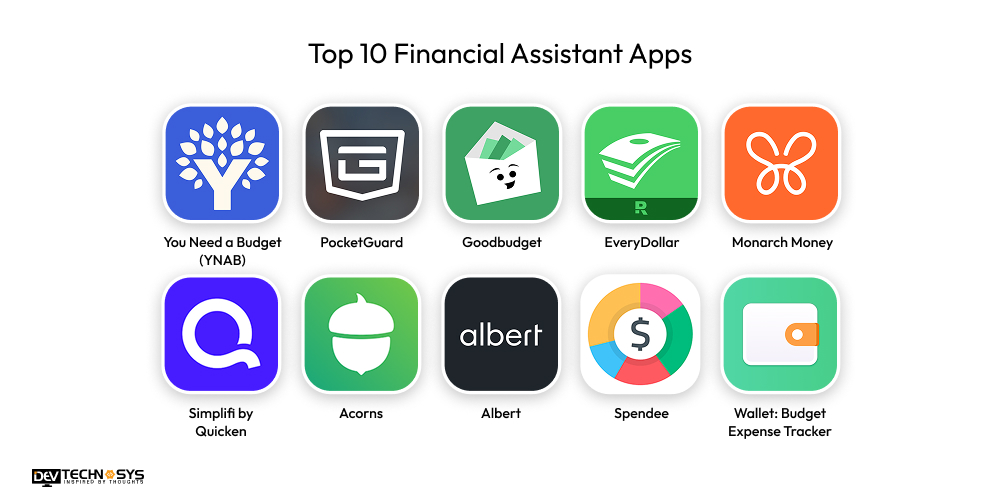
Top 10 Financial Assistant Apps
Are you looking to build a financial advisor app with unique features? Then, you need to observe these existing applications that record higher growth and popularity. So, let’s consider these best financial assistant apps:
App Name |
Launch Year |
Downloads (approx.) |
Avg. Rating |
Platforms |
| You Need a Budget (YNAB) | 2004 | 1M+ | 4.7 | Android, iOS, Web |
| PocketGuard | 2015 | 1M+ | 4.5 | Android, iOS |
| Goodbudget | 2013 | 1M+ | 4.7 | Android, iOS |
| EveryDollar | 2015 | 1M+ | 4.8 | Android, iOS, Web |
| Monarch Money | 2020 | 500K+ | 4.6 | Android, iOS, Web |
| Simplifi by Quicken | 2020 | 500K+ | 4.4 | Android, iOS, Web |
| Acorns | 2014 | 10M+ | 4.7 | Android, iOS |
| Albert | 2016 | 500K+ | 4.1 | Android, iOS, Web |
| Spendee | 2013 | 1M+ | 4.3 | Android, iOS, Web |
| Wallet: Budget Expense Tracker | 2015 | 10M+ | 4.7 | Android, iOS, Web |
Why Today’s Entrepreneurs Want to Invest in Financial Assistant App Development?
Today’s entrepreneurs are investing in fintech app development because people want easier ways to manage money. With AI-powered financial assistant development solutions, ways to earn revenue, and growing interest in financial literacy, these apps are becoming highly popular and useful.
1. Growing Demand
Consumers increasingly seek tools like investment portfolio tracker to track spending, savings, and investments. Financial assistance apps offer automated budgeting, expense analysis, and personalized insights, making them highly appealing for users aiming to achieve financial stability and smart money management.
2. Advancements in AI and ML
A money management app like Fi Money can analyze massive data sets, predict spending trends, and provide tailored advice. Entrepreneurs see this as an opportunity to deliver highly intelligent, adaptive apps that provide rxpense categorization, improving user experience and engagement, enhancing customer retention.
3. Rising Digital Banking Adoption
With smartphones ubiquitous and digital banking on the rise, users expect seamless, on-the-go financial solutions. Develop a financial AI assistant app aligns with this trend, offering convenience and real-time insights, which attracts tech-savvy users seeking efficient money management.
4. Potential for Revenue Streams
If businesses develop a financial app like CAIXA, it offers multiple revenue channels, including premium subscriptions, affiliate partnerships, and personalized financial product recommendations.
Entrepreneurs recognize the potential for sustainable income while providing value-driven services, making financial AI assistant app development a lucrative investment.
5. Increased Awareness of Financial Literacy
Consumers are more conscious of financial planning, debt management, and investment opportunities. Entrepreneurs see a market gap for apps that educate users, simplify financial decisions, and encourage smarter habits, meeting societal needs while driving app adoption and loyalty.
Why Businesses Integrate AI in Financial Assistant Apps?
- AI in digital finance assistant analyzes large financial datasets, providing accurate insights to help users make smarter investment and budgeting decisions.
- Machine learning tailors recommendations based on spending habits, income patterns, and financial goals for each individual user.
- AI continuously monitors transactions, detecting unusual activities in real time to prevent fraudulent behavior and ensure account security with OAuth 2.0.
- AI automates bill payments, expense tracking, and report generation, saving users time and reducing human error.
- AI-powered chatbots in spending tracker app provide instant assistance, answering financial queries and resolving issues without human intervention anytime.
7 Easy Steps to Develop a Financial Assistant App
To develop a wealth management app, it involves seven simple steps, including market research, defining features, designing intuitive interfaces, and integrating AI. And ensuring data security with biometric authentication, thorough testing, and launching effectively to deliver a smart, secure, and user-friendly financial management experience.
1. Project Requirements
Before going through any process of developing Financial goal planner app, first you need to know what type of financial assistant app you want to develop and what features and services you need to implement. To clear the confusion and misunderstanding, you can make a clear or organized sheet of the project’s needs and requirements.
2. Features and Functions
Move to the second stage to make a financial assistant app and identify the core and advanced features of the app. There are various features, including user registration, real-time expense tracking, smart budgeting, an AI chatbot, cloud backup, and shared family. You can also check out the existing app features to implement in your app.
3. Select Technologies
In the third phase of investment app development, select the best tech stacks that can lead to successful app development. It involves different tech stacks such as testing, designing, APIs, frontend and backend frameworks, cloud storage, firebase realtime database, and many more. But some of them have a premium version, and it can be higher cost.
4. Design User-Interface
Do you like confusing and clunky navigation within an app? Of course not. Designing that looks simple and easily navigates functionalities can increase user engagement.
There are different types of UI elements are exist, such as layouts, fonts, search bars, styles, themes, textures, plugins, wireframes, prototyping, and more.
5. App Development
Come to the fifth step to make a financial assistant app, hire backend developers from a Chatbot development company to start the real coding for backend processes. It includes various processes such as managing servers, user authentication, data processing, creating APIs, and maintaining server-side code.
6. Testing and QA
Test the financial planning assistant app under the various conditions or techniques, such as integration testing, functional testing, security testing, and unit testing.
Make sure all the specifications are working correctly and running at their peak performance. This step can increase the user’s experience by performing every task perfectly.
7. Publish and Maintenance
At last, publish the financial advisor assistant app on the specific platforms such as Android and iOS. Hire mobile app developers from an AI development company to conduct the maintenance services to keep the app up-to-date. It involves various maintenance services such as fixing bugs or glitches, regular updates, OS version upgrades, solving security issues, and more.
10 Key Features that Must Be Integrated in a Financial Assistant App
Are you puzzled about which features to include in a financial assistant app? Then, look at the given features are needed for financial assistant app that can increase your app’s user engagement.
-
Expense Tracking
The financial personal assistant tools track the users’ daily expenses via accounts and offer a visual spending report to help users identify their spending habits.
-
User-Friendly Interface
Apps like Zogo have a simple user interface that displays expenses, budgets, income, and savings insights. It offers a seamless experience and quick navigation.
-
Budget Management
The wealth management app enables users to create a personalized budget by tracking progress in real-time and getting an alert when they exceed the limit.
-
Multi-Account Integration
The personal finance management app securely connects bank, wallet, loan, and investment accounts, offering a unified view of all finances in one place.
-
AI-Powered Financial Insights
The money management assistant app uses artificial intelligence to analyze spending behavior, detect patterns, and offer actionable recommendations to optimize budgeting.
-
Bill Reminders & Payments
A finance assistant chatbot app sends timely reminders for upcoming bills, automates recurring payments, and prevents late fees through integrated payment gateways.
-
Smart Savings Goals
A money budgeting app like Mint enables users to set savings targets with automated progress tracking, motivational reminders, and predictive insights.
-
Offline Access & Sync
An automated budgeting and expense tracking app allows users to view and update essential financial data offline, syncing automatically when internet connectivity resumes.

-
Real-Time Notifications
Top AI assistant apps for finance deliver instant alerts for transactions, low balances, unusual activity, or spending limits to keep users informed and prevent financial surprises.
-
Voice & Chat Assistance
Voice-enabled financial assistant app for instant financial queries, account summaries, and smart advice, enhancing accessibility and user convenience.
The Cost to Develop a Financial Assistant App
The cost to build a financial assistant app ranges from $8,000 to $25,000 or depending on the special project demand. The financial assistant application contains a wide variety of features such as real-time expense tracking, budget management, smart savings goals, and a voice assistant.
So, these can fluctuate the overall cost to build a personal finance management app, and other factors are project complexity, tech stacks, third-party integrations, and the development team. For the detailed cost, look at the cost table below:
Stage / Component |
Description |
Estimated Cost (USD) |
| Market Research & Planning | Requirement analysis, competitor study, and feature planning | $1,000 – $2,000 |
| UI/UX Design | Wireframes, mockups, and user interface design for mobile/web platforms | $4,000 – $6,000 |
| Front-End Development | Building the user interface and integrating basic interactivity | $5,000 – $9,000 |
| Back-End Development | Server-side logic, APIs, and database integration for transactions and analytics | $7,000 – $11,000 |
| AI/ML Integration | Implementing financial insights, a chatbot assistant, or budget forecasting | $1,000 – $4,000 |
| Testing & Quality Assurance | Functional, performance, and security testing | $800 – $2,000 |
| Deployment & Maintenance | App store deployment, bug fixes, and minor updates post-launch | $1,200 – $4,000 |
| Total Estimated Cost | (Depending on complexity and features) | $8,000 – $25,000 |
Crucial Factors That Affect the Financial Assistant App Development Cost
There are various major factors that can highly impact the overall financial assistant app development cost. It involves the developer’s location, complexity, project size, and more. So, let’s take a look at the following factors:
1. Tech Stacks
Choosing the best technologies is a must in every budget tracking app development, but some tech stacks have higher fees to use. That directly impacts the financial AI assistant app development cost. So, choose tech stacks as per the overall project budget.
Component |
Estimated Cost Impact |
| Frontend Framework (React Native / Flutter) | $2,000 – $4,000 |
| Backend Framework (Node.js / Django / Laravel) | $1,500 – $3,000 |
| Database (PostgreSQL / Firebase / MongoDB) | $1,000 – $2,000 |
2. Platform Choice
There are many platforms available for deployment, such as Android, iOS, and more. But each platform’s fees are different from others; sometimes, it can be higher depending on the application type. So, it can raise the cost to build a financial assistant app.
Platform |
Estimated Cost Impact |
| Android Only | $3,000 – $5,000 |
| iOS Only | $3,500 – $6,000 |
| Cross-Platform (iOS + Android) | $5,000 – $8,000 |
3. Backend Infrastructure
In backend infrastructure, it involves various processes such as managing the database, creating banking APIs, handling server-side, and more. But these processes are time-consuming and this can increase the time of developers. Basically, this directly affects the financial assistant on-demand app development cost.
Component |
Estimated Cost Impact |
| Cloud Hosting (AWS / Google Cloud) | $1,000 – $2,500 |
| API Integrations (Banking, Payment Gateways) | $1,500 – $3,000 |
| Security & Compliance (Data Encryption, GDPR Compliance) | $1,000 – $2,500 |
4. Post-Maintenance Services
Starting the post-maintenance services is necessary to maintain the actual performance. It involves regular updates, solving security patches, upgrading OS versions, adding new enhancements, and more. These are time-consuming and influence the total cost to develop a financial assistant app.
Service |
Estimated Cost Impact |
| Bug Fixes & Updates | $800 – $1,500 / year |
| Feature Enhancements | $1,000 – $2,000 / year |
| Cloud & Server Management | $700 – $1,200 / year |
5 Monetization Techniques of Financial Assistant Applications
Financial assistant apps are transforming money management through AI integration, offering personalized insights, automation, and security. At the same time, monetizing via subscriptions, freemium upgrades, data analytics, partnerships, and targeted advertisements for sustainable growth.
1. Subscription Model
Users pay monthly or annual fees to access premium features like advanced analytics, personalized financial advice, and investment tracking tools. Ensuring steady recurring revenue and fostering long-term customer relationships for the app developers or businesses.
2. Freemium Model
An app like Empower offers essential financial tools for free while charging for premium services such as portfolio management, AI-driven insights, or advanced reporting, attracting a large user base before converting active users into paying customers.
3. Affiliate Partnerships
The best financial assistant apps earn commissions by promoting third-party products like credit cards, insurance, or investment platforms. Recommending suitable offers to users based on their financial profiles, thus helping users with credit score monitoring, thus generating passive income through strategic partnerships and referrals.
4. In-App Advertisements
Carefully targeted, non-intrusive ads for relevant financial products, such as savings accounts, loans, or budgeting tools. According to the mobile app development company, it allows free app access for users while generating consistent revenue for developers through advertiser partnerships and click-based monetization strategies.
5. Data Analytics Services
Aggregated, anonymized financial data is analyzed to uncover market trends and insights, which can be sold to financial institutions. It helps them refine their products, enhance marketing strategies, and understand evolving consumer spending behaviors effectively.
Conclusion
In conclusion, develop a financial AI assistant app requires a clear strategy, robust security, AI integration, and a user-friendly interface to ensure efficiency and trust. Partnering with an experienced fintech app development company helps transform innovative ideas into reliable, scalable solutions tailored to user needs.
Such a partnership ensures PCI DSS compliance, seamless integration with banking systems, and future-ready technology. Ultimately, a well-developed financial assistant app enhances user engagement, promotes financial literacy, and drives long-term business growth in the competitive fintech landscape.
Frequently Asked Questions
Q1. What Features Should I Look For in a Financial Assistant App?
A. There are various types of features that must be integrated into a expense management tool:
- Expense Tracking
- Bill Reminders
- Investment Insight
- AI-Driven Advice
- Multi-Account Sync
- Budgeting Tools
Q2. How Can a Financial Personal Assistant Help Me Manage My Finances Better?
A. A financial personal assistant helps you manage finances by tracking spending, setting budgets, analyzing income patterns, and providing real-time insights to improve money management and achieve financial goals efficiently.
Q3. Are There Any AI-Powered Financial Assistants Recommended for Personal Use?
A. AI-powered financial assistants like Cleo, YNAB, Mint, and PocketGuard use artificial intelligence to track expenses, create budgets, analyze spending habits, and provide personalized financial insights for smarter money management.
Q4. What is the Cost to Develop a Financial Assistant App?
A. The cost to build a financial assistant app lies between $8,000 and $25,000. The simple Stock market analysis app can be less expensive because it has limited functionalities, and the complex app can fluctuate the overall project budget due to premium features and high-quality design.
Q5. How Long Does it Take to Create a Financial Assistant App?
A. To create a financial assistant app, the basic financial assistant app takes around 2 to 4 months. The premium applications take around 3 to 6 months. The development time normally depends on various factors such as the number of features, complexity, size, and more.