

















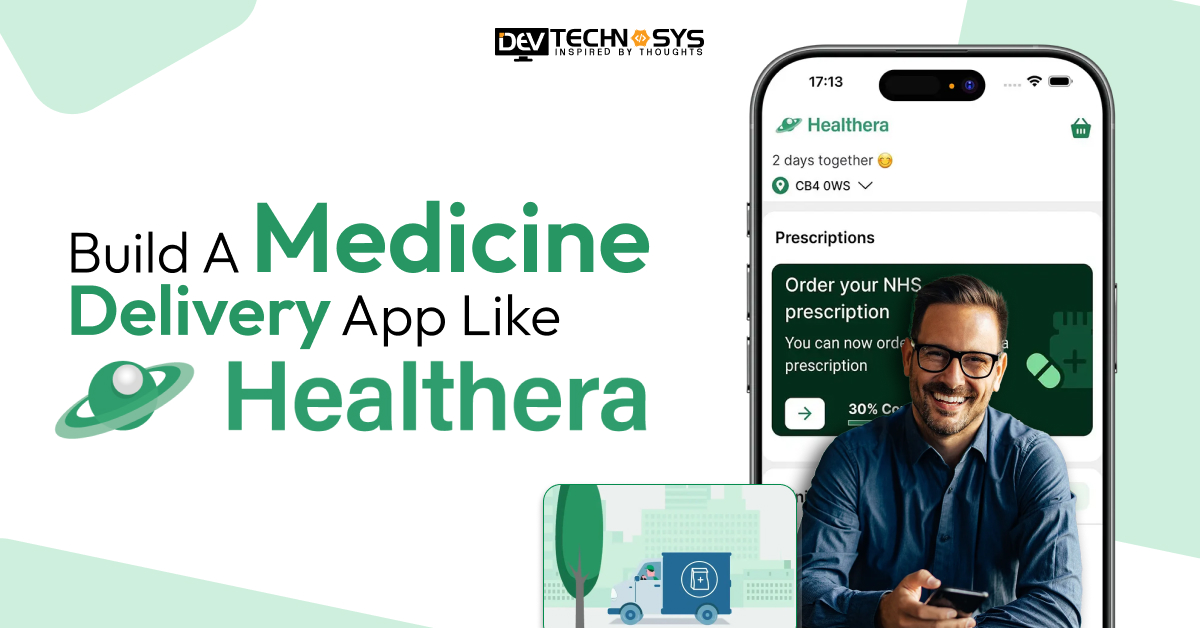
There is no denying that convenience is vital in healthcare, just like it is in every other aspect of life. Medicine delivery applications like Healthera have made it easier for customers to obtain prescriptions and pharmacy services.
Imagine ordering, tracking, and consulting a pharmacist all on your phone. However, creating a medicine delivery app like Healthera or any other similar app ideally has more to do with building a dependable, user-friendly, and efficient interface that connects patients, pharmacies, and healthcare providers seamlessly.
Whether you are an entrepreneur, a startup, or a seasoned healthcare provider, learning about the ins and outs of such an app has the potential to transform your business in the expanding digital health market.
Here is how to build a medicine delivery app like Healthera.
Market Analysis of Medicine Delivery Applications
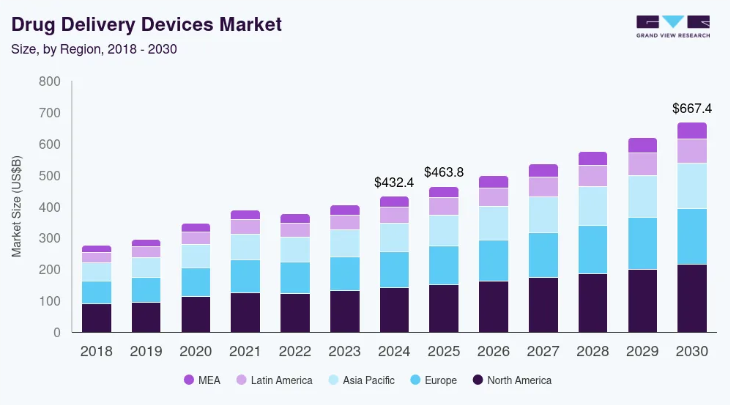
- The global medicine delivery apps were valued at around $432.4 billion in 2024, and it is expected to grow to around $667.4 billion by the end of 2030.
- As for the product-wise, the inhaler segment holds the largest market share, around 9% in 2024.
- The North American medicine delivery platforms dominate the global market and accounted for around 4% market revenue share in 2024.
- According to the application-wise, the drug delivery services segment records the largest share around 1% in 2024.
- As per the latest survey, the medicine delivery apps are expected to increase with a CAGR of 5% from 2025 to 2030.
What is Healthera?
Healthera is a pharmacy delivery and order platform where users can easily order their prescription-based medicines and have them delivered to their doorsteps or collect them local pharmacy store. Users can book an appointment with a doctor and set a medication reminder to track their health. In the UK, Healthera partners with Uber to deliver pharmacy or medicines same day and instant delivery.
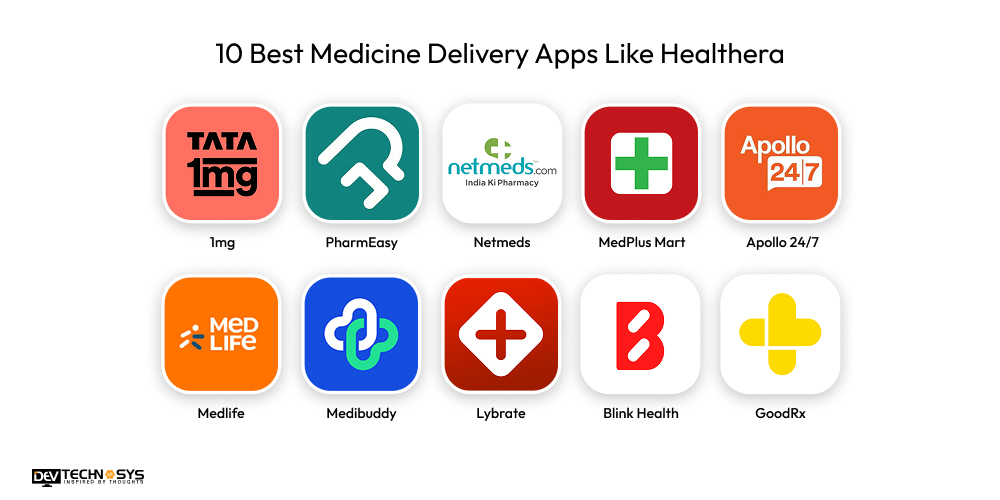
10 Best Medicine Delivery Apps Like Healthera
Let’s find out the top medicine delivery apps to understand their functionalities and services. It helps businesses to get an idea of which type of app is perfect for them.
App Name |
Downloads |
Average Rating |
Launch Year |
Platform Availability |
| 1mg | 10M+ | 4.4 | 2015 | Android, iOS |
| PharmEasy | 10M+ | 4.5 | 2014 | Android, iOS |
| Netmeds | 10M+ | 4.4 | 2015 | Android, iOS, Web |
| MedPlus Mart | 50M+ | 4.3 | 2006 | Android, iOS |
| Apollo 24/7 | 10M+ | 4.5 | 2018 | Android, iOS |
| Medlife | 5M+ | 4.3 | 2015 | Android, iOS |
| Medibuddy | 1M+ | 4.2 | 2015 | Android, iOS |
| Lybrate | 5M+ | 4.3 | 2013 | Android, iOS, Web |
| Blink Health | 1M+ | 4.1 | 2014 | Android, iOS |
| GoodRx | 10M+ | 4.6 | 2011 | Android, iOS, Web |
Why Businesses Want to Invest in Medicine Delivery App Development?
Businesses invest in medicine delivery app development to quickly and easily provide customers with medications safely and conveniently. This boosts customer satisfaction and loyalty while expanding the business’s digital presence and capturing the growing demand for home healthcare solutions in the fast-paced, technology-driven market.
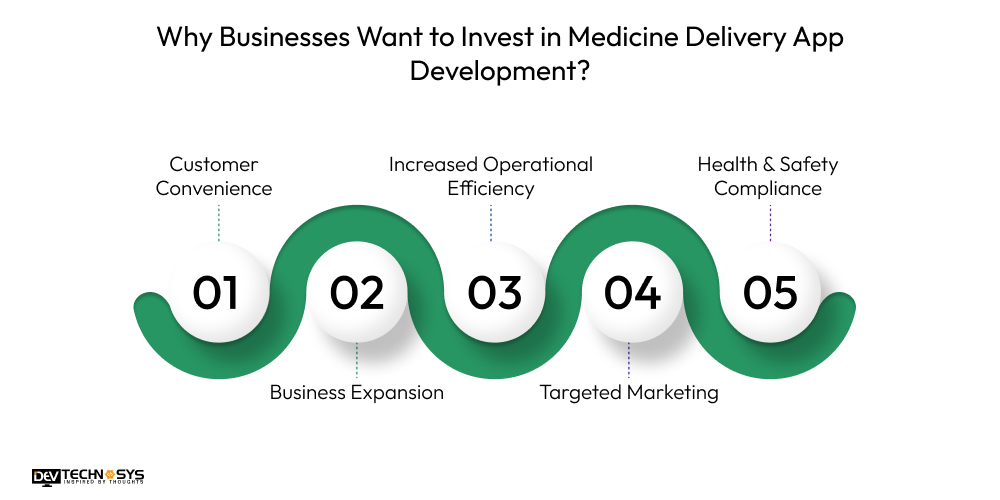
1. Customer Convenience
Medicine delivery app USA gives customers the opportunity to get prescriptions without leaving their homes. This effortless service enhances customer satisfaction and drives loyalty. Increased customer loyalty translates to customer retention and improved sales and market reach for healthcare businesses.
2. Business Expansion
Businesses that build a medicine delivery app like 1mg to deliver prescriptions electronically can gain customers outside the traditional reach of their physical locations. This is important for customers in new regions and increases a company’s profitability while improving its position in the highly competitive digital healthcare sector.
3. Increased Operational Efficiency
The automation of order processing and delivery helps cut excess operational costs and geopolitical bottlenecks and minimizes logistical errors. This increases the company’s ability to activate and service more customers and improve their profitability.
4. Targeted Marketing
The customer data accessed through a delivery app like Capsule is useful in developing specific offerings and marketing strategies. By improving target marketing, you improve customer acquisition and retention, which ultimately translates to revenue growth.
5. Health & Safety Compliance
With service offerings in healthcare delivery applications, customers gain effortless access to medicine while maintaining the regulations for contactless service delivery, real-time tracking, and swift closure of remote medicine access. This drives trust, which improves the company’s preference.
How AI Can Help Medicine Delivery Applications?
- AI suggests medicines based on user history, preferences, and health conditions for tailored delivery options.
- AI predicts medicine demand trends to optimize inventory and reduce stockouts or overstock situations.
- AI calculates the fastest delivery routes, minimizing delivery time and fuel consumption for efficiency.
- AI-powered bots provide 24/7 customer support, answering queries and processing orders instantly.
- AI detects suspicious activities and prevents fraudulent transactions, ensuring secure and trustworthy service.
- AI streamlines order verification, billing, and dispatch, reducing manual errors and delays.
7 Robust Steps to Build a Medicine Delivery App Like Healthera
To create a medicine delivery app like Healthera, you must follow these mobile app development process steps and know about the features that have to be integrated. From the market analysis to post-maintenance services, explain all of these in detail. So, here we provide a step-by-step business guide for startups to build a medicine delivery app like Healthera:
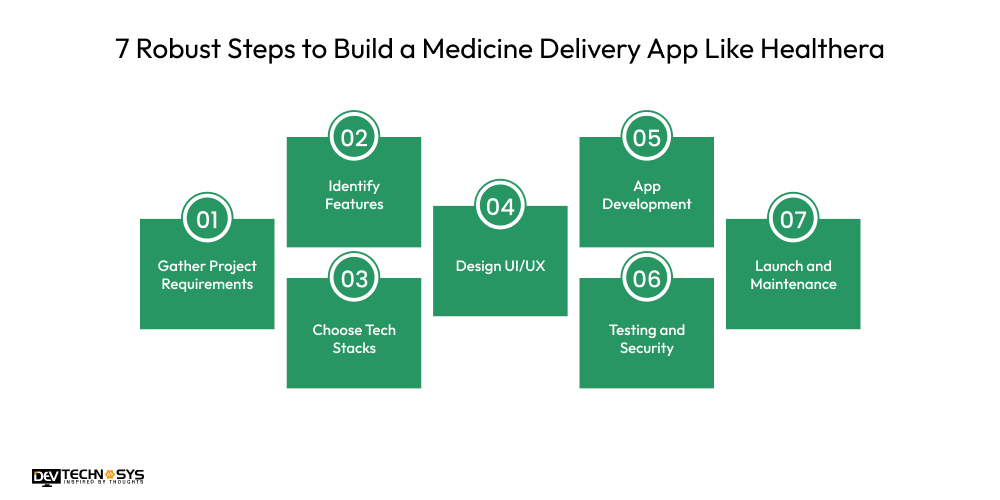
1. Gather Project Requirements
Let’s begin the first step to develop a medicine delivery app like Healthera, and make a list of project requirements that must be added. Observe the latest market trends to determine which type of medicine delivery app gains higher success rates and analyze the existing applications. Make a plan for competitors on how they can compete and identify the ideal users.
2. Identify Features
In another stage, to make a medicine delivery app like Healthera, hire dedicated developers to find out the best features for the application. Create a structured list of features to eliminate data redundancy and misunderstandings. It includes various types of features such as prescription upload, multiple payment options, real-time order tracking, and more.
3. Choose Tech Stacks
Moving to the third step of the Healthera clone app development process, select the best tech stacks that can lead to a successful development. It includes various types of tech stacks such as designing, APIs, testing, security, frontend and backend development, database, cloud storage, and more.
4. Design UI/UX
Designing a user interface is one of the most important steps to create a medicine delivery app like Healthera. Involves various design elements such as layouts, themes, fonts, styles, templates, in-built plugins, and more. Hire mobile app developers to use high-tech designing tools like Figma, Sketch, Marvel, Zeplin, InVision, Adobe XD, and more.
5. App Development
In the fifth stage, to build an app like Healthera, assemble skilled developers to start the coding for backend development. It involves server-side logics, database, servers, API creation, security, and data processing. Developers make sure that all technical operations are working perfectly and smoothly.
6. Testing and Security
Before publishing the Healthera clone app, you must test its features and services. It involves various testing techniques such as unit testing, integration testing, security testing, functional testing, and more. Hire a mobile app development company to integrate the strong security methods, such as authentication, biometrics, encryption techniques, and more.
7. Launch and Maintenance
Finally, it’s the right time to release the app on the selected platforms, such as iOS and Android. Make sure all the phases are successfully deployed. After that, conduct the post-maintenance services to monitor the overall performance. It includes fixing bugs or glitches, regular backups, upgrading OS versions, adding new features, and design enhancements.
10 Must-Have Features to Integrate in Medicine Delivery Apps
List and describe the must-have features of a medicine delivery app like Healthera, such as prescription management, real-time tracking, pharmacy integration, and medication reminders.
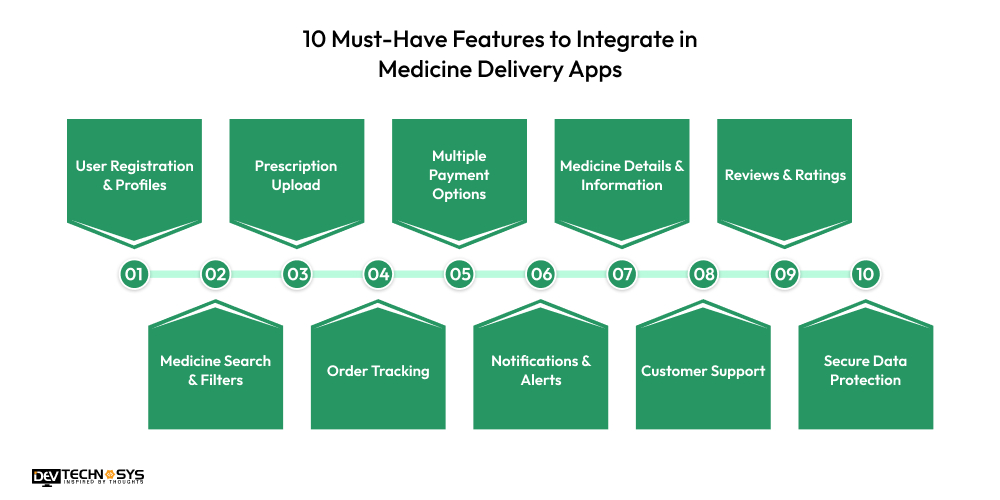
1. User Registration & Profiles
Secure sign-up and profile management for personalized experiences and easy order tracking in the app.
2. Medicine Search & Filters
Healthera alternatives can efficiently search with filters by name, category, or symptoms to quickly find required medicines.
3. Prescription Upload
Option to upload prescriptions for verification, ensuring accurate medicine dispensing and compliance with regulations.
4. Order Tracking
Medicine delivery apps like Pharmeasy offer real-time tracking of orders from the pharmacy to the doorstep, providing transparency and delivery updates.
5. Multiple Payment Options
Integration of various payment methods, including cards, wallets, and cash-on-delivery, for customer convenience.
6. Notifications & Alerts
Healthera medicine delivery app provides push notifications for order status, discounts, and medicine reminders to keep users informed and engaged.
7. Medicine Details & Information
Healthera alternatives offer comprehensive descriptions, dosage instructions, and side effects for informed user decisions.
8. Customer Support
In-app chat or call support for resolving queries and assistance during ordering and delivery processes.
9. Reviews & Ratings
User feedback on medicines and delivery service to enhance app credibility and service quality.
10. Secure Data Protection
Strong encryption and privacy measures to protect sensitive user and medical information within the app.
What is the Cost to Build a Medicine Delivery App Like Healthera?
The cost to develop a medicine delivery app like Healthera ranges from $8,000 to $25,000 or depending on the special requirements. It can fluctuate due to custom development, premium features, design, complexity, backend infrastructure, development team, testing, tech stacks, and more.
There are additional factors that can affect the overall medicine delivery app development cost, such as deployment platforms, third-party integrations, and maintenance services.
Development Phase |
Estimated Cost (USD) |
| Planning & Research | $1,000 – $3,000 |
| UI/UX Design (Basic) | $2,000 – $5,000 |
| Frontend Development (Single Platform) | $3,000 – $7,000 |
| Backend Development | $5,000 – $10,000 |
| Third-Party Integrations | $1,000 – $3,000 |
| Quality Assurance & Testing | $1,000 – $3,000 |
| Deployment & Launch | $500 – $1,000 |
| Post-Launch Maintenance (1 Year) | $2,000 – $5,000 |
Total Development Cost: $8,000 – $25,000+
What are the Factors Affecting the Medicine Delivery App Development Cost?
To create an app like Healthera within a fixed budget, you must observe the factors that can affect the total Healthera app development cost. It includes project complexity, backend infrastructure, tech stacks, design, and more. Let’s take a look at the cost-affecting factors:
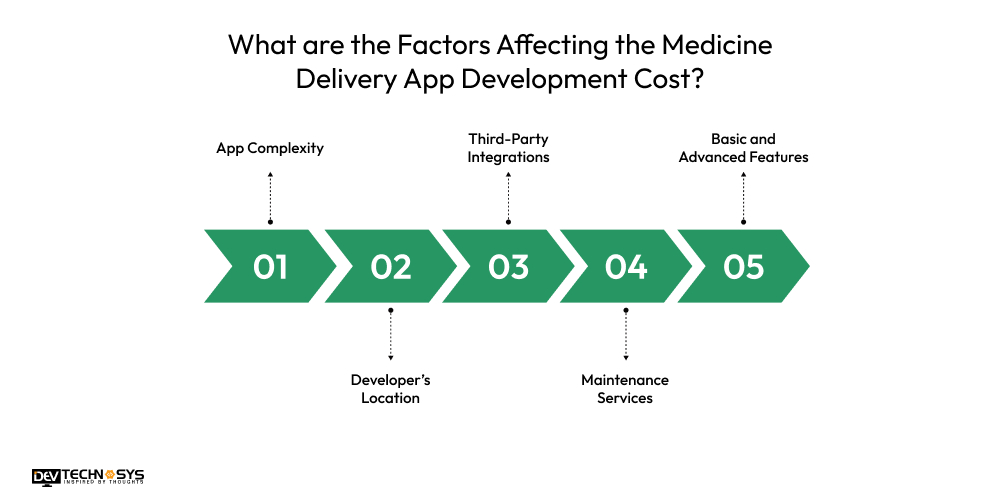
1. App Complexity
In the first cost-affecting factor, the application complexity has different types, such as basic, medium, and premium. Basic app includes limited features and simple UI/UX design, but the premium complexity involves advanced features and high-quality design. So, this can increase the overall mobile app development cost.
App Type |
Features |
Estimated Cost (USD) |
Basic MVP |
User login, medicine catalog, order placement | $8,000 – $12,000 |
Intermediate |
Real-time tracking, digital payments, push notifications | $12,000 – $18,000 |
Advanced |
Telemedicine, AI recommendations, vendor management | $18,000 – $25,000 |

2. Developer’s Location
Move to the second factor, hire developers from different locations such as the USA, the UK, India, Japan, and more. But each region has a different cost because of its living expenses and more. If businesses hire developers from the USA and the UK, then it can raise the cost to develop a medicine delivery app like Healthera. So, choose developers according to the overall project budget.
Region |
Hourly Rate (USD) |
Estimated Cost (USD) |
| South Asia (e.g., India) | $15 – $25 | $8,000 – $15,000 |
| Southeast Asia (e.g., Vietnam) | $25 – $45 | $12,000 – $18,000 |
| Eastern Europe (e.g., Ukraine) | $25 – $75 | $15,000 – $20,000 |
3. Third-Party Integrations
In the fourth factor, there are various third-party tools available for integration to increase the users’ accessibility and flexibility. It involves CRM, ERP, analytics and reporting, communication tools, payment gateways, and social media logins. Some of them have higher licensing fees and take more time to integrate. This can lead to higher on-demand app development costs and time.
Integration Type |
Examples |
Estimated Cost (USD) |
Basic Integration |
Single payment gateway, basic GPS tracking | $1,000 – $5,000 |
Intermediate Integration |
Multiple payment gateways, advanced GPS, and SMS notifications | $5,000 – $10,000 |
Advanced Integration |
Real-time analytics, AI-powered features, multiple APIs | $10,000 – $15,000 |
4. Maintenance Services
Let’s come to the last factor, starting the maintenance services is necessary to keep the app up-to-date. It involves various services such as upgrading to the latest OS version, updating outdated features, regular updates, design enhancement, fixing security patches, solving bugs and errors, and more. But, some of the maintenance services take a longer time and cost to build a medicine delivery app like Healthera.
Maintenance Type |
Services Included |
Estimated Annual Cost (USD) |
Basic Maintenance |
Bug fixes, minor updates | $1,000 – $3,000 |
Standard Maintenance |
Regular updates, performance monitoring | $3,000 – $5,000 |
Comprehensive Maintenance |
Frequent updates, security patches, user support | $5,000 – $8,000 |
5. Basic and Advanced Features
Select features for your medicine delivery app; it can be another cost-impacting factor. It includes many advanced features such as real-time order tracking, personalized recommendations, appointment scheduling, delivery type, multiple payment options, and more.
According to the pickup and delivery app development company, these advanced features have the ability to fluctuate the Healthera app development cost.
Feature Set |
Description |
Estimated Cost (USD) |
Basic Features |
User profile, order history, basic search | $8,000 – $12,000 |
Intermediate Features |
Real-time tracking, digital payments, push notifications | $12,000 – $18,000 |
Advanced Features |
Telemedicine, AI recommendations, vendor management | $18,000 – $25,000 |
How to Make Money From Medicine Delivery Apps Like Healthera?
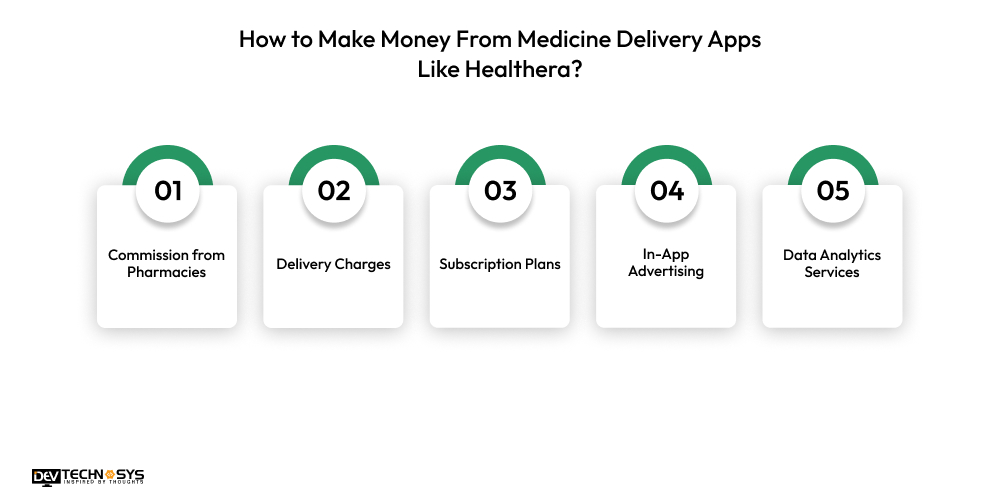
1. Commission from Pharmacies
If businesses build an ayurvedic medicine delivery app, they can earn a percentage fee on every order placed through the app by partnering with pharmacies. They are charging a commission for sales generated via their platform.
2. Delivery Charges
Charge customers a delivery fee for each medicine order, which can vary based on distance, urgency, or order size, generating a steady revenue stream from logistics services.
3. Subscription Plans
Medicine delivery apps like Walgreens and Healthera offer premium subscription packages to customers or pharmacies, providing benefits like faster delivery, exclusive discounts, or priority support, ensuring recurring monthly or annual income.
4. In-App Advertising
Monetize app traffic by displaying targeted advertisements from pharmaceutical brands, health products, or wellness services, earning revenue through clicks or impressions.
5. Data Analytics Services
Apps like CVS Health sell anonymized user data insights to healthcare companies or pharmacies to help them improve marketing strategies, inventory management, or customer engagement, creating an additional revenue source.
Conclusion
Building an online medicine delivery app like Healthera requires careful planning, user-friendly design, and seamless integration of features such as prescription uploads, medicine reminders, and secure payments. Partnering with a reliable healthcare app development company ensures expert guidance through compliance, technology choices, and user experience optimization.
This collaboration helps create a robust, scalable app that meets patient needs while maintaining privacy and security. Ultimately, a professional development team can transform your vision into a successful healthcare solution.
Frequently Asked Questions
1. How can AI and Automation Enhance a Medicine Delivery App Like Healthera?
AI and automation can enhance a medicine delivery app like Healthera by enabling personalized recommendations, optimizing delivery routes, automating order processing, and providing real-time inventory updates. These can improve efficiency and user experience significantly.
2. How Can Developers Integrate Real-Time Prescription Tracking And Pharmacy Communication APIs?
Developers can integrate real-time prescription tracking and pharmacy communication APIs using secure RESTful APIs. This enables seamless data exchange, real-time status updates, prescription verification, and direct messaging between users, pharmacies, and healthcare providers for efficient order management.
3. How Much Does it Cost to Build a Medicine Delivery App Like Healthera?
The cost to develop a medicine delivery app like Healthera is around $8,000 to $25,000 or higher. There are several factors that can influence the cost, such as features, functions, size, backend infrastructure, and complexity.
4. How Long Does it Take to Create a Medicine Delivery App Like Healthera?
To make a medicine delivery app like Healthera, it usually takes around 5 to 18 weeks. The time can be changed because of the number of features, project complexity, third-party integrations, size, and more.
5. What Technologies are Used to Develop a Medicine Delivery App Like Healthera?
Here is the list of technologies that are used to build an app like Healthera:
- Java
- Python
- C++
- js
- PHP