















Key takeaways:
-
- The market for ERP software around the world is really big; it is worth between 78 billion dollars and 106 billion dollars in 2026. This is what research companies say. It is still growing very fast.
- SAP and Oracle are the choices for big companies, while Odoo is what small and medium-sized businesses prefer because it is cheaper.
- More and more companies are making their own ERP software in 2026 because the ERP software you can buy is not very flexible. Companies have to change the way they work to use this software, which is not ideal.
- The cost of ERP software can vary a lot. For example, Odoo can cost more than 30 dollars per user per month, but SAP S/4HANA can cost thousands of dollars per user per month for big and complicated projects.>
In the past few years, Enterprise Resource Planning (ERP) software has evolved a lot. It has now become the digital backbone of modern businesses. Businesses use ERP systems to automate workflows, connect multiple business applications, provide AI-driven insights, and support long-term growth.
There are many ERP options in the market, so you need to choose according to your business’s requirements.
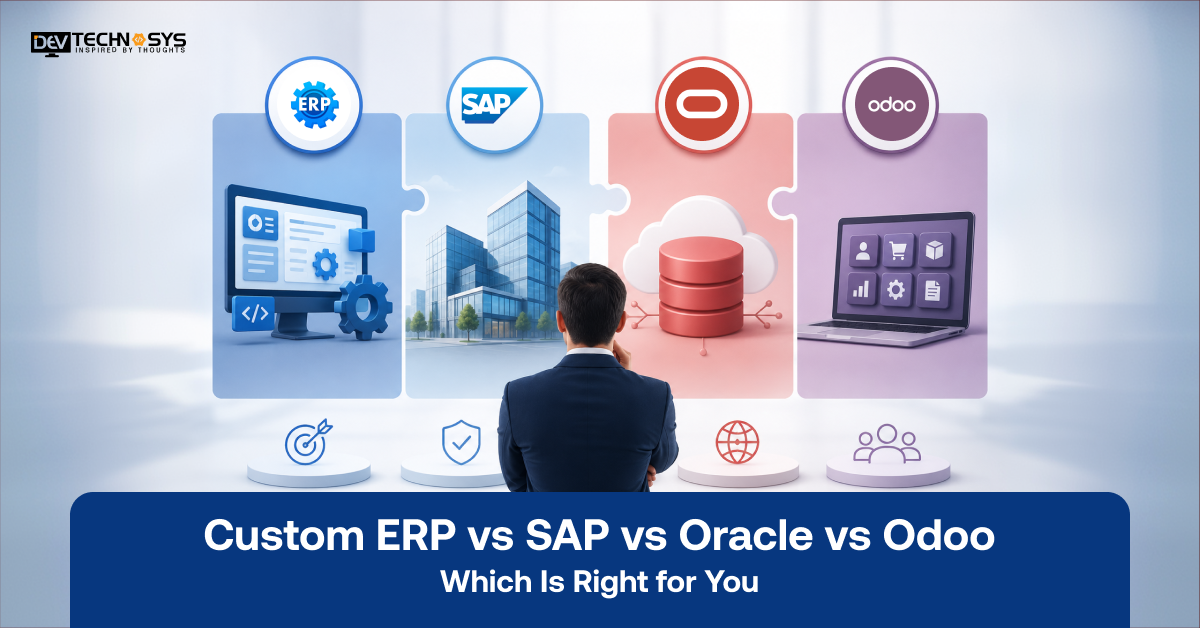
In this blog, we have compared custom ERP vs SAP vs Oracle vs Odoo on the basis of features, price, benefits, and more. If you are confused about which ERP is right for your business, then you can look into this according to your requirements. By the end of this blog, you will understand which ERP aligns best with your business goals.
What Is an ERP System?
Enterprise Resource Planning software is a way to bring all the important parts of a business together. This means that things like money, accounting, inventory, supply chain, manufacturing, employees, and customers are all connected.
Instead of having one system for money and another for inventory and employees, ERP software gives everyone a single place to find information. It gets very convenient because when all your data is collected into one system, you can get real-time visibility into the cash flow, production capacity, and stock levels. This makes compliance, forecasting, and day-to-day operations much easier.
ERP Software Market Statistics in 2026
In this section, we have presented the market statistics for ERP systems:
Metric |
Details |
| Market Size (2026) | $77.1 billion, expected to grow to $83.2 billion in 2026 and $157.1 billion by 2033, at a CAGR of 9.5%. |
| Market size (alternate estimate) | $92.6 billion in 2025, expected to grow to $106.22 billion in 2026, at a CAGR of 13%. |
| Implementation risk | For mid-size implementations, the average price is $7.1 million and 17.4 months, running 3.6 months late; 68% of projects run longer than planned, 55% of projects go over budget, and only 61% meet their true goal. |
| AI Impact | Companies report a 20% gain in forecasting accuracy, a 15% cut in operational costs, a 25% reduction in delivery times, and 35% faster decision-making with AI-enabled ERP reports |
| Deployment and industry mix | The cloud segment held at 54.4% in 2025; the manufacturing segment held at 19.7% in 2025. |
| Vendor market share | SAP leads at about 22%, Oracle at 12%, and Microsoft Dynamics at 9%. In 2024, cloud ERP adoption reached 64%. |
Get a Cost Estimate
Get a tailored development cost estimate in a few simple steps.
- 3 quick steps
- 100% free
- Reply in 1 business day
2 Minutes Read
Understanding the Four ERP Options: Custom ERP vs SAP vs Oracle vs Odoo
To choose the best ERP for your business between Custom ERP vs SAP vs Oracle vs Odoo, you should compare them based on various factors. But before Oracle vs Odoo vs Custom ERP vs SAP comparision, let’s understand their meaning thoroughly:
1. Custom ERP
When you think about Custom ERP, you are basically talking about building a system from the ground up or using a framework that can be changed to fit your company’s way of doing things. With Custom ERP, you have control over the code, the way your data is organized, and the plan for the future. This option is very flexible. To make a custom ERP, you need to hire dedicated developers, have a clear idea of your goal, and be patient.
2. SAP
SAP should be considered for big companies, especially those in manufacturing and the car industry, and companies with complicated supply chains all over the world. SAP’s main product, S/4HANA, is very powerful. It can be changed to fit the needs of companies that need the same processes in many different countries and parts of the business.
3. Oracle
Oracle is another player in the market with products like Oracle Fusion Cloud ERP and Oracle NetSuite, and it competes directly with SAP when it comes to big companies. Oracle NetSuite is special because it is aimed at companies that are growing fast and are not too big yet, and these companies want a system that is mature and can be used by many people at the same time without being too hard to set up, as SAP can be.
4. Odoo
Odoo is an option because it is open-source and made up of different parts. It has become the go-to choice for medium-sized businesses. The way Odoo prices its product, where you pay per user and get all the apps, makes it quick to get started and not too expensive at first. However, if you need to make changes to the system, you still need to work with professionals who know what they are doing.
Planning a Mobile App?
Get a tailored development cost estimate in 3 simple steps — app basics, features, timeline, and your contact details.
- 3 quick steps
- 100% free
- Reply in 1 business day
2 Minutes Read
Feature Comparison: Custom ERP vs SAP vs Oracle vs Odoo
In this section, we have provided a Custom vs Odoo vs SAP vs Oracle ERP comparison. You can compare their key features and then choose the correct one for your business according to your needs.
Feature |
Custom ERP |
SAP |
Oracle |
Odoo |
| Core modules (finance, inventory, HR, CRM) | Built according to specification | Extensive, industry-specific | Extensive, finance-strength | Broad, modular app store |
| Scalability | Depends on architecture | Best ERP for enterprise companies | Built for large, global enterprises | Best ERP for small business to lower mid-market |
| Customization | Unlimited | Configurable within SAP’s framework | Configurable | High, via Odoo Studio and open source |
| Ownership of code/data | Full | Vendor-controlled | Vendor-controlled | Full for Community edition |
| AI/analytics | Whatever you build | Advanced, embedded | Advanced, embedded | Growing, add-on modules |
| Implementation speed | Slowest (months to a year+) | Slow to moderate (4- 14 months) | Slow to moderate (4-14 months) | Fastest (3-8 months) |
In the above ERP software comparison between Custom ERP vs Oracle vs Odoo vs SAP ERP, there is a pattern between control and convenience. You can have total control with Custom ERP, but it demands the most time and in-house expertise. Oracle and SAP provide you with industry-tested platforms that are rich in features. But you need to adapt your processes to their structure. Odoo is somewhere in between the two. It is flexible enough to adapt but scales faster when a company outgrows the lower-mid market.
Pricing Comparison: Which ERP Offers Better Value?
In this section, you will get to learn about the price comparison of Custom vs SAP vs Oracle vs Odoo. We have broken down the costs of ERP Integration Services at various stages:
Cost Factor |
Custom ERP |
SAP ERP |
Oracle ERP |
Odoo ERP |
| Initial Implementation Cost | $30,000-$150,000+ | $100,000-$1,000,000+ | $100,000-$800,000+ | $10,000-$80,000+ |
| Customization Cost | Included in development scope; future enhancements as required | High | High | Moderate |
| Maintenance & Support | 15-20% of development cost annually (optional) | Annual vendor maintenance and support fees | Included in subscription with premium support options | Lower maintenance; Enterprise support available |
| Licensing Model | No recurring software licensing (self-owned) | Subscription or perpetual license | Subscription-based | Community (Free) or Enterprise Subscription |
| Implementation Timeline | 4-10 months | 9-18 months | 6-15 months | 2-6 months |
| Training Cost | Moderate | High | High | Low to Moderate |
| Hidden Costs | Future feature enhancements, infrastructure, and integrations | Consulting, customization, user licenses, upgrades | Consulting, integrations, premium support | Enterprise apps, custom modules, third-party integrations |
| Infrastructure Cost | Cloud, On-Premise, or Hybrid (based on deployment) | Moderate to High | Primarily Cloud | Low for Cloud deployments |
| Scalability Cost | Flexible; pay only for additional features and integrations | Additional user licenses and implementation services | Additional subscriptions and implementation services | Add modules as the business grows |
| Long-Term ROI | Excellent | High | High | Good |

Pros and Cons of Each ERP Solution
Here are the pros and cons of Custom ERP vs Odoo vs Oracle vs SAP:
ERP Option |
Pros |
Cons |
| SAP | Industry-specific deep functionality; proven at large scale, strong compliance and reporting tools for multinational operations | Long timeline for deployment, strictly standardized process, steep learning curve for end users, expensive licensing and implementation |
| Custom ERP Development | Can be built around your workflows, no forced upgrades, provides ownership of full data, no licensing fees per user. | Longest timeline and highest upfront cost, requires a contracted or in-house development team, requires ongoing maintenance. |
| Oracle | Best for fast-growing medium companies, strong financial management capabilities; Oracle NetSuite provides a multi-tenant cloud architecture | Prices can shoot up as users and modules scale; Enterprise Oracle Fusion deployments can have SAP-level complexity and cost. |
| Odoo | Large app marketplace, low starting cost, fast implementation, flexible open-source core | Scale ceiling can become apparent for complex or large organizations; hosting and customization can increase the cost even after subscription, requires specific configuration and partner support to match enterprise-grade depth |
Factors to Consider Before Choosing an ERP Solution
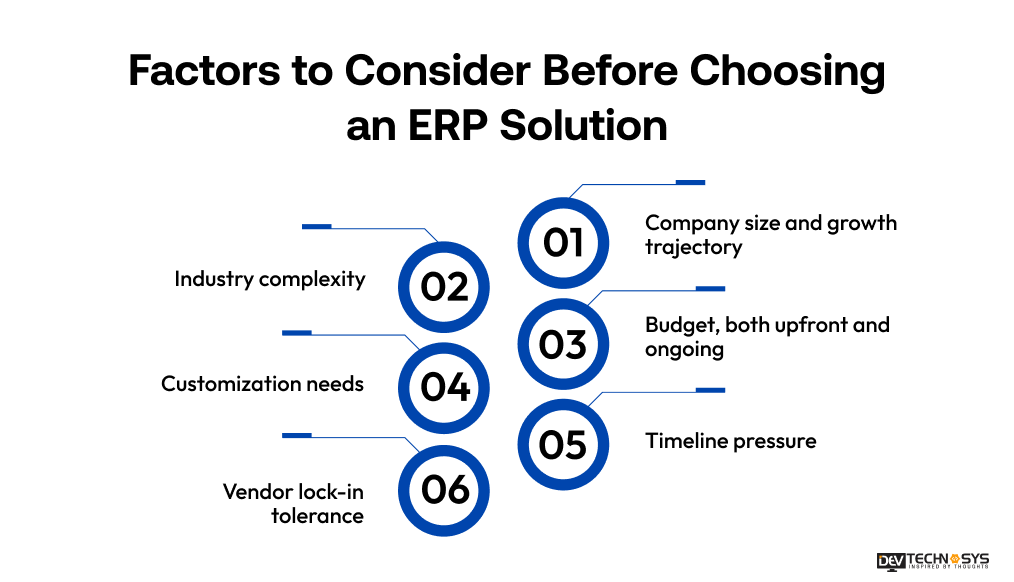
Here are some of the factors you need to consider before choosing the right ERP solution for your business:
1. Company size and growth trajectory
When we talk about company size and growth, a small company with 20 people and a big company with 2,000 people have needs for Enterprise Resource Planning. Small teams can work well with platforms, but bigger companies with many parts need software that can handle all that complexity. We should also think about how the company will grow in the future when we choose an ERP system.
2. Industry complexity
The type of industry is also important. For example, companies that make things, like manufacturers or those in the business, or big retail companies that sell things all around the world need special software like SAP and Oracle. These companies have to follow many rules and manage systems for moving materials and making products, which can be hard for simple platforms to handle.
3. Budget, both upfront and ongoing
We also need to think about the budget. This includes the cost of the software, putting it in place, training people to use it, and the extra costs that often come up when we implement a system. We should budget for the time we will be using the system, not just the cost of the software. This means thinking about the cost of consultants moving to the system, training, and maintenance every year because all these things can add up quickly.
4. Customization needs
If our company does things in a unique way, we might need a system that can be customized to fit our needs. If we do things in a pretty standard way, it might be faster and cheaper to use a system that already exists and just configure it a bit. We should be honest with ourselves about how unique our company is before we decide to pay for a customized system.
5. Timeline pressure
Another thing to consider is how quickly we need the system to be up and running. If we need it to be working in a few months, a system like Odoo or NetSuite might be a better choice than SAP or a customized system. Big systems and customized systems take longer to get started, to configure, and to test.
6. Vendor lock-in tolerance
Finally, we should think about how we are willing to be tied to one vendor. Customized ERP systems and open-source systems like Odoo give us more freedom to make our own choices than systems like SAP or Oracle. If we choose a system that is owned by one company, we have to accept their prices, their schedule for updates, and their timeline for supporting the system, which might not be what we want.
Planning a Blockchain Project?
Get a tailored development cost estimate in a few simple steps.
- 3 quick steps
- 100% free
- Reply in 1 business day
2 Minutes Read
Why Are Businesses Investing in Custom ERP Development in 2026?
As companies move toward new technologies, traditional ERP systems do not always work. These systems are not made for their needs. Even big platforms like SAP, Oracle, and Odoo have many features. They are expensive to change and often require companies to change the way they work.
Custom ERP software is different. It is made specifically for a company’s needs, taking into account the way they work, the rules they have to follow, and what they want to achieve. It also allows companies to connect it to their existing software easily, and it can grow with the company. It is also more secure. The company has full control over it.
A custom ERP system can save companies money in the long run because of the one-time payment, unlike ERP systems that you have to pay for every month. It also gives them the freedom to use technologies like AI, machine learning, and automation.
For companies that want to be more efficient and stand out from the crowd. Using the latest technology, getting a Custom ERP system is a smart decision. In 2026, companies are looking for ERP systems that are made for them and can change as they grow. This helps them grow and get a better return on their investment.
Companies want Custom ERP systems because they want to do things their way. They want systems that can adapt to their needs and help them achieve their goals. Custom ERP systems are the way to go for companies that want to be in control of their technology and their future.
Conclusion
There is no single winner when we talk about custom ERP vs SAP vs Oracle vs Odoo. SAP and Oracle are still the choice for big companies with complicated systems that need a lot of special features. These companies can handle the cost and the time it takes to set up SAP and Oracle.
On the other hand, Odoo is a good choice for small and medium-sized businesses that do not have a lot of money to spend and need to make decisions quickly. Custom ERP is the option for companies that have grown too big for regular software and want to be in charge of their own information and plans.
The right decision comes down to your size, complexity, budget, and appetite for customization-not name recognition. If you need an ERP built entirely around your workflows, Dev Technosys brings custom ERP Software development services to design and scale a system that fits your business exactly.
Frequently Asked Questions
Find answers to the most common questions related to this article.
Odoo, because it has plans that start under thirty dollars per user per month. It also has a free open-source Community edition. So Odoo is generally the cheapest way to get started.
It really depends on the platform. What needs to be done. Implementations for medium-sized businesses often take longer than planned. They usually start with a twelve-month plan. They often end up taking seventeen months or more.
No, they do not. SAP and Oracle have products for small businesses, like SAP Business One and Oracle NetSuite. Their main platforms are designed for large and complex organizations, and they are priced that way.
The main reasons why projects run over budget and past the deadline are data migration and scope creep. These reasons are consistent no matter which platform you choose.