




















Key takeaways:
-
- The main features of Warehouse Slotting Optimization are looking at how fast SKUs move, using heatmaps, trying out ideas with simulation tools, getting suggestions for slots from artificial intelligence, and seamless ERP/WMS integration.
- According to Grand View Research, the global warehouse automation market will be worth USD 59.5 billion by 2030. It will grow by 18.7% every year because more people are using artificial intelligence and automation.
- In the future, Warehouse Slotting Optimization will be done with the help of intelligence, Internet of Things, digital twins, and Autonomous Mobile Robots.
- You should treat warehouse slotting as a continuous optimization process. You must regularly analyze SKU movement. Update slotting strategies and track warehouse KPIs.
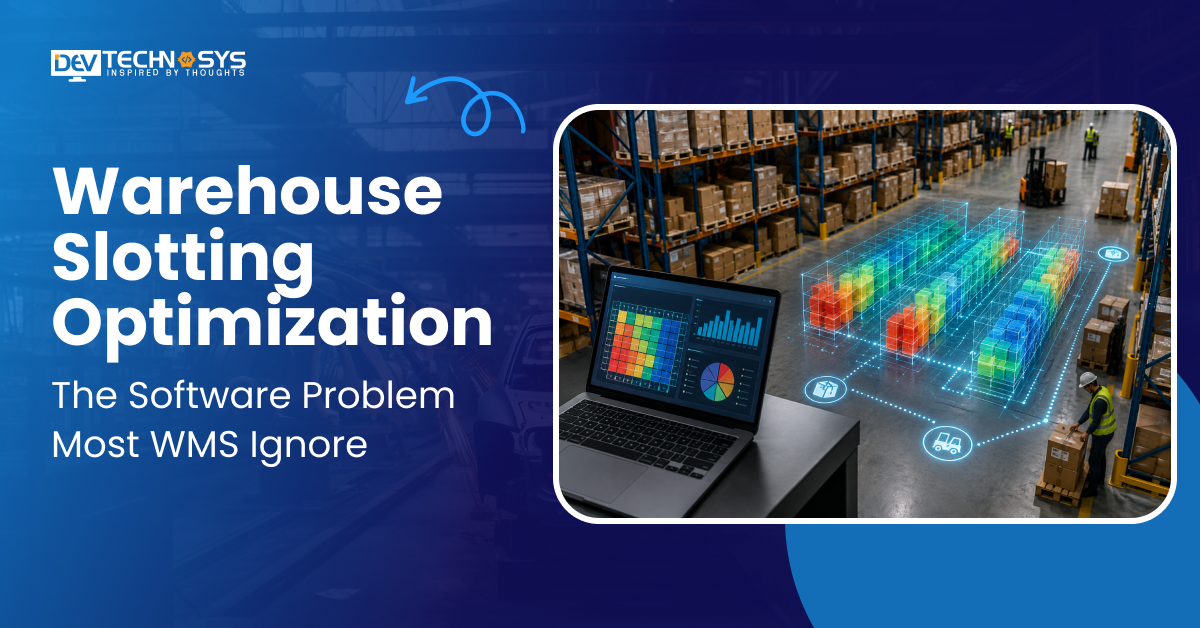
Warehouse Slotting Optimization has become an important part of modern businesses. They help in sorting out the warehouses and keeping the items handy according to demand. Just imagine that in a distribution center, if the pickers have to walk miles just because the high-demand products are kept far behind, and the slow movers have occupied most of the prime spots. This creates nothing but exhaustion for the pickers. Labor costs shoot up, and shipping deadlines are also missed by the businesses, causing them a great loss.
Warehouse Slotting Solutions can transform your chaotic warehouse operations into profitable, efficient fulfillment engines. Businesses investing in asset tracking software development gain better inventory visibility before slotting optimization. To make these strategies more powerful, you can pair them up with modern warehouse slotting software.
In this guide, we have mentioned all the details that every warehouse manager should know: how to optimize warehouse slotting. We have explained what it means, how you can use it, challenges to overcome, features, AI trends, its future, and more.
What is Warehouse Slotting Optimization?
In simple words, warehouse slotting means knowing the optimal storage location for each product in a facility. You can think of it as making a strategic address system for all the products where they are allotted their designated home according to their specific criteria. These criteria include weight, product dimensions, pick frequency, order patterns, and compatibility with other items.
This is an important practice because inefficient warehouse space optimization can create so many operational problems. If the high-demand items are scattered all over the warehouse and stored in hard-to-reach locations, then pickers have to spend more time traveling and less time completing the orders.
Here are some of the common factors that are included:
- Seasonal trends
- Item dimensions and weight
- Order frequency
- Product affinity
- Picking methods
- Product demand and sales velocity
- Replenishment requirements
Planning a Supply Chain Project?
Get a tailored development cost estimate in a few simple steps.
- 3 quick steps
- 100% free
- Reply in 1 business day
2 Minutes Read
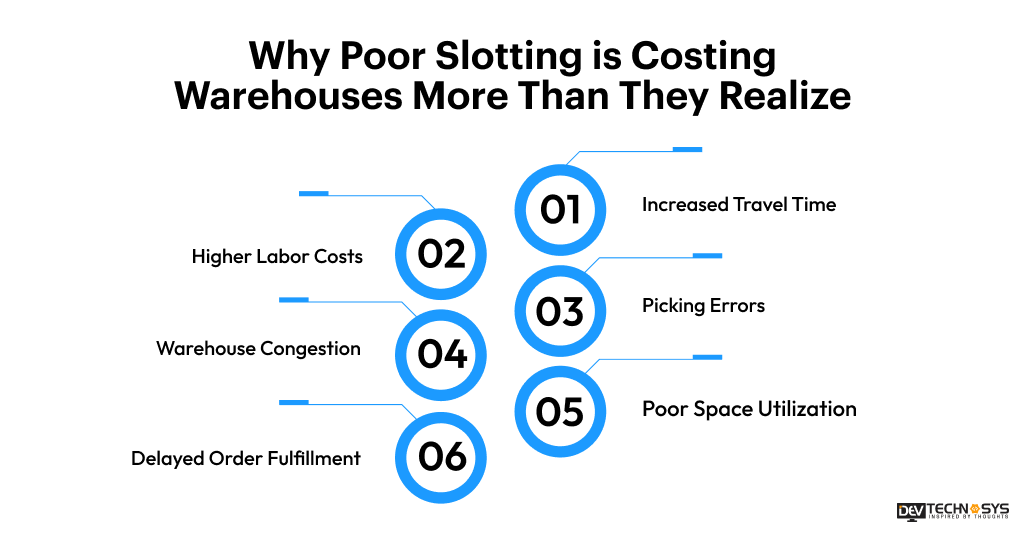
Why Poor Slotting is Costing Warehouses More Than They Realize
The Warehouse management software development company gets affected too much by poor slotting decisions. Even though the effects might not show up, poor product placement leads to high costs over time.
1. Increased Travel Time
Picking is usually the biggest part of warehouse costs. If workers have to walk a lot between places, their productivity drops a lot. Bad slotting can make workers walk further for each order, which means they can pick fewer items in an hour.
2. Higher Labor Costs
Longer distances that workers have to walk mean higher labor costs. Companies might need people just to keep up with the same level of service. If the labor cost is increased then it can also impact on the total cost to build warehouse management software.
3. Picking Errors
When products are stored in places that are confusing or not organized well, it’s easier to make mistakes when picking. Mistakes can lead to returns, unhappy customers, and more costs to fix things.
4. Warehouse Congestion
Products that are picked are often placed in areas that create traffic jams. These jams slow down workers, forklifts, and even automated systems.
5. Poor Space Utilization
Without SKU slotting optimization, warehouses often don’t use their space well. Big areas might be given to products while products that are needed a lot fight for space that’s easy to reach.
6. Delayed Order Fulfillment
Bad layouts in the warehouse make it hard to meet what customers want, like day or next-day delivery. With Order Management System Development, warehouses can improve their delivery time.
Over time, these problems hurt profits, make customers unhappy, and make it harder to grow the business. These are some of the common signs your factory needs WMS: high picking errors, slow fulfillment, poor visibility, excess labor costs, etc.
The Software Problem Most Warehouse Management Systems Ignore
Here’s the uncomfortable truth: most WMS platforms focus on transactions rather than on improvement. They are great at noting when an item moves from Location A to Location B. They struggle to suggest whether it should move there in the first place or indicate that it shouldn’t have been in a location for the last six months.
Several structural reasons contribute to this gap:
1. WMS platforms start as inventory records.
Their main job is to keep an accurate, verifiable list of what’s where. Improvement comes as an additional layer, and many vendors either never included it or created only a basic, rules-driven version.
2. Slotting logic often stops after the initial setup.
Many systems have a slotting process when they go live and then keep the locations unchanged unless someone manually updates them. There’s no system that automatically revisits assignments as activity levels change.
3. Multi-factor optimization is challenging.
Balancing speed, preference, ease of use, and physical limitations at the same time is a complex problem. It’s much simpler to create a system that manages just one factor, usually speed, than to tackle all of them together, which is what most platforms do.
4. Building simulation is costly.
Allowing a manager to test a proposed slotting change using past order data before altering a single physical location requires real modeling capabilities, not just a reporting tool. Few WMS vendors invest in this area since it doesn’t appear as a key feature in a sales presentation.
5. Integration with automation is falling behind.
As warehouses introduce conveyors, AMRs, and goods-to-person systems, slotting logic needs to consider different travel and access rules, which many older WMS platforms can’t adjust to quickly enough.
This is why many businesses partner with companies offering logistics software development services to build custom WMS solutions that include intelligent slotting, AI-powered recommendations, simulation tools, and seamless automation instead of relying solely on traditional warehouse management systems.
Warehouse Slotting Optimization vs Traditional WMS
A Warehouse Management Software and Warehouse slotting optimization software work together. The WMS manages the operations while slotting software analyzes data and recommends optimal product placement strategies.
Feature |
Traditional WMS |
Slotting Optimization Software |
| Inventory Tracking | Yes | Limited |
| Order Management | Yes | No |
| Static Location Rules | Yes | Yes |
| Dynamic Slotting | Limited | Yes |
| Demand Forecasting | Limited | Advanced |
| SKU Velocity Analysis | Basic | Advanced |
| Affinity Analysis | Rare | Yes |
| AI Recommendations | Limited | Yes |
| Simulation Tools | Rare | Yes |
| Continous Optimization | Limited | Yes |
Want a chatbot demo or pricing? Fill the form and talk to our experts today.
Pick what you need below — you can select more than one — then tap Get detail to continue.
-
Chatbot demo dashboard
-
Cost to develop an app
-
Industry report
-
Case study
Modern Warehouse Slotting Strategies
When it comes to optimizing warehouse slotting, there is no approach that works for everyone. The best strategy for a warehouse depends on things like how much a product is in demand, the layout of the warehouse, the characteristics of the products, the types of orders that are being filled, and what the warehouse is trying to achieve.
While some older warehouses use methods that do not change, modern warehouses use different strategies and also use artificial intelligence to make decisions, which helps to make the warehouse run more efficiently.
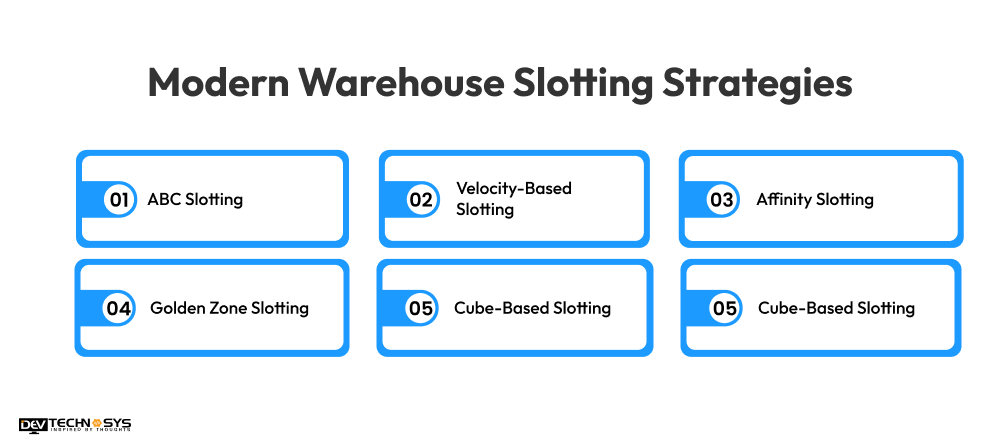
Here are the common warehouse slotting strategies that are used:
1. ABC Slotting
This method groups products into categories based on how they are picked and how important they are to the business.
A-items are products that are picked often and are very important to the business.
B-items are products that are picked regularly. They are not as important as A-items.
C-items are products that are picked rarely and are not as important to the business.
The products that are picked the most, which are the A-items, are stored close to the areas where orders are packed and shipped, which helps to reduce the time it takes to pick and pack orders.
2. Velocity-Based Slotting
This strategy groups products based on how they are sold. The products that are sold quickly are stored in easy-to-reach locations while the products that are sold slowly are stored away.
3. Affinity Slotting
This method stores the products that are often ordered together in the same area. For example, a case for a phone might be stored near the phone chargers and the screen protectors.
By storing the products, the people who pick the orders can do their job more quickly, and the warehouse can run more efficiently.
4. Golden Zone Slotting
The “golden zone” is the area in the warehouse that’s between a worker’s waist and shoulder level. Products that are picked often are stored in this area, which helps to reduce the amount of bending and stretching that workers have to do.
This method not only helps to speed up the picking process, but it also helps to reduce the risk of workers getting hurt on the job.
5. Cube-Based Slotting
This method takes into account the size and the shape of each product when deciding where to store the product. Unlike storing the products based on how often the products are picked, this method makes sure that each product is stored in a space that is the right size for the product.
6. Dynamic Slotting
This method is different from other methods because it uses real-time data to decide where to store products. It takes into account things like how much product is in demand, what time of year it is, how much inventory is on hand, and what orders have been placed in the past.
Market Statistics: Why Warehouse Slotting Optimization Matters
Most warehouses invest in smart warehouse slotting techniques instead of depending on traditional Warehouse Management Systems (WMS). This happens because of the increasing growth of eCommerce, SKU counts, and customer expectations.
The following statistics from Grand View Research explain why warehouse optimization software has now become a priority for businesses:
Market Metric |
Value |
| Market Size (2021) | USD 3.0 Billion |
| Market Size (2025) | USD 3.4 Billion |
| Projected Market Size (2033) | USD 16.0 Billion |
| Forecast Period | 2026–2033 |
| Compound Annual Growth Rate (CAGR) | 21.9% |
| Fastest Growing Region | Asia Pacific |
| Major Growth Regions | North America, Europe, Latin America, Middle East & Africa (MEA) |
| Key End-Use Industries | Transportation & Logistics, Retail, Healthcare, Manufacturing, Food & Beverage, Others |
These trends show that modern warehouses have come a long way and are leaving basic inventory management behind. Most businesses are adopting AI-powered slotting optimization, warehouse automation software, and predictive analytics, instead of traditional WMS platforms, to improve picking efficiency, reduce fulfillment costs, and maximize storage utilization.

AI-Powered Warehouse Slotting: The Future of Warehouse Optimization
A smart warehouse management system combines AI, IoT, and automation to optimize slotting decisions in real time. Rule-based slotting, like “if velocity exceeds X, move to zone A,” works but only reacts to set conditions. AI-driven slotting takes a different route. Instead of sticking to fixed rules, it learns patterns from past order and movement data.
In practice, this looks like:
- Pattern discovery: Identifying subtle links between SKUs, like two accessories that aren’t obviously related but are often bought together, without anyone manually coding that rule.
- Demand forecasting integrated with placement: Understanding the demand during a seasonal spike and placing your inventory in advance will help you a lot at the time of surge. Modern AI inventory management software development enables predictive replenishment, SKU forecasting, and automated stock optimization.
- Continuous recalibration: You should not wait for the quarterly scheduled review; instead, you should refine the customer recommendations automatically as new data is collected.
- Simulated impact scoring: You should keep an idea of the expected effect of a proposed re-slot (including labor hours, travel distance, replenishment load) before moving a single item physically.
Warehouse slottling is as good as the historical one, along with real data feeding it. You can tamper with the hype a little bit. No matter how sophisticated the underlying AI model is, a facility with inconsistent location names, messy inventory records, or gaps in order history will get unreliable recommendations. AI improves the quality of data; it does not replace it.
Key Features to Look for in Warehouse Slotting Software
If you’re evaluating standalone slotting software or a slotting module bundled into a broader WMS optimization, the following capabilities are the ones that actually separate a useful tool from a glorified spreadsheet with a nicer interface.
Feature |
Why it Matters |
| Multi-factor optimization engine | Balances velocity, affinity, ergonomics, and constraints together, not one at a time |
| Real-time data integration | Recommendations reflect current inventory and order activity, not last quarter’s snapshot |
| ERP Integration | Seamless ERP integration services synchronize inventory, purchasing, and warehouse operations |
| Simulation / “what-if” modeling | Lets you test a proposed layout change before committing labor to move anything |
| Configurable rules engine | Reflects your specific constraints — hazmat separation, temperature zones, client-specific rules for 3PLs |
| Actionable move lists | Produces ready-to-execute relocation tasks, not just abstract dashboards |
| Impact-prioritized recommendations | Surfaces the highest-value changes first so teams don’t waste effort on marginal moves |
| Automation-aware logic | Accounts for AS/RS, AMR, and conveyor constraints, not just manual pick paths |
| Reporting on projected gains | Quantifies expected travel-distance and labor-hour savings before implementation |
| Usable interface | Doesn’t require a data scientist or IT ticket to run a re-slotting analysis |
A useful filter question when evaluating vendors: ask them to show you a simulation of a proposed change, not just a report of the current state. If the platform can’t model “what happens if we move these 200 SKUs,” it’s a tracking tool wearing a slotting label.
How to Implement Warehouse Slotting Optimization?
For a Logistics Software Development Company, slotting optimization works well when it is done in phases over time rather than trying to do everything in one weekend. Here are the steps that you can follow to implement the Warehouse Slotting Optimization process:
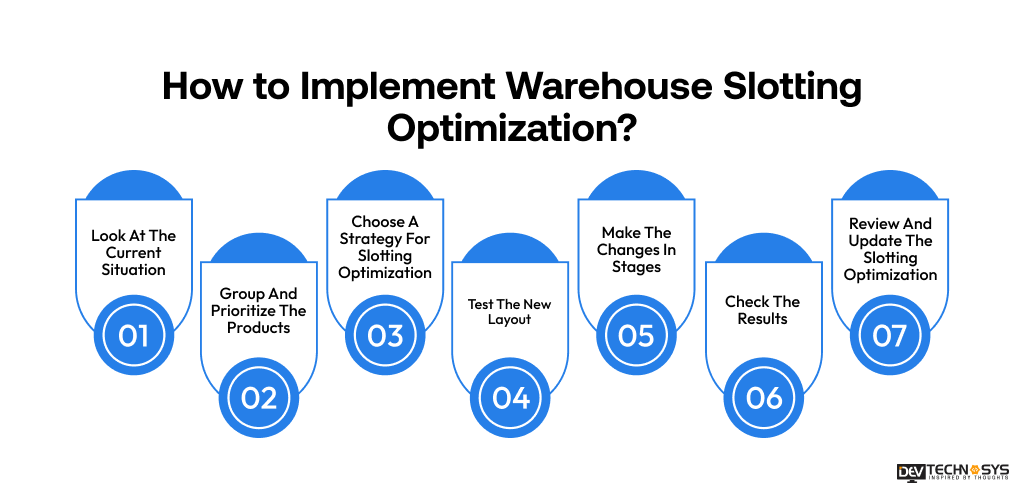
1. Look At The Current Situation
We need to write down where all the products are now, how long it takes to pick them, and how far people have to travel to get them. We also need to find the products that are in the wrong place and fix any problems with the way the products are labeled and recorded. Businesses often develop a barcode reader app to improve inventory accuracy during warehouse audits.
2. Group And Prioritize The Products
We need to look at how products are ordered and how often they are ordered together. We do this by looking at the orders from the past few months. We can then group the products into categories like the popular products, the medium popular products, and the least popular products. We also need to find products that are often ordered together and group them.
3. Choose A Strategy For Slotting Optimization
We need to decide which type of warehouse slotting strategy is best for our business. We can choose from fixed, dynamic, or hybrid slotting optimization. Most businesses that sell products in ways use hybrid slotting optimization.
4. Test The New Layout
If our software allows it, we can test the layout to see how it will work before we actually make any changes. We can use orders to see how the new layout would work. This helps us know if the changes we want to make will actually work.
5. Make The Changes In Stages
We need to start by moving the popular products to better locations. We should do this when it is not busy so we do not disrupt the work. We also need to tell the people who pick the products about the changes before they start work.
6. Check The Results
We need to track how the changes are working. We can do this by looking at how many products are picked per hour, how far people have to travel to pick products, and how many mistakes are made. Many enterprises build barcode asset tracking software to improve SKU visibility and reduce misplaced inventory.
7. Review And Update The Slotting Optimization
The slotting optimization will not stay the same over time. We need to review it every month or every few months. We need to check if the products are still in the places and move them if they are not. We should also try to anticipate when we will be busy, like during holidays, and make changes before it gets busy.
Here is the short overview of how to implement slotting optimization. We have mentioned the primary results according to the different phases.
| Phase | Primary Output |
| Audit | Baseline metrics + data-quality fixes |
| Classify | ABC tiers + affinity map |
| Strategy selection | Fixed/dynamic/hybrid model |
| Simulation | Projected impact of proposed changes |
| Execution | Physical re-slotting, wave-based |
| Measurement | Before/after KPI comparison |
| Ongoing review | Recurring re-slotting cadence |

The Future of Warehouse Slotting Optimization
There are a few things that will change Warehouse Slotting Optimization in the next few years:
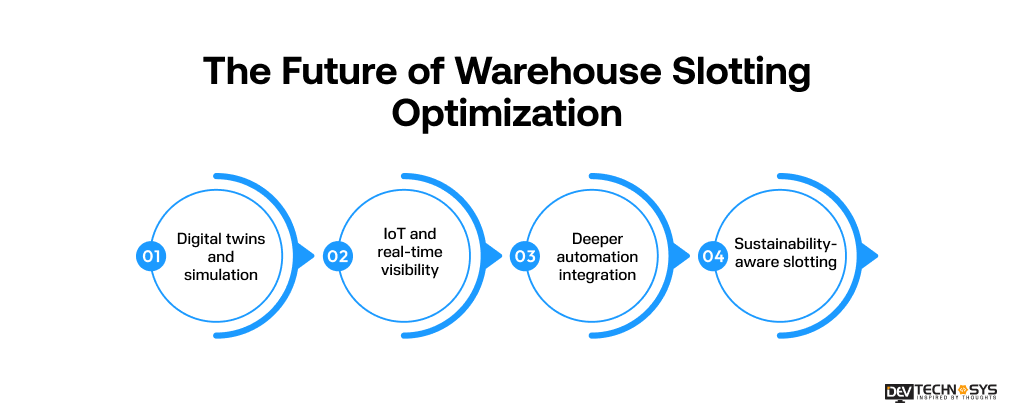
1. Digital twins and simulation
This is like a copy of the actual warehouse. It lets the people in charge try out changes without it affecting the real warehouse.
They can try things like what happens when demand goes up high or when they add new machines.
2. IoT and real-time visibility
This uses sensors and special tags to track what is actually happening in the warehouse. It shows how people are really picking items and how items are moving.
This is better than using ideas of how it should work.
3. Deeper automation integration
As warehouses start using machines like robots and special systems that bring items to people
the way items are stored will have to change.
The rules for how to get to items will be different than when people have to walk to get them.
4. Sustainability-aware slotting
This means that when the warehouse is set up to be as efficient as possible, it will also think about how to use energy and make the machines last longer.
These new things do not replace the ideas of Warehouse Slotting Optimization. If a warehouse does not have the basics right, it will not get the benefits of these things.
Conclusion
Warehouse slotting optimization is one of the impactful improvements that is available for distribution operations. Facilities can get more productivity benefits by positioning inventory in a strategic way, without any major monetary investments. Its main feature lies in understanding the true meaning of warehouse slotting and then applying its strategies accurately with the help of capable technology.
Businesses can reduce travel time, increase the usage of storage, reduce labor costs, and improve picking accuracy just by combining the modern warehouse slotting strategies with AI-powered optimization software.
You may also consider taking Supply Chain Software Development Services from Dev Technosys. We can build custom software solutions for your company that also include a Warehouse Management System and Inventory control platforms.
Frequently Asked Questions
Find answers to the most common questions related to this article.
It means deciding where each product should live in the warehouse and adjusting that over time based on how fast the product sells, the size of the product, what products are related to each other, and how the products need to be handled.
My warehouse management system tracks where the inventory is in the warehouse. It tells me where the inventory should be in the warehouse and recommends changes to make it better.
Most warehouses should re-slot their inventory every month or every quarter. They should also review it before the busy seasons. If a warehouse has a lot of products that are always changing, they may need to re-slot their inventory all the time.
A simple rule-based system works fine for warehouses that do not have a lot of changes in their products. If a warehouse has a lot of products that are always changing, or if the products are related to each other in complex ways, or if the demand for the products is always going up and down, then special software that uses artificial intelligence can be very helpful.
The cost to build warehouse management software typically ranges from $30,000 to $200,000+, depending on the software's complexity, features, integrations, deployment model, and customization requirements.