



















Nowadays, there are many development methodologies available. Right from lean development to agile development, many development approaches are used by developers. But these methodologies have their own merits and demerits. One popular technique is Trunk based development.
Developers created this method by using version control systems and agile practices. Git, which is a distributed version control system, led to the development of the trunk technique.
Trunk-based development allows for continuous software delivery, similar to agile methods. By using this approach in your software development process, you can make things more efficient and launch your product more quickly.
So, let’s begin!
What is Trunk Based Development?
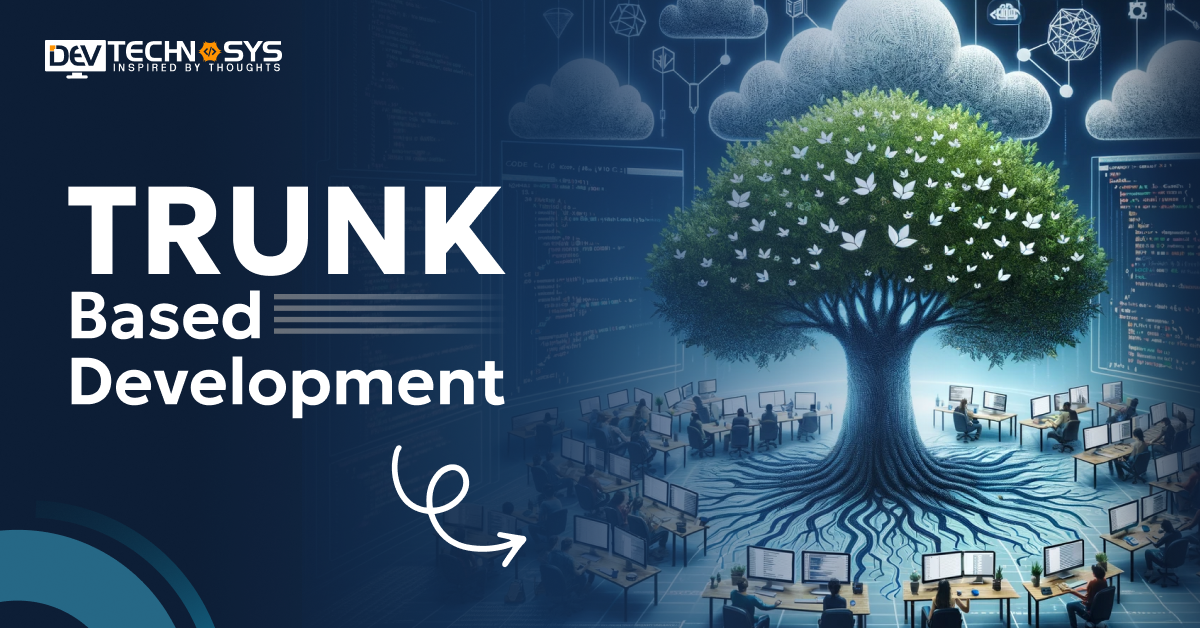
Trunk-based development is a method for handling source code where all team members work in the same branch, known as the “trunk.” Small changes can be bug fixes, changes in code or new feature enhancement.
They do not use long-lasting feature branches. This approach is commonly used in continuous integration workflows. Trunk based development ensures that each team member commits to the main branch at least once every day.
This approach supports continuous integration and ensures that the code can be released at any moment. It is essential for continuous delivery and launch.
How TBD Is Different From Other Development Models?
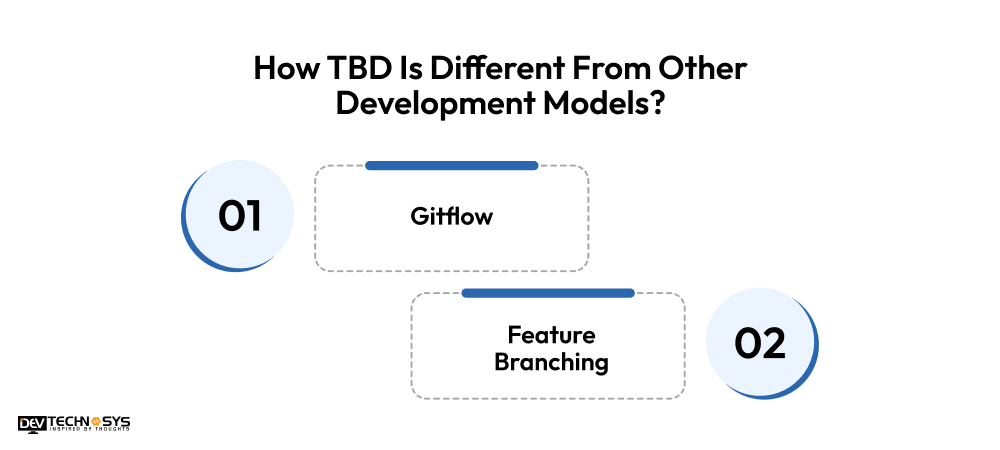
Trunk-based development stands out from other development models in its approach to handling the codebase. A brief comparison can show these differences clearly.
1. Gitflow
Gitflow is commonly used for big projects and has two main branches that last forever: master and develop. New features, fixes, and releases are worked on in separate branches and merged into ‘develop’ or ‘master’ when they are complete. This software development lifecycle approach is sort of distinct from TBD, where every work is done directly on the trunk.
2. Feature Branching
In feature branching, each new function is developed in its own branch, and merging occurs once the feature is finished. This approach can create branches that last a long time, leading to difficult integration issues.
In contrast, github trunk based development focuses on making regular commits to the main branch and only uses short-lived branches for pull requests when reviews are needed before merging.
How Trunk-Based Development Work?
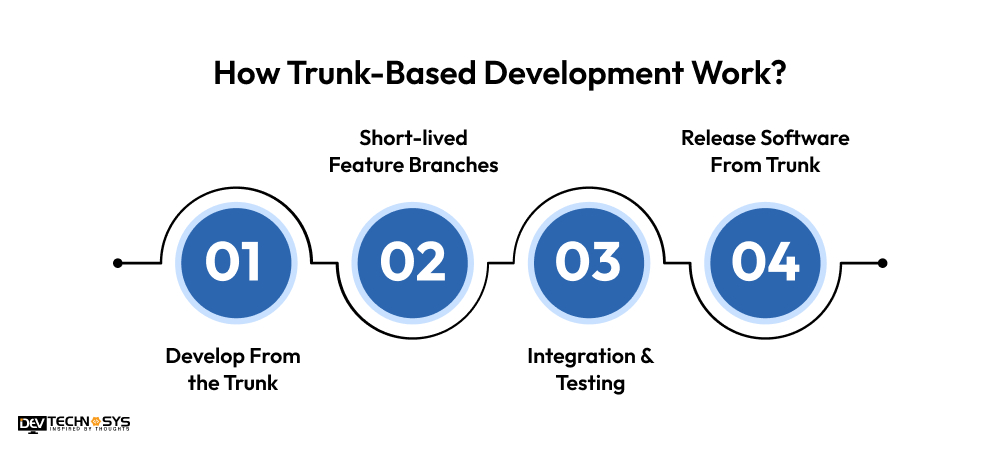
In this section, we will discuss the working process of TBD before you implement it. If you add these steps to your regular workflow, it is vital for mastering trunk-based development. So, let’s check out the working procedure.
1. Develop From the Trunk
Developers start their work with the trunk, the primary branch of the code repository. The whole team uses and adds to this central code base. This shared method links everyone to a common objective.
Software developers review and add their code to the main branch. It assures their contributions align with the project’s goals. This system promotes openness, keeps everyone coordinated, and helps quickly identify any issues with code integration.
2. Short-lived Feature Branches
In trunk-based development, branches are only temporary, unlike in many other development models where they can last for weeks or months. Developers make short-lived branches to work on specific features or fixes and usually merge them back into the main trunk within a day.
Once the work is done, the developer connects into the trunk and deletes it. This approach reduces the chances of merge conflicts and helps keep the codebase clean and organized.
3. Continuous Integration & Testing
Continuous integration is essential for trunk-based development. The software developers for hire frequently add code changes to the trunk, creating a constant demand for CI to make sure these changes do not disrupt the build or clash with other updates.
Automated testing is important in this process, as it evaluates each commit to verify its effectiveness and keep the codebase stable. This approach allows teams to find errors early, making them easier to fix compared to discovering them later in the process.
By integrating work from the trunk, using short-lived feature branches, and applying continuous integration. The trunk-based development boosts rapid feedback, early error identification, and the production of high-quality software.
4. Release Software from Trunk
Trunk-based development differs from other models that create separate branches for releases. Instead, it focuses on the main trunk as the single source of truth for all production releases.
Every commit is potentially ready for release, enabling teams to adapt quickly to market changes and shorten the time from idea to production. This method promotes more flexible and frequent deployments, aligning with the agile development principles that trunk based development emphasizes.
Why is Trunk Based Development Essential?
Trunk-based Development is becoming a popular method among developers around the world. Why is that? Let’s get to know the key advantages of this approach:
● Allows Continuous Code Integration
In trunk-based development, there is a main repository where commits are regularly added to the main branch. By implementing an automated test suite and monitoring code coverage for these commits, continuous integration is achieved. Whenever new code is merged into the trunk, automated tests for integration and code coverage are executed to ensure the quality of the code.
● Ensures Continuous Code Review
Quick, small updates in custom software development help make code reviews faster. With smaller branches, developers can easily spot and check minor changes.
This is much simpler than dealing with a long-lasting feature branch, where a reviewer has to go through many pages of code. They can look over a wide range of code changes manually.
● Enables Consecutive Production Code Releases
Teams need to merge into the main branch often, ideally every day. Trunk-based development aims to keep the trunk branch in a good state, meaning it can be deployed with any commit.
Automated tests, code integration, and code reviews ensure that a trunk-based development project is always ready for production. This enables teams to release updates often and aim for daily production launches.
● Trunk-based Development and CI/CD
As continuous integration and continuous delivery became more popular, branching models improved, resulting in trunk-based development. Today, Git trunk based development is essential for continuous integration.
Developers in continuous integration use trunk-based development and run automated tests after every commit to the trunk. This keeps the project functioning properly at all times.
Best Practices To Implement Trunk-Based Development
To successfully use a trunk-based development strategy, you need to focus on changing the culture, improving processes, and wisely using tools. So, if you want to implement a trunk-based development method, you should first go through the below practices.
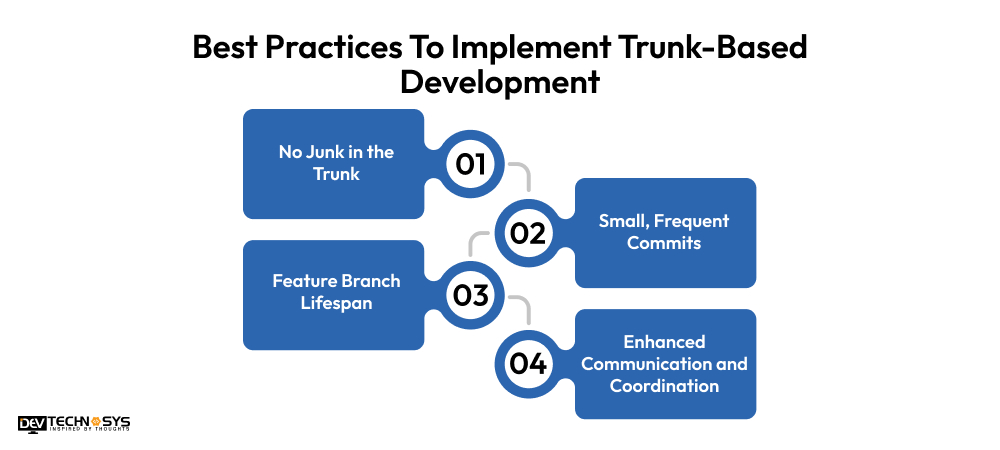
1. No Junk in the Trunk
One thing you can do is make sure the trunk is always easy to launch. It covers strong testing protocols in place and accountability culture. The mobile app developers can maintain your trunk’s health. You must encourage the custom software development company to do tests before carrying out broken links instantly. It will keep the mainline strong and ready for release.
2. Small, Frequent Commits
Just ask the developers to do minor and manageable commits instead of bigger ones. It can minimize the merge intricacy and assist in finding issues faster. If the work is divided into smaller parts, the developers can easily add changes more often. It will provide simple customer reviews and faster issue identification.
3. Feature Branch Lifespan
If feature branches are used just for temporary purposes with TBD, you must assure that it is short-lived to reduce separation from trunk. But if the branch is longer than trunk, the risk can be greater to connect conflicts and integration issues. So, you must make a rule for maximum feature branches age. Also, for updated branches, you must merge it from the trunk.
4. Enhanced Communication and Coordination
You must promote open communication within your team. These software development methodologies assure you to be informed about updates to the main project. It will help you in managing dependencies and avoiding potential issues.
Additionally, regular stand-up meetings or brief check-ins can be extremely beneficial for keeping everyone aligned on current tasks and upcoming changes.
Major Difference Between TBD and Gitflow
In this section, we will discuss the crucial difference between trunk-based methodology development and Gitflow. So, let’s have a look at the trunk based development vs gitflow comparison:
Features |
TBD (Team-Based Development) |
Gitflow |
| Branching Strategy | It mainly focuses on team-based branching. In this, each team has its own feature branches. You can use the main branches for integration and launches. | When developers uses Gitflow method, it comes with a strict set of branches: master, develop, feature, release, hotfix. |
| Workflow | It is more scalable and flexible to distinct team infrastructure and project needs. | It is highly structured and dictatorial. It defines a particular rule for branch development, connecting, and launching. |
| Complexity | Developers find it less hard to implement and handle. | It may be somewhat harder for new team members to understand and apply. |
| Flexibility | It provides an amazing flexibility in terms of branching and merging strategies. | It is less flexible due to its defined branching model. |
| Focus | The main focus of TBD is to focus on team building and effective code integration. | Its main focus is on managing launches and maintaining a stable development environment. |
| Suitable for | It is best suitable for projects that have larger development teams and is more flexible. | It is appropriate for frequent launches and needs a high degree of stability. |

Key Challenges of Trunk-Based Development Approach
TBD, like any good software, implementation, or service, has its pros and cons. Let’s now look at the below challenges of TBD approach.
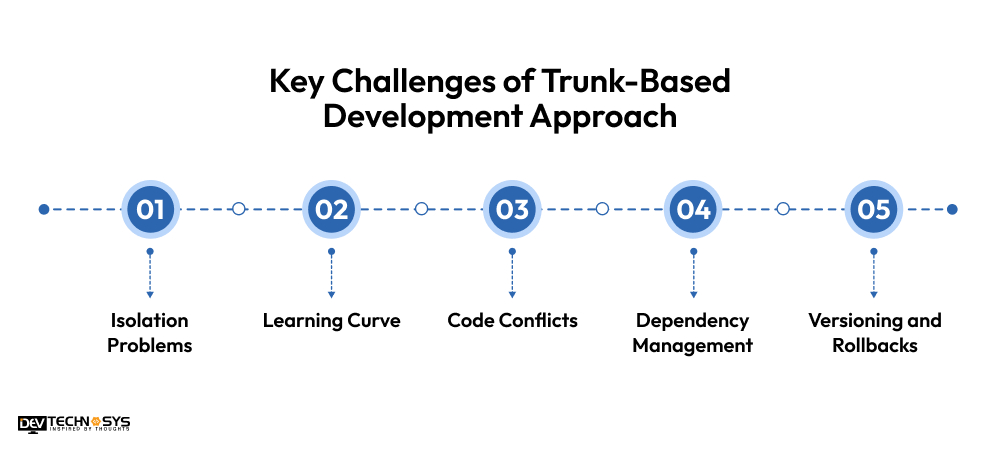
● Isolation Problems
Without feature branches, it can be hard to separate changes for testing before they are added to the main code.
● Learning Curve
It can be tough to understand TBD if you’re not very tech-savvy. To make it easier, consider using training resources like e-books, videos, and support from the community.
● Code Conflicts
If codes are not merged correctly, it can cause conflicts in your main codebase or trunk.
● Dependency Management
Trunk-based development makes it harder to manage dependencies. It is because the software development services provider can’t easily separate different components or features.
● Versioning and Rollbacks
Managing versions and rollbacks can be trickier in TBD. It is especially when several versions are being developed at the same time.
Final Thoughts
Ultimately, the advantages of this technique greatly overcome its drawbacks. The best way to manage source code depends on your team’s needs. If you want to provide top-notch releases to your customers and help smooth teamwork among the software product development company. The simple approach is to adopt this practice in your organization.
However, if you are in need of a flexible software development team that knows project requirements and uses agile methods? At Dev Technosys, we offer in-depth software product development services with a skilled team ready to handle your project swiftly and effectively. So, what are you waiting for? Contact us right away for an amazing solution!
Frequently Asked Questions
1. What is Trunk-Based Development?
Trunk-based development involves each developer breaking their tasks into small parts and merging those parts into the main branch at least once.
2. What Are the Benefits of TBD?
Let’s look at the crucial benefits of trunk-based development approach:
- Enable continuous code integration
- Assure continuous code review
- Enable development code release
- Trunk development and CI/CD
3. What is a Trunk Based Branching Strategy?
It is a branching approach where software developers frequently make minor code updates to a single common branch in the version control system.
4. How To Implement TBD?
If you want to implement trunk-based development, you need to go through the below steps:
- Set up your version control system
- Implement CI/CD
- Build a bespoke automated test suite
- Merge frequently
- Track and address create failures instantly
- Review and iterate