




















Have you ever wondered how flowers get delivered right to someone’s door with just a few taps on a phone?
That’s the magic of an app for flower delivery!
These apps make it super easy for people to order beautiful bouquets for birthdays, anniversaries, or just to make someone smile.
But behind that magic is a lot of work and money.
Key Takeaways:
-
- The cost to develop a flower delivery app ranges from $8,000 to $25,000, with advanced features like product listing, cart, and checkout.
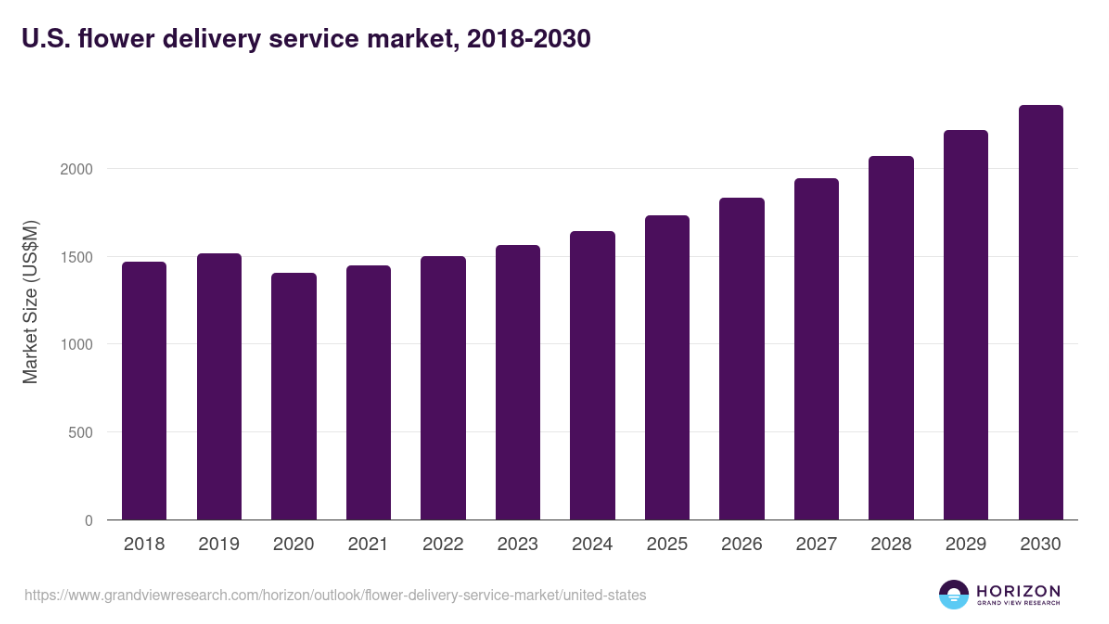
- Revenue in the United States flower delivery service market was 1,644.8 million USD in 2024 and is projected to reach 2,363.3 million USD by 2030.
- Apps like Ferns N Petals, 1-800-Flowers, and Bloom & Wild make flower delivery fun, fast, and beautifully effortless!
- Choose your development model (freelancer, agency, in-house) and location wisely, as they significantly impact hourly rates.
If you’ve ever thought about creating your own flower delivery app, one big question comes up: how much does it cost?
From designing the app to adding features like tracking, payments, and pretty pictures of flowers, everything adds to the price.
In this blog, we’ll explore how much it really cost to develop a flower delivery app, what factors affect the cost, and why it’s worth the investment.
Current and Future Market Projections of Flower Delivery Apps
- The market for flower delivery services in the United States is projected to grow from USD 1,644.8 million in 2024 to USD 2,363.3 million by 2030.
- A compound annual growth rate (CAGR) of4% is anticipated for the U.S. market between 2025 and 2030.
- As per the global analysis, the rose is one of the largest revenue-generating products in 2025.
- With a deep knowledge, tulip has a lucrative product segment in the flower delivery industry during the forecast period.
- In 2024, the United States held a6% revenue share in the worldwide flower delivery service market.
What is the Flower Delivery App?
The flower delivery app is a digital platform that allows users to order flowers, plants, and related gifts for delivery to their doorstep. Users can also send flowers to their recipients directly on same-day delivery or schedule delivery as per their preferences.
It includes many advanced features such as browsing flowers, real-time tracking, online payment options, and loyalty programs. The top flower delivery apps like Forward connect users to local florists to quickly deliver flowers to their specific location, and it is popular for special occasions.
What is the Cost to Develop a Flower Delivery App?
The cost to build a flower delivery app is around $8,000 to $25,000 or higher. The flower delivery app development cost mainly depends on the crucial factors such as the project’s complexity, development team, features, functions, size, infrastructure, deployment platforms, and more.
It has additional development cost factors like security measurements, networking, hardware, testing, designing, and maintenance. Businesses can consult with a professional mobile app development company to receive the exact cost to develop a mobile app.
App Type |
Estimated Cost |
Estimated Timeframe |
| Simple App Development | $8,000 – $12,000 | 2 to 4 Months |
| Medium App Development | $13,000 – $18,000 | 4 to 6 Months |
| Premium App Development | $25,000+ | 8+ Months |
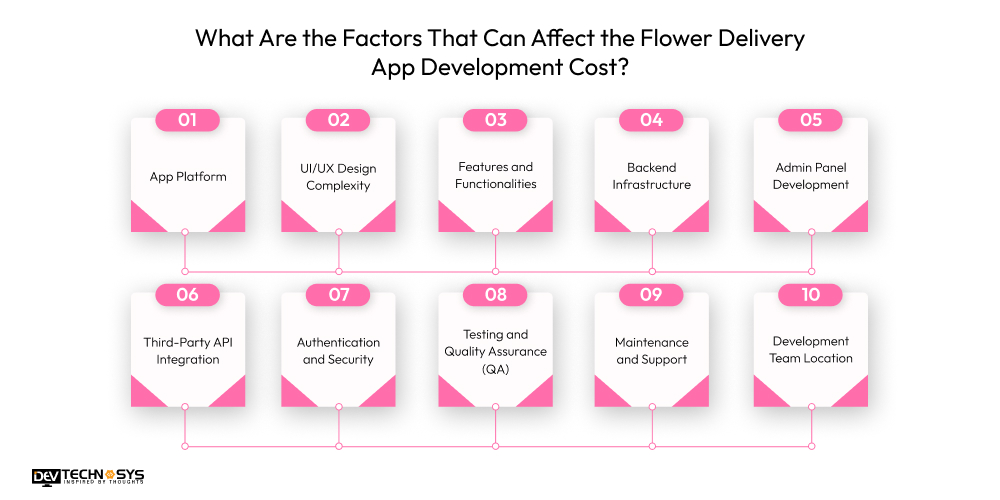
What Are the Factors That Can Affect the Flower Delivery App Development Cost?
Before starting your project, you must be aware of the cost-affected factors. There are crucial factors that have a high impact on the overall cost to develop a flower delivery app. Let’s determine which factors can most significantly impact your project cost.
1. App Platform
The app platform is one of the common cost-affected factors. There are different costs for each factor, and it can influence the overall flower delivery app development cost. If businesses choose cross-platform, which means an app that works on both platforms, such as Android and iOS, then it can increase the cost to create a flower delivery app.
Therefore, select the app platforms according to your project requirements and personal preferences.
Platform |
Estimated Cost Range |
| Android Only | $10,000 – $20,000 |
| iOS Only | $10,000 – $22,000 |
| Cross-Platform | $15,000 – $30,000 |
| Web App (PWA) | $8,000 – $15,000 |
2. UI/UX Design Complexity
UI/UX design defines how users interact with the app. Costs increase with custom animations, branding, interactive elements, and responsive layouts. A basic design is affordable, but an advanced, polished UI with prototyping and user testing significantly raises the cost to build a flower delivery app.
Investing in great design improves customer satisfaction, retention, and overall usability, making it a critical factor in app success.
Design Level |
Estimated Cost |
| Basic | $1,500 – $4,000 |
| Medium | $4,000 – $8,000 |
| Custom/Advanced | $8,000 – $15,000 |
| With Animation | +$2,000 – $5,000 |
3. Features and Functionalities
The number and complexity of features greatly impact the cost of flower delivery app development solutions. Core features include product catalogs, cart, checkout, payments, delivery tracking, and user profiles. Advanced features like personalized suggestions, real-time chat, and order scheduling require more development.
More features mean increased development time, integration needs, and testing. Prioritizing features for MVP versus full version helps control costs while meeting user expectations.
Feature |
Estimated Cost |
| User Registration/Login | $1,000 – $3,000 |
| Flower Catalog & Filters | $2,000 – $5,000 |
| Cart & Checkout | $2,000 – $4,000 |
| Payment Gateway Integration | $2,000 – $5,000 |
| Real-time Tracking | $3,000 – $7,000 |
| Push Notifications | $800 – $2,000 |
4. Backend Infrastructure
Backend systems manage app logic, database, APIs, authentication, and server communication. The complexity of the backend influences the cost to create a flower delivery app; scalable, secure systems that handle real-time updates or large user volumes are more expensive.
Choosing cloud platforms (AWS, Firebase, etc.) can help scale efficiently, but adds to infrastructure cost. Strong backend design ensures the app functions smoothly, reliably, and securely over time.
Backend Service Type |
Estimated Cost |
| Basic Cloud Backend | $3,000 – $6,000 |
| Scalable Server Architecture | $6,000 – $12,000 |
| Admin Dashboard | $2,000 – $5,000 |
| API Integration | $2,000 – $6,000 |
5. Admin Panel Development
An admin panel allows owners to manage products, users, orders, payments, and reports. Costs depend on panel complexity; basic dashboards cost less, while advanced panels with analytics, automation, and support tools are pricier.
A well-designed admin interface improves business efficiency by centralizing control and insights. Building a custom panel offers flexibility but adds to mobile application development services and design efforts.
Admin Feature |
Estimated Cost |
| Basic Analytics | $1,000 – $3,000 |
| Order Management | $2,000 – $4,000 |
| Customer Support Tools | $1,500 – $3,000 |
| Promo & Discount Manager | $1,000 – $2,500 |
6. Third-Party API Integration
APIs enhance functionality by connecting external services like payment gateways, SMS, maps, and email tools. Integration complexity varies, simple plug-ins are cheaper, while APIs with custom data handling or security compliance require more work.
Common APIs include Stripe, PayPal, Google Maps, and Twilio. These integrations save time compared to custom development but increase costs based on quantity, type, and required configurations.
API Type |
Estimated Cost |
| SMS Gateway (Twilio, etc.) | $500 – $1,500 |
| Payment (Stripe, PayPal) | $1,500 – $3,500 |
| Email (Mailchimp, etc.) | $500 – $1,200 |
| Shipping Partner API | $2,000 – $4,000 |
7. Authentication and Security
Security ensures data privacy and app reliability. Basic authentication uses email/password, but advanced options like social login, two-factor authentication, or biometric login cost more. Encrypting sensitive data, using secure APIs, and complying with GDPR or PCI-DSS add to the cost of Android app development services.
Strong security builds user trust, protects business integrity, and minimizes legal risks, making it a non-negotiable investment.
Feature |
Estimated Cost |
| SSL Implementation | $500 – $1,000 |
| OAuth & Social Login | $1,000 – $2,000 |
| Two-Factor Authentication | $1,500 – $3,000 |
| Data Encryption | $1,000 – $2,500 |
8. Testing and Quality Assurance (QA)
QA ensures the app functions without bugs across devices and platforms. It includes manual testing, automated testing, performance checks, and security assessments. A thorough QA process increases time and cost but avoids post-launch failures. As features grow, so does testing complexity. Investing in QA leads to a smoother user experience, better reviews, and lower maintenance needs after release.
QA Type |
Estimated Cost |
| Manual Testing | $2,000 – $4,000 |
| Automated Testing | $3,000 – $7,000 |
| Performance Testing | $1,500 – $3,500 |
9. Maintenance and Support
After launch, ongoing maintenance includes fixing bugs, updating OS compatibility, improving features, and handling customer issues. Basic support costs less, while continuous development or major upgrades require a dedicated team.
Ignoring maintenance leads to poor performance and user churn. A clear post-launch plan, including regular updates and monitoring, ensures long-term app stability and user satisfaction, influencing overall cost to create a flower delivery app.
Maintenance Plan |
Estimated Annual Cost |
| Basic (Bug Fixes) | $3,000 – $5,000 |
| Standard (Minor Updates) | $5,000 – $8,000 |
| Premium (Full Support) | $8,000 – $12,000 |
10. Development Team Location
Developer location affects hourly rates and total cost. Teams in the U.S. or Western Europe charge more than those in Eastern Europe or Asia. However, lower cost doesn’t always mean lower quality; many skilled developers operate globally.
Hire mobile app developers who involve balancing price, experience, communication, and reliability. Outsourcing offers affordability, while local teams may offer closer collaboration and timezone advantages.
Region |
Hourly Rate |
Full Project Cost (Est.) |
| USA/Canada | $50 – $100/hr | $40,000 – $70,000 |
| Western Europe | $45 – $75/hr | $30,000 – $50,000 |
| Eastern Europe | $40 – $65/hr | $30,000 – $45,000 |
| India/Southeast Asia | $15 – $25/hr | $8,000 – $22,000 |

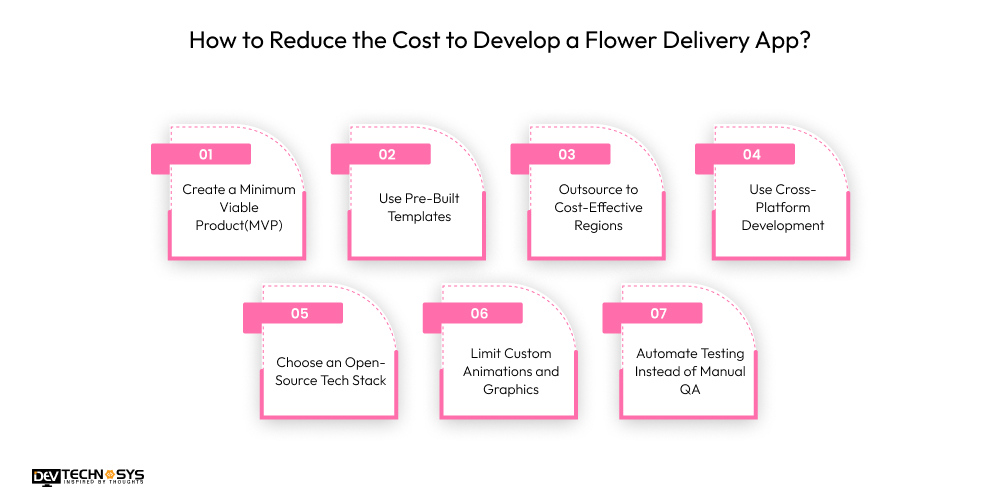
How to Reduce the Cost to Develop a Flower Delivery App?
Do you want to build a flower delivery Android app within a fixed budget? Then this section is for you. To reduce the flower delivery app development cost, you must take care of a few factors and apply some new ways when developing an app. So, let’s take a look at the following points:
1. Create a Minimum Viable Product(MVP)
Build only the core features your users need, such as product browsing, ordering, and payment, to launch quickly and test market demand. Avoid over-engineering; add advanced functionality later based on real user feedback and behavior. This reduces the initial time and cost of flower delivery app development services.
Feature |
Full Product Cost |
MVP Cost |
Cost Reduction |
| User Registration/Login | $3,000 | $2,000 | $1,000 |
| Flower Catalog & Filters | $6,000 | $3,000 | $3,000 |
| Order Placement & Checkout | $5,000 | $3,000 | $2,000 |
| Total | $14,000 | $8,000 | $6,000 |
2. Use Pre-Built Templates
Instead of designing every screen from scratch, use professionally designed UI kits or app templates. These are customizable, mobile-responsive, and significantly speed up the design and development process. This approach cuts design costs, shortens time to market, and ensures UI consistency with minimal effort.
Component |
Custom Design |
Template-Based |
Cost Reduction |
| Home Page UI | $2,000 | $800 | $1,200 |
| Product Detail Page | $1,500 | $600 | $900 |
| Cart & Checkout UI | $2,000 | $800 | $1,200 |
| Total | $5,500 | $2,200 | $3,300 |
3. Outsource to Cost-Effective Regions
Hire dedicated developers from countries with lower labor costs, such as India, Eastern Europe, or Southeast Asia. These regions offer high-quality work at a fraction of Western rates. Ensure good communication practices and clear documentation to maintain productivity and app quality across time zones.
Role |
In-House (US) |
Offshore (India) |
Cost Reduction |
| Mobile App Developer | $30,000 | $10,000 | $20,000 |
| Backend Developer | $20,000 | $7,000 | $13,000 |
| UI/UX Designer | $10,000 | $4,000 | $6,000 |
| Total | $60,000 | $21,000 | $39,000 |
4. Use Cross-Platform Development
Instead of building separate iOS and Android apps, use frameworks like Flutter or React Native to build one codebase that works on both platforms. This approach halves development effort, simplifies maintenance, and ensures simultaneous feature updates across devices, saving both cost to make a flower delivery app.
Platform Type |
Native (iOS + Android) |
Cross-Platform (Flutter/React Native) |
Cost Reduction |
| Development Cost | $40,000 | $25,000 | $15,000 |
| Maintenance & Updates | $10,000/year | $6,000/year | $4,000 |
| Total | $50,000 | $31,000 | $19,000 |
5. Choose an Open-Source Tech Stack
Adopt widely supported open-source tools, frameworks, and libraries, like Node.js, PostgreSQL, or Firebase. These tools are free to use and backed by large developer communities. This reduces licensing costs, speeds up development, and gives your team access to a wide pool of reusable components.
Feature |
Custom API Cost |
Third-Party API Cost |
Cost Reduction |
| Payment Integration (Stripe) | $5,000 | $1,500 | $3,500 |
| Delivery & Map Tracking | $4,000 | $1,000 (Google Maps) | $3,000 |
| SMS/Email Notifications | $2,000 | $500 (Twilio/Mailgun) | $1,500 |
| Total | $11,000 | $3,000 | $8,000 |
6. Limit Custom Animations and Graphics
Fancy UI animations and custom illustrations increase the cost to create a mobile app. Stick to clean, functional, and minimal design using standard components. This not only saves on design and development resources but also improves app performance and user experience across all devices.
Aspect |
Manual QA |
Automated Testing |
| Testing Time/Release | 40–60 hours | 10–20 hours |
| Initial Cost | $0–$500 | $1,500–$2,500 |
| Monthly Cost | $2,000–$3,000 | $500–$1,000 |
| Bug Detection Speed | Slower | Faster |
| Long-Term Savings | Low | High |

7. Automate Testing Instead of Manual QA
Use automated testing tools like Selenium, Appium, or Detox to handle repetitive test cases. Automation reduces the need for manual QA, catches bugs early, and ensures consistent performance across updates. While there’s some upfront setup, it saves significant cost to make a flower delivery app.
Aspect |
Custom Design |
Standard UI |
| Design Cost | $4,000–$7,000 | $1,500–$2,500 |
| Development Time | 4–5 weeks | 1–2 weeks |
| Performance | May be slower | Faster & smoother |
| Maintenance | High | Low |
| Cost Savings | Low | High |
What is the Cost to Maintain a Flower Delivery App?
The cost to maintain a flower delivery app typically ranges from $1,500 to $5,000 per month, depending on complexity, user base, and feature updates. This includes bug fixes, server hosting, third-party API fees (like payment or maps), OS compatibility updates, and occasional UI/UX improvements.
Apps with real-time features, custom dashboards, or integrated logistics may incur higher costs. Proactive maintenance ensures smooth performance, user satisfaction, and security compliance over time, making it a crucial long-term investment.
Maintenance Item |
Estimated Monthly Cost (USD) |
| Bug Fixes & Updates | $500 – $1,500 |
| Server Hosting | $100 – $500 |
| Third-Party APIs (e.g., Maps, Payments) | $100 – $800 |
| OS & Device Compatibility | $200 – $700 |
| Security & Performance Monitoring | $100 – $500 |
| UI/UX Improvements | $200 – $1,000 |
| Customer Support Tools | $100 – $300 |
| Total Estimated Cost | $1,500 – $5,000 |
What Type of Tech Stacks Are Used to Make a Flower Delivery App?
Choosing the right tech stack is crucial for building the best flower delivery app. Common technologies include React Native or Flutter for mobile, Node.js or Django for backend, and Google Maps for real-time tracking integration.
Component |
Technology Options |
Description |
| Frontend (Mobile) | React Native, Flutter, Swift (iOS), Kotlin (Android) | Frameworks/languages for building cross-platform or native mobile apps. |
| Backend | Node.js, Django (Python), Ruby on Rails, Laravel (PHP) | Server-side frameworks for handling app logic, APIs, and business rules. |
| Database | MongoDB, PostgreSQL, MySQL, Firebase Realtime DB | Databases for storing user, order, and product information. |
| Real-Time Tracking | Google Maps API, Mapbox, OpenStreetMap | APIs for location tracking, routing, and map integration. |
| Payment Integration | Stripe, PayPal, Razorpay, Braintree | Secure payment gateways for processing transactions. |
| Push Notifications | Firebase Cloud Messaging (FCM), OneSignal | Services for sending real-time updates and notifications. |
| Cloud Hosting | AWS, Google Cloud Platform, Microsoft Azure | Cloud providers for hosting backend and storage solutions. |
| Authentication | Firebase Auth, OAuth 2.0, Auth0 | Secure user login and identity management services. |
| Analytics | Google Analytics, Mixpanel, Firebase Analytics | Tools to track user behavior and app performance. |
How AI Can Improve the Operations of a Flower Delivery App?
- AI analyzes customer preferences and purchase history to suggest personalized flower arrangements, increasing customer satisfaction and boosting sales through tailored shopping experiences.
- AI-powered algorithms optimize delivery routes based on traffic and weather, reducing delivery times and fuel costs, improving efficiency and customer satisfaction.
- AI forecasts demand trends to help florists manage inventory better, minimizing waste and ensuring fresh flowers are always available for timely delivery.
- AI chatbots provide instant responses to customer queries, handle orders, and resolve issues 24/7, improving service without increasing support staff.
- AI analyzes market trends and demand fluctuations to adjust pricing dynamically, maximizing profits during peak times and offering discounts when needed.
- AI-powered image recognition can assess flower quality before shipment, ensuring only fresh, high-quality bouquets reach customers, enhancing brand reputation.
How to Make Money From Flower Delivery Applications?
Developing a top flower delivery app is an excellent decision, but how can you make money from this app? There are various ways that can help you make huge money from these applications. So, let’s take a look at the best money-making strategies:
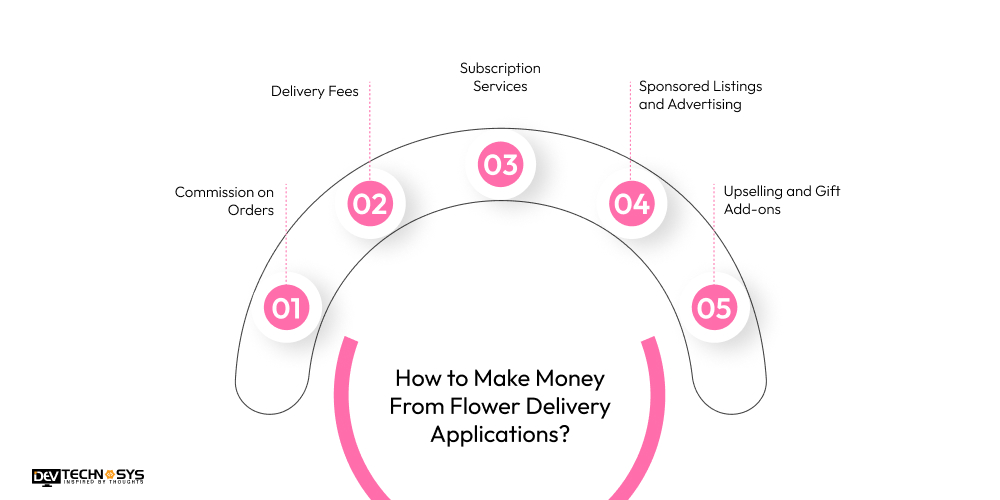
1. Commission on Orders
Charge a commission fee on every flower purchase made through your app. By partnering with local florists and handling order processing, your platform earns a percentage of each sale. This model incentivizes you to increase orders while providing a seamless experience for customers, creating a steady, scalable revenue stream.
2. Delivery Fees
Incorporate delivery charges into customer orders to cover transportation costs and generate profit. Offering different delivery options like standard, express, or same-day services can justify higher fees. These fees help cover expenses while adding an extra income source, ensuring that the app’s logistics remain profitable and customers receive timely flower delivery.
3. Subscription Services
Create subscription plans offering regular flower deliveries, such as weekly or monthly bouquets. Subscribers pay a fixed fee, providing consistent, recurring revenue. This model boosts customer loyalty and improves cash flow predictability, helping your business grow steadily while meeting the demand for fresh, scheduled floral arrangements.
4. Sponsored Listings and Advertising
Allow florists to pay for premium placement or advertisements within the app. Sponsored listings increase florist visibility, driving more sales for them and generating advertising revenue for you. According to the mobile app development company, monetizing ad space adds a lucrative income stream beyond commissions, benefiting both your platform and the florists.
5. Upselling and Gift Add-ons
Encourage customers to enhance their flower orders with extras like chocolates, greeting cards, vases, or gift wrapping. Offering premium bouquets and add-on options raises the average order value, increasing overall profits. Upselling enhances the customer experience while maximizing each transaction’s revenue potential for your app.
Conclusion
The cost to develop a flower delivery app varies based on features, design complexity, and platform choice. Hiring a reliable flower delivery app development company ensures quality, timely delivery, and a smooth user experience, which are crucial for success. While initial investment can be significant, a well-built app attracts customers and generates revenue through multiple streams.
Careful planning with the right development partner helps balance budget and functionality, making your flower delivery business competitive and scalable in the growing market. Choose experienced developers to maximize your app’s potential.
Frequently Asked Questions
Q1. How Much Does It Cost To Develop A Flower Delivery App?
The cost to develop a flower delivery app lies between $8,000 and $25,000, depending on features, design, platform, and developer rates. Costs increase with advanced functionalities like real-time tracking, in-app payments, and custom user interfaces.
Q2. How Long Does it Take to Create A Flower Delivery App?
To create a flower delivery app, it usually takes 3 to 6 months, depending on complexity, features, and development team size. Basic apps take less time, while advanced versions with custom features may require longer.
Q3. What is the Cost to Hire Flower Delivery App Developers?
The cost to hire flower delivery app developers is around $15 to $25 per hour. The hiring cost mainly depends on various factors such as experience level, project complexity, skill set, developers’ living location, and more.
Q4. Does Adding Advanced Features Like Real-Time Tracking Increase The Cost?
Yes, adding advanced features like real-time tracking significantly increases development costs. These features require GPS integration, backend support, and live data processing, which involve more development time, testing, and infrastructure, making the overall flower delivery app more expensive to build.
Q5. What Are The Hidden Costs Of Flower Delivery App Development?
Hidden costs of flower delivery app development may include app store fees, server hosting, third-party API subscriptions, maintenance, updates, customer support, and marketing expenses. These ongoing costs are essential to keep the app functional, secure, and competitive post-launch.
Q6. What Is The Best Way To Estimate The Total Project Cost?
The best way to estimate the total project cost is to consult a reputable flower delivery app development company. Provide detailed requirements, desired features, and design preferences to receive a customized quote that accurately reflects development, testing, deployment, and maintenance expenses.
Q7. How Do I Reduce App Development Costs Without Sacrificing Quality?
To reduce app development costs without sacrificing quality, prioritize essential features, start with a Minimum Viable Product (MVP), use cross-platform frameworks like Flutter or React Native, and choose experienced developers. Clear communication and iterative testing also help avoid costly revisions later on.