











Developing AI products is all thrilling and fun, but only if you dive in with proper validation. MVP exists to prevent any costly mistake from occurring due to diving into complex AI solutions without proper planning, unlike Traditional MVPs, which prioritize main crucial functionalities to test and ensure that your project is fit for the market. Deciding to develop an AI MVP is a smart move because a data-driven MVP can meaningfully address the actual issue, even at the simple level.
An AI-based MVP creation can offer a golden opportunity for entrepreneurs, solo founders, and enterprise innovation teams. It allows them to test their hypothesis, understand user preferences and behavior, and dig out important data with minimum resource investment. The rapid evolution of AI tools from large language models to vision-based systems makes development of a powerful AI minimum viable product faster and more efficient.
Key takeaways:
-
- The AI market is projected to reach $407 billion by 2027 (Source: MarketsandMarkets).
- AI startups with MVPs raise 2x more seed funding than non-AI startups due to higher investor interest.
- AI MVPs allow businesses to validate ideas in 6–12 weeks, compared to 4–6 months traditionally
- Most successful AI MVPs fall into categories like healthcare, fintech, e-commerce, and SaaS tools.
This AI MVP guide will take you on an insightful journey about how to develop an AI MVP from figuring out problems to making a simple interface, and defying the success metrics. If you are a business considering building a minimum viable AI product, then this blog is for you. So without further ado, let’s jump in!
What is a Minimum Viable Product?
Before learning about ‘how to create AI MVP’, let’s first learn what MVP stands for. A minimum viable product (MVP) is the most basic version of a product that can be launched to early adopters to gather feedback and validate a product idea.
Whether Android app development or iOS app development, an MVP plays a crucial role. It’s a strategy that focuses on quickly testing a product’s core functionality with a limited set of features, minimizing development costs and maximizing learning about user needs.
Core Concepts of an MVP are:
- Minimum: In order to be viable and functional for early users, the AI minimum viable product contains less features.
- Viable: Enough functionality allows customers to grasp the main selling point and offer helpful feedback.
- Product: The product may be a basic app, website, or even an actual product.
Why Does MVP Matter?
Minimum Viable Product (MVP) helps businesses quickly validate their ideas with more cost-efficiency. It is beneficial to develop an AI MVP because:
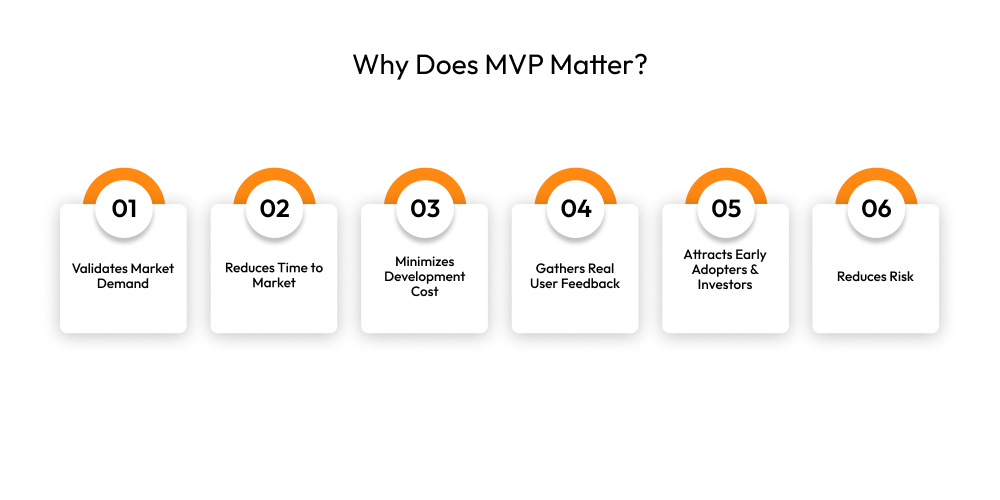
1. Validates Market Demand
An MVP plays an important role as it allows businesses to test their AI product idea with real users before investing heavily in full development. This helps ensure there is actual demand.
2. Reduces Time to Market
Releasing a basic and simplistic version allows businesses to enter the market faster, learn early, and adapt based on user feedback.
3. Minimizes Development Cost
In an MVP, you need to develop an AI MVP with only the core features first. It is cost-saving and helps avoid unnecessary investment in features users might not need.
4. Gathers Real User Feedback
An MVP can help businesses understand the way users interact with your product, what they love, and what needs improvement, all based on real usage data.
5. Attracts Early Adopters & Investors
Create a mobile app MVPs that will give you a working product to showcase to investors and potential users, making it easier to secure funding or build a community.
6. Reduces Risk
According to a top blockchain MVP development company, by identifying flaws and pivoting early, MVPs reduce the risk of releasing an AI product in the market.
Difference Table Between AI MVP and Traditional MVP With Real-World Examples
Before learning how to create an AI MVP, let’s see how AI MVP is different from traditional MVPs:
Aspect |
AI MVP |
Traditional MVP |
Real-World Example |
| Definition | A minimum viable product to build an AI Agent leverages AI algorithms for automation or prediction. | A basic version of a product with core functionalities to validate an idea. | AI: Replika (AI chatbot), Traditional: Dropbox MVP |
| Core Technology | Uses machine learning, NLP, or computer vision for core functionality. | Relies on manual workflows or basic code logic. | AI: Grammarly’s early AI spellcheck, Traditional: Airbnb’s basic listing website |
| Development Time | Longer due to the need for data training, model testing. | Comparatively shorter. | AI MVPs often take 2–3 months minimum. |
| Cost | Higher (due to AI model development, testing, infrastructure). | Lower (simpler architecture). | AI: $20k–$80k+, Traditional: $5k–$30k |
| Data Dependency | Requires quality and large volumes of data. | Less data-dependent at MVP stage. | AI: Spotify’s recommendation engine |
| User Personalization | High personalization through predictive algorithms. | Limited personalization. | AI: Netflix content suggestions |
| Testing Approach | Includes model validation, A/B testing, accuracy metrics. | Focuses on usability, UX feedback, and bug testing. | AI: ChatGPT prompt testing, Traditional: early Uber app testing |
| Scalability Potential | Very high if trained and deployed correctly. | Medium – usually enhanced in later versions. | AI: Google Assistant, Traditional: Trello MVP |
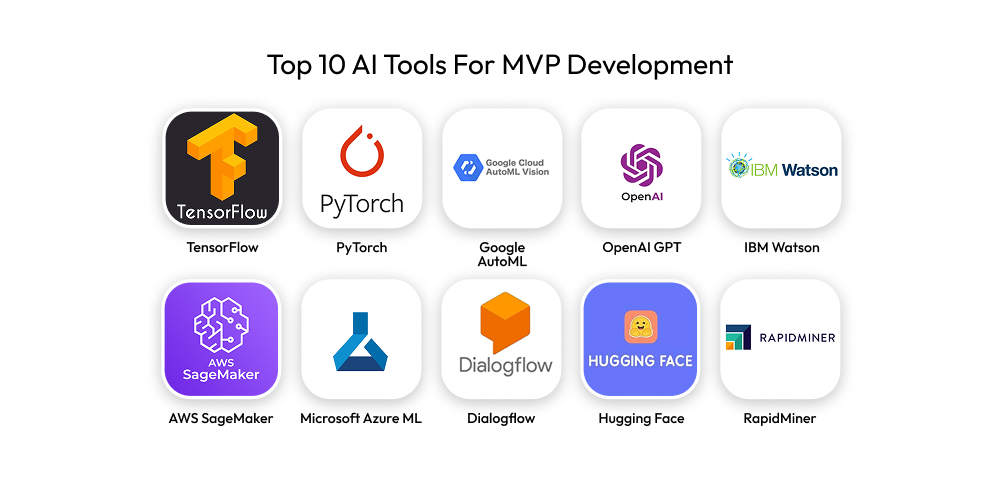
Top 10 AI Tools For MVP Development
Here are the top 10 AI tools that can help businesses build an MVP for their project. It is advisable to consult a leading Android application development company to understand more about these technologies and how these will benefit your business. Let’s take a look:
Tool |
Primary Use |
Key Benefits |
| TensorFlow | Machine learning & deep learning models | Open-source, highly flexible, scalable |
| PyTorch | Deep learning model development | Dynamic computation graph, easy debugging |
| Google AutoML | Custom ML model creation without coding | User-friendly, cloud-integrated |
| OpenAI GPT | Natural language processing (NLP) tasks | Advanced language understanding & generation |
| IBM Watson | NLP, visual recognition, and chatbot services | Enterprise-ready, scalable, secure |
| AWS SageMaker | End-to-end ML model development | Integrated with AWS, scalable infrastructure |
| Microsoft Azure ML | Machine learning model deployment | Drag-and-drop interface, secure deployment |
| Dialogflow | Chatbot and voice assistant development | Integrates with Google Assistant, NLP support |
| Hugging Face | Pre-trained NLP models & transformers | Launch An AI MVP with Fast deployment, rich model hub |
| RapidMiner | Data prep, ML modeling, and deployment | No-code UI, built-in ML algorithms |
Step-by-Step Process to Build an AI MVP
According to top companies that provide artificial intelligence development services, here is a step-by-step process for building an AI MVP.
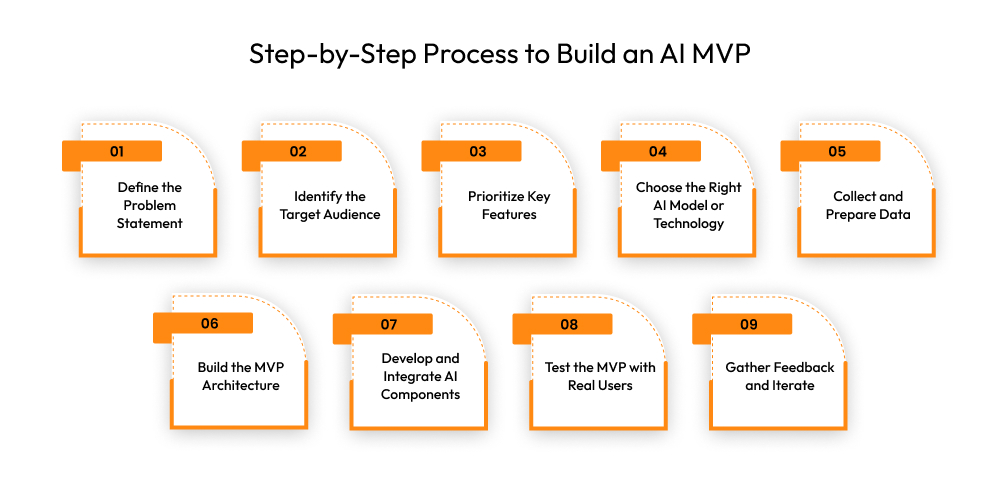
Step 1: Define the Problem Statement
This is the main step to develop an AI MVP. Before diving into any AI development, you must clearly state the problem you are trying to solve.
What to do:
- Identify a real pain point: What challenge are your users or business facing that AI could uniquely address?
- Be specific: to make an AI MVP, avoid vague statements. Instead of “improve customer service,” think “reduce customer wait times for technical support inquiries by 30%.”
- Quantify if possible: How will you measure success? What metrics will indicate that the problem is being solved?
Why it’s important:
According to experts from a top on demand app development company, clearly defined issues can ensure the AI MVP remains focused, relevant, and measurable. It prevents scope creep and ensures you’re developing something truly valuable.
Step 2: Identify the Target Audience
To launch an AI MVP, you need to first decide your target audience and their preferences. It can affect the quality of design, features, and even the type of AI you might use.
What to do:
- Create user personas: To make an AI MVP, detail their demographics, behaviors, needs, goals, and pain points related to the problem.
- Understand their context: How will they interact with the AI? What devices will they use? What is their technical proficiency?
- Identify their current workflow: How do they currently solve the problem (or cope with it)? This helps identify friction points your AI can alleviate.
Why it’s important:
Knowing your audience will help you create a product roadmap from MVP and ensure your AI solution is user-centric, intuitive, and truly solves their specific needs, leading to higher adoption and satisfaction.
Step 3: Prioritize Key Features
An MVP, by definition, is “minimum.” This step to create an AI MVP is about identifying the absolute core functionalities needed to solve the defined problem for the target audience.
What to do:
- Brainstorm all possible features: List every idea that comes to mind for solving the problem.
- Categorize features: Group them into “must-have,” “nice-to-have,” and “future considerations.”
- Apply the “MVP lens”: Select only the “must-have” features that provide you the core value proposition and allow for early user testing.
- Figure out common mistakes: To make an AI MVP, you need to figure out what the smallest possible set of features is that still addresses the core problem.
- Define success metrics for each feature: How will you know if a feature is working as expected?
Why it’s important:
Prioritization prevents over-engineering, reduces development time and cost, and allows businesses to create an AI app with faster market entry and early feedback.
Step 4: Choose the Right AI Model or Technology
This step involves selecting an AI approach that works best for that specific problem and data at hand.
What to do:
- Consider the problem type: To create a mobile app MVP, it is important to find out the cause of the problem. Is it classification, regression, natural language processing (NLP), computer vision, recommendation, or generative AI?
- Evaluate existing models/APIs: Can you leverage pre-trained models (e.g., from Google Cloud AI, AWS AI/ML, OpenAI, Hugging Face) or APIs to accelerate development? This is often ideal for MVPs.
- Assess data requirements: Does the chosen model align with the type and volume of data you have or can acquire?
- Consider scalability and cost: Ask your AI development company questions like: How will the model perform at scale, and what are the associated operational costs?
Why it’s important:
Choosing the right technology ensures technical feasibility, efficiency, and cost-effectiveness for your MVP. For an MVP, leveraging existing tools often trumps building from scratch.

Step 5: Collect and Prepare Data
AI models are only as good as the data they’re specifically trained on. This is a critical and often time-consuming step.
What to do:
- Identify data sources: Where can you get relevant internal databases, public datasets, web scraping, user input data?
- Define data requirements: What format, volume, and quality of data are needed for the selected AI model?
- Collect data: Gather the necessary datasets.
- Clean and preprocess data: This involves handling missing values, removing inconsistencies, normalizing data, and transforming it into a format best suited for the AI model.
- Label data (if necessary): For supervised learning, data requires accurate labeling.
Why it’s important:
It is important for an AI model to use high-quality, relevant, and well-prepared data to learn effectively and provide accurate, useful outputs. Poor data leads to poor AI performance.
Step 6: Build the MVP Architecture
Building a robust architecture is crucial to launch an AI MVP. This step includes designing the overall structure of your app. It may include how well the AI components will integrate.
What to do:
- Design the user interface (UI) and user experience (UX): Based on Step 2, create wireframes and mockups for how users will interact with the app.
- Define backend services: How will the app handle user requests, data storage, and communication with the AI model?
- Plan API integrations: How will your app communicate with the chosen AI model or how will internal AI modules interact with other parts of the system?
- Consider deployment environment: Where will the MVP be hosted?
Why it’s important:
Hire MVP Developers and designers from a reputable MVP development company to ensure robust MVP architecture development. A well-planned architecture ensures that the MVP is robust, scalable (for future iterations), and allows for seamless integration of AI functionalities.
Step 7: Develop and Integrate AI Components
This is where the coding and AI model implementation occurs.
What to do:
- Implement the AI model: Train your chosen AI model using the prepared data. If using an API, integrate it into your backend.
- Develop the application logic: Build the frontend (user interface) and backend services that interact with the AI component.
- Set up data pipelines: Ensure smooth flow of data from the application to the AI model and back.
- Implement basic error handling: What happens if the AI model fails or returns unexpected results?
Why it’s important:
This step brings your AI concept to life, creating a functional prototype that can be tested.
Step 8: Test the MVP with Real Users
To build an AI MVP, you need to ensure quality testing. Once the MVP is functional, it’s crucial to make it reach the hands of target users.
What to do:
- Select a small group of target users: Put focus on quality rather than quantity to gain initial positive feedback.
- Conduct usability testing: Observe the way users interact with the app and the AI features.
- Collect qualitative feedback: Ask open-ended questions about their experience, pain points, and suggestions.
- Track quantitative metrics: Monitor usage patterns, feature adoption, and initial performance against your success metrics.
Why it’s important:
Real-world testing reveals usability issues, unexpected behaviors, and validates whether the AI truly solves the problem for its intended users.
Step 9: Gather Feedback and Iterate
The MVP process is cyclical. Feedback from testing fuels the next set of changes and improvements.
What to do:
- Analyze collected feedback: Figure out the common mistakes, patterns, critical bugs, and high-impact suggestions.
- Prioritize improvements: Depending on feedback and your initial problem statement, decide which changes are most important for the next iteration.
- Plan the next iteration: Refine the problem statement (if needed), add/modify features, improve the AI model, or enhance the user experience.
- Repeat the cycle: Continue to build, test, and iterate based on new insights.
Why it’s important:
Iteration is key to refining the AI solution, ensuring it efficiently meets user needs and evolves to fit into the market.
Choosing the Right Tech Stack for AI MVP
To ensure effortless performance of your AI MVP, selecting the right tech stack is essential. Hire dedicated developers from reputable firms who will help you choose ideal technologies according to your project requirements. Here’s are some essential components and suitable technologies:
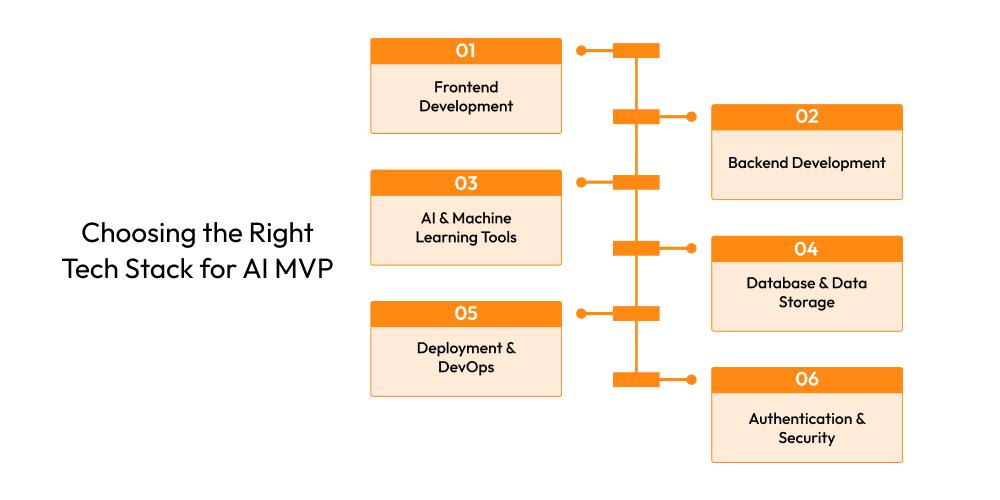
1. Frontend Development
- Web Apps: React.js and Vue.js offer fast rendering and a responsive UI.
- Mobile Apps: Flutter, React Native, ideal for cross-platform development.
2. Backend Development
- Languages: Python is best suitable for AI, Node.js.
- Frameworks: FastAPI, Django, Flask, all of these work well with AI integrations and API development.
3. AI & Machine Learning Tools
- Libraries: TensorFlow, PyTorch, Scikit-learn are ideal for building and training models.
- NLP Tools: SpaCy, Hugging Face Transformers are best for language-based AI applications.
4. Database & Data Storage
- Relational Databases: PostgreSQL, MySQL.
- NoSQL Databases: MongoDB is crucial and advantageous for structured data.
- Cloud Storage: AWS S3, Google Cloud Storage, used for large datasets and model storage.
5. Deployment & DevOps
- Containers: Docker, Kubernetes, help with scalable and repetitive deployments.
- CI/CD: GitHub Actions, GitLab CI, simplifies the entire process of development.
- Cloud Platforms: it includes Cloud Platforms, AWS, Azure, scalable and AI-ready environments.
6. Authentication & Security
- User Auth: Firebase Auth, secure and easy-to-implement options.
- Security: SSL, HTTPS, OWASP best practices, ensure data protection and compliance.
Want a chatbot demo or pricing? Fill the form and talk to our experts today.
Pick what you need below — you can select more than one — then tap Get detail to continue.
-
Chatbot demo dashboard
-
Cost to develop an app
-
Industry report
-
Case study
Choosing the Right Tech Stack for AI MVP
Choosing the right tech stack for your AI MVP (Minimum Viable Product) is crucial to ensure optimal performance, scalability, and a smooth development process. Hire dedicated developers that will help you choose the right tech stack according to your project requirements. Here’s a breakdown of essential components and suitable technologies:
1. Frontend Development
- Web Apps: React.js, Vue.js, offer fast rendering and a responsive UI.
- Mobile Apps: Flutter, React Native, ideal for cross-platform development.
2. Backend Development
- Languages: Python (most popular for AI), Node.js.
- Frameworks: Django, FastAPI, Flask, work well with AI integrations and API development.
3. AI & Machine Learning Tools
- Libraries: TensorFlow, PyTorch, Scikit-learn, powerful for building and training models.
- NLP Tools: SpaCy, Hugging Face Transformers, best for language-based AI applications.
4. Database & Data Storage
- Relational Databases: PostgreSQL, MySQL.
- NoSQL Databases: MongoDB,great for unstructured data.
- Cloud Storage: AWS S3, Google Cloud Storage, used for large datasets and model storage.
5. Deployment & DevOps
- Containers: Docker, Kubernetes, help with scalable and repeatable deployments.
- CI/CD: GitHub Actions, GitLab CI, streamline the development lifecycle.
- Cloud Platforms: AWS, Google Cloud, Azure, scalable and AI-ready environments.
6. Authentication & Security
- User Auth: Firebase Auth, secure and easy-to-implement options.
- Security: SSL, HTTPS, OWASP best practices, ensure data protection and compliance.
Cost Estimation of an AI MVP
The estimated cost to develop an AI MVP can range from $8,000 to $25,000+ in 2025, with differentiation in the final cost due to factors like complexity of the project and integrating specific features.
A basic MVP development cost can range from $8,000 to $15,000, whereas an AI MVP Cost with advanced features and functionalities can range higher, exceeding $25,000.
Factors like AI model complexity, frontend and backend development services, collecting data and feedback, preparation process, cloud infrastructure, and team costs all can impact the overall development cost.
AI MVP Type |
Estimated Cost (USD) |
Timeline |
| Chatbot MVP | $8,000 – $15,000 | 3 – 5 weeks |
| Recommendation System MVP | $12,000 – $20,000 | 4 – 6 weeks |
| Predictive Analytics MVP | $15,000 – $25,000 | 4 – 7 weeks |
| Image Recognition MVP | $18,000 – $30,000 | 5 – 8 weeks |
| Voice Assistant MVP | $20,000 – $35,000 | 6 – 9 weeks |
| Generative AI MVP | $25,000 – $50,000+ | 6 – 10 weeks |
Key Factors Influencing Cost
The cost to create an AI MVP from scratch depends on several important factors. It includes app complexity and features, platform selection, UI/UX design, third-party API, and post launch support.
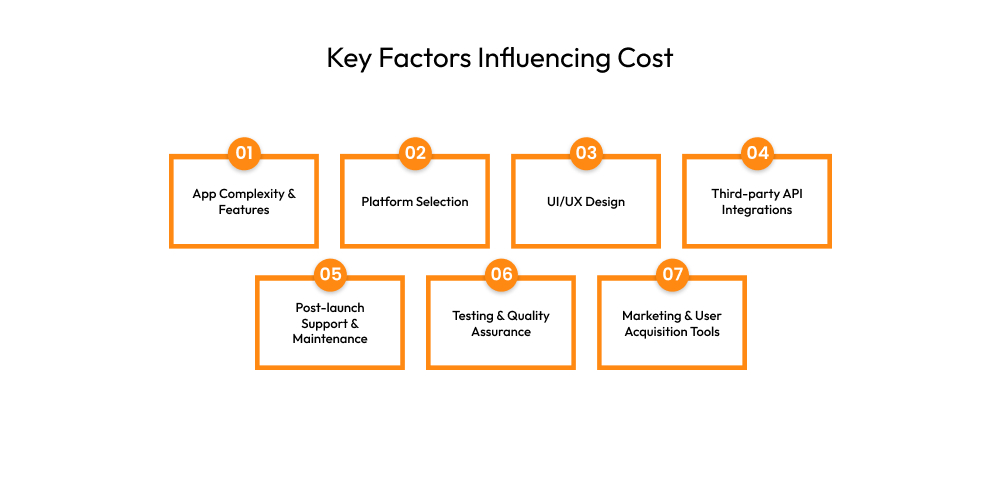
1. App Complexity & Features
Cost to create an AI MVP from scratch depends on the app complexity and features. Basic apps with limited functionality are cheaper, while advanced apps with live scoring, team creation, and contests require more development effort and cost.
Complexity Level |
Estimated Cost (USD) |
Timeline |
| Basic | $8,000 – $12,000 | 2 – 4 weeks |
| Moderate | $12,000 – $20,000 | 4 – 6 weeks |
| Advanced | $20,000 – $35,000+ | 6 – 9 weeks |
2. Platform Selection
Cost To Build Artificial Intelligence Project can differ depending on your platform selection. Building for a single platform (Android or iOS) reduces AI MVP cost, whereas cross-platform or native development for both increased time and budget requirements.
Platform |
Estimated Cost (USD) |
Timeline |
| Web-only MVP | $8,000 – $15,000 | 3 – 5 weeks |
| Mobile (iOS or Android) | $10,000 – $18,000 | 4 – 6 weeks |
| Cross-platform (Web + Mobile) | $18,000 – $30,000+ | 6 – 8 weeks |
3. UI/UX Design
A visually appealing and intuitive design tailored for engagement takes more time and resources, especially if custom animations or interfaces are involved.
Design Complexity |
Estimated Cost (USD) |
Timeline |
| Basic | $2,000 – $5,000 | 1 – 2 weeks |
| Custom | $5,000 – $8,000 | 2 – 3 weeks |
| Advanced | $8,000 – $12,000 | 3 – 4 weeks |
4. Third-party API Integrations
Integrating APIs for real-time scores, payments, social login, and analytics incurs additional cost to develop an AI MVP, both in terms of licensing and development time.
Integration Type |
Estimated Cost (USD) |
Timeline |
| Basic | $1,000 – $3,000 | 1 week |
| Moderate | $3,000 – $7,000 | 2 – 3 weeks |
| Complex | $7,000 – $12,000 | 3 – 4 weeks |
5. Post-launch Support & Maintenance
Ongoing bug fixes, feature updates, and performance improvements ensure app longevity but require regular investment. Post launch maintenance can increase AI agent development cost.
Support Level |
Estimated Cost (USD/month) |
Timeline |
| Basic | $500 – $1,000 | Ongoing |
| Moderate | $1,000 – $2,000 | Ongoing |
| Full Support | $2,000 – $4,000+ | Ongoing |
6. Testing & Quality Assurance
The cost to develop an AI MVP can increase because of testing and QA. You need to hire skilled QA teams for extensive testing across devices, browsers, and OS versions is critical to ensure smooth functionality.
Testing Scope |
Estimated Cost (USD) |
Timeline |
| Basic | $1,000 – $2,000 | 1 week |
| Moderate | $2,000 – $5,000 | 2 weeks |
| Comprehensive | $5,000 – $10,000 | 2 – 3 weeks |
7. Marketing & User Acquisition Tools
Cost to Build An AI MVP can be influenced due to the addition of marketing and user acquisition tools. Features like referral programs, push notifications, and analytics dashboards add marketing value but increase the scope and cost of development.
Marketing Level |
Estimated Cost (USD) |
Timeline |
| Basic | $500 – $1,500 | 1 week |
| Moderate | $1,500 – $4,000 | 2 – 3 weeks |
| Full Campaign | $5,000 – $15,000+ | 3 – 5 weeks |
Monetization strategies for an AI MVP
Here are some top monetization strategies for an AI MVP:
- Freemium Model: Offer core AI features for free to attract users, with advanced tools or services available through in-app purchases or upgrades.
- Subscription-Based Model: Charge users a monthly or yearly fee for continuous access to the AI tool, ideal for productivity, health, or analytics apps.
- Pay-Per-Use: Users pay based on how often or how much they use the AI functionality, common for APIs, predictions, or data processing.
- In-App Purchases: Build an AI MVP with AI-driven add-ons like premium datasets, enhanced insights,or customizations directly within the app.
- Ads and Sponsored Content: Monetize through targeted ads or sponsored results generated by the AI, especially if the app has a large user base.
Pros of Using AI Tools for MVP Development
Here are some of the benefits of using AI tools for an MVP development:
- Faster Time to Market: AI-powered tools automate many development tasks, like code generation, testing, or data processing, accelerating the overall MVP delivery.
- Cost Efficiency: By reducing manual efforts in areas such as prototyping, coding, and testing, AI tools help minimize labor costs for AI MVP Development and avoid resource overuse during early-stage development.
- Better Decision Making: AI analytics tools provide insights from user behavior, helping you make smarter, data-driven choices to refine your MVP faster and more accurately.
- Improved Personalization: AI enables hyper-personalized user experiences through recommendation engines and behavioral predictions, essential for MVPs aimed at user retention.
- Rapid Prototyping: AI design tools like Uizard and Figma AI allow non-technical founders to generate mockups and flows rapidly, validating ideas without full development.
Conclusion
The above-provided details and information highlight how to develop a minimum viable AI product for businesses. In the above blog, we covered everything you need to know before starting to develop your AI MVP for your project. We also discussed the benefits and estimated development cost.
If you are someone looking for a custom software development company to build an ideal MVP, contact Dev Technosys. Their experts are well versed in MVP development with AI integration. And stay tuned for more informative updates.
FAQs
Q1.What is MVP Development?
A. Minimum Viable Product (MVP) development is the process of creating a basic version of a product with just enough features to validate an idea and gather user feedback before proceeding with full-scale development.
Q2. How to Build an MVP With the Help of AI?
A. AI accelerates development, reduces costs, and enhances personalization. An AI MVP development requires :
- Integrating AI tools for prototyping, automation
- user behavior analysis
- Feature testing
Q3. What is The Cost of Building an MVP?
A. The estimated cost to develop an MVP ranges from:
- Basic MVP: $8,000–$15,000
- Intermediate MVP: $15,000–$20,000
- Advanced MVP: $20,000–$25,000+
Q4. What are the Challenges in Developing an AI MVP?
A. The challenges that occur during AI MVP development include:
- Gathering valuable and quality data for training.
- Choosing and training the right AI models.
- Ensuring smooth performance and accuracy.
Q5. What Are The Benefits of Using AI Tools for MVP Development?
A. The benefits of using AI tools for MVP development include:
- Speeds up development
- Reduces cost
- Offers smart user insights
- Enables personalization
- Scales easily
Q6. What are the steps to build a successful MVP with AI?
A. The 7 crucial steps to build a successful AI MVP are:
- Define your problem
- Pick the right AI use case.
- Choose a tech stack.
- Gather and prepare data.
- Build core features
- Test with users
- Improve with feedback