


















Key takeaways:
-
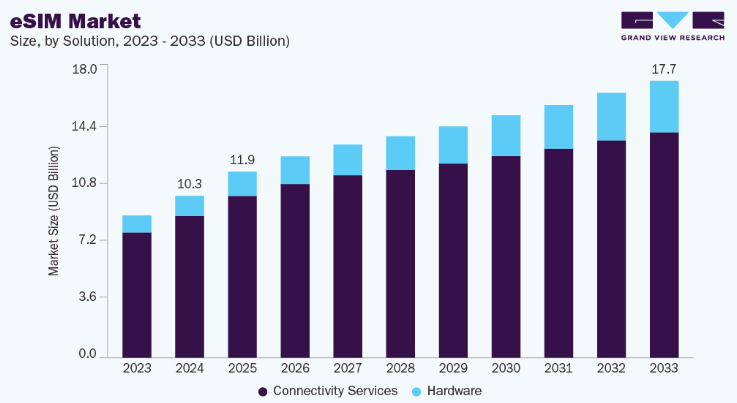
- The global eSIM market was valued at around $10.32 billion in 2024; it is projected to increase to around $17.67 billion by the end of 2033.
- There are many monetization techniques that exist, such as subscription plans, transaction fees, and the freemium model.
- Apps like Holafly, Ubigi, and GigSky are popular eSIM applications that have already gained huge success rates as compared to other apps.
In this day and age, travelling to other countries has become much easier. Have you ever gone on a trip and felt the hassle of getting a SIM card in a different country and the problems that come with it?
Well, there is a better solution to this problem, which is eSIM apps such as Saily, which allow users to access the internet without the need for a physical SIM card.
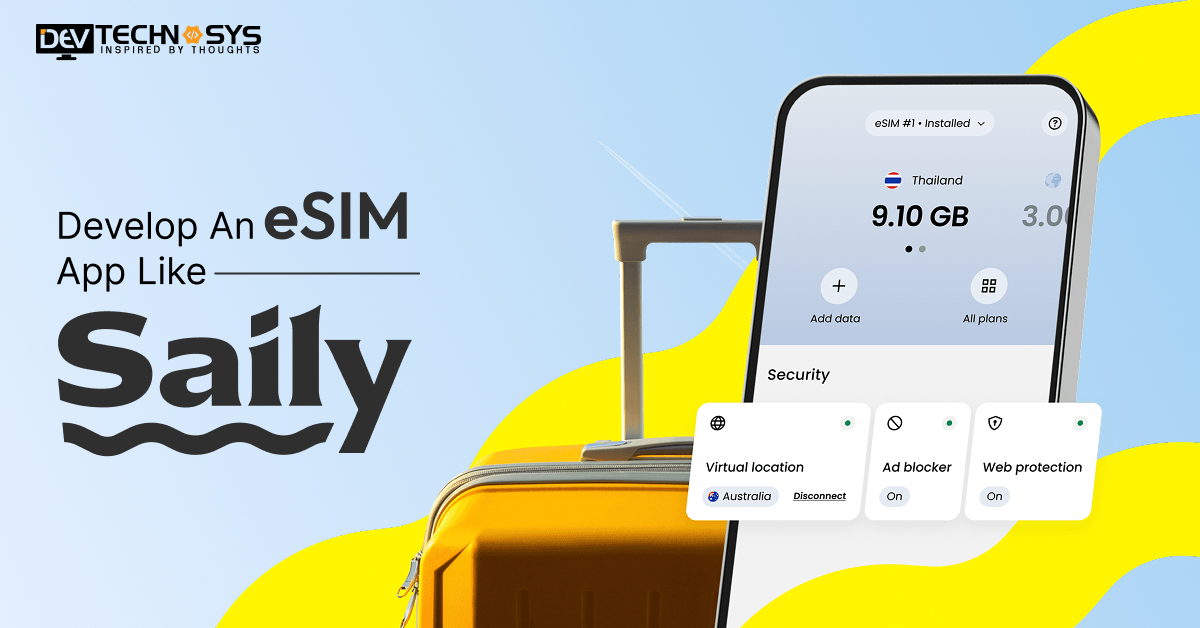
This blog will learn in depth about how to develop an eSIM app like Saily that allows its users to roam across the globe without losing internet connection.
We will cover in detail the functionalities within the special apps, the logic behind how they operate, and the reasons behind the immense popularity of such apps among users.
This is a great opportunity to learn the features of an eSIM app.
Market Statistics of Global eSIM Applications
- As per the global reports, the eSIM applications market is estimated to be around $10.32 billion in 2024, and this can grow to around $17.67 billion by the end of 2033.
- With global news, North America holds the highest market revenue share of eSIM applications, around 42.8% in 2024.
- Looking at the solution-wise, the connectivity services segment dominates a large share of around 87.5%.
- As an application, the M2M segment records the highest share of eSIM applications and is expected to increase during the forecast period.
- According to the global market, the eSIM applications market is expected to reach a CAGR of 5.1% from 2025 to 2033.
What is Saily?
Saily is an eSIM app that offers fast and affordable mobile data plans for international travelers. It allows users to purchase and activate eSIMs instantly without physical SIM cards.
Saily provides coverage in over 150 countries, with a focus on simplicity, secure payments, and competitive pricing. Ideal for tourists and remote workers, the app helps avoid roaming charges and ensures reliable internet access while abroad.
Success Story: Saily
- Saily debuted in March 2024 as Nord Security’s global travel eSIM, offering affordable plans across 150+ countries with seamless one‑tap activation.
- Within three months after launch, Saily experienced a 200 % surge in user registrations, signaling strong market demand for secure eSIM connectivity.
- By September 2024, Saily will launch “Saily Business,” enabling effortless one‑tap eSIM setup for employees in over 150 countries.
- In May 2025, Saily introduced unlimited data plans across 37 destinations plus auto-renewal top‑ups for uninterrupted global internet access.
- Saily unveiled “Ultra” in August 2025, offering unlimited data, Nord cybersecurity suite access, 8 % back in credits, plus priority support.
Various Types of eSIM Applications
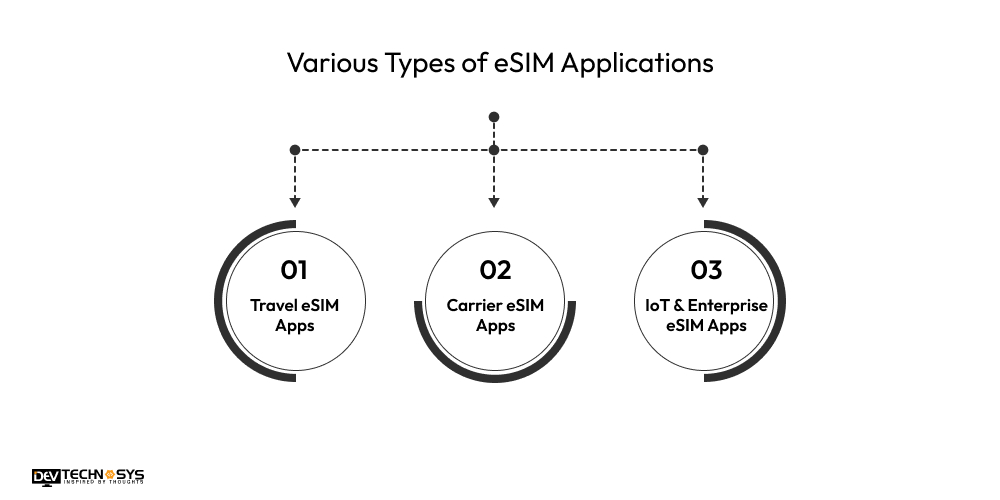
Discover the three main types of eSIM apps: Travel, Carrier, and IoT/Enterprise. Each serves a unique purpose, offering seamless connectivity, remote management, and flexibility for global users and businesses alike.
1. Travel eSIM Apps
Travel eSIM apps provide international data plans for tourists and frequent travelers. They offer instant connectivity in multiple countries without the need for physical SIM cards. Users can compare plans, purchase data, and activate eSIMs directly through the app, avoiding roaming charges and local SIM hassles.
2. Carrier eSIM Apps
Carrier eSIM apps are provided by mobile network operators to activate and manage eSIM profiles. They allow users to switch plans, manage multiple numbers, and access data and voice services. These apps support seamless onboarding, especially for devices without SIM slots or for users upgrading to eSIM-compatible phones.
3. IoT & Enterprise eSIM Apps
IoT and enterprise eSIM apps are designed to manage eSIM connectivity across smart devices, industrial equipment, and large fleets. These platforms enable centralized SIM provisioning, remote management, and secure connectivity. Ideal for businesses, they ensure scalability, operational efficiency, and real-time monitoring across global deployments.
10 Best eSIM Apps Like Saily
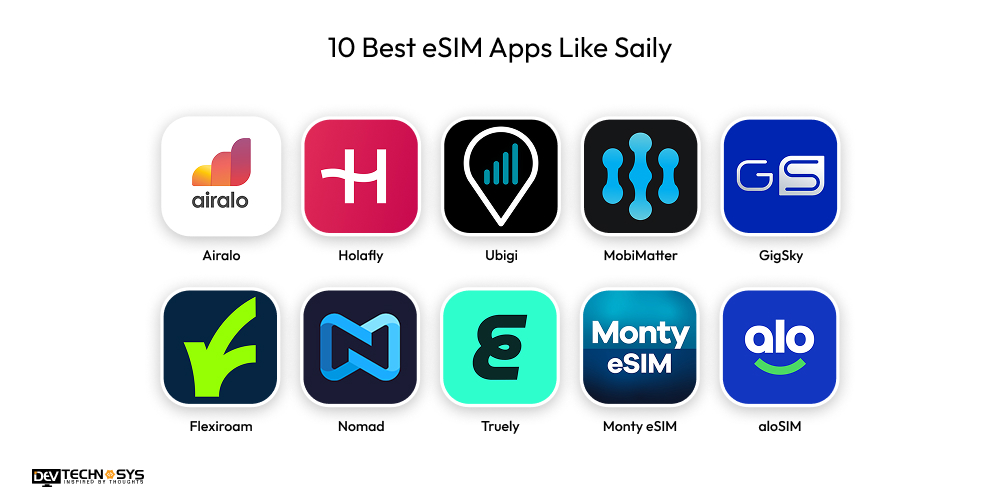
Explore a wide variety of eSIM applications that can help businesses understand their working and service criteria and implement them in their own digital SIM. So, let’s take a look at the Saily alternatives:
App Name |
Approx. Downloads |
User Rating |
Launch Year |
Platform Availability |
| Airalo | 1M+ | 4.7 | 2019 | iOS, Android |
| Holafly | 1M+ | 4.5 | 2019 | iOS, Android |
| Ubigi | 1M+ | 4.4 | 2016 | iOS, Android, Windows |
| MobiMatter | 1M+ | 4.7 | 2019 | iOS, Android |
| GigSky | 1M+ | 4.3 | 2010 | iOS, Android |
| Flexiroam | 1M+ | 4.0 | 2011 | iOS, Android |
| Nomad | 1M+ | 4.7 | 2020 | iOS, Android |
| Truely | 50K+ | 4.0 | 2023 | iOS, Android |
| Monty eSIM | 100K+ | 3.8 | 2021 | iOS, Android |
| aloSIM | 500K+ | 4.2 | 2022 | iOS, Android |
Why Do Entrepreneurs Want to Invest in eSIM App Development?
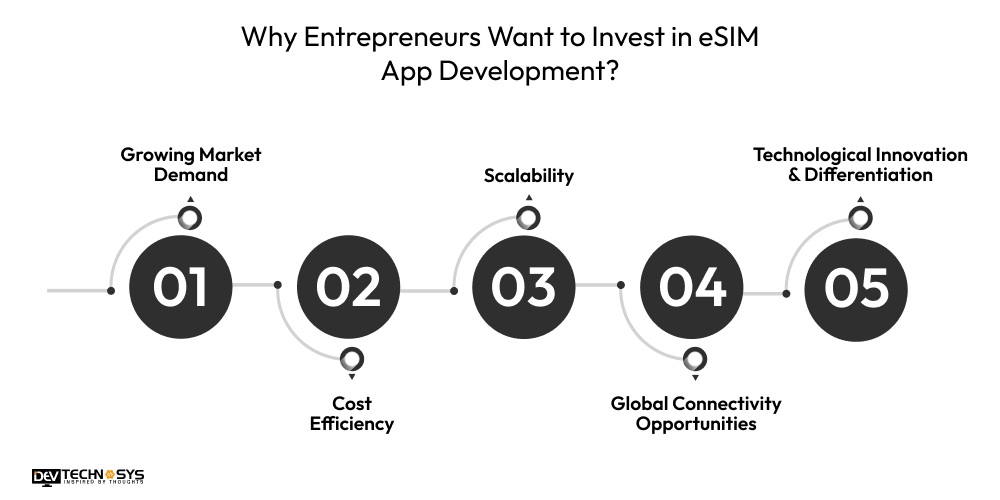
Most businesses are trying to invest in growing areas, and eSIM applications have seen a significant increase in their market. That’s why businesses are investing in eSIM on-demand app development solutions to expand their business to the next level. So, let’s explore the various benefits:
- Growing Market Demand
- Cost Efficiency
- Enhanced User Experience
- Global Connectivity Opportunities
- Technological Innovation & Differentiation
1. Growing Market Demand
The eSIM market is experiencing rapid growth as more smartphone users and IoT devices adopt this technology. Entrepreneurs are eager to capitalize on this expanding demand by developing innovative eSIM apps that provide seamless connectivity, flexibility, and convenience. This positions them well to capture a large, tech-savvy customer base.
2. Cost Efficiency
eSIM apps eliminate the need for physical SIM cards, cutting manufacturing, distribution, and logistics expenses. Entrepreneurs recognize that investing in digital SIM solutions reduces overhead and operational costs significantly.
Bonus Read: Develop a VoIP Calling App
This cost efficiency makes mobile app development for eSIM an attractive business opportunity, enabling scalable growth and higher profit margins in the telecom industry.
3. Enhanced User Experience
eSIM technology in travel allows users to switch carriers, manage multiple profiles, and activate plans instantly without physical SIM swaps.
Entrepreneurs understand that delivering a smooth, intuitive app experience boosts customer satisfaction and loyalty. By focusing on user-friendly interfaces and seamless functionality, they can differentiate their offerings in a competitive market.
4. Global Connectivity Opportunities
eSIM for travel industry provides easy access to international networks, making them perfect for travelers and businesses with global operations.
Entrepreneurs see a lucrative opportunity to offer affordable, borderless connectivity solutions that remove roaming hassles. This global reach enables tapping into diverse markets, expanding customer bases, and increasing revenue potential worldwide.
5. Technological Innovation & Differentiation
Investing in eSIM app development allows entrepreneurs to harness cutting-edge technology, incorporating advanced security, personalization, and integration features.
This innovation helps them stand out in a crowded telecom market. By creating unique value propositions and strategic partnerships, entrepreneurs can build strong brand presence and sustainable competitive advantages.
Also read: Top eSIM Apps To Use Globally
The Role of AI in eSIM Applications
- AI helps eSIM apps automatically choose the best network based on signal strength, speed, and user location in real-time.
- AI monitors unusual activities and detects potential fraud, ensuring secure eSIM provisioning and protecting user identity and sensitive information.
- AI continuously evaluates and scores network performance, helping the app dynamically switch to better providers without user intervention.
- AI chatbots handle user queries, troubleshoot issues, and guide users through activation steps, reducing dependency on human customer support.
- AI manages eSIM activation, renewal, and deactivation schedules efficiently, minimizing manual errors and improving service uptime for users.

7 Simple Steps to Develop an eSIM App Like Saily
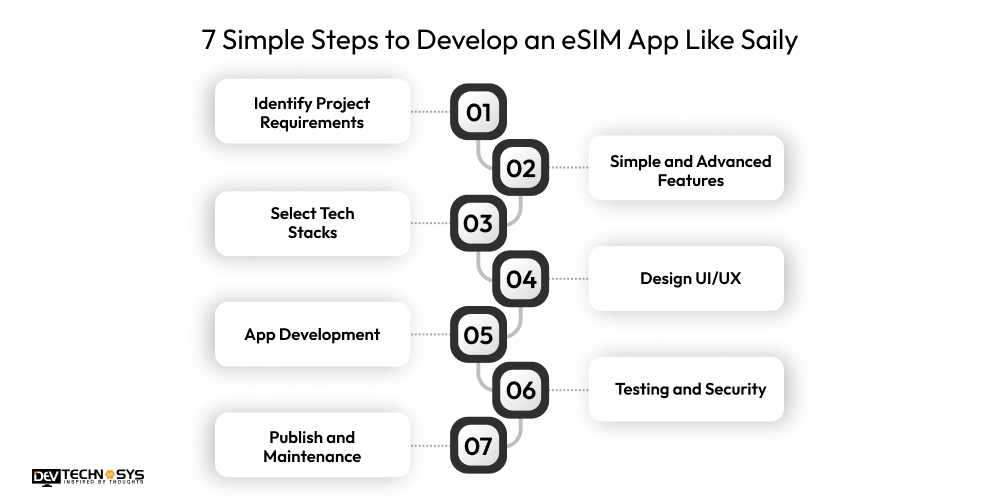
To create an eSIM app like Saily with proper guidance, you must follow the development processes. From the initial research stage to final post-launch maintenance services, businesses can easily lead the way to successful mobile app development. Let’s begin the step-by-step guide to eSIM and travel app development process:
- Identify Project Requirements
- Simple and Advanced Features
- Select Tech Stacks
- Design UI/UX
- App Development
- Testing and Security
- Publish and Maintenance
1. Identify Project Requirements
Begin the first stage to develop an eSIM app like Saily, and find out the project’s basic and advanced requirements that must be integrated. Hire developers from a travel app development company to make a proper list of requirements to reduce misunderstandings and data redundancy.
Research in this competitive market about which eSIM applications are gaining huge popularity and higher success rates as compared to other applications.
2. Simple and Advanced Features
In the second stage, to build an eSIM app like Saily, identify basic and advanced features that have to be installed in your project. It includes various types of features such as data plans, payment integration, customer support, in-app VPN integration, offline installation support, and privacy and security features. There are many highly paid features, so integrate features as per the requirements and the fixed project budget.
3. Select Tech Stacks
Let’s move to the third step to develop an eSIM app like Saily, hire expert developers from an artificial intelligence development company to choose the best tech stacks.
It involves various types of tech stacks such as cloud storage, database, APIs, security, testing, designing, frontend, backend, and many more. Businesses can also observe the existing app technologies and measure their operational performance to get an idea of which technology is best.
4. Design UI/UX
Come ahead to the fourth stage of the Saily clone app development, employ professional designers to design a simple, intuitive interface with customized elements.
It includes various types of design tools such as Figma, Marvel, Sketch, Adobe XD, Farmer, and more. Make sure all the navigation is easily accessible by users and uses high-quality themes, templates, built-in plugins, and many more.
5. App Development
In the fifth stage, to create an eSIM app like Saily, hire a highly skilled development team from a professional mobile app development company to begin the coding process.
There are various third-party tools and applications, such as payment gateways, social media logins, CRM, analytics, ERP, communication tools, and more. Make sure all the integration phases are successfully uploaded.
6. Testing and Security
Moving to the second last stage of Saily clone app development, test the application under various testing techniques before publishing the app. It involves various types of testing approaches such as unit testing, black-box testing, white-box testing, functional testing, integration testing, and more.
Install the high-tech security techniques to protect your app’s sensitive data, such as encryption techniques, biometrics, authentication, and many more.
7. Publish and Maintenance
Finally, it’s the right time to publish the Saily alternatives on specific platforms such as Android and iOS. Hire focused developers from a web app development company to make sure that all integrated phases are successfully deployed, and conduct the marketing campaigns to promote the app.
Start the maintenance services to keep the app up-to-date and maintain the actual performance. It involves fixing bugs or glitches, regular backups, adding new features, upgrading OS versions, and more.
Important FAQs
Q1. What are the Core Features of the eSIM App Like Saily?
Here we provide the list of core features of the eSIM apps like Saily:
- Travel Companion Tools
- Payment Gateway Integration
- eSIM Installation
- VPN Services
Q2. How Much Does an eSIM Cost?
The travel eSIM cost is around $7 to $100, or based on the specific region, duration, data, and more. The cost can also depend on the data speed ,and users can purchase the plan as per their requirements.
Q3. What is the Future of eSIM in Tourism?
The future of eSIM in the tourism streamlines the connectivity of data during travel and eliminates the physical SIM cards. It enables travelers to switch their data plan without any problem and with global coverage.
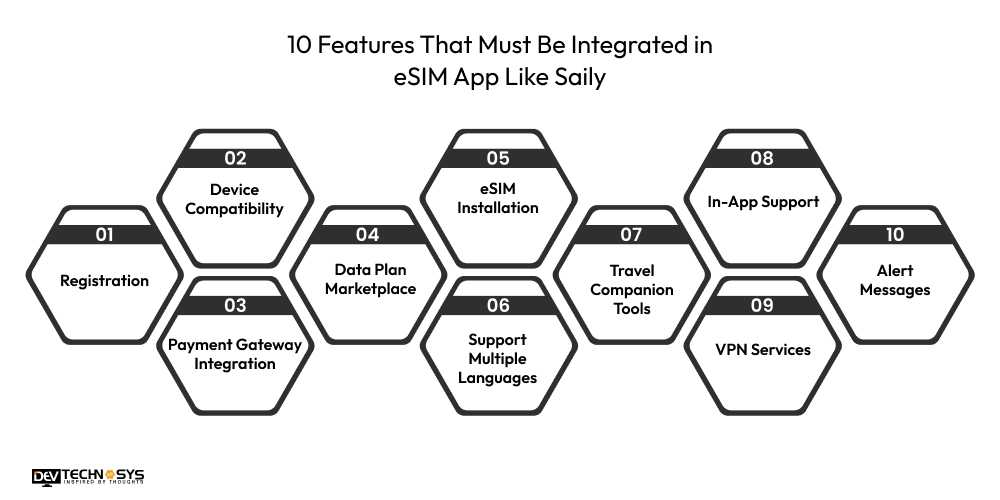
10 Features That Must Be Integrated in eSIM App Like Saily
When building a Saily alternative, you must know what type of features must be integrated. Let’s explore the wide variety of eSIM app features for travelers that provide a competitive advantage over other existing apps.
-
Registration
The saily eSIM app enables users to create their own account using email, phone numbers, social media logins, and other signup options.
-
Device Compatibility
The Saily alternatives automatically check device compatibility, ensuring the device supports eSIM functionality, and offer alternative options.
-
Payment Gateway Integration
The eSIM technology in travel offers various online payment options such as credit or debit cards, net banking, digital wallets, and many more.
-
Data Plan Marketplace
The Saily clone apps offer global data plans, enabling users to browse, compare plans, and filter plans based on country, duration, and more.
-
eSIM Installation
If businesses create a mobile app for eSIM, it allows users to easily install an eSIM profile using a QR code and offers the option of manual installation.
-
Support Multiple Languages
The Saily alternatives support multiple languages to increase the flexibility for users to change the app’s language as per their preferences and requirements.
-
Travel Companion Tools
Similar apps like Saily provide a currency converter, offline maps, emergency numbers, and eSIM laws to enhance the user’s experience.
-
In-App Support
If users have any queries or issues, they can directly ask the customer support team and get a response back instantly, and solve the problem as soon as possible.
-
VPN Services
Integrate VPN services for data protection and privacy when travelling abroad using mobile networks and offer value-added services.
-
Alert Messages
The similar apps like Saily send push notifications to users for activating eSIM, new country arrival, new data plans, and expiring plans.
The Cost to Develop an eSIM App Like Saily
The cost to build an eSIM app like Saily lies between $8,000 and $25,000, depending on extra functionality. The overall eSIM app development for travel industry cost can fluctuate due to various factors such as project complexity, premium features, size, infrastructure, tech stacks, testing, and more.
There are also additional factors that can impact the cost to develop a mobile app, such as maintenance, development team, security measures, deployment platforms, and more.
Let’s take a look at the detailed explanation of Saily app development cost in the table below:
Development Phase |
Estimated Cost (USD) |
| Project Planning & Research | $500 – $2,000 |
| UI/UX Design | $1,000 – $3,000 |
| Frontend Development (App) | $3,000 – $8,000 |
| Backend Development | $5,000 – $15,000 |
| API Integration (eSIM, etc.) | $500 – $2,000 |
| QA & Testing | $500 – $1,500 |
| Deployment & Publishing | $200 – $500 |
| Initial Maintenance (3–6 mo.) | $300 – $1,000 |
Estimated Cost: $8,000 – $25,000+
5 Key Factors That Can Affect the eSIM App Development Cost
There are various crucial factors that can highly impact the eSIM app development cost. It includes development team, tech stacks, deployment platforms, third-party integrations, and more. Let’s take a look at the key cost-affecting factors:
1. Third-Party Integrations
Let’s talk about the first factor: implementing third-party tools is important for an app to increase accessibility and flexibility. Some of the third-party applications or tools have higher licensing fees, and developers take too much time to integrate.
It includes a wide variety of tools such as CRM, ERP, analytics, communication tools, payment gateway integrations, social media logins, and more. So, these integrations can raise the cost to develop a eSIM app.
Integration Type |
Estimated Cost (USD) |
| Basic API (e.g., user login, analytics SDK) | $500 – $1,500 |
| Geolocation / Mapping | $1,000 – $3,000 |
| Payment or eSIM provisioning services | $1,500 – $4,000 |
| Multiple integrations combined | $2,000 – $5,000 |
2. Normal and Premium Features
Normal and premium features have different implementation costs, which can influence the overall Saily app development cost. It includes various premium features that are highly expensive, such as a data plan marketplace, in-app VPN services, payment gateway integrations, user registration, smart plan recommendations, and customer support. These features can increase the cost to develop an eSIM app like Saily.
Feature Type |
Estimated Cost (USD) |
| Basic (e.g., QR scanning, provisioning) | $1,000 – $5,000 |
| Standard (e.g., in-app purchases, simple analytics) | $2,000 – $8,000 |
| Premium (e.g., advanced encryption, custom VPN, multi-profile management) | $3,000 – $10,000 |
| Combined (MVP-level mix) | $1,000 – $10,000 |
3. Development Team
The developer’s team is one of the most common cost-affecting factors; there are various reasons that can affect the GPS tracking app development cost.
If businesses hire experienced developers with a rich skill set, then they definitely demand a higher salary package, and it can directly impact the project budget. Developers from different regions or countries have different costs, so hire developers from which region who provide developers at a lower cost.
Team Type |
Estimated Cost (USD) |
| Freelancer / Junior Offshore | $2,000 – $8,000 |
| Small Dedicated (mixed experience) | $4,000 – $12,000 |
| Local Mid-sized Agency | $8,000 – $20,000 |
| Hybrid (Offshore dev + local PM) | $3,000 – $15,000 |
4. Platform Choice
Connected to the fourth cost-affecting factor, there is a wide variety of platforms available to deploy the project, but the cost of every platform differs from each other. Businesses build an eSIM app for the iOS platform, which can lead to higher costs, because iOS developers demand higher salary packages as compared to Android developers.
Using cross-platform frameworks to build apps for both platforms, such as Android and iOS with a single codebase, can help maintain the project budget and be cheaper than separate platforms.
Platform Strategy |
Estimated Cost (USD) |
| Single native (either iOS or Android) | $8,000 – $20,000 |
| Cross‑Platform (e.g., Flutter/React Native) | $7,000 – $15,000 |
| Both native (iOS + Android) | $10,000 – $25,000 |
| Web or PWA (simplified access) | $6,000 – $13,000 |
5. Maintenance Services
Moving to the last cost-affecting factor, post-maintenance services are necessary after launching the app on the live phase to keep it up-to-date and maintain the speed.
It involves various maintenance services such as fixing bugs or glitches, updating outdated features, upgrading OS versions, performance optimization, regular backups, and more. Some of the maintenance services can take more developers, this can increase the telecom software development cost.
Maintenance Scope |
Estimated Cost (USD) |
| Minimal (bug fixes, os updates) | $1,200 – $3,000 |
| Moderate (feature tweaks, occasional improvements) | $1,600 – $5,000 |
| Proactive (regular enhancements & support) | $2,000 – $6,000 |
| Lean (emergency fixes only) | $800 – $2,000 |
Tech Stacks Are Required to Develop an eSIM App Like Saily
Layer / Function |
Recommended Technologies / Tools |
| Frontend (Mobile App) | Flutter / React Native (cross-platform)OR Kotlin (Android) / Swift (iOS) |
| Backend | Node.js / ExpressOR Django (Python) |
| Database | Firebase Firestore / PostgreSQL / MongoDB |
| eSIM Integration | Truphone, 1oT, Telna, or GSMA-compliant eSIM APIs |
| Authentication | Firebase Auth / Auth0 / OAuth 2.0 |
| Cloud Hosting | Firebase / AWS / Heroku / DigitalOcean |
| APIs / SDKs | REST / GraphQL APIs eSIM partner SDKs |
| Payments (if any) | Stripe / Google Pay / Apple Pay |
| Push Notifications | Firebase Cloud Messaging (FCM) / OneSignal |
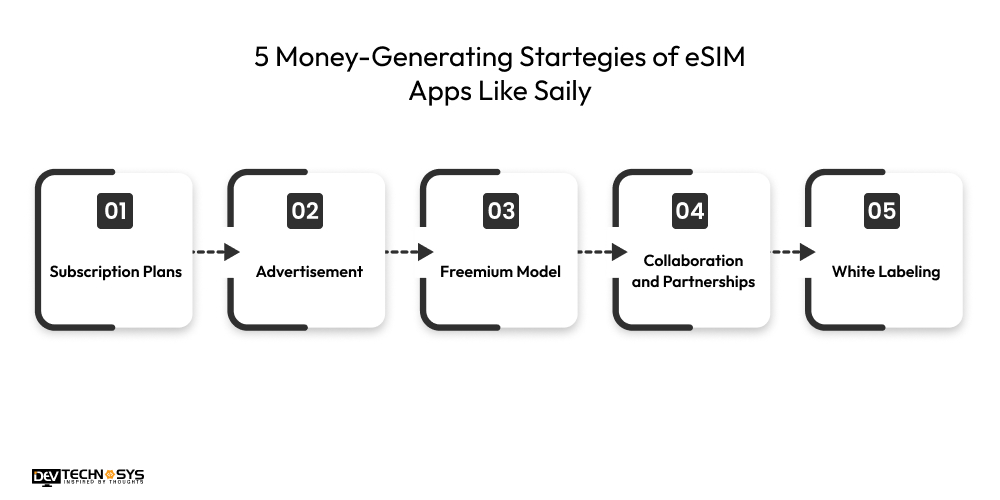
5 Money-Generating Startegies of eSIM Apps Like Saily
After developing the eSIM app like Saily, businesses are looking to generate higher revenue streams to increase the overall valuation. We provide useful monetization techniques that help businesses expand and increase sales:
- Subscription Plans
- Advertisement
- Freemium Model
- Collaboration and Partnerships
- White Labeling
1. Subscription Plans
Let’s talk about the first money-making technique, the eSIM applications offer paid subscription plans such as basic, premium, and enterprise. With the help of these paid plans, users can access rich functionality and unlimited accessibility. To do so, they need to purchase an enterprise or premium plan on a yearly or monthly basis.
2. Advertisement
In the second monetization model, similar apps like Saily can sell the ad space to third-party organizations to show or display their products or services. Businesses can charge a fee of around 8% to 12% of each advertisement. There are different types of advertisement formats, such as banners, native, display, image, pop-up windows, and many more.
3. Freemium Model
The Saily clone applications offer a free version for newly added users with limited functionality. To access the advanced and additional features, users need to pay extra fees or purchase subscription plans. So, this freemium model can be a new income source for businesses and increase the valuation.
4. Collaboration and Partnerships
eSIM apps collaborate with telecom operators, travel agencies, and digital marketplaces to expand their reach. These partnerships often include revenue-sharing models, affiliate links, or co-branded promotions.
According to the Blockchain development company, this strategy helps generate income while reducing marketing costs and increasing visibility through trusted partners’ networks.
5. White Labeling
eSIM platforms offer their infrastructure to businesses under a white-label model, allowing partners to sell eSIM services under their own brand. The app earns setup fees and a share of ongoing revenue, creating a scalable B2B income stream without having to acquire end users directly.

Conclusion
Developing an eSIM app like Saily for the travel industry requires strategic planning, seamless user experience, robust security, and reliable connectivity. From carrier partnerships to intuitive UI/UX and global compatibility, each element plays a crucial role in success.
Collaborating with a trusted mobile app development firm ensures expert guidance, efficient execution, and a competitive edge in a growing market. As eSIM technology continues to reshape travel, investing in a high-quality app can enhance customer satisfaction, reduce roaming costs, and position your brand at the forefront of digital innovation.
Frequently Asked Questions
Q1. How Much Does it Cost to Develop an eSIM App Like Saily?
A. The cost to build an eSIM app like Saily is around $8,000 to $25,000 or higher. The project cost can be influenced by various factors such as premium features, functions, size, complexity, development team, tech stacks, and more.
Q2. How Long Does it Take to Create an eSIM App Like Saily?
A. To create an eSIM app like Saily, it normally takes around 5 to 10 weeks. The timeline is based on several factors, such as project complexity, number of features, customized services, and more.
Q3. How to Set Up an eSIM for Travel?
A. Here are the various steps to set up an eSIM for travel:
- Start Wi-Fi
- Open device settings
- Choose connections
- Choose SIM card manager
- Add a mobile data plan
- Choose the QR code scanner
- Scan the QR code sent by the SIM company in the Email
- Input the confirmation code sent through Email
Q4. Which are the Best eSIM Applications for Travel?
A. Here is the list of embedded SIM applications:
- Saily
- Airalo
- Holafly
- Ubigi
- Nomad
Q5. What Type of Technologies are Used to Make an eSIM App Like Saily?
A. Robust technologies are used to make an eSIM app like Saily. Let’s explore the technologies:
- Java
- Python
- C++
- PHP
- Objective-C
- C#