


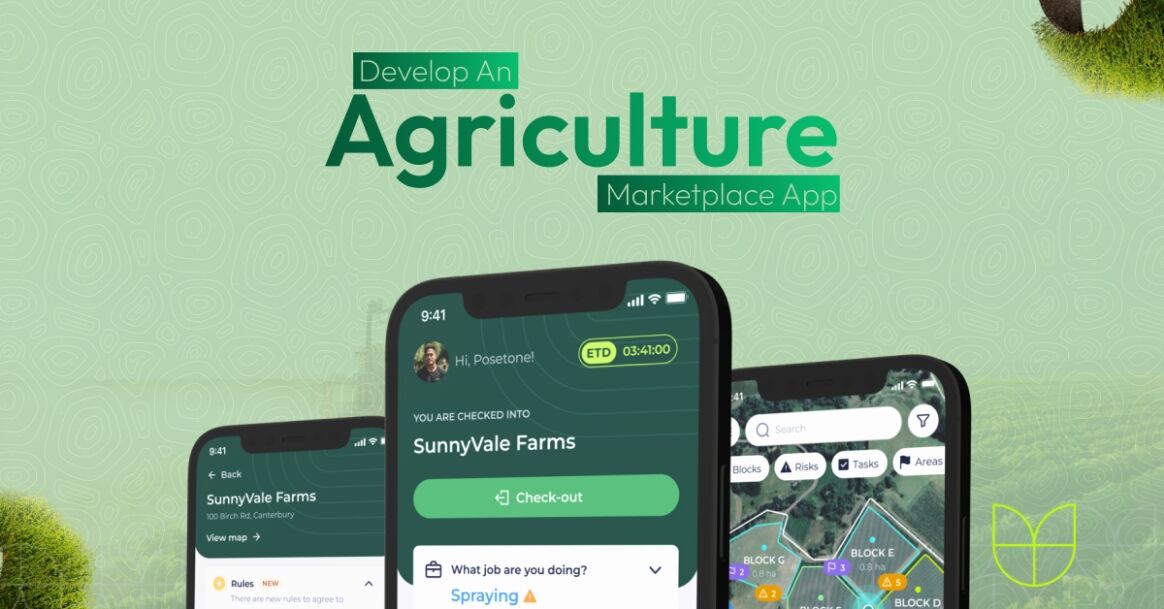
Are you an aspiring business wanting to enter the agriculture industry with your own Agriculture marketplace App, but don’t know where to start and whom to approach? If yes, then you have arrived at the right place. Here you’ll find the information required to develop an agricultural marketplace and agrimp platform.
Whether it’s a small-scale farmer looking to reach new markets or a consumer seeking fresh, locally-sourced produce, an online agriculture marketplace app can change the way food moves from the farm to the table.
If you’re sure about your decision to develop an agriculture marketplace app, this guide will guide you through every step of the agriculture marketplace app development process. So, let’s dive in without further delay!
What is the Agriculture Marketplace App?
An agriculture marketplace app is a mobile app that connects farmers, traders, and buyers to efficiently purchase and sell agricultural products. An agriculture app involves one-time market prices, trends, and crop advisories. It also provides secure transactions and logistics services. Key features of agriculture marketplace app include:
- Transparent Pricing
- Pre-Harvest Marketing
- Simple Deal Creation
- Real-time Market Price Listing
- Supports Secure Transactions and Logistics
Agriculture Analytics Market Stats
- The global digital agriculture marketplace market size was valued at USD 14.56 billion in 2024 and is projected to reach from USD 16.45 billion in 2025 to USD 43.73 billion by 2033, growing at a CAGR of 13% during the forecast period (2025-2033).
- North America agriculture analytics market held a significant share of 45.1% in 2024.
- By offering, the solution segment dominated the market with a revenue share of 58.6% in 2024.

- In terms of application, the precision farming segment dominated the market with a revenue share of 47.6% in 2024.
- By field size, the large field size segment dominated the market in terms of revenue, with a revenue share of 49.8% in 2024.
Why Should Businesses Invest in Agriculture E-commerce Platform Development?
Agriculture marketplace apps are opening new opportunities for businesses. There are various benefits of investing in AgTech software development. Some of the significant business benefits of investing in an agriculture product buying selling app are given below:

1. Diversified revenue streams:
By using a top mobile app for a farmers marketplace, businesses can reduce reliance on a single market and create a new, flexible, and scalable sales channel.
2. Improved market access:
Deciding to build an app like FarmRise can be beneficial for businesses. Through agriculture apps, they can connect directly with a wider customer base in cities, states, or even globally, expanding beyond local markets.
3. Increased profitability:
Businesses can simply invest in the best agriculture marketplace app for buying seeds, fertilizers, machinery, and earn higher margins. They just need to sell directly to consumers and avoid the costs associated with traditional middlemen.
4. Reduced Waste:
Businesses can develop an agriculture app like AgriApp to minimize post-harvest losses by streamlining the supply chain with optimized logistics and faster delivery to consumers.
5. Enhanced supply chain efficiency:
Top agriculture marketplace apps integrate and manage various aspects of the supply chain. It includes tasks like order management, packaging, transportation, and delivery, often with AI and IoT support.
6. Price transparency and autonomy:
Businesses should develop an Agritech mobile app that provides users with real-time pricing data, enabling them to make better decisions and gain more control over the price of produce.
Top 10 Agriculture Marketplace Apps To Explore in 2025
Here we present the list of top agriculture marketplace apps currently leading the market. All these best agtech apps offer unique features to enhance farming tasks.
App Name | Launch Year | Ratings | Platform Availability |
| FarmLogs | 2011 | 4.5/5 | iOS, Android |
| AGRIVI Engage | 2015 | 4.6/5 | iOS, Android |
| Climate FieldView™ | 2014 | 4.4/5 | iOS, Android |
| AgDNA | 2018 | 4.3/5 | iOS, Android |
| AGMRI | 2019 | 4.7/5 | iOS, Web |
| AgriApp | 2025 | 4.2/5 | Android |
| AgriBazaar | 2025 | 4.3/5 | Android |
| Syngenta Cropwise Grower | 2025 | 4.5/5 | iOS, Android |
| Farm Lead | 2015 | 4.4/5 | iOS, Android |
| Farmbucks Mobile App | 2025 | 4.1/5 | Android |
How to Develop an Agriculture Marketplace App For Businesses?
Do you want to learn how to develop an agriculture marketplace app without hassle and complexities? If yes, then you are at the right place. This section provides a step-by-step guide to build an agriculture marketplace app.
Step1. Ideation
The first step to develop an agriculture marketplace app is identifying the purpose of creating a product listing and classifieds agriculture app. You need a clear vision of the business idea you are working on.
Ensure it reflects your vision and business needs, and explain it clearly to the experts at On demand app development company. The significant points of discussion would be:
- What is the purpose of developing the agriculture app?
- Who is your target audience?
- What would be your USP?
- Who are your competitors?
- Would you like the marketing team to promote your app?
- Do you require post-launch maintenance services for your agriculture apps?
Step 2. Get to Know the Market
To make an agriculture marketplace app, you need to conduct market research to understand the trends and user demands, enabling you to connect with your customers easily. Research your competitors and see what their weak and strong points are.
Conducting in-depth research will provide you with an understanding of the buyers’ persona, which will help you develop an agriculture marketplace app.
Step3. UI/UX Design and Wireframes
Now it’s time to create a user interface design for your app. Hire skilled designers from a top AgTech App Development Company. Design an intuitive, farmer-friendly interface that’s easy to navigate even in low-connectivity areas.
Creating the best farming apps for crop sales involves reading wireframes that outline user journeys for buying, selling, and communication. A well-planned design ensures seamless access to market prices, crop insights, and transactions, increasing user engagement and satisfaction.
Step 4. Features and Platform Selection
Create a multi-language support agriculture marketplace platform with features that deliver real value. The features that you need to add to develop an agriculture marketplace app include live market rates, product listing, in-app chat, payment gateways, and logistics tracking.
For platform selection, decide between Android, iOS, or a cross-platform app depending on your target audience. Build an agriculture marketplace app with crucial features like multilingual support and push notifications to enhance usability and accessibility across diverse agricultural communities.

Step 5: Tech-stack and Development
The experts who provide marketplace app development services will select a robust agriculture app tech stack that supports scalability and security. Common technologies include React Native or Flutter for cross-platform apps,
Node.js or Django for backend, and AWS or Firebase for hosting. Ensure the architecture supports real-time data updates and offline access. Development should progress in sprints to allow feature testing and timely updates.
Step 6. Testing Phase
IIn this step, testers will thoroughly test the app to ensure smooth functionality, usability, performance, and data security. To build an agriculture marketplace app, they need to conduct both alpha and beta testing with real users (especially farmers and traders) to collect actual feedback.
Check for bugs, crashes, and slow responses. Quality assurance at this stage ensures the app runs smoothly across devices and network conditions, improving trust and user retention.
Step 7. Launch and Promote the App
The experts who create an agriculture marketplace app know how important launching a product is. After getting a thumbs up from the testing team, strategically launch the app on relevant app stores.
Promote your application through digital campaigns, agricultural events, and partnerships with farming cooperatives. An agriculture mobile app development company should promote its app by offering referral bonuses or first-time user rewards.
Step 8: Post-Launch Maintenance
After launch, proceed towards monetization through premium features, commission-based transactions, ads, or subscription plans. Collect reviews and feedback from users to enhance features and functionalities like crop insurance or financing. Frequent updates, monitoring, and customer support are needed to maintain long-term growth and increase revenue potential.
Features to Incorporate in an Agriculture Marketplace App
Do you want to build an agriculture marketplace app that connects farmers, buyers, and traders seamlessly? If yes, then don’t forget to add the advanced and useful features. Some of the must-have features of agriculture apps are:
-
GPS Tracking:
Create an agriculture marketplace app with a GPS tracking feature. GPS enables real-time vehicle and field tracking, ensuring timely deliveries, optimized logistics, and better transparency.
-
Cattle Management:
Helps monitor livestock health, breeding, and feeding schedules, improving animal productivity and farm profitability through organized data tracking.
-
Data-Driven Decisions:
If you want to make an agriculture marketplace App, then add analytics to guide planting, pricing, and harvesting strategies. It helps farmers in making informed and profitable agricultural decisions.
-
Weather Analysis:
Agriculture apps include features like weather analytics that provide accurate forecasts for rainfall, temperature, and storms, helping farmers plan irrigation and harvesting efficiently.
-
Push Notifications:
agriculture apps send instant alerts on market trends, weather changes, and order updates to keep users informed and engaged.
-
Agriculture Planning and Mapping:
Visualizes crop layouts and land zones, improving soil usage, crop rotation, and overall farm productivity.
-
Agriculture Schedule:
Allows farmers to plan and automate daily farming tasks, enhancing time management and operational efficiency. If you want to create an agriculture marketplace app, then adding this feature is crucial.
-
Farm Management Apps Integration:
Connects external farm tools for unified monitoring of inventory, finances, and crop performance across one platform.
What is the Cost To Build An Agriculture Marketplace App?
The cost to develop a marketplace app ranges between $8,000 – $25,000, depending on factors like features, platform choice, design complexity, tech stack, and developers’ geographical location.
Cost to develop an agriculture marketplace app for a simple app with basic features and standard design will cost less, around $15,000. On the other hand, a complex app with advanced features and functionalities can increase the agriculture marketplace app development costs.
App Type | Description | Development Timeline | Estimated Cost (USD) |
| Basic App | Core features like user registration, listings, and simple marketplace functions. | 6–8 weeks | $8,000 – $12,000 |
| Moderate App | Includes GPS tracking, weather integration, and payment gateways. | 10–14 weeks | $13,000 – $18,000 |
| Advanced App | AI-driven insights, IoT integration, analytics dashboard, and real-time updates. | 16–20 weeks | $19,000 – $25,000 |
Factors Affecting the Cost of Developing an Agriculture Marketplace App
Stating a fixed cost to build an agriculture software is extremely difficult, as various factors influence it. Some of the major factors that affect the cost to develop an agriculture marketplace app are given below:
1. App Complexity and Features
The number and sophistication of features like GPS tracking, weather integration, or data analytics directly impact the cost to develop an agriculture marketplace app. Advanced features require more coding time, testing, and backend infrastructure, raising overall expenses. Take a look at the table highlighting the cost to create an agriculture marketplace app based on its features:
Level | Timeline | Cost (USD) |
| Basic | 6–8 weeks | $8,000 – $12,000 |
| Moderate | 10–14 weeks | $13,000 – $18,000 |
| Advanced | 16–20 weeks | $19,000 – $25,000 |
2. Platform Selection
Developing for a single platform (Android or iOS) costs less than building a cross-platform or hybrid app. However, the cost to build an agriculture marketplace app for multiple platforms ensures a broader reach and scalability, though it requires additional investment.
Type | Timeline | Cost (USD) |
| Single Platform | 5–8 weeks | $8,000 – $13,000 |
| Cross-Platform | 10–12 weeks | $14,000 – $20,000 |
| Native Apps | 12–16 weeks | $18,000 – $25,000 |
3. UI/UX Design
The cost to develop a smart farming app also depends on how complex your UI design is. A user-friendly and localized interface tailored to farmers’ needs adds design complexity.
Custom graphics, animations, and multi-language support increase costs but significantly enhance engagement and usability. The table mentioned below highlights the cost to create an agriculture marketplace app depending on design complexity.
Design Level | Timeline | Cost (USD) |
| Basic | 2–3 weeks | $2,000 – $4,000 |
| Standard | 4–6 weeks | $5,000 – $8,000 |
| Advanced | 6–8 weeks | $9,000 – $12,000 |
4. Technology Stack
The choice of tech stack will also affect the cost to make an agriculture marketplace app. Technologies such as Flutter, React Native, or native frameworks affect the performance and cost to make an agriculture marketplace app. Integrating AI, IoT, or blockchain for advanced analytics or secure transactions also increases expenses.
Stack Type | Timeline | Cost (USD) |
| Basic | 6–8 weeks | $8,000 – $12,000 |
| Mid-Level | 10–12 weeks | $13,000 – $18,000 |
| Advanced | 14–18 weeks | $19,000 – $25,000 |
5. Post-Launch Maintenance and Updates
The cost to build an agriculture marketplace App also differs based on maintenance services after launch. Regular updates, bug fixes, and feature updates ensure the stability of the app.
Maintenance of the app typically costs 15–25% of the initial agriculture marketplace app development cost. The table below displays the cost to create an agriculture marketplace app according to support type:
Support Type | Timeline | Annual Cost (USD) |
| Basic | Ongoing | $1,000 – $3,000 |
| Standard | Ongoing | $4,000 – $6,000 |
| Comprehensive | Ongoing | $7,000 – $10,000 |
How Do Agriculture Marketplace Apps Make Money?
According to a top agri marketplace app development company, agriculture marketplace apps primarily generate revenue through various methods. Let’s discuss some of these monetization methods in detail.
1. Commission on Transactions:
The best farming apps for crop sales earn a small percentage from each sale made between farmers and buyers. This is the most common and sustainable revenue model, ensuring steady income as user activity grows.
2. Subscription Plans:
An agriculture platform for small farms offers premium memberships to farmers, traders, or agribusinesses with exclusive benefits such as advanced analytics, priority listings, or unlimited trading options for a monthly or annual fee.
3. Featured Listings:
Sellers or suppliers can pay to promote their products at the top of search results or on the homepage, increasing visibility and sales opportunities.
4. Advertisement Revenue:
Earn through in-app ads from agri-product manufacturers, equipment companies, or fertilizer brands. Both banner and video ads can generate additional income.
5. Data Monetization:
Aggregate anonymized data on crop trends, pricing, and market behavior to sell insights to agricultural agencies, research firms, or policymakers.
Conclusion
The above blog talks about how to develop an agriculture marketplace app, covering key aspects from ideation to UI/UX design, feature selection, development, and post-launch maintenance.
We hope you find this information useful. For professional support, contact a reputed marketplace app development company like Dev Technosys. And stay tuned for more informative updates.
FAQs
Q1. How Much Does It Cost To Build An Agriculture Marketplace App?
A. The cost to build an agriculture marketplace app typically ranges from $8,000 to $25,000, depending on app complexity, features, platform selection, and technology stack.
Q2. How Long Does It Take To Develop Such An Agriculture Marketplace App?
A. The time it takes to develop an agriculture marketplace app usually ranges from 2 to 5 months, depending on app features, design, and backend complexity.
Q3. Are There Any Online Platforms To Buy Fresh Crops Directly From Farmers?
A. Yes, platforms like AgriBazaar, Farm Lead, and Agri App allow you to purchase fresh crops directly from farmers, ensuring quality and fair pricing.
Q4. How Can I Find The Best Fresh Crops Marketplace Near Me?
A. Use location-based features in agriculture marketplace apps to locate nearby sellers, farmers, or distributors offering fresh produce.
Q5. What Should I Look For When Choosing Fresh Produce At A Marketplace?
A. Check for freshness, color, firmness, and smell, and ensure sellers have verified profiles and positive reviews within the app.
Q6. What Are The Benefits Of Buying From Local Crop Markets?
A. Buying locally supports farmers, ensures fresher produce, reduces transportation costs, and promotes a sustainable food ecosystem.


