















Key takeaways:
-
- Overall Cost Range: The cost to develop a marketplace app varies approximately over $12,000 – $30,000 depending on features, complexity, and scalability.
- Cost by Complexity:
- Basic/MVP: $12,000 – $18,000 (core features, simple UI)
- Mid-Level: $18,000 – $25,000 (payments, filters, user engagement features)
- Advanced: $25,000 – $30,000 (AI, analytics, multi-vendor scalability)
- Key Cost Factors: App complexity, UI/UX design, platform choice, backend development, third-party integrations, security, and team structure.
- Development Timeline: Typically takes 3–6 months including planning, design, development, testing, and deployment.
- Regional Development Rates: Asia ($15–$40/hr), Eastern Europe ($40–$80/hr), North America ($80–$150/hr).
Having a marketplace application is no longer a mere trend but a thriving digital goldmine. Take for instance Amazon and Airbnb; these marketplace platforms are introducing a new way for people to buy, sell, and connect worldwide.
Shopping malls have greatly contributed towards changes in the purchasing habits of people and online marketplaces today contribute over 60% of worldwide eCommerce sales, and this figure will be over $8 trillion by 2026.
Exciting, isn’t it?
But here’s the real question, how much does it cost to develop a marketplace app?
It doesn’t matter if you are planning a small platform or the next big disruptor, the ecommerce website development will depend largely on the features, the tech stack, and scalability. This blog will lay bare the actual cost to develop a marketplace app, main factors, and effective budgeting tips. So you can set up your marketplace app without emptying your wallet.
What is the Marketplace App?
Marketplaces are essentially online venues that assemble sellers and buyers so that they can exchange goods or services without having to be physically present. By providing a secure environment, online marketplace platforms enable their users to perform a range of functions, such as making transactions, posting listings, transferring funds, and communicating with each other. This way, buying and selling become remarkably fast, easy, and available to everyone.
How Much Does It Cost To Develop A Marketplace App?
The cost to build a marketplace app can range from $10,000 to $80,000 or more. There are B2B ecommerce platforms (from $12,000 to $18,000) that share the same features as most online stores or marketplaces – such as product listing, ecommerce management, and basic functionalities.
A mid-range marketplace app (from $18,000 to $30,000) with an advanced search engine, integrated payment system, and customer reviews is akin to early eBay. On the other hand, a very costly, large-scale app ($30,000+), equipped with AI-driven recommendations, order tracking, a multi-vendor system, and scalable ecommerce marketplace like Amazon, is also very expensive. Ultimately, the costs would be affected by the design, technology, and location of the developers you choose to work with – local or offshore.
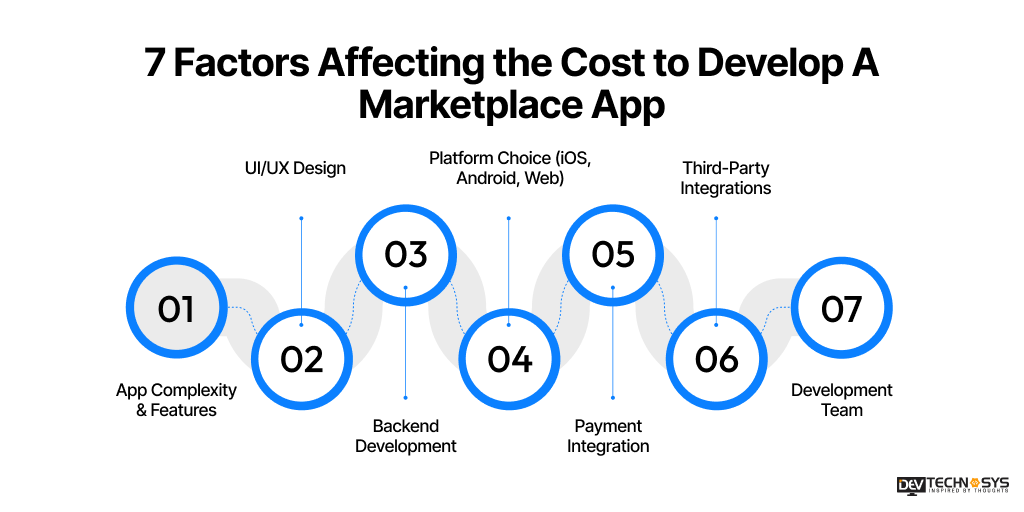
7 Factors Affecting the Cost to Develop A Marketplace App
Your marketplace app’s cost of development will be influenced by many factors, including features, design, platform, and security. Knowing these critical components allows you to set up a good budget and keep surprises at bay.
1. App Complexity & Features
Your choices will determine both the complexity of your online marketplace application and, hence, the ecommerce web development price you will have to pay. For example, a simple app with just product listings and user authentication will be quite cheap, but if you decide to include features like live messenger, AI suggestions, and vendor management dashboards. You will drastically increase the developer’s time and effort, which will also reflect on the total ecommerce app development cost.
Complexity Level |
Features Included |
Estimated Cost |
| Basic | Listings, login, profiles | $2,000 – $4,000 |
| Medium | Filters, chat, payments | $4,000 – $6,000 |
| Advanced | AI, analytics, multi-vendor | $6,000 – $8,000 |
2. UI/UX Design
It is well known that a design that is clear, pretty, and easy to understand greatly influences a user’s decision to continue using the product. However, it can also be the main reason for the cost of the product.
For instance, a simpler and straightforward design will surely cost less. If the design includes custom animations, is responsive, and user-centric, it will require more designing hours along with rigorous testing and multiple refinement rounds to make sure that the new features work smoothly on different devices.
Design Type |
Description |
Estimated Cost |
| Basic UI | Standard templates | $1,000 – $2,000 |
| Custom UI | Unique layouts, branding | $2,000 – $3,000 |
| Premium UX | Animations, advanced flow | $3,000 – $4,000 |
3. Backend Development
The backend is the core of your e-commerce marketplace app that handles databases, servers, and user interactions. Therefore, the NFT marketplace development services price of one with fewer features and functionalities will be much less than that of a backend with a scalable architecture, APIs, real-time updates, and data handling that also requires more powerful infrastructure.
Backend Type |
Description |
Estimated Cost |
| Basic | Limited database | $1,500 – $2,500 |
| Moderate | API integration | $2,500 – $3,500 |
| Advanced | Scalable architecture | $3,500 – $5,000 |
4. Platform Choice (iOS, Android, Web)
Another consideration affecting how much something will cost is making a choice between working with only one platform or going for multi-platform development. It is a fact that focusing on a single platform is less expensive.
However, when it comes to cross-platform or multi-platform applications, the development time and cost of coding, testing, and optimization required to keep consistent performance on the different devices and operating systems increase significantly.
Platform Type |
Description |
Estimated Cost |
| Single Platform | Android or iOS | $2,000 – $4,000 |
| Cross-Platform | Flutter/React Native | $3,000 – $5,000 |
| Multi-Platform | Web + Mobile | $5,000 – $6,000 |
5. Payment Integration
Flawless and secure payment software are prerequisites for digital marketplace platforms. The integration of standard secure payment gateways is quite feasible; however, the inclusion of multiple payment options, wallets, and subscriptions along with security features such as encryption not only increases development time but also affects the cost to develop a marketplace app.
Integration Type |
Description |
Estimated Cost |
| Basic | Single payment gateway | $1,000 – $2,000 |
| Standard | Multiple payment options | $2,000 – $3,000 |
| Advanced | Wallets, subscriptions | $3,000 – $4,000 |
6. Third-Party Integrations
Another thing is that buying and selling apps are usually dependent on third-party services such as maps, notifications, ecommerce analytics, and chat systems. Simple and regular integrations are quite affordable however, when it comes to advanced integrations that come with APIs and external tools that require an additional ecommerce development services effort as well as ongoing maintenance.
Integration Level |
Description |
Estimated Cost |
| Basic | Notifications, email | $1,000 – $1,500 |
| Medium | Maps, analytics | $1,500 – $2,500 |
| Advanced | AI tools, chatbots | $2,500 – $3,500 |
7. Development Team
The makeup and skill level of your development team play a critical part in determining the total spend on a peer-to-peer trading app. Choosing freelancers may be the cheapest option, whereas a high-level marketplace development agency or in-house teams will assure higher quality, quicker turnarounds, and easy scalability but require a bigger budget.
Team Type |
Description |
Estimated Cost |
| Freelancers | Individual developers, lower cost | $1,000 – $2,000 |
| Mid-Level Team | Small agency or mixed expertise | $2,000 – $3,000 |
| Expert Team | Experienced agency, full support | $3,000 – $4,000 |
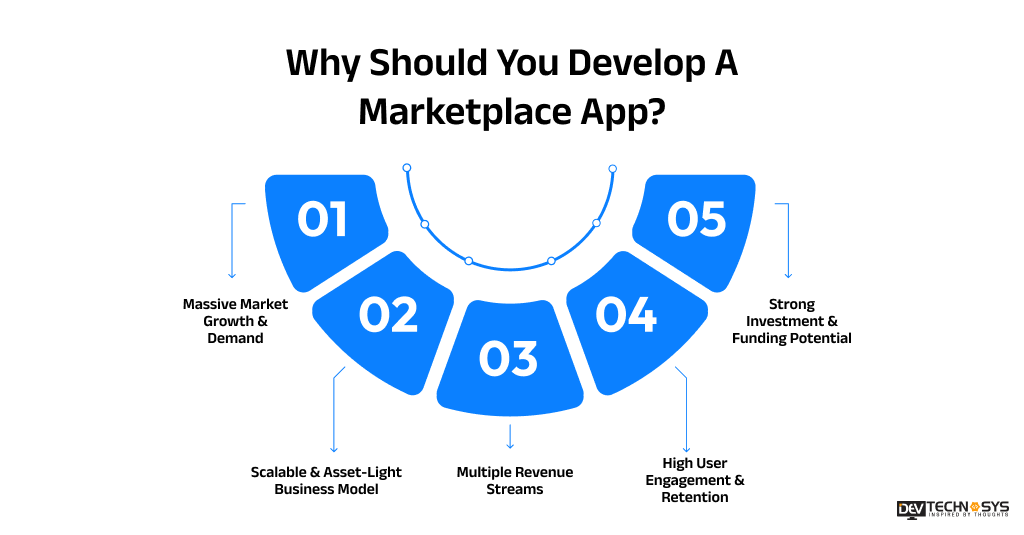
Why Should You Develop A Marketplace App?
An online shopping marketplace app is changing the face of digital business with a scalable model that is highly in demand with the public and capable of generating significant revenue. For investors and entrepreneurs, it is a great chance to offer a profitable, future-ready platform.
1. Massive Market Growth & Demand
The worldwide online marketplace sector is thriving. Headless commerce is predicted to reach $8 trillion by 2026. More than 60% of online transactions are conducted via marketplaces, thereby demonstrating consumers’ great confidence and constant demand in multi-vendor platforms across different industries.
2. Scalable & Asset-Light Business Model
Classified marketplace apps, unlike conventional businesses, do not require you to keep stocks. Amazon-type platforms work with third-party sellers, which enable you to rapidly grow with negligible operational costs, broaden categories, vendors, and user base, all without heavy infrastructure investment.
3. Multiple Revenue Streams
Marketplace app development solutions provide a wide range of ways to make money from the platform, such as commissions, subscriptions , featured ads, and so on. To illustrate, Airbnb and similar platforms profit from service fee charges to both parties, buyers and sellers. The approach offers continuous and scalable revenue-generating potential.
4. High User Engagement & Retention
Multi-vendor shopping apps are always associated with repeat usage. In fact, research reveals that users spend 30-50% more time on platforms that provide variety and competitive pricing. Besides, mechanisms like reviews, recommendations, and personalized feeds play a role in hooking users and fostering retention over the long haul.
5. Strong Investment & Funding Potential
Due to their scalability and high profitability potential, marketplace startups intrigue investors a lot. The success of companies like Uber and Etsy, which have attracted large amounts of funding, serves as an example that commerce platform apps, when properly executed, have the capability to grow rapidly and even attain very high valuations.
Why Budgeting for Your Project is Crucial?
Budgeting is an essential part of a marketplace app project as it helps to keep the development process in line with your goals and also acts as a backstop against overspending. Technically, the budget clarity helps to feature prioritization, better resource allocation, competitor and market research, and less overspending on developmental phases.
Moreover, it is helpful in better decision-making, timely delivery, and ROI planning. As far as entrepreneurs and investors are concerned, good budgeting results in the minimization of financial risks, better project transparency, and ensuring long-term sustainability during the scaling of the platform in a strategic manner.
Types of Marketplace Application in 2026: Cost Breakdown
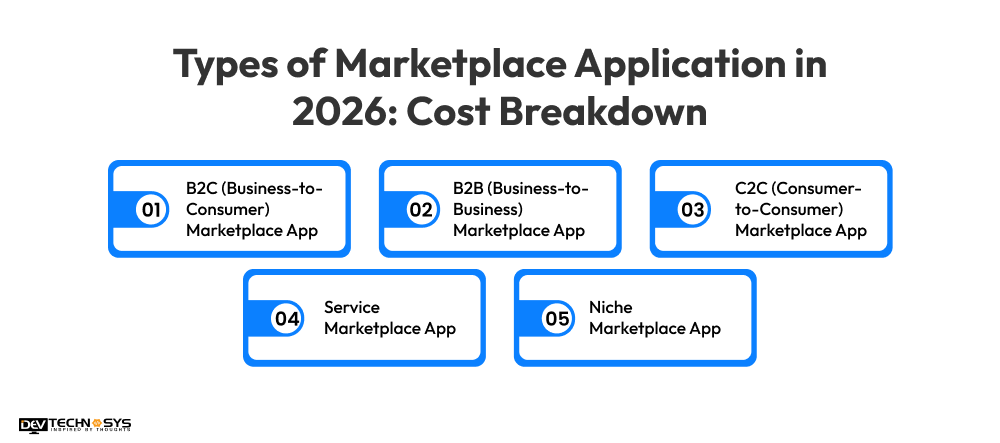
1. B2C (Business-to-Consumer) Marketplace App
A B2C marketplace is one of the most popular types of online marketplace mobile applications, where businesses and end customers are connected directly to one another and perform online selling activities.
These platforms provide a wide range of products, very competitive prices, and are very convenient to use. One of the most well-known examples is Amazon, where, through several sellers, a very large global audience is reached very efficiently.
B2C Marketplace App Development Cost Breakdown
Development Level |
Features Included |
Estimated Cost |
| Basic | Product listings, cart, user login | $12,000 – $15,000 |
| Medium | Payment integration, reviews, filters | $15,000 – $17,000 |
| Advanced | AI recommendations, multi-vendor panel | $30,000 |
2. B2B (Business-to-Business) Marketplace App
B2B (Business-to-Business) marketplaces are primarily focused on businesses being able to perform transactions with each other. These transactions are often between bulk orders or wholesale pricing, and generally, a longer-term relationship between the partners is also expected.
B2B marketplaces like these also facilitate the procurement or sourcing of goods and the management of the supply chain. If you look at Alibaba, their platform is a perfect example. It enables manufacturers and suppliers to connect with retailers and distributors from all over the world.
B2B Marketplace App Development Cost Breakdown
Development Level |
Features Included |
Estimated Cost |
| Basic | Vendor profiles, product catalog | $13,500 – $15,500 |
| Medium | Bulk pricing, order management | $15,500 – $19,500 |
| Advanced | Ecommerce CRM, analytics dashboard | $19,500 – $29,500 |
3. C2C (Consumer-to-Consumer) Marketplace App
People selling products or services directly to the consumers of their products or services can do so with the help of a C2C (consumer-to-consumer) platform. Thanks to a C2C online platform, people can sell products or services in an easy, quick, and convenient manner.
Such online platforms, which are primarily peer-to-peer exchanges, of course, have become very popular mainly as a means of reselling or selling second-hand goods. eBay and OLX are the two most famous examples. They offer tools to both buyers and sellers so that they can make their transactions as simple and accessible as possible.
C2C (Consumer-to-Consumer) Marketplace App Development Cost Breakdown
Development Level |
Features Included |
Estimated Cost |
| Basic | User listings, messaging | $12,500 – $14,500 |
| Medium | Ratings, search filters, payments | $14,500 – $16,500 |
| Advanced | Location tracking, fraud detection | $16,500 – $28,500 |

4. Service Marketplace App
Service marketplaces enable users to connect with professionals or service providers rather than buying physical products. Users of these platforms can access various kinds of services such as transportation, freelancing home services, and other on-demand services.
To give you some examples, if you need a ride, Uber will come to you. On the other hand, if you are a business looking to get some freelancing work done, then a service marketplace like Fiverr would be the place to go.
Service Marketplace App Development Cost Breakdown
Development Level |
Features Included |
Estimated Cost |
| Basic | Service listings, booking system | $13,000 – $15,000 |
| Medium | Scheduling, payments, notifications | $15,000 – $17,000 |
| Advanced | Real-time tracking, AI matching | $17,000 – $29,000 |
5. Niche Marketplace App
A niche marketplace app is used to denote a type of marketplace that is either catering to a very specific audience or just a very specific product category, in other words, focusing on very targeted customer needs.
Not only do these platforms bring together customers with a shared set of interests, but they also often offer a varied range of specialized products that you can’t easily find anywhere else. One of the best examples is Etsy, which specializes in handmade and various kinds of creative/artistic items, which in turn allows them to consistently attract a unique and very loyal customer base.
Niche Marketplace App Development Cost Breakdown
Development Level |
Features Included |
Estimated Cost |
| Basic | Category-specific listings | $12,500 – $14,000 |
| Medium | Custom filters, branding | $14,000 – $16,000 |
| Advanced | Personalization, community features | $16,000 – $28,000 |
Hidden Costs of Marketplace App Development You Shouldn’t Ignore
Hidden charges that can eat up your overall budget when it comes to cost to build a marketplace app. Undoubtedly, some of them are not so straightforward to spot at first sight, especially if we are talking about “initial” ones.
Knowing the costs of your market ahead of time will allow you to better prepare yourself financially and avoid surprises down the road, which will help you maintain a steady and secure financial situation over time.
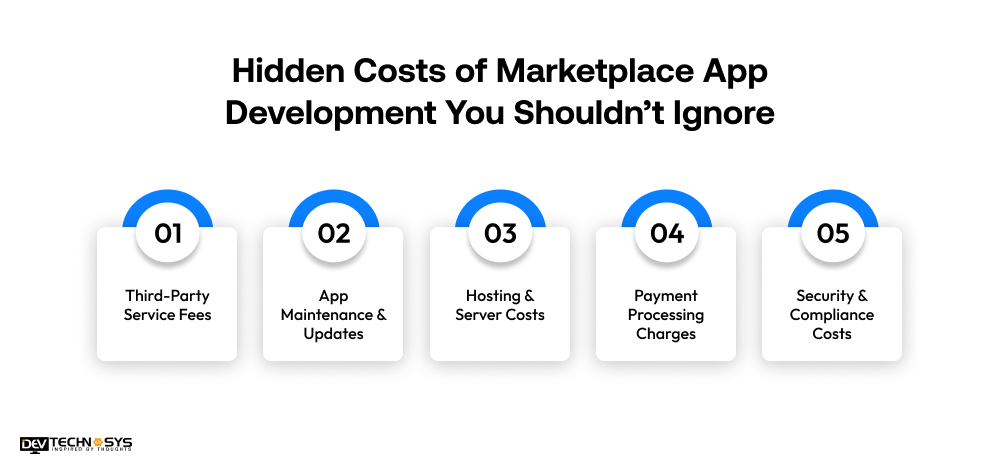
Hidden Cost Factor |
Short Description |
Estimated Cost |
| Third-Party Service Fees | APIs like payments, SMS, analytics | $100 – $500/month |
| App Maintenance & Updates | Bug fixes, updates, improvements | $2,000 – $5,000/year |
| Hosting & Server Costs | Cloud storage and server scaling | $200 – $800/month |
| Payment Processing Charges | Transaction fees by gateways | 2% – 5% per transaction |
| Security & Compliance Costs | Data protection and legal compliance | $1,500 – $4,000/year |
1. Third-Party Service Fees
Most ecommerce software uses third-party applications for payment processing gateways, SMS notifications, maps, reporting tools, etc. Each of these services typically charges either a monthly fee or a fee for each transaction performed, and while the fees may seem insignificant in the short term, they will likely add up quickly as your number of users continues to increase.
2. App Maintenance & Updates
Once your app is launched, you will also have ongoing maintenance to fix bugs, improve performance, and provide updates for the lifetime of your application. The ongoing online marketplace app maintenance services costs for new operating system versions and feature enhancements are usually a major expense and can be roughly 15-20% of the total initial cost to develop a marketplace app each year.
3. Hosting & Server Costs
As your marketplace continues to grow, you will need to continually expand your infrastructure and the cloud services you use to support the increasing demand for your app, including both the amount of data stored and the amount of data transmitted by users on your platform. In addition to this, your operational costs will continue to rise as the number of active users and transactions on your platform rises.
4. Payment Processing Charges
Whenever a customer completes a transaction through your marketplace, the payment gateway provider will charge your business a fee based on a percentage of the total transaction amount. The typical fee is usually around 2% to 5% of the total amount, depending on the number of transactions you processed that day or week. This fee structure can limit your profit margins as you continue to process more transactions.
Want a chatbot demo or pricing? Fill the form and talk to our experts today.
Pick what you need below — you can select more than one — then tap Get detail to continue.
-
Chatbot demo dashboard
-
Cost to develop an app
-
Industry report
-
Case study
5. Security & Compliance Costs
Ensuring data security and meeting legal compliance standards, such as GDPR or payment security regulations, requires additional investment. This includes encryption, audits, and security updates, which are essential but often underestimated in the initial development budget.
How Long Does It Take to Build a Marketplace App? A Complete Timeline Breakdown
A virtual marketplace application will be developed in a 3 to 6-month timeframe. The duration depends largely on the type of features you want to include, as well as on the app’s overall complexity level. First of all, it’s the planning stage when you’re shaping your idea, then comes designing the app’s UI, etc. Next, the developers will create the app’s frontend and backend, then integrate key functionalities, and finally test the app before it is released.
Marketplace App Development Timeline
Stage |
Activities |
Duration |
| Planning | Define goals, features, and requirements | 1–2 weeks |
| UI/UX Design | Create wireframes and user interface | 2–3 weeks |
| Development | Frontend, backend, integrations | 6–10 weeks |
| Testing | Bug fixing and performance checks | 2–3 weeks |
| Deployment | Launch on app stores | 1 week |
5 Proven Tips to Reduce Marketplace App Development Costs
Building a marketplace app doesn’t have to be so expensive that it changes your financial plans. Actually, by utilizing the right methods and clever planning, you can really cut many of the expenses related to app development, at the same time making the platform that is both of excellent quality and capable of growth, and also competitive.
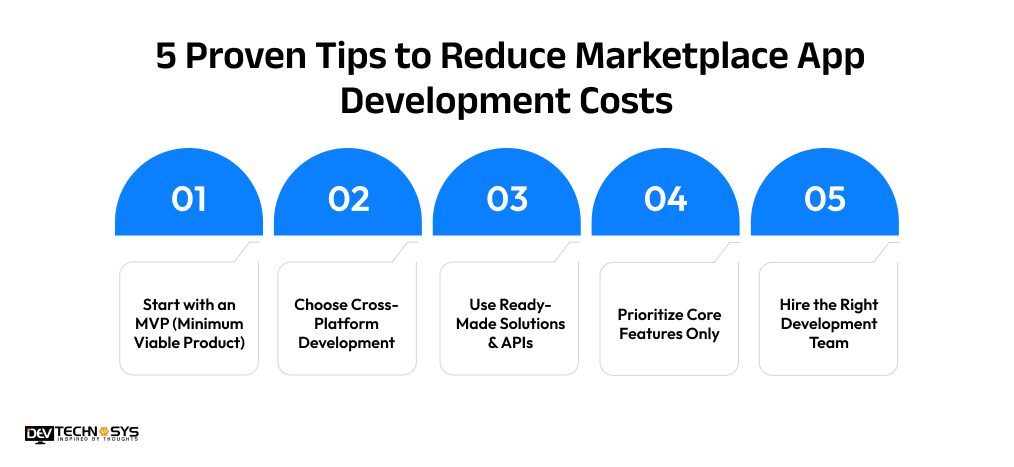
1. Start with an MVP (Minimum Viable Product)
Initially, do not invest all your resources in building the perfect and full-featured app. Rather, limit your reach and concentrate on making an MVP (Minimum Viable Product) only with essential features such as user certification, voice search, listings, and payments.
Such a scheme helps you both reduce your custom ecommerce development cost and, at the same time, will give you a chance to test your concept, collect users’ feedback, and gradually make improvements.
2. Choose Cross-Platform Development
By adopting cross-platform frameworks such as React Native or Flutter, you simultaneously create a mobile app that is compatible with both major operating systems, i.e. Android and iOS. Using shared resources eliminates the need for multiple development teams to develop and maintain each feature individually, thereby reducing the amount of code that would need to be written, which in turn reduces the costs associated with developing and maintaining an app.
3. Use Ready-Made Solutions & APIs
Use existing tools, templates, and third-party APIs for specific features, such as payments, chat, notifications, and analytics, which means you don’t have to develop each feature from scratch, allowing you to spend less time and money developing and provide a working and scalable app that meets the requirements of a marketplace, as a result.
4. Prioritize Core Features Only
Do not add unnecessary features to the initial version of your application; rather, concentrate on the core features that will have the most significant impact on user experience and revenue generation. Features can always be added to a later phase, enabling you to develop your app within your budget and launch it more quickly than if you added features from the start.
5. Hire the Right Development Team
Having the proper development team is also a major contributor to cost. An experienced shopping app development company may seem expensive but working with them can save you time and money by reducing costly mistakes, development delays, and rework compared to working with a less experienced ecommerce web design company, as well as providing you with a higher-quality and scalable marketplace app.
Top Features That Influence Marketplace App Development Cost
The features you choose for your marketplace app can greatly affect your total cost to build a marketplace app. Features range from simple application functionality and interactive capabilities (the most basic) to complex functionality and advanced capabilities; each feature adds additional levels of complexity and affects performance and scalability.
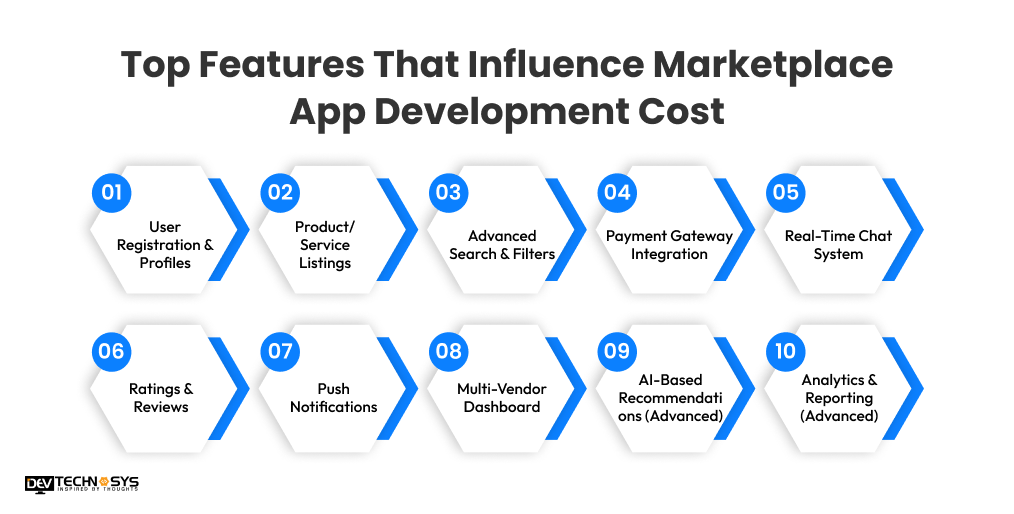
Feature |
Estimated Cost |
| User Registration & Profiles | $800 – $1,500 |
| Product/Service Listings | $1,000 – $2,000 |
| Advanced Search & Filters | $1,200 – $2,500 |
| Payment Gateway Integration | $1,000 – $2,000 |
| Real-Time Chat System | $1,500 – $3,000 |
| Ratings & Reviews | $800 – $1,500 |
| Push Notifications | $700 – $1,200 |
| Multi-Vendor Dashboard | $2,000 – $4,000 |
| AI-Based Recommendations | $2,500 – $5,000 |
| Analytics & Reporting | $1,500 – $3,000 |
1. User Registration & Profiles
Provides the user with a secure method to sign up for the marketplace, login to their marketplace account, and manage their profile to create a buyer’s or seller’s account and manage their account and personal information.
2. Product/Service Listings
Multi-vendor ecommerce marketplace allows sellers to register products or services with various categories, including different types of product or service images, descriptions, pricing, and classification/styling.
3. Advanced Search & Filters
Highly effective product search feature equipped with various filters, including price category, location, and ratings, greatly enhances the overall user experience and enables users to locate suitable results very efficiently.
4. Payment Gateway Integration
A secure system for payment processing that supports a wide range of payment options, like credit cards, wallets, and UPI, contributes to the seamless and reliable completion of transactions happening within the platform.
5. Real-Time Chat System
ecommerce solutions integrating a messaging tool offers instant communication between buyer and seller, opening them up to discussing details, negotiating prices, and even creating more buyer and seller engagement and trust.
6. Ratings & Reviews
Giving users a platform to express their feedback and rate products or sellers is a great way to establish trust and credibility, helping new buyers make better purchasing decisions.
7. Push Notifications
Receiving notifications on a real-time basis about new offers, messages , order statuses, and promotions is one of the ways of keeping users involved and encouraging them to interact frequently with the marketplace platform.
8. Multi-Vendor Dashboard
Various sellers can work on adding new products, shipping inventory management, and retaining the marketplace’s operational control while administrators monitor the marketplace operations and hold the analytics via a control panel for admins.
9. AI-Based Recommendations (Advanced)
By analyzing user behavior, preferences, and previous activity, AI ecommerce can suggest products or services that meet the user’s profile, thus significantly enhancing personalization and conversion rates.
10. Analytics & Reporting (Advanced)
Leaders in charge of the platform can leverage sophisticated analytics to understand customer behavior, measure sales effectiveness, and identify trends, thus enabling them to make data-informed decisions and strategically scale their marketplaces.
5 Ways to Monetize a Marketplace App in 2026
Successful monetization of marketplace apps in 2026 involves implementing thoughtful methods that complement not only the user’s experience but also the platform’s core revenue model. Intelligently selected monetization strategies help ensure steady streams of income and efficient platform growth.
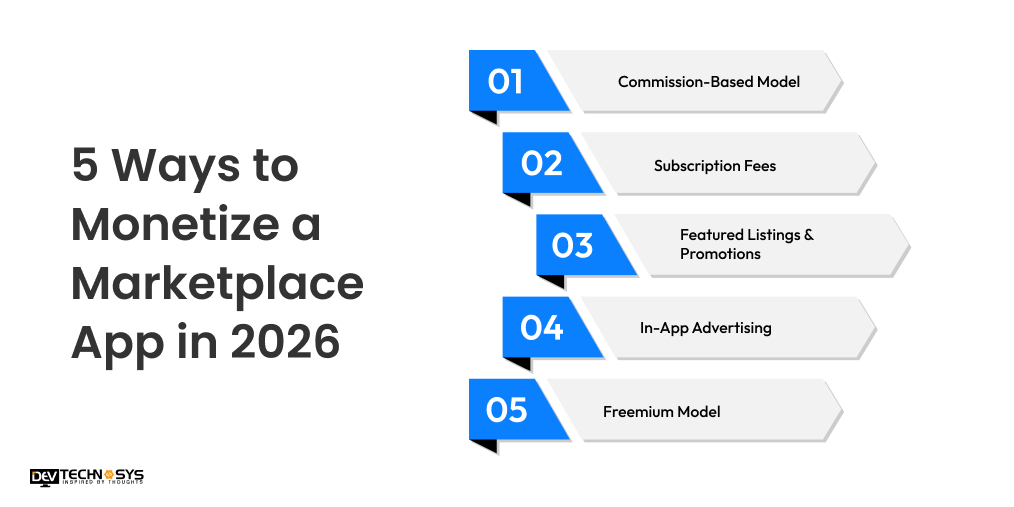
1. Commission-Based Model
Charge a commission percentage from each transaction closing between buyers and sellers. This base monetization strategy is the most widely used and is able to accommodate a large number of transactions since the sum paid increases as usage of the platform goes up and does not entail payment in advance from the users; hence, by this method, sellers and buyers become customers more easily.
2. Subscription Fees
Give sellers or service providers a package of subscription that grants access to exclusive features, for example, enhanced reporting, better visibility and unlimited listing opportunities. According to the ecommerce development company, this will generate a steady and predictable revenue flow, and simultaneously push the businesses to stay engaged on your platform.
3. Featured Listings & Promotions
Marketplace apps like ETSY enable sellers to pay a higher amount in order to put their product or service in the first place among search results, or in a note-worthy area on the website. Besides getting a better sales performance through the increase in the seller visibility, your platform will also be able to earn more money through the sale of paid ads.
4. In-App Advertising
Hosting ads by third-party marketers within your app is one way to generate income.As your user base continues to grow in size, brands will want to reach your users, thus making advertising an excellent source of passive income for your platform, without charging users for using the platform.
5. Freemium Model
Provide users with basic functionalities of your platform for free, but charge them for using high-end functionalities like advanced filtering, priority support, and exclusive tools. By using this model, you will initially bring many more users to your platform, and then over the course of time, convert a small portion of those users to become paid customers.
You can reach out anytime; we are available 24/7. Our team provides a quick response.

Conclusion
There is a wide range in the cost to build a marketplace app. Features, complexity, and scalability play a big role. Accordingly, the cost to develop an e-commerce marketplace can range from $12,000 to $30,000. Planning & design, development, and maintenance are all stages that add up to the final budget.
Eventually, a marketplace app can scale well, become a source of revenue, and thus become a business that grows and delivers a strong return on investment for both entrepreneurs and investors. Starting with a minimum viable product (MVP), focusing on the main features, and selecting the most appropriate way to develop are the steps that help you in cost-saving measures.
How Dev Technsoys Can Help You Build A Marketplace App?
We leverage our expertise gained over 15 years to develop scalable and efficient marketplace apps. Our competent team can take care of all the stages from the validation of the concept, UI/UX designing, to development, testing, and implementation.
Dev Technosys is an online marketplace development company that aligns with your business objectives, offering not only smooth performance but also up-to-date features and scalability in the future. Our client-oriented method and proven skills are at your disposal to bring to market a safe, cost-effective, and a marketplace app that is driven by revenue generation.
Frequently Asked Questions
Find answers to the most common questions related to this article.
Cost to develop a marketplace app varies from $8000 to $30,000. However there factors influencing the price of your project are the complexity of the software, the features, the design, as well as the team in charge of development. You will also need to consider that sophisticated features and the need for greater capability can markedly increase expenditure.
Typically, it takes anywhere from three to six months for the full marketplace app development life cycle (which includes planning, UI/UX design, development, testing and deployment). Depending on the app complexity (i.e., how customized and/or integrated) and the advanced functionality desired, it may take longer than six months to develop the app.
Some of the main cost components of an app include complexity, design quality, platform selection, backend development, third-party integrations, security features, and development team expertise. The cost to make a marketplace app will be a function (e.g., time and money) of the level of customization and/or scalability required for each of these components.
To save the cost to create a marketplace app for startups, you may begin with a minimum viable product (MVP), utilize cross-platform development tools and focus on essential features. By leveraging pre-built solutions and APIs, you can reduce development time and costs while maintaining the intended functionality and performance of your marketplace app.
Marketplace apps monetize by charging commissions per transaction, subscription fees, and advertising. Some platforms use freemium models, in which users receive free access to basic services while paying for premium services, providing a consistent and scalable source of income for the platform.