



















In this contemporary world, Artificial Intelligence (AI) has taken over almost every industry. From automatic cars to personalized apps, AI systems everywhere are transforming the way decisions are made. However, several AI systems work as Black Box, where we can see inputs and outputs but remain unaware of how they actually work.
This opaqueness always raises questions about accountability, trust, and the fairness of Black Box AI. So this article will cover details related to Black Box AI, how it works, what exactly it is, and why explainability is needed. We will also learn the techniques used in Black Box interpretation, comparison between Black Box AI and White Box AI.
This guide also discusses the challenges and future of Black Box AI. As the blog ends, you will also end up having a deep learning Black Box.
What Is Black Box AI?
Let’s say you are working with an AI system that usually makes important decisions. The decision includes loan approvals, face recognition, detecting a tumor in a scan, and so on. An output of these decisions is approved or rejected. But when we ask how this conclusion has come, there is no clear answer. So, this is what Black Box is.
Black Box AI is an Artificial Intelligence system where we have input and output, but its internal working is not easily understood by humans. The lack of transparency makes it less trusted, and the result is marked as AI-generated. That’s why choosing a generative AI development company to create a transparent and reliable AI system is in demand.
How Does Black Box AI Work?
In this section, we will study the process, how a Black Box AI works:
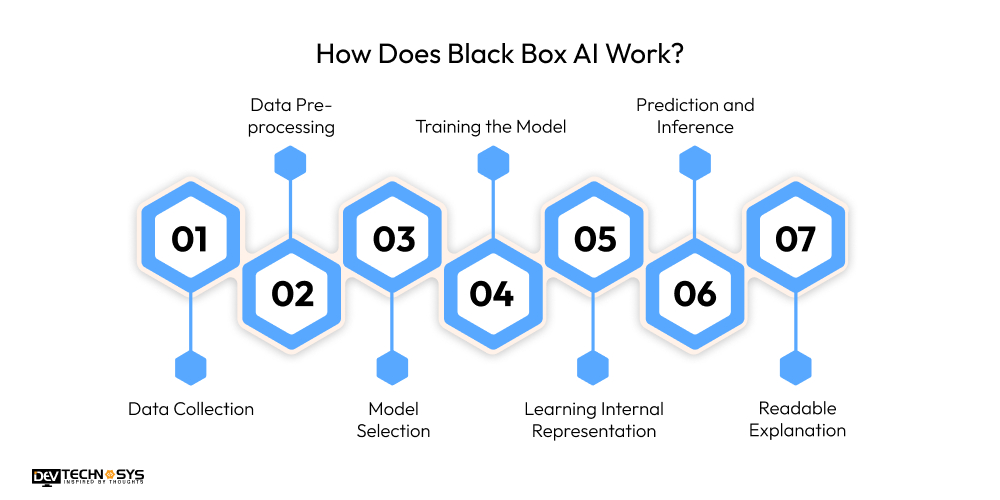
1. Data Collection
The first step in that begins the working of Black Box AI is collecting vast data. This data collection includes financial records, images, and behavior logs of the users. The quantity of the data collected significantly impacts AI decision-making.
2. Data Pre-processing
In this step, the data collected is cleaned and structured. Here, developers eliminate mistakes, normalize values, and convert data into a proper format. Make sure you have a dedicated developer team that creates stable models that are all set for scalable learning.
3. Model Selection
In the third step, AI engineers select a strong algorithm to handle its complexity. They generally pick a neural network for its capability to manage the difficulty. However, transparency is sacrificed by these opaque algorithms for performance.
4. Training the Model
Through optimization methods, the model processes inputs that adjust internal parameters. This process prepares the model to expect accurate outputs. However, the internal logic remains hidden even from the designers.
5. Learning Internal Representation
The models develop abstract patterns throughout multiple layers during the training. These patterns cannot be understood by humans and lead to neural network interpretability. This makes it difficult to explain how the model makes a decision.
6. Prediction and Inference
As the training is completed, the model is prepared to evaluate new inputs and generate outputs. But because of Black Box problem in AI, users can see only the result, not the logic and variables behind each process.
7. Readable Explanation
Finally, when the result appears, Black Box AI doesn’t show how the input affected the result. The internal logic remains hidden under the weight of values and mathematical functions. This makes it impossible to explain the decision in normal language.
What Are Real-World Examples Of Black Box AI?
Healthcare, finance, hiring, and autonomous systems are some of the sectors Black Box AI is used. Let us understand the concept of Black Box AI with some real-world examples.
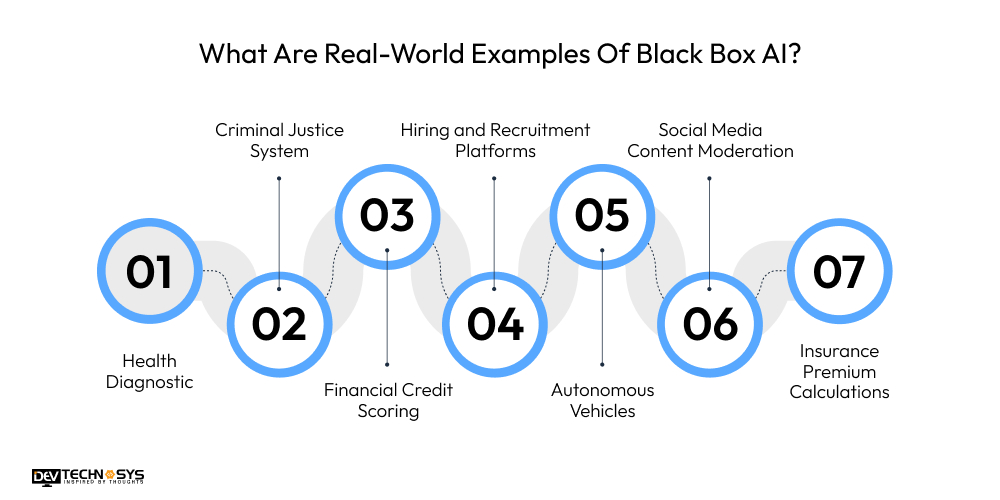
1. Health Diagnostic
In the healthcare sector, diseases like cancer can be detected from medical scans with the help of deep learning models. They surpass doctors’ theories when it comes to accuracy. The reason behind the result remains opaque, leaving doctors hesitant about whether to trust this result or not.
2. Criminal Justice System
AI-based risk assessment tools are used in numerous courts to predict the chances of reoffending a crime. Usually, lawyers and even the accused cannot see or challenge the result given by Black Box AI. However, this sometimes leads to unfair outcomes and injustice.
3. Financial Credit Scoring
Banks utilize AI to decide who is eligible for a loan. If the system rejects any application, even banks don’t know why it gets rejected, or how to challenge this decision. This results in worsening current economic and social differences.
4. Hiring and Recruitment Platforms
Automated screening tools examine resumes to identify who is suitable for the job. But sometimes these tools can unfairly favor some undeserving candidates. In such cases, AI does not give any reason for its decision.
5. Autonomous Vehicles
Autonomous vehicles, such as self-driving cars, use AI to make quick driving decisions in case of panic situations. Sometimes it becomes difficult for even developers to analyze the way AI acts when an accident takes place.
6. Social Media Content Moderation
Usually, harmful and inappropriate contents get detected by AI filters on social media platforms. Oftentimes, user accounts get suspended or some posts get removed without clear reasons. Due to this, people’s trust and credibility in such platforms are reduced.
7. Insurance Premium Calculations
Some insurance companies use AI to guess how risky a person is, which makes the insurance prices for people go up. However, these people remain unaware of the exact reason why and how it happened.
What is the Importance of Explainability in AI?
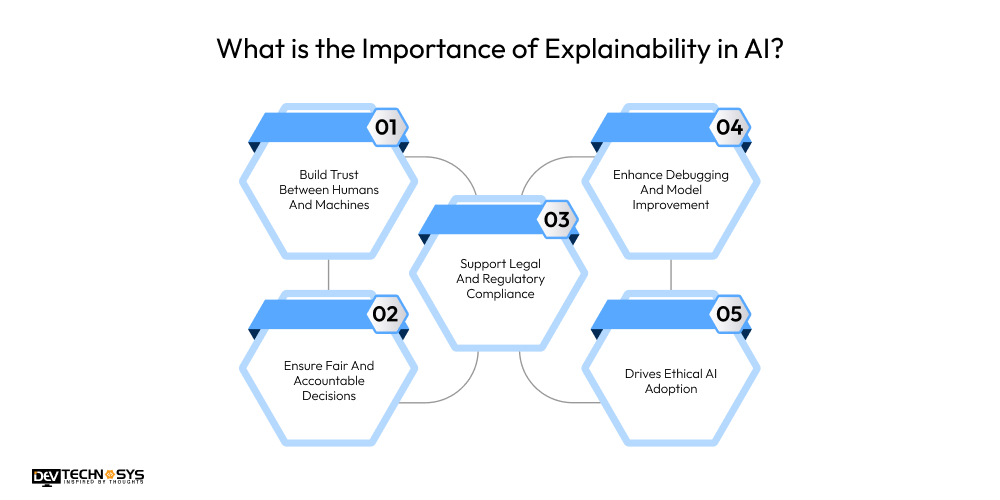
Explainability makes AI decisions understandable, trustworthy, and fair. It helps users and organizations make informed, responsible, and ethical choices. Here, we will go through the importance of Explainability in AI.
1. Build Trust Between Humans And Machines
Explainability in AI connects human users and technical systems. When people get to understand the reason behind the decisions made by AI, they start trusting AI applications. This encourages the usage of AI in crucial sectors like governance, health, finance, and IT.
2. Ensure Fair And Accountable Decisions
Transparency in AI allows organizations to understand how the AI system works, along with the proper data and logic behind it. This supports AI accountability on explainable outcomes. This makes it easier to find and fix any unfair decision.
3. Support Legal And Regulatory Compliance
Governments are working on making laws in which companies to elaborate on the reasons behind automated decisions. In this case, explainable AI (XAI) models meet the requirements set by the government.

4. Enhance Debugging And Model Improvement
When engineers can understand how the AI model works, they can easily improve debugging and models. They can effortlessly find and fix the issues. This makes the AI system more trustworthy, reliable, and faster.
5. Drives Ethical AI Adoption
Explainable systems adapt AI ethics to encourage innovations and support the use of technology. It makes sure every decision taken with AI is clear and justified. This helps in promoting transparency and accountability in innovation.
What Are The Techniques To Interpret Black Box AI?
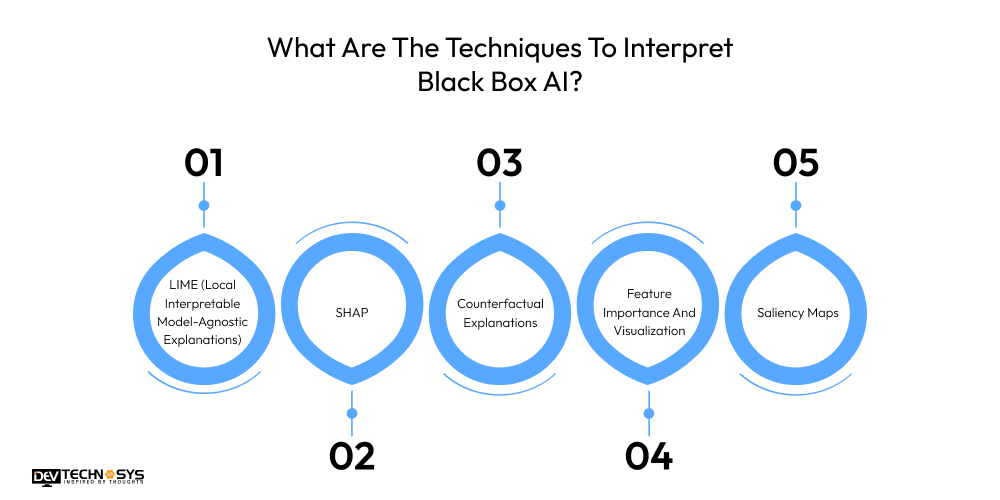
LIME, SHAP, counterfactuals, and saliency maps are the techniques that help reveal hidden logics in AI decisions. It improves transparency and reduces errors. Now we will discuss these techniques that are used to interpret Black Box AI.
1. LIME (Local Interpretable Model-Agnostic Explanations)
LIME (Local Interpretable Model-Agnostic Explanations) helps make complex AI decisions easy to understand. It explains the reason behind the specific predictions made by AI, and shows the factors that influence the result. It modifies complicated models into clear and human-friendly insights and even builds trust and transparency.
2. SHAP
SHAP (Shapley Additive exPlanations) uses fair mathematical rules from game theory to show how each factor impacts the AI estimations. It also explains the contribution of each feature exactly, and it helps develop trust and transparency among the users. It also empowers businesses and users to make data-driven and confident decisions.
3. Counterfactual Explanations
Counterfactual Explanations techniques explain that even a small change could result in a different AI decision. They provide transparent and actionable insights to help users make decisions and boundaries. Mobile app developers for hire to make informed choices for clear, better, and unbiased outcomes. It makes sure that the AI decision aligns with real-world expectations.
4. Feature Importance And Visualization
To interpret Black Box AI, techniques like permutation importance and partial dependence plots are mainly used. These techniques explain which factors affect the decision of AI models the most. It provides a clear and big-picture view of features shaping overall AI outcomes. AI becomes more understandable and transparent with these techniques.
5. Saliency Maps
Saliency Maps work for neural networks in image recognition. These maps highlight the parts of an image that primarily affect the decision of AI. It makes people see exactly what the model emphasizes. It improves machine learning transparency in computer vision systems and makes it transparent and trustworthy.
What is the Difference Between Black Box AI Vs White Box AI?
White Box AI offers visible internal logic, making it easier to understand, audit, or justify the predictions as compared to Black Box AI. This is the biggest difference between them. Let us compare Black Box AI and White Box AI on different bases:
Basis |
Black Box AI |
White Box AI |
| AI Interpretability | Low. The decision process is hidden | High. Logic is transparent and easy to follow |
| Algorithm Type | Complex (e.g., deep neural networks, ensemble models) | Simple (e.g, decision trees, linear regression) |
| Performance on Complex Tasks | Often high due to deep pattern recognition | May be lower on highly complex or unstructured data |
| Transparency | Opaque – users can’t see how outputs are made | Clear – outputs are traceable to inputs |
| Debugging & Auditing | Difficult – hard to identify issues | Easier – errors can be traced back and fixed |
| Regulatory Compliance | Challenging – lacks explainability in sensitive areas | Easier – meets standards in sectors needing accountability |
| Use Cases | Image recognition, natural language, and fraud detection | Risk assessment, credit scoring, and medical rules-based systems |
| Trust & Accountability | Lower – hard to justify decisions | Higher – decisions can be explained and defended |
Why Is Black Box AI a Problem?
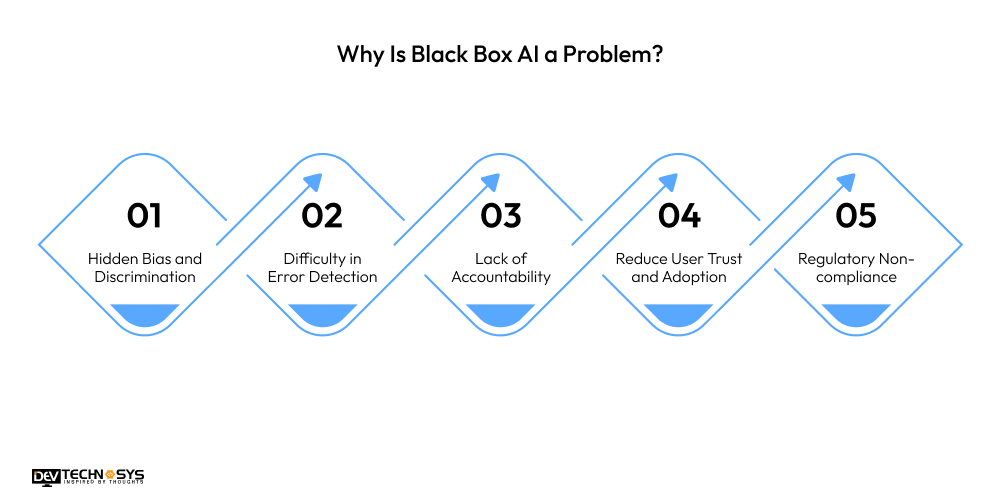
Black Box AI can create bias, reduce trust, cause regulatory issues, and increase AI app development cost when errors need correction. Here, we will learn the reasons why Black Box AI is considered a problem in detail.
1. Hidden Bias and Discrimination
Without explainability and AI interpretability, Black Box AI can unknowingly spread hidden biases from its training data. This leads to unethical, unfair, and unequal outcomes. This results in a lack of transparency, and it becomes more difficult to detect and fix determinations. This raises serious concerns related to AI bias and fairness.
2. Difficulty in Error Detection
As Black Box AI systems are difficult to understand, so identifying errors and malicious manipulations becomes difficult. This can be considered dangerous in sectors like transportation and healthcare. A single unclear decision can lead to an extremely serious risk in these sectors. So organizations must create safer and reliable systems.
3. Lack of Accountability
When the AI’s decisions are undesirable and without a proper explanation, the organization comes with a lack of accountability. These decisions are considered unjustified and can’t even get audited. It will get hard to rectify the errors and ensure fairness. It doesn’t abide by the ethics and transparency standards of AI governance.
4. Reduce User Trust and Adoption
When users question the outcomes of AI opaque models, it weakens AI trust and transparency.
When people are unable to understand or interpret results, they hesitate to adopt such systems for further use. It also reduces overall acceptance, engagement, and confidence in solutions that are powered by technology.
5. Regulatory Non-compliance
Usually, when organizations fail to explain decisions, Black Box AI causes regulatory non-compliance. Laws such as GDPR demand accountability, fairness, and transparency in AI systems’ decisions. When AI models are not explainable, it becomes risky and expensive for businesses to use them legally and responsibly.
What is the Future of Black Box AI?
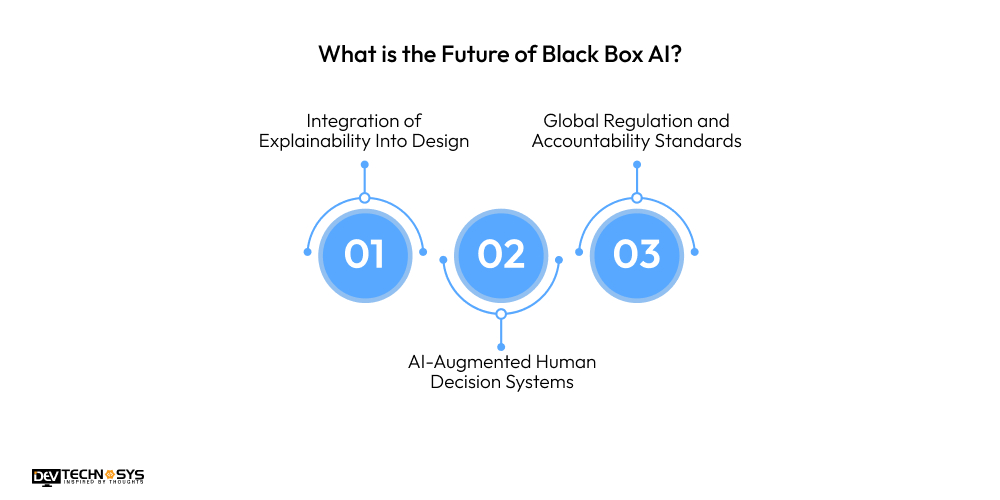
Now, you might have a question: Is there any future of Black Bocx AI? So we will now study some crucial points that explain the conditions in which Black Box has a future.
1. Integration of Explainability Into Design
The future of Black Box AI is only in their ability to build transparency from the beginning. Nowadays, AI development company focus on developing design systems with built-in model explainability. This helps them not waste time, energy, and effort in fixing opaque models later. Integrating explainability makes every prediction understandable, ethical, and aligned. It also fosters the user trust and regulatory needs.
2. Global Regulation and Accountability Standards
The government has introduced global AI rules and regulations, making transparency no longer an option. These rules are strict and force organizations to eliminate algorithm opacity. These regulations maintain the standards of accountability by promoting fairness and clarity in decisions. Its responsible compliance across industries throughout the world will be a new definition when it comes to Black Box AI’s future.
3. AI-Augmented Human Decision Systems
The concept that AI will replace human decisions is false; AI will assist human decisions, but does not replace them. Many businesses will go for skilled mobile app developers for hire and develop apps combining automation and human insight. When AI-augmented human decision systems are generated, they will result in accurate, accountable, and ethical outcomes. AI assists humans by improving decisions through explainable, user-focused systems.
Conclusion
Coming to a conclusion, we can say that Black Box AI makes it hard to understand how decisions are made. This reduces trust, fairness, and legal compliance in the results. This problem is solved by explainable AI by making systems transparent and interpretation easy. From designing to monitoring, the organization also needs to build transparency with growing AI implementation. The primary goal is not just to make AI a smart tool but also a trustworthy tool. This allows people to rely on clear, responsible, and fair decisions made by AI. You can approach a mobile application development company like Dev Technosys to clearly understand Black Box AI.
FAQs
Q1. What Is Explainable AI [XAI]?
Explainable AI is a technological method that transforms AI decisions so that humans can easily understand them. It enables logic and accountability with every decision.
Q2. Why Is AI Interpretability Important?
AI interpretability is important as it lets developers and users grasp the model decisions, builds trust, compliance, and transparency in sensitive cases.
Q3. What Are The Main Challenges With Black Box AI?
The challenges that appear with AI include:
- Difficulty in auditing
- Non-compliant with regulatory demands for transparency
- Prone to systematic bias
Q4. How Can Companies Reduce AI Development Costs While Ensuring Transparency?
Companies can reduce the costs of AI development while ensuring transparency by:
- Adopting modular frameworks
- Open-source XAI tools
- Reusable interpretability models
Q5. What Role Do Ethics Play In AI?
Ethics plays a vital role in designing AI responsibly, lowering the damage, protecting privacy, and aligning the decisions with human values.