


















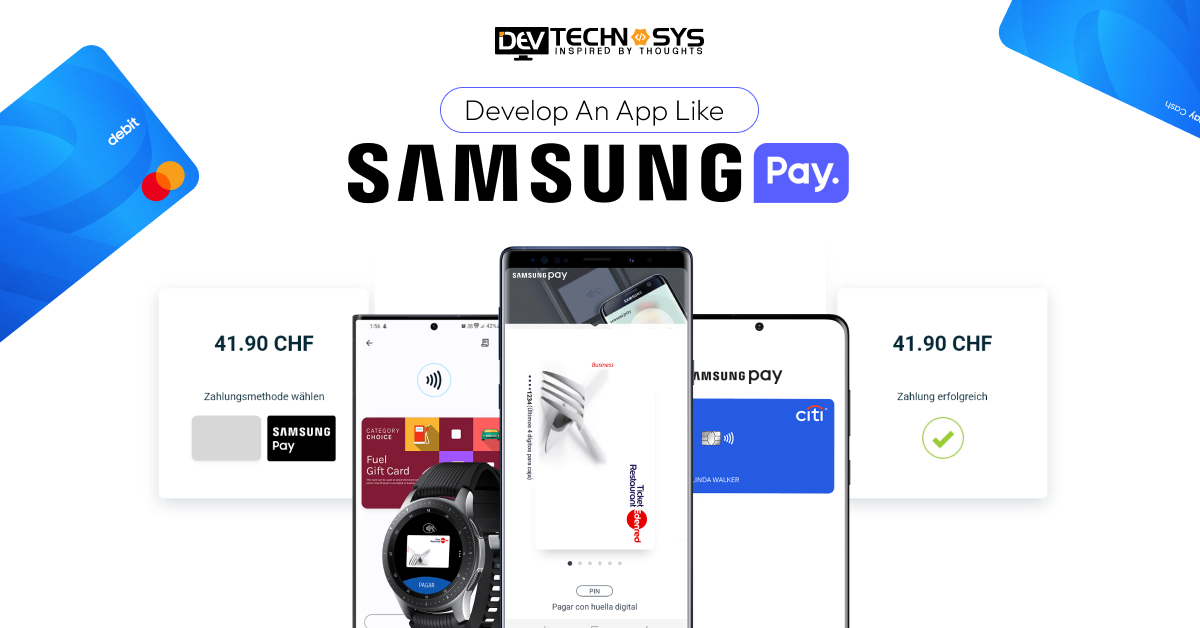
Have you ever thought of paying for coffee, groceries, or even your next flight ticket by just a quick tap of your phone? This is the world of digital payments, which is slowly but surely taking over our everyday lives as wallets become smaller and cards disappear.
One of the superheroes which are leading this transformation is Samsung Pay fast, secure, and very convenient. So, what if you could come up with an app that works the same magic?
This blog is an exploration of the exciting way to develop an app like Samsung Pay without complicated technical terms and endless confusion. If you are a startup or a business, the outcome of either your big dream or your readiness to dominate the fintech space is the same: creating a secure, feature-rich, user-friendly payment app that is loved by its users is feasible.
We’ll handle it step-by-step by breaking down the buzzwords such as NFC and digital tokenization into simple, practical steps.
It’s time to make your payment app work for you instead of you working for the app!
What is Samsung Pay?
Samsung Pay is a handy wallet that snugly fits in your Samsung smartphone or smartwatch. Fast and easy, Samsung Pay is an all-in-one NFC and MST service that makes your device a point-of-sale terminal.
Thus, it is compatible with most RFID and NFC card terminals, digitizes your real-world wallet by allowing you to add as many cards as you like, and grants you swift, hassle-free, and encrypted payment transactions wherever you go and whatever you buy.
How Does Samsung Pay Work?
Before use the app, you must know that how does the Samsung Pay app work. So, here we provide the step by step working process:
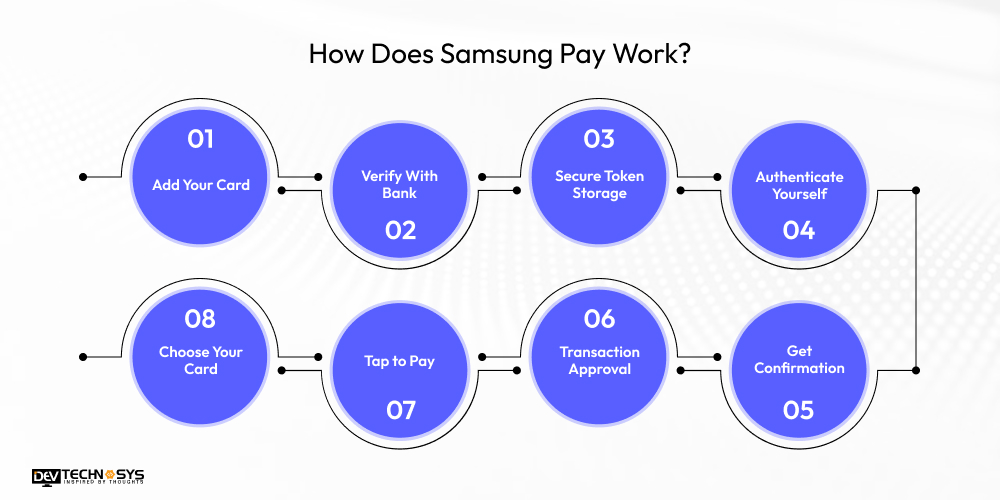
1. Add Your Card
Introduce your card to Samsung Pay by scanning the card or entering your card information manually.
2. Verify With Bank
Follow the given instructions for verification through an OTP or bank authentication to ensure proper activation of your card.
3. Secure Token Storage
Using tokenization and encryption technologies, Samsung Knox stores a very secure and private version of your card.
4. Authenticate Yourself
In order to make a payment, it is necessary to unlock your device with a PIN, fingerprint, or face recognition.
5. Get Confirmation
Once the transaction is done, get an instant notification and a digital receipt.
6. Transaction Approval
The bank that issued your card processes the token and gives a green light for the transaction to go through.
7. Tap to Pay
By holding the phone close to the payment terminal the transaction is carried out either through NFC or MST, an interaction completed in a matter of seconds and is contactless.
8. Choose Your Card
Navigate to the card you wish to use with the help of Samsung Pay and select it.
Market Stats on Samsung Pay
- Samsung Pay is used in about 29–31 countries worldwide.
- Samsung Pay has a global market share of around 14% in mobile payments and is thereby ranked as one of the top-3 mobile wallets in the world.
- According to the report, Samsung Pay processed approximately 1.6 billion transactions annually in 2025.
- The average transaction value of the service is roughly estimated to be 42.50 US dollars, which is notably higher than the vast majority of its competitors.
- As regards the Asia-Pacific region (which includes the home market of Samsung), approximately 40% of Samsung Pay users worldwide can be found there.
- About 75% of Samsung Pay transactions are retail purchases, the remaining 25% being made in other areas such as in-store and online payments, for instance.
- It is said that the platform operates on top of the Android-based mobile-wallets market with a 35% share of Android wallet transactions.
- In some of its strong markets nfc payment app development reaches very high levels of adoption: for example, in its core markets, a great majority of smartphone owners are said to be the ones that actively use it.
6 Steps to Develop an App Like Samsung Pay
To develop an ewallet app like Samsung Pay, it takes careful and expert planning, strong technologies, and a full-range execution to build a secure, high-performing digital wallet like Samsung Pay. The process is made easier if you hire a professional mobile app development company, as they guarantee that your app will comply with global finance standards.
Here are six detailed steps to assist you in developing an app like Samsung Pay:
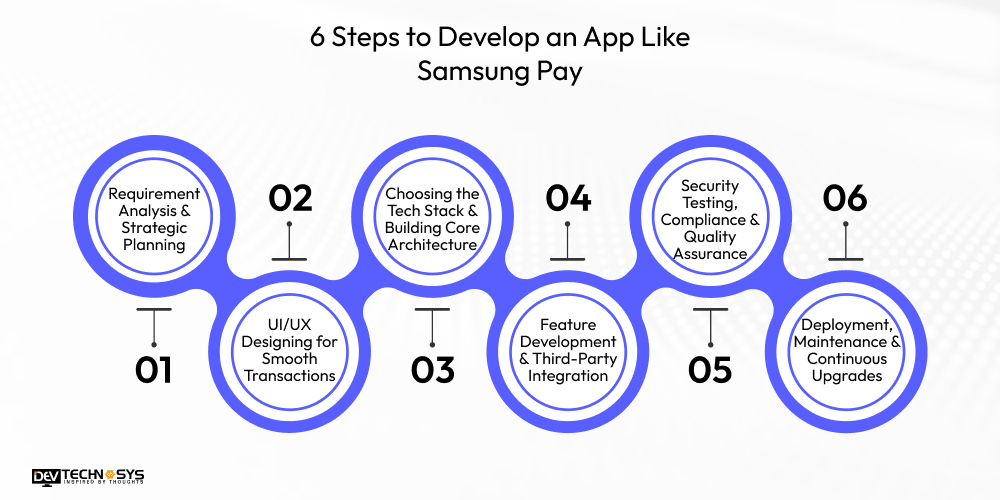
1. Requirement Analysis & Strategic Planning
In the first step to develop an app like Samsung Pay, define your vision jointly with the mobile app development company. You discuss the purpose of the app, the possible users, the payment technologies to be used (NFC, MST, QR), and the core features like contactless payments, tokenization, biometric security, in-app wallets, and card management.
To back up their actions, the development team performs market research, competitor analysis, and feasibility studies. After that, the roadmap is filled in with the schedule, money, and materials that will be used, thus ensuring that the project will start with a clear understanding and a strategic approach.
2. UI/UX Designing for Smooth Transactions
The step after that is the creation of a simple-to-use digital wallet layout. A proficient mobile app development firm draws up wireframes, mockups, and interactive prototypes that demonstrate the effortless user flows.
UI/UX design is all about the easy addition of cards, the speedy execution of payments, the authentication taking a minimum of steps, and a clean dashboard for rewards, offers, and transaction history. The main thing is the app to be as simple, fast, and secure as Samsung Pay’s minimum yet very powerful interface.
3. Choosing the Tech Stack & Building Core Architecture
Hire mobile app developers to decide the technology stack after getting the green light for the design – the stack usually consists of Kotlin/Java for Android, Swift for iOS, React Native/Flutter for cross-platform, and dependable back-end frameworks like Node.js, Python, or Java Spring Boot.
The development company is constructing a secure system that enables various payment methods such as NFC, MST alternatives, UPI, QR code scanning, tokenized payments, and card management.Apart from this, the stage comprises of constructing various layers such as encryption, biometric systems, cloud infrastructure, and database management to handle millions of transactions securely.
4. Feature Development & Third-Party Integration
In the fourth stage to build an ewallet app like Samsung Pay, it is all about programming the necessary advanced features, such as contactless payments, virtual cards, expense tracking, loyalty rewards, biometric login, one-tap authentication, and fraud monitoring systems.
Besides that, the app development company also integrates tokenization services, secure payment gateway integrations, banking APIs, and customer support modules. The developers take great care to ensure that the application works smoothly in various devices and environments.
5. Security Testing, Compliance & Quality Assurance
The firm that develops Samsung Pay-like apps carries out very strict security testing as these apps handle very sensitive financial data. The testing comprises penetration testing, encryption testing, device-level security evaluation, biometric accuracy checks, and transaction integrity verification.
Security measures are in place such as PCI DSS, GDPR, and RBI guidelines, KYC norms, and industry-standard security protocols. Alongside other types of testing such as functional, performance, usability, and load testing are also performed to remove the bugs that the app can handle large transaction volumes smoothly and ensures users’ satisfaction.
6. Deployment, Maintenance & Continuous Upgrades
Afterward, the app is released in app stores as well as being linked with payment networks, partner banks, and secure servers. The Android app development company keeps track of the functioning, resolves the issues, and releases the patches, along with adding new features such as AI-based insights, virtual cards, and travel mode wallets.
The uninterrupted maintenance guarantees the stability, security, and smooth user experience of the app in the long run.
Why Do Entrepreneurs Want to Develop an App Like Samsung Pay?
In a world where smartphones serve as wallets and digital payments are gradually becoming the norm, entrepreneurs are inclined to develop an e-wallet app like Paytm or Samsung Pay. So, why is this trend gaining so much popularity? Here are five reasons that are propelling this vision:
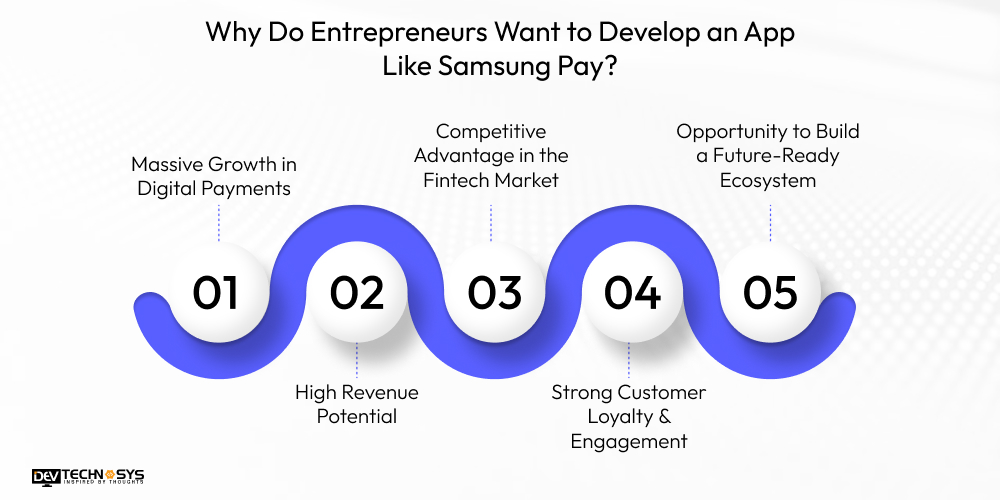
1. Massive Growth in Digital Payments
Cashless payments have become very popular globally. Millions of people are using contactless methods without the need for cash or cards. Samsung Pay alternatives would be a smart business move for entrepreneurs to enter the market because they can rapidly offer their customers a convenient and modern way to pay. The demand is rising, and businesses want to ride the wave early.
2. High Revenue Potential
A fintech app like PayPal significantly increases the revenue potential of the business by opening various streams such as transaction fees, merchant partnerships, loyalty programs, value-added services, subscription plans, and data-driven insights. Entrepreneurs consider apps like Samsung Pay, which is based on technology, as future assets that can bring them steady and scalable revenue.
You can reach out anytime; we are available 24/7. Our team provides a quick response.
3. Competitive Advantage in the Fintech Market
By standing out, businesses can create a significantly positive impact on their growth. The provision of a secure, feature-rich digital wallet is definitely one way to make a business distinguish itself from others in the market.
Samsung Pay alternatives futuristic features, including NFC, tokenization, biometric login, and fast transactions, brilliantly motivate entrepreneurs to elevate their customer experience with innovative, next-level solutions.
4. Strong Customer Loyalty & Engagement
Banking applications like Chime have become the hub of people’s daily lives. From utility payments and shopping to traveling and online purchases, people employ these apps for various purposes in their lives. Such daily routine involvement provides business owners with a solid base for brand loyalty, which eventually helps in the creation of a user-dependent ecosystem.
5. Opportunity to Build a Future-Ready Ecosystem
A payment app is not simply a product it is a long-term ecosystem that the entrepreneurs can extend into. They can turn it into rewards platforms, credit solutions, budgeting tools, financial planning, and merchant services. Developing an app such as Samsung Pay is the first step in creating a complete digital finance ecosystem that has infinite potential for growth.
Best Samsung Pay Alternatives
Now that you know the mobile app development process it is best if you go through some of the amazing samsung pay alternatives. So lets go get the alternatives of samsung pay.
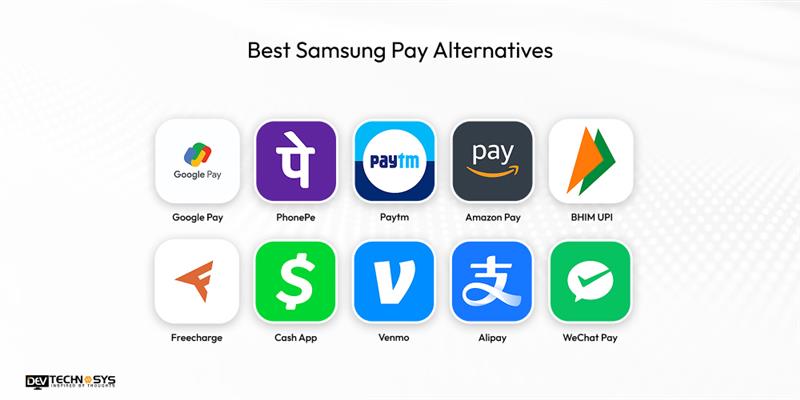
App Name |
Rating |
Downloads |
Use |
| Google Pay | 4.4 | 1B+ | UPI payments |
| PhonePe | 4.3 | 500M+ | Daily transfers |
| Paytm | 4.6 | 100M+ | Bills & UPI |
| Amazon Pay | 4.5 | 100M+ | Shopping payments |
| BHIM UPI | 4.5 | 50M+ | Simple UPI |
| Freecharge | 4.3 | 50M+ | Recharges & bills |
| Cash App | 4.6 | 50M+ | Money transfer |
| Venmo | 4.5 | 50M+ | Social payments |
| Alipay | 4.8 | 1B+ | Super-app wallet |
| WeChat Pay | 4.6 | 1B+ | Chat payments |
Advanced Functions Of An App Like Samsung Pay
Here is the list of some amazing & advanced functions of an app like samsung pay which will help you build a better alternative.
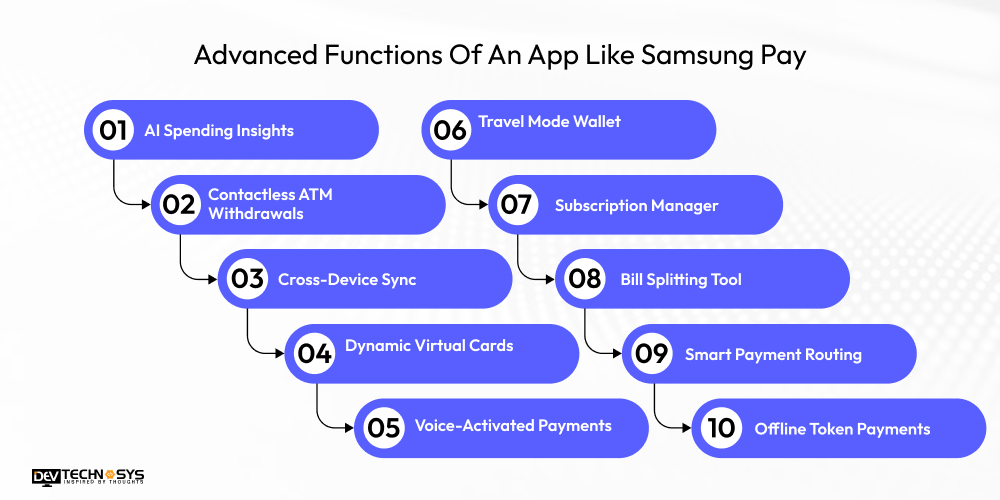
1. AI Spending Insights
Samsung Pay app clone intelligently figures out your spending habits with the help of AI and accordingly offers very helpful and practical budgeting tips, category-wise expense predictions, as well as monthly financial health scores to users, thus giving them the opportunity to make money-related decisions in a smart way, and that too practically without exerting any effort.
2. Contactless ATM Withdrawals
Without the need to insert a card, users can get money out of ATMs that support them through NFC-based authentication. Along with this, biometric verification and encrypted tokens ensure that the person using the cash is the right one and that this method is completely secure. So, at any time, users can have touch-free access to their money.
3. Cross-Device Sync
All payment information, cards, rewards, and settings of a user are effortlessly synchronized across their smartphones, tablets, and smartwatches. In this way, the user can have their wallet with them at any of the linked devices and can make payments from there without wasting time.
4. Dynamic Virtual Cards
An app like Brigit creates ephemeral virtual card numbers for Internet purchases so that no one will be able to steal the card details that are provided during the transaction. Once the transaction is done, the temporary card number that has been used expires immediately thus providing augmented safety for digital transactions.
5. Voice-Activated Payments
In an environment, where a user can quickly and easily employ the means available to him in order to complete transactions, the transaction becomes even more comfortable when the user uses his/her voice for authorization. This process is carried out using pure AI voice recognition, multi-layer security checks, and encryption to ensure the user’s utmost safety and issuelessness.
6. Travel Mode Wallet
It automatically adjusts to global travel by displaying the local currency, giving up-to-the-minute conversion rates, permitting worldwide cards, and turning on cross-border security features to make travel payments hassle-free.
7. Subscription Manager
An app like Zelle locates and monitors all the subscriptions in use and sends reminders, auto-cancel options, and spending summaries so that users can efficiently manage streaming, shopping, and service renewals.
8. Bill Splitting Tool
By using AI-based expense recognition, it automatically separates expenses with friends, sends payment requests, tracks settlements, and integrates with contact lists to make group payments and shared purchases simple.
9. Smart Payment Routing
Card rewards, cashback, card limits, and current offers are some of the factors considered when the system chooses the best card for each purchase, thereby helping users save more by making every transaction work.
10. Offline Token Payments
By using pre-stored encrypted tokens, it offers the possibility of limited secure offline payments. This ensures that transactions can be carried out even if there is no internet connection. This can be very helpful in situations such as travel, emergencies, or when there is a network outage.
Key Features of App Like Samsung Pay
Customer Panel |
Merchant Panel |
Admin Panel |
| Quick & Easy Pay | Real-Time Payment Tracking | Centralized User Management |
| Secure Card Storage | Automated Refund Handling | Advanced Data Monitoring |
| Earn Reward Points | Smart Invoice Alerts | Intelligent Fraud Detection |
| Tap & Go Payments | Deep Customer Insights | Regular System Updates |
| Detailed Expense Logs | Monthly Sales Reports | Configurable Access Rights |
| Personalized Offer Alerts | QR Code Payment Support | Policy & Rule Setup |
| Biometric Secure Login | Fast Transaction Search | Scheduled Server Backups |
| Manage Multiple Cards | Instant Payout Requests | Detailed Activity Logs |
| Simple App Setup | Easy Billing Tools | High-Level App Security |
| Faster Checkout Experience | Complete Order Management | Role-Based Management |

How Much Does It Cost To Develop An App Like Samsung Pay?
Normally, the cost to build an app like Samsung Pay is between $8,000 and $25,000 or more. The mobile app development cost depends on the security layers, features, NFC integration, multi-platform development, compliance, and advanced payment capabilities. Bank integrations may increase the Samsung pay app development cost of enterprise-level builds to over $30,000.
App Type / Complexity |
Estimated Cost |
What’s Included |
Basic Digital Wallet App |
$8,000 – $12,000 | Simple payments, authentication, basic UI, limited integrations |
Mid-Level Samsung Pay–Like App |
$12,000 – $25,000 | NFC support, tokenization, card storage, encryption, multi-platform build |
Advanced Samsung Pay Clone |
$25,000 – $30,000 | Biometric security, fraud detection, bank integrations, AML/KYC compliance |
Enterprise-Level Payment App |
$30,000+ | Multi-bank integrations, AI fraud monitoring, PCI-DSS compliance, advanced security, large-scale infrastructure |
5 Factors Affecting the Samsung Pay App Development Cost
To maintain the overall project budget, you must know about the cost-affecting factors that can highly impact on cost. it includes various factors such as backend infrastructure, project complexity, basic and advanced features, deployment platforms, and more. So, here we provide the several key factors:
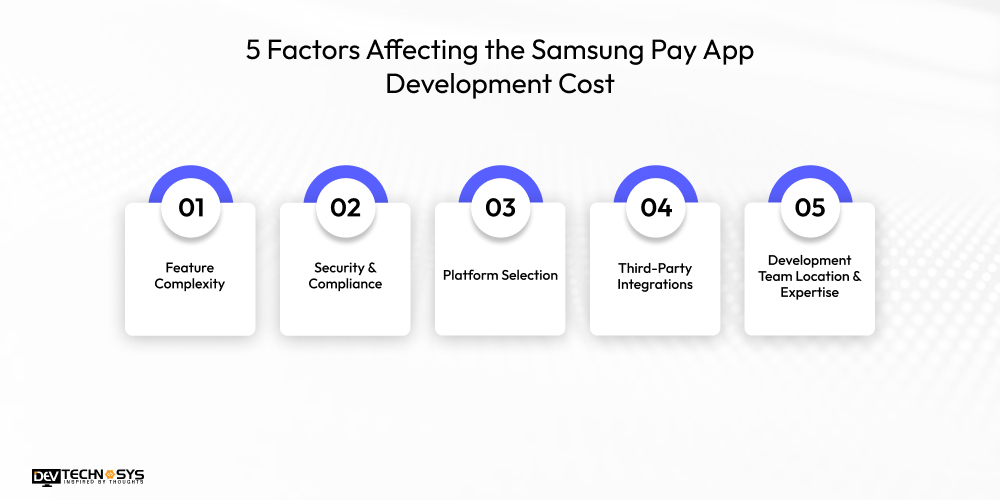
1. Feature Complexity
The development of the advanced features would require, for example, NFC payments, tokenization, biometric authentication, card integration, fraud detection, and real-time transaction monitoring.
This will significantly increase the development time as well as the security requirements and hence the total cost to develop an app like samsung pay will be much higher compared to that of a simple payment related app.
2. Security & Compliance
The main factor that influences the ewallet app development cost is the implementation of invasive payment standards such as PCI-DSS, AML, KYC compliance, encryption, and multi-layer fraud protection requires a developers team with top-notch skills. thorough testing which in turn results in higher samsung pay app development cost but at the same time ensures safe financial transactions and user confidence.
3. Platform Selection
The cost to develop an app like Samsung Pay is affected by the decision to build an app for Android, iOS, or a cross-platform. Non-cross-platform applications need separate codebases, and thus, more development hours will be required, whereas cross-platform development cuts down the cost to build an ewallet app but gives a slight chance of limited access to device-specific NFC features and capabilities.
4. Third-Party Integrations
On the other hand, it sounds complicated enough that you can only imagine the complexity of this code if the author writes about integrating quite a number of things: banks, card issuers, payment gateways, wallets, NFC systems, and APIs.
Consummation of each on the list of integrations involves licensing, custom software development, security audit, and testing with these stages contributing significantly to the whole cost to build an app like Samsung Pay.
5. Development Team Location & Expertise
Where the iphone app development company lives makes a difference in how much they command per hour. The difference between the rates of the US/UK and India teams is significant since those coming from the first-mentioned places ask for much higher rates than those from the second one.
Senior ewallet app developers, knowledgeable in security, will enhance the product but will, at the same time, increase the cost to build an app like Samsung Pay.
Monetization Ways Of Samsung Pay
If you want to invest in ewallet app development solutions like Samsung, having knowledge on monetization techniques in your pocket is a must. In this we have covered 5 impeccable monetization techniques which is a must.
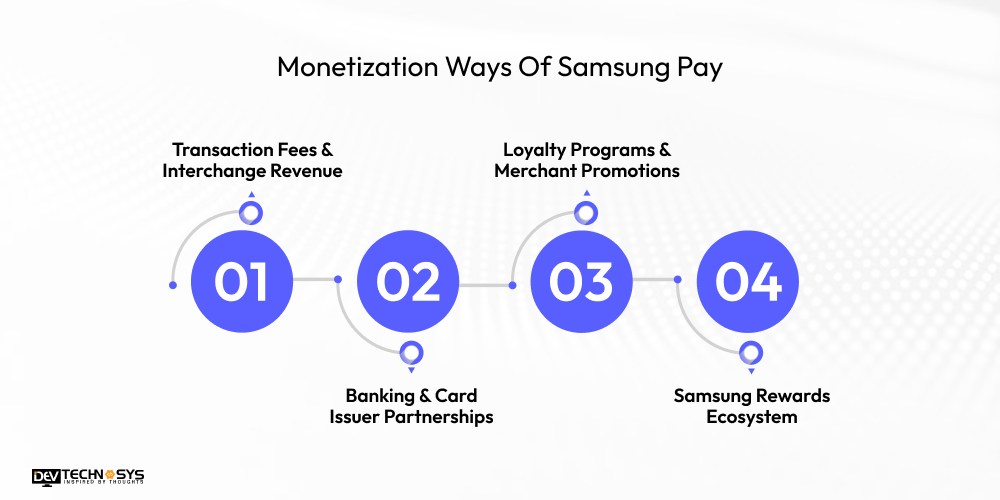
1. Transaction Fees & Interchange Revenue
Samsung Pay is able to take a cut of the money spent with the bank or card network which is usually a percentage but still, a small fraction of the whole. In essence, fees are low per transaction, but the high volume of transactions drives consistent revenue for Samsung Pay.
2. Banking & Card Issuer Partnerships
Banks and financial institutions are the ones paying Samsung for what looks like the following activities: integrating cards, promoting digital payments, and offering co-branded financial services. These partnerships fund Samsung Pay’s network extension and overall long-term partnership revenues.
3. Loyalty Programs & Merchant Promotions
In collaboration with retail brands, paypal app development can offer exclusive in-app deals, cashback offers, and reward points to users.According to the merchants, they are billed for the visibility, ad placements, and performance-based promotions that lead to customer spending.
4. Samsung Rewards Ecosystem
Users earn points for transactions, thus, motivating them to use the same method of payment again. Part of the Samsung strategy is to monetize this ecosystem by creating partnerships with brands which pay to advertise their products, rewards, or gift cards in the points redemption marketplace.
In A Nutshell!
The Samsung Pay app kind of building the app is your gateway to the digital payment revolution, the era of which is dominated by unparallelled convenience, security, and innovation. With a proper developer team, the concept of your app can be turned into a brilliant, clever, and user-friendly payment app capable of handling the future.
You are therefore one step closer to the creation of a fintech marvel with each move you make in this direction, a move that consists of the simple, tap-and-go encrypted transactions and the intelligent features. So, if you want to make an app like Samsung Pay, connect with a reputed ewallet app development company to get high-quality solutions.
Frequently Asked Questions
Find answers to the most common questions related to this article.
The price of digital payment applications with full functionality and security varies by features, security layers, tech stack, and region, and generally, the cost to build an app like Samsung Pay is between $10,000 and $25,000.
Typically, creating an app like Samsung Pay takes around 4 to 9 months, and it includes the stages of planning, UI/UX design, core development, API integrations, security testing, and regulatory compliance needed for a high-performance fintech app.
Users encounter the following problems: slow authentication, a limited number of merchants accepting the method, overly complex interfaces, security worries, poor offline functionality, and the absence of a unified rewards system. A new app can provide quicker, safer, more user-friendly, and universally compatible payment methods.
The right stack would be Kotlin/Java for Android, Swift for iOS, React Native/Flutter for cross-platform, Node.js or Spring Boot backend, PostgreSQL/MongoDB databases, AWS/Azure cloud, and secure APIs for payments and authentication.
The best outcome is reached with a mixed model transaction fees, merchant commissions, premium security tools, loyalty partnerships, and subscription-based features. This diversified strategy is a guarantee of consistent revenue, user engagement, and scalability in the long run for fintech growth.