














Key takeaways:
-
- Uncensored AI mobile apps allow conversational freedom to the users while still operating within legal and ethical boundaries
- The growing demand for personalized AI experiences has encouraged businesses and developers to develop uncensored AI mobile apps for better content creation, educational purposes, or conducting in-depth research.
- Functionalities such as text-to-speech, voice interaction, and speech recognition promote a natural user experience.
- These AI-powered mobile applications require responsible AI practices while maintaining security, scalability, and user accessibility.
- Developers should always consider privacy and user control while building such apps to avoid legal issues.
Artificial intelligence has transformed almost all industries, including the AI mobile app development. This advancement is, in fact, a boon for developers to build innovative solutions. They can now develop uncensored AI mobile apps as content generators and business productivity tools.
This rapid adoption of AI technologies has driven significant market growth. According to Market Research Future, the global AI market is expected to grow at a 30.31% CAGR between 2025 and 2035. While most AI-powered applications operate under strict content moderation policies, uncensored AI mobile apps offer greater flexibility.
This factor has increased the demand to build an AI app with minimal restrictions. These apps aim to balance the freedom of expression, user privacy, and responsible AI development while providing open interactions for users. As a result, uncensored AI app development has emerged as a growing trend.
This guide will help users understand the steps to build an AI app, the cost, features, legal considerations, and more.
Understanding Uncensored AI Mobile Apps
Uncensored AI Mobile Apps are designed to provide open-ended conversations with fewer content restrictions. Most AI tools limit discussions or refuse to answer for certain prompts, but uncensored AI apps deliver unfiltered responses based on the user queries.
These applications generate answers based on user intent rather than applying extensive content moderation filters. Since users can engage in broader discussions, uncensored AI apps are used for research, role play, educational, and creative writing. Businesses are finding this to be a great opportunity to develop uncensored AI mobile apps for user engagement.
What Makes an AI App “Uncensored?”
‘Uncensored’ apps are becoming popular because AI platforms enforce strict moderation policies. The goal of creating such an app is to give a more adaptable AI experience to the users. A few points below distinguish the app from conventional AI mobile apps:
1. Privacy-focused Interaction:
Communication made by a user with such apps remains confidential. This ensures users can interact freely with AI without concerns about unnecessary data exposure. Many organizations create uncensored AI mobile apps while keeping privacy in mind.
2. Minimized Content Filtering:
Since conversations are not limited, users have the freedom to discuss a wide variety of topics in detail. There are no automated restrictions for user prompts. This makes the platform effective for research, learning, and content creation.
3. Customizable Moderation Rules:
Developers have the freedom to modify the content policies and restrictions. A more personalized AI experience can be added in the mobile apps while maintaining safety and compliance protocols.
Planning a Mobile App?
Get a tailored development cost estimate in 3 simple steps — app basics, features, timeline, and your contact details.
- 3 quick steps
- 100% free
- Reply in 1 business day
2 Minutes Read
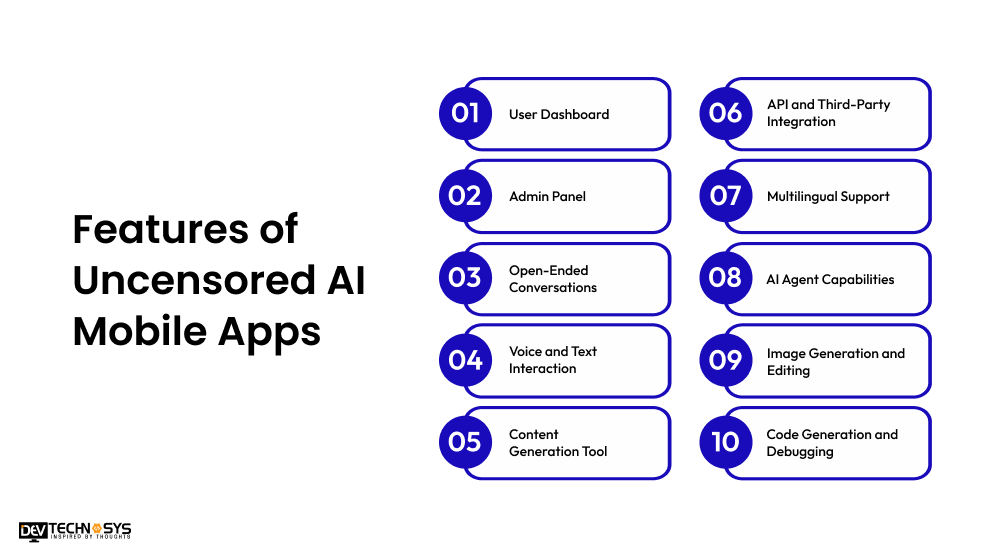
Features of Uncensored AI Mobile Apps
Uncensored AI mobile apps deliver open-ended conversations for the users. These offer greater flexibility with features such as content generation, voice & text interaction, and more while maintaining security. To develop uncensored AI mobile apps, developers must focus on responsible AI practices while assuring scalability and performance.
1. User Dashboard
A centralized dashboard that allows users to view chat history, manage subscription plans, configure privacy settings, and access more controls. Users can get access to all activities from a single page.
2. Admin Panel
This allows administrators to improve privacy policies, configure AI models, manage users, and improve functionality. The admin panel is used to handle user requests, update prompts, and review system logs.
3. Open-Ended Conversations
Users are free to chat over various topics without worrying about prompt restrictions. This not only helps users to get knowledge but also promotes understanding of multiple subjects.
4. Voice and Text Interaction
Considering specific search queries of modern and Gen Z users, AI-powered mobile applications support text-to-speech, speech-to-text, and voice commands. This improves the accessibility of the app and enhances user experience.
5. Content Generation Tool
Conventional AI platforms limit users in content creation, while these AI apps allow users to generate stories, code, articles, and other forms of content.
6.API and Third-Party Integration
Uncensored AI mobile apps can be easily integrated with CRMs, databases, and external tools, allowing developers to build customized AI-driven solutions.
7. Multilingual Support
This attracts a global audience to access the uncensored AI mobile apps. This feature improves user engagement and increases the chances of app usage in different regions.
8. AI Agent Capabilities
Businesses frequently search for AI agent development solutions to manage their regular workflow. This feature automates tasks, helping companies to work effectively with less time consumption.
9. Image Generation and Editing
Modern users are actively generating visuals from text prompts for social media, blogging, or other purposes. This feature allows text-based interactions and improves creative workflow.
10. Code Generation and Debugging
Programmers use uncensored AI mobile apps to identify errors or to generate code snippets. This is a kind of programming assistance that most technical team use to create the best software applications.
Industry Insight:
According to industry projections by Statista, the global AI app market is projected to 14.82% CAGR between 2026 and 2032. This data shows a rapid increase in the adoption of AI-powered solutions by the leading industries.
How to Develop Uncensored AI Apps?
Uncensored AI applications are not developed like traditional AI chatbot apps. The purpose of such apps is to offer greater flexibility for content creation, roleplay, AI image/video/GIF generation, and personalized conversations.
Developers must focus on model selection, defining architecture, and improving user experience. Below is the step-by-step process for large language model app development.
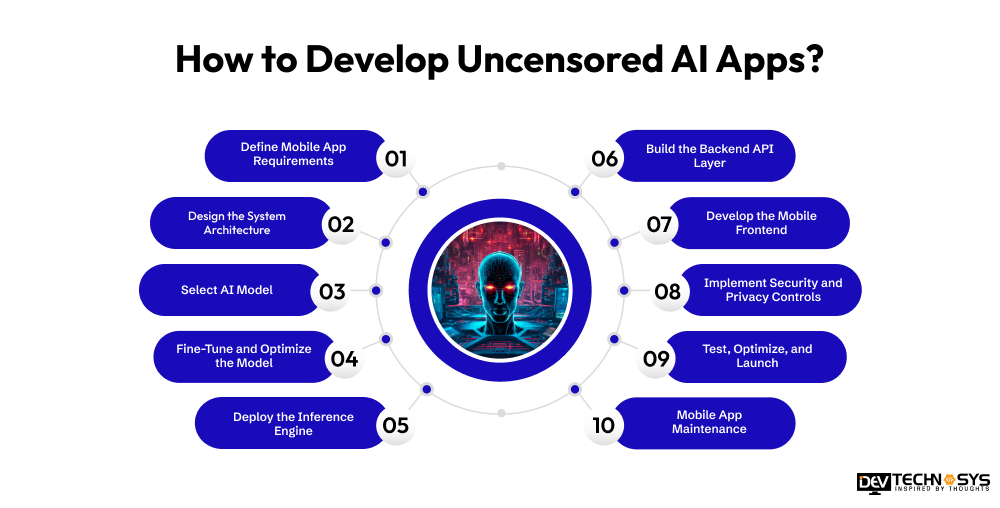
Step 1: Define Mobile App Requirements
Developers should identify the purpose of creating an Uncensored app. Whether it is for educational use, creative storytelling, roleplay, or research assistance. Understanding a clear roadmap is also helpful to analyze the AI app development cost and resources required. Always take note of these details:
- Target audience
- Core features
- Supported platforms (iOS, Android, or both)
- Monetization strategy
- User privacy requirements
- Guidelines of Google Play and App Stores
- Legal Considerations

Step 2: Design the System Architecture
This step is crucial to make the mobile app scalable to make necessary improvements in the future. Architecture should support data storage, real-time communication of the users, improve engagement, and support AI inference. A typical architecture includes:
- AI model hosting layer
- Backend API services
- Authentication system
- Database layer
- Analytics tools
- Mobile frontend
- Cloud infrastructure
Step 3: Select AI Model
For applications such as uncensored AI, it is important to choose the right open-source language model. Popular AI models are Llama, Mistral, DeepSeek, and Gemma. Developers should consider:
- Model size
- Context window length
- Response quality
- Hardware requirements
- Fine-tuning capabilities
- Inference speed
Step 4: Fine-Tune and Optimize the Model
To make uncensored AI mobile apps, fine-tuning must be added to provide a better user experience. This allows customized responses for the users when they search for a specific query. An optimized model ensures quality. This process may involve:
- Instruction tuning
- Reinforcement learning techniques
- Domain-specific training datasets
- Personality customization
- Conversation memory optimization
Step 5: Deploy the Inference Engine
Deploying a high-performance inference framework means a developer is adding value to the usability of the app. Meaning that multiple user requests can be handled efficiently. Popular deployment solutions include:
- vLLM
- Ollama
- Text Generation Inference (TGI)
- TensorRT-LLM
- Hugging Face Endpoints
Step 6: Build the Backend API Layer
Backend is important for security, data storage and management, and for scalability. This is a bridge between the AI model and the mobile app. A secure API layer ensures easy maintenance of the app, handling user requests.
Recommended technologies include:
- Python FastAPI
- Node.js
- Go
- Express.js
- NestJS
Key backend responsibilities include:
- User authentication
- Prompt processing
- Session management
- Subscription handling
- Analytics tracking
- Conversation history storage
- AI response streaming
Step 7: Develop the Mobile Frontend
Frontend in conversational AI app development has to be intuitive and responsive. Users can easily navigate or access the mobile app. Flutter and React Native are the most commonly used technology stacks to build a frontend. Popular frameworks include:
- Flutter
- React Native
- Swift (iOS)
- Kotlin (Android)
Core frontend features of AI agent development typically include:
- Real-time chat interface
- User profiles
- Conversation history
- Voice interactions
- Push notifications
- Theme customization
- Subscription management
Step 8: Implement Security and Privacy Controls
AI applications process a large amount of user-generated content for which privacy should be treated as a top priority. Ensure strong security practices are implemented to safeguard the data. Important measures include:
- End-to-end encryption
- Secure API authentication
- Data anonymization
- Role-based access controls
- GDPR and privacy compliance
- Regular security audits
Step 9: Test, Optimize, and Launch
A mobile app development company or dedicated AI developers focus on continuous testing and optimizing the application to resolve usability issues. Testing should cover:
- AI response quality
- Load testing
- API performance
- Cross-device compatibility
- Security vulnerabilities
- User experience testing
Step 10: Mobile App Maintenance
Developers should introduce new capabilities in the mobile app to improve user experience. They must check for any updates or secure the application. Common post-launch improvements include:
- Voice-enabled AI interactions
- Multilingual support
- Image generation features
- Personalized AI companions
- Agent-based workflows
- Advanced memory system
Timeline to Develop Uncensored AI Mobile Apps
A developer might take 7 months or more to plan, design, develop, test, & launch to build uncensored AI mobile apps. Each development phase is crucial and requires a dedicated timeline. Businesses should be aware of development time to allocate resources and execute the project efficiently.
Development Phase |
Average Timeline |
Description |
| Product Discovery & Requirement Analysis | 1 – 2 Weeks | To understand the target audience, user accessibility requirements, tools/techniques/frameworks used, and monetization strategies |
| System Architecture & Infrastructure Planning | 1 Week | This phase is important to decide cloud architecture, data transfer strategies, and improve the scalability of the app |
| AI Model Selection & Evaluation | 1 – 2 Weeks | This phase requires proper planning of the AI model to be used, features & functionalities that need to be added, cost, and performance factors. |
| AI Model Fine-Tuning & Optimization | 2 – 4 Weeks | Uncensored mobile apps are slightly different from conventional AI tools. These need to be optimized to display data according to role play, content creation, and research. |
| Inference Engine Setup & Deployment | 1 – 2 Weeks | Frameworks such as vLLM or Ollama are deployed to ensure fast responses are delivered while maintaining scalable inference. |
| Backend API Development | 2 – 4 Weeks | Develops APIs for user authentication, prompt processing, session management, AI response handling, and in-app purchases made by a user |
| Database & Memory Management Integration | 1 – 2 Weeks | This phase is essential to deliver a personalized user experience. The app stores user profiles, conversation history, preferences, and contextual memory |
| Mobile Frontend Development | 4 – 8 Weeks | Builds the Android and iOS user interface for real-time response streaming. |
| Security Testing & Quality Assurance | 2 – 3 Weeks | Before the application is about to launch, it is tested for bugs, functionality, and usability improvements. It is assured that the app is secure for the users. |
| Complete Uncensored AI Mobile App Development | 4 – 7+ Months | This is an entire development process that results in delivering a production-ready AI application with custom AI capabilities. The app is launched while following security factors. |
AI Models Used in Uncensored AI Apps
A developer needs a foundational architecture to build a mobile app. We have curated a list of AI models that can be used for uncensored AI mobile app development.
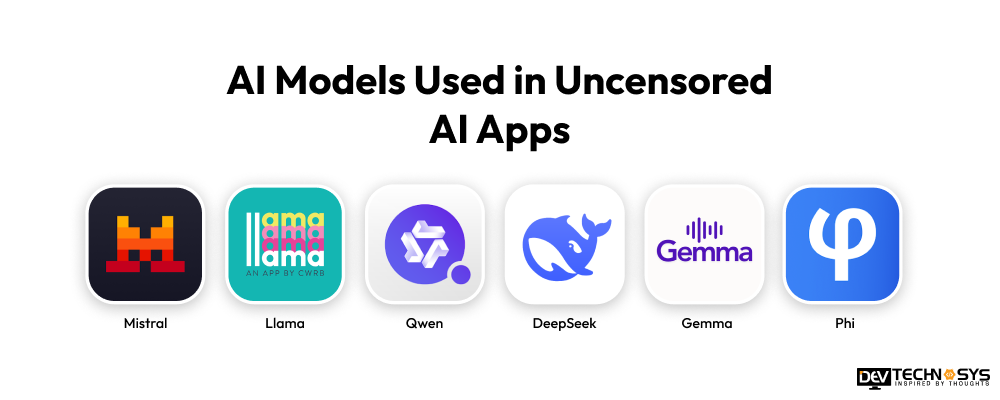
1. Llama
Llama is developed by Meta and is known as the most popular AI model due to its reasoning capabilities. Llama 3 and Llama 3.1 are the commonly used models. Developers can choose this model to build research assistants, AI companions, chatbots, or for content generation.
2. Mistral
This is a lightweight AI model and is cost-effective as well. Variants such as Hermes-Mistral and Mistral-Nemo have fast inference speeds, making them perfect for mobile chat speeds.
3. Qwen
Qwen models are great to use for formatting or to create a structured JSON output. Developers use this model to create a mobile app that is multilingual.
Industry Insight:
According to Business of Apps, the AI app market generated $18.5 billion in 2025. This statistic is a clear indication that businesses are willing to partner with an AI companion app development company.
4. DeepSeek
This is an advanced model that is used by the developers to support deep research prompts by users. Mostly, DeepSeek-V3 or R1 reasoning models are used. This allows users to give deep-logic prompts without standard filtering.
5. Gemma
This AI model is used because of its ability to generate creative content. Implementing this model helps users search for specific prompts to find creative content.
6. Phi
Phi-3 or Phi-4 are typically smaller models that are designed specifically for uncensored AI deployment. The benefit of using Phi is that a developer does not need to purchase a cloud server; the application can be directly accessed on a user’s mobile device.
Want a chatbot demo or pricing? Fill the form and talk to our experts today.
Pick what you need below — you can select more than one — then tap Get detail to continue.
-
Chatbot demo dashboard
-
Cost to develop an app
-
Industry report
-
Case study
Tech Stack Used in Uncensored AI Mobile Apps
A balanced tech stack supports real-time interaction, scalable AI interface, secure data handling, and promotes cross-platform mobile development.
Layer |
Common Technologies |
Purpose |
| Frontend | Flutter | Developers can build cross-platform apps with a single code base for Android and iOS operating systems. They can include multiple features in the mobile app while maintaining the development cost. |
| Backend | Node.js + Express | Their event-driven architecture is well-suited for AI applications to process large volumes of real-time user interactions. These technologies handle APi requests, session management, and chat message processing. |
| Database | PostgreSQL | This type of database is capable of handling data, including user chat history, subscription information, or analytics. PostgreSQL is ideal for building scalable applications with large database handling systems. |
| AI Infrastructure | OpenAI API | Provides access to large language models to generate human-like responses. It helps developers to integrate natural language processing capabilities into their applications quickly. |
| Cloud Hosting | AWS (EC2, ECS, Lambda) | Cloud hosting is important to run backend services and to support serverless execution for automated tasks. |
Developers must use HTTPS, JWT authentication, and encrypted storage to ensure security and privacy. Also, for uncensored or custom-tuned models, self-hosting on GPU servers must be used rather than third-party APIs.
What is the Average Cost to Build Uncensored AI Mobile Apps?
The cost to build uncensored AI mobile apps usually ranges between $30,000 to $150,000, depending on the AI model, features, and functionalities required. Below are development tiers with which developers and businesses can estimate the development budget.
1. Basic Uncensored AI App:
The lowest cost to develop uncensored AI mobile apps is up to $60,000, in which mobile AI chatbot solutions are provided with minimum functionality. Developers create register/login features, chat interactions, and profile management.
2. Medium-Complexity Uncensored AI App:
Businesses seeking to provide a more engaging experience to users must spend $60,000 to $100,000. In this cost, developers will include advanced features such as personalized interaction with an AI chat app.
3. Enterprise-Grade Uncensored AI App:
The highest cost to create uncensored AI mobile apps ranges from $100,000 to $150,000+. These are high-end applications in which Retrieval-Augmented Generation (RAG), advanced analytics, and multimodal AI capabilities are designed.
Factors Affecting the Cost of Uncensored AI Mobile App Development
To develop uncensored AI mobile apps, businesses and developers should consider the factors impacting the overall cost. This section discusses the major factors affecting the cost to build uncensored AI mobile apps.
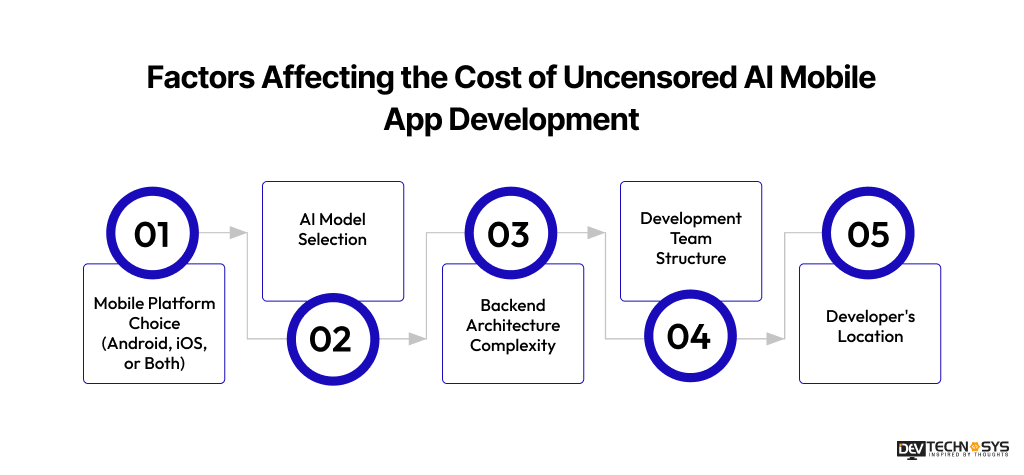
1. Mobile Platform Choice (Android, iOS, or Both)
Selecting the right platform is important for businesses to make an informed decision to invest in AI chatbot app development. Because the choice of mobile platform affects project cost, timeline, and maintenance requirements. Platform strategy helps to evaluate the long-term scalability of a mobile app.
Platform Choice |
Estimated Cost |
| Android App | $10,000 – $18,000 |
| iOS App | $12,000 – $20,000 |
| Android + iOS App (Cross-platform) | $18,000 – $25,000 |
| Android + iOS (Native Development) | $25,000 – $30,000 |
2. AI Model Selection
For uncensored mobile apps, only open-source AI models are used. The cost of this selection depends on the model size. The larger the size of the AI model, the greater its price will be.
AI Model Type |
Estimated Cost |
| Small Open Source Model | $10,000 – $15,000 |
| Mid-sized Open Source Model | $15,000 – $25,000 |
| Large Open Source Model | $25,000 – $35,000 |
| Proprietary AI Model Integration | $30,000 – $40,000 |
3. Backend Architecture Complexity
Backend architecture is a foundation for developing uncensored AI mobile apps. The complexity of this architecture depends on AI model integration, security protocols, and scalability requirements. Understanding its cost is beneficial to provide the best AI chat app development services.
Backend Complexity |
Estimated Cost |
| Basic Backend | $10,000 – $15,000 |
| Standard AI Backend | $15,000 – $20,000 |
| Advanced Scalable Backend | $20,000 – $23,000 |
| Enterprise-grade Architecture | $23,000 – $25,000 |
4. Development Team Structure
AI Development Company has a dedicated team that focuses on project quality, communication efficiency, and scalability of the mobile app. In-house teams are reliable, considering support throughout the development process.
Team Type |
Estimated Cost |
| Small Dedicated Team | $12,000 – $15,000 |
| In-house Development Team | $18,000 – $23,000 |
| App Development Company | $20,000 – $25,000 |
5. Developer’s Location
Choosing skilled teams or agencies from Asia or Latin America is more affordable than hiring from North America. The costs are determined according to technical expertise, market demand, and the cost of labor in different regions.
Developer Location |
Estimated Cost |
| India & South Asia | $10,000 – $15,000 |
| Eastern Europe | $14,000 – $18,000 |
| Latin America | $15,000 – $20,000 |
| USA & Canada | $20,000 – $23,000 |
Mistakes to Avoid While Developing Uncensored AI Mobile Apps
Developers should understand specific mistakes while building conversational AI. Avoiding these challenges can improve overall mobile app performance and enhance user experience.
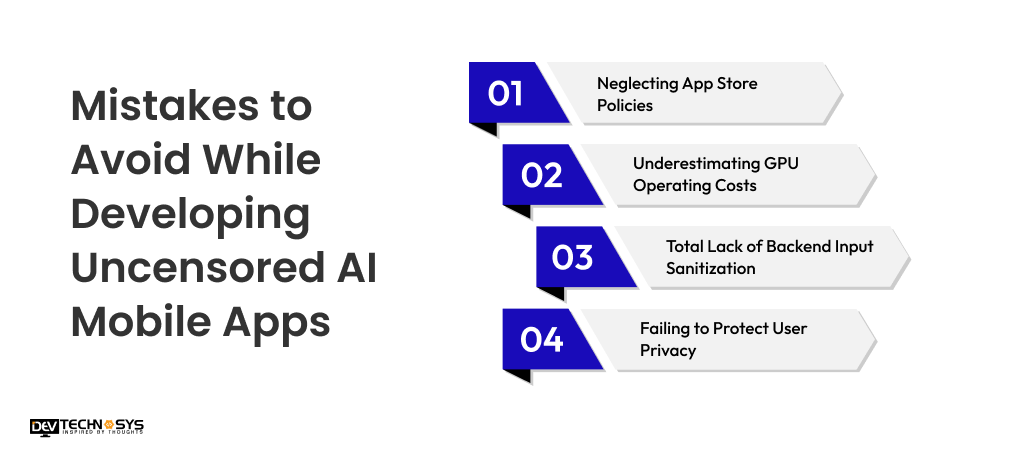
1. Neglecting App Store Policies
App Store and Google Play Store have strict policies regarding user-generated content. If the mobile app generates harmful or illegal content, then your developer account might get permanently closed. Implement a client-side keyword filter or opt for a safe-for-work toggle inside the mobile client to meet policies.
2. Underestimating GPU Operating Costs
Raw open weight models require dedicated cloud GPUs. Such a dedicated server is expensive, but it is essential to avoid a system crash. To avoid this situation, use the RunPod serverless GPU platform to compress your model.
3. Total Lack of Backend Input Sanitization
Creating Uncensored AI Mobile Apps does not mean allowing users to give a prompt for malicious content or code. Otherwise, it will exploit your AI wrapper or overflow the buffer. To avoid this, manage inputs at the API middleware layer. This will stop users from writing malicious system-level commands.
4. Failing to Protect User Privacy
Developers need to protect the data from data breaches. If the chats are centralized, then it will be easier for the hacker to extract data. Implementing a zero-knowledge architecture and encrypting chat databases using user-derived local keys. The best thing you can do is to store the chat on a user’s device rather than your servers.
Top Uncensored AI Apps for Unlimited AI Conversations
The continuous demand for unrestricted AI chatbots is allowing users to explore various topics. They can even improve research or chat with an AI companion. Some of the popular mobile applications are listed below:
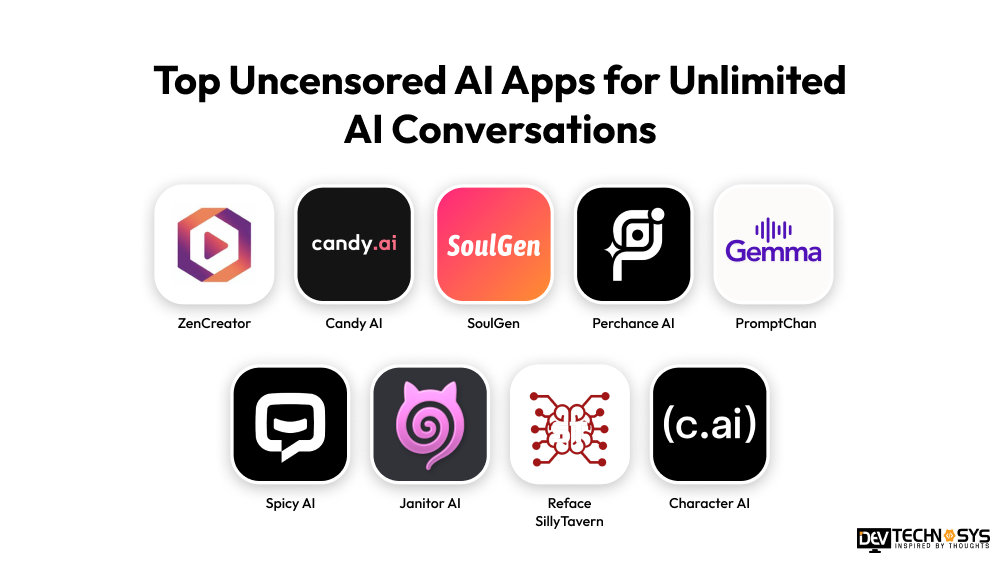
App Name |
Description |
Features |
| Candy AI | The platform showcases modern AI chatbot app development by offering interactive conversations to the users. |
|
| ZenCreator | Content creators can use this app to create stories or virtual personalities using advanced generative AI technologies |
|
| SoulGen | Users can generate anime and realistic characters from a text prompt specific to adult themes |
|
| Perchance AI | This is a free image generation tool that allows explicit content with a text-to-image scenario |
|
| PromptChan | The purpose of this app is to generate creative images, and it is the best example to showcase the growing demand for uncensored AI app development |
|
| Janitor AI | This is a popular character chat platform that does not restrict users from engaging in deep adult conversations |
|
| Spicy AI | The platform allows users to engage in adult conversations and create roleplay scenarios without content filters |
|
| Reface | This AI media app allows face swapping, suitable for creating videos |
|
| SillyTavern | An open-source frontend that is used by developers to experiment with unrestricted AI app development |
|
| Character AI | This is an AI character platform that consists of a library of conversational agents and user-created personalities |
|
Most of these applications offer 100% content freedom for research and information, but some might need a premium subscription.
Industry Insight:
At Dev Technosys, we have worked on completed multiple projects on uncensored AI mobile apps. We have analyzed that there is an increase in demand for AI solutions. This has been a learning as well as a growth opportunity for us.
Top Use Cases of Uncensored AI Mobile Apps
The demand for AI assistant app development continues to grow as users are seeking more personalized experiences. Industries such as marketing, gaming, education, and AI companionship are adopting uncensored AI mobile apps for multiple purposes.
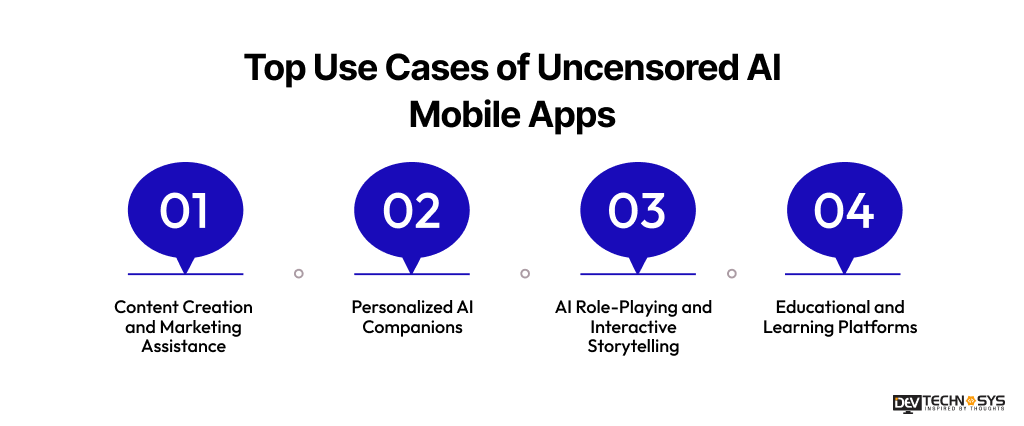
1. Content Creation and Marketing Assistance
Content creators and businesses can easily produce creative content with fewer restrictions. Marketers, bloggers, and social media creators make use of such applications to accelerate content workflows.
2. Personalized AI Companions
In this fast-paced lifestyle, individuals find uncensored AI mobile applications to be their friend and a companion. Personalized conversations create a more engaging experience.
3. AI Role-Playing and Interactive Storytelling
In the entertainment industry, AI-powered mobile applications are used to create interactive stories, including roleplay. Since these are free from content filters, uncensored AI apps are popular among entertainment enthusiasts.
4. Educational and Learning Platforms
Students find it interesting to learn in detail about subjects like maths, history, and science. These AI mobile apps are interactive and help to answer complex questions. These applications act as a home tutor for many learners.
Industry Insight:
According to Stack Overflow, 84% of respondents have shared that they are using AI tools for coding and to solve complex challenges. Programmers are even using these to develop uncensored AI mobile apps.
App Store and Google Play Store Policies to Build Uncensored AI
After the unrestricted AI app development, developers have to share a thought on launching these on a mainstream platform. Below is the detail of policies that a developer should be aware of before launching an AI content generation app.
1. Apple App Store Review Guidelines
Developers should go through the review guidelines by Apple App Store to ensure a safe user experience and prevent the distribution of sensitive content. If AI chatbot app development is done correctly with these terms, then the chances of approval automatically increase.
2. Objectionable Content
Mobile apps should not contain insensitive, offensive content or contextually inappropriate content. If explicit themes or other harmful instructions are included in the app, then it might get banned.
3. User Generated Content
An app must include:
- A way to filter objectionable material before the user accesses the application.
- A robust mechanism for the users to report inappropriate AI outputs
- Ability for the developer to immediately block rogue generations.

Google Play Store Developer Policies
Programmers who develop uncensored AI mobile apps must ensure that their application complies with the Google Play Store content moderation policies. Implementing these during the early development process helps to eliminate the app rejection risk.
1. Prohibited Content Generation
Apps should not create Child Sexual Abuse Material or content that is offensive. An app must have an option to report offensive AI-generated content.
2. Safety Inversion Risk
Deploying open-weight models usually leads to a complete safety collapse. Google’s automated scanners look for this vulnerability, and if the model is found to be criminal or offensive, then it will be removed from the store.
3. Developer Playbook for Store Compliance
- On-Device vs Cloud Separation:
Use strict API-side safety filters to catch hardline violations. Meaning that content related to sexual harassment, suicide, criminal activity, or child abuse is not displayed to the user. This also protects apps from viruses or malware attacks.
- Age Rating Adjustments:
Developers have to set the age of app usage to users aged 17+. This ensures that mobile app stores understand that the application is only for adults and not for kids.
Legal Considerations for the Uncensored AI App Development
Businesses that are planning to develop uncensored AI mobile apps must understand legal terms to avoid operational risks. User consent, copyright, and privacy laws should be considered to build trust among the users.
Copyright
Copyright means a legal right granted to the original creator of the content. This gives control over how their work can be used. This prevents other users from copying, adapting, distributing, or displaying content without the permission of the owner.
-
Training & Data Scraping Interventions:
While hosting an open-weight model, developers must carefully go through the international law that is the EU AI Act. This means that your application cannot use the data from the websites that restrict data extraction.
-
Output Copyrightability:
If uncensored AI is used to create commercial content, then a user does not directly have a copyright. Users have to add a human value to the content to use it further. They cannot claim an AI-generated work as their own.
-
Content Liability:
This means that developers and users are both responsible for creating explicit content from the mobile app. If a user avoids terms and policies, then developers will also be responsible for such an action.
-
Demise of Section 230:
Under this section in the United States, users were responsible for creating deepfake content. But now the rule is changed, and a developer also has to take the credibility.
-
Product & Manufacturer Liability:
If a developer has not added a safety filter in the app and if the users come to know the ways to create drugs or conduct abuse, then the developer will be responsible for creating an app in which such a prompt is given.
Privacy Laws & GDPR
Uncensored models easily catch attention for those seeking safety measures for user privacy. Thus, a developer must be aware of such legal considerations.
- User Consent: You must obtain consent from the users that this data will be used to filter their search. A user must be aware of the privacy policies before accessing an uncensored AI mobile app.
- Protection from Memory Leakage: Uncensored AI mobile apps are known to be black boxes. It might happen that the tool shares private information of a user to a particular prompt. It is the responsibility of the developer to avoid this situation.
- Right to Be Forgotten: Under this European GDPR Law, if a user requests the entire data deletion, then it has to be erased from the database. Because if the data is stored in the server, then it will cost more to logically remove that data.
In a Nutshell
Growing demand for uncensored AI mobile apps has created opportunities for developers and every AI app development company to build innovative solutions for major industries, including education and healthcare. Developers are utilizing this chance to earn a good income.
This blog has shared an in-depth knowledge regarding unrestricted AI app development, timeline, cost, mistakes to avoid, AI models, and more. However, developers must identify the target audience, key features, and the AI model before building an AI app. This will help them to create a robust and scalable app.
Frequently Asked Questions
Find answers to the most common questions related to this article.
Unrestricted AI mobile app development is legal if it does not promote illegal activities or share a harmful output. The application should comply with guidelines, laws, and policies associated with such a development.
Cross-platform tools, foundation models, Large language models, custom backends that integrate with AI models, natural language processing, AI Inference Engine, and other important frameworks.
A Mobile app development company implements end-to-end encryption (E2EE) during user interaction. Also, user authentication and secure cloud databases are used to ensure privacy.
These applications are effective for conducting in-depth research without any restrictions. LLM integration in mobile apps allows users to create content for role-play and AI companionship.
Conversational AI app development cost depends on multiple factors. If a developer wants to add multiple features, including fine-tuning and security, then the cost will be higher.