


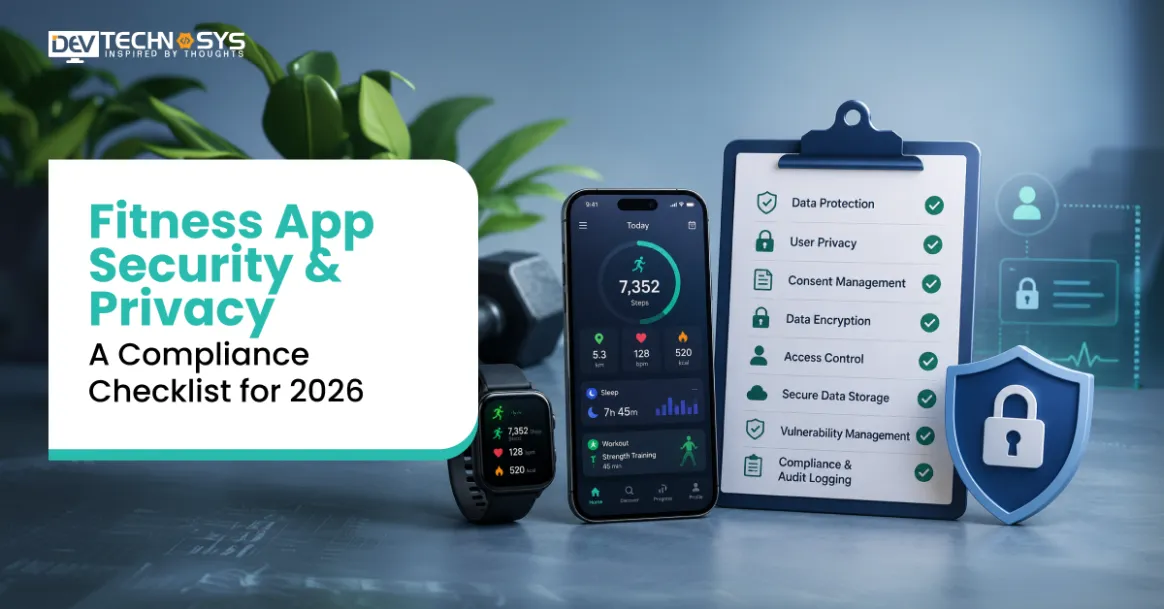
Quick Summary:
The global fitness application sector is estimated at $13.9 billion in 2026, with a CAGR of 13.4% between 2026 and 2033, indicating spectacular business opportunities for fitness companies and app manufacturers.
The latest applications can acquire health metrics, information on exercises, GPS locations, multi-biometric information, payment system information, and information from wearable devices; thus, high-level data security solutions are required.
Fitness app compliance does not depend on a single law. GDPR, CCPA/CPRA, COPPA, and the FTC Health Breach Notification Law can be used as well due to customer ethics, territory, type of data, and nature of business relationships.
Strong fitness app cybersecurity encryption, secure APIs, authentication systems, access control systems, monitoring, data security, retention policies, and safe deletion are required.
Following a structured fitness app security checklist and fitness app privacy checklist from the very beginning helps avoid exposing data, increase users’ trust, and deal with changing regulatory conditions.
Fitness applications are no longer merely tools to measure steps or log exercises. Today’s applications monitor myriad parameters such as heart rate, total calories burned, location via GPS, sleep, weight, and a variety of vital signs through smartwatches or other digital gadgets. While these capabilities create better user experiences, they also increase the need for stronger fitness app security & privacy.
Therefore, in 2026, fitness companies must pay attention to taking a step beyond providing standard security. The application should also ensure data privacy. Taking into account such fields as GDPR and HIPAA, as well as encryption, secure API, access control, and breach response, all layers are essential.
This guide explains how to secure a fitness app, protect sensitive user information, meet major fitness app compliance requirements in 2026, and build a privacy-first application that is secure, trustworthy, and ready for growth.
Why Fitness App Security & Privacy Matters in 2026?
Fitness applications can now gather much more than just ordinary exercise data. Users can give away their heart rate, sleeping habits, body size measurements, geographical locations, calories, diet, and data from their wearable gadgets. All of the above can disclose sensitive information about a person’s health, lifestyle, and routines.
A weakness in a mobile application, API, cloud environment, or third-party integration can expose thousands of users. Effective fitness app data breach prevention therefore requires security controls across the entire ecosystem rather than simply protecting the database.
This growing volume of information makes fitness app data protection requirements increasingly important. As AI coaches, smartwatches, linked exercise machines, and external health apps are becoming more popular, more possibilities for data sharing and transmission arise.
At the same time, privacy laws like GDPR, HIPAA, CCPA/CPRA, and the FTC Health Breach Notification Rule add even more obligations depending on the type of app, its business model, and data practices. Thus, for fitness companies, fitness app security & privacy compliance becomes one of the basic requirements for building trust among users and ensuring the security of sensitive data.
What Data Does a Fitness App Collect?
Depending on the available features, integrations, and services of different fitness applications, all kinds of personal data of users can be collected. Among the types of data collected, there may be basic personal information, exercise history, health measurements, GPS details, wearable device information, payment details, and app usage.
Understanding the data collected is the first step toward effective personal health data protection and sensitive health data security. In the table provided below, we have mentioned the categories of data that are collected by a fitness app along with their examples.
Data Category | Examples |
| Personal Information | Name, email, phone number, age |
| Behavioral Data | App usage, preferences, engagement patterns |
| Fitness Data | Workouts, calories burned, exercise history |
| Children’s Data | Age, activity, profile information |
| Biometric Data | Biometric identifiers or body measurements |
| Wearable Data | Smartwatch and fitness tracker information |
| Device Data | Device ID, IP address, operating system |
| Health Data | Heart rate, sleep patterns, blood pressure, health goals |
| Location Data | GPS routes, live location, workout locations |
| Payment Data | Payment tokens, subscription and transaction details |
Fitness App Compliance: Which Regulations Apply?
Most fitness app developers make a common mistake of assuming that one security regulation automatically covers the entire application. They should assess the app based on its users, geography, functionality, data, processing activities, and business relationships.

1. GDPR
The General Data Protection Regulation is applicable in any case when the entity processes the information of people within the European Economic Area.
Fitness applications need to take into consideration health-data-related issues since the GDPR regards health information as a special category of personal information, along with some biometric data needed to provide someone’s unique identification. Processing this type of information usually requires getting consent under Article 9.
The GDPR also underlines the importance of the principle known as data protection by design and by default. It obliges the specified enterprise to use relevant means of both technological and organizational character to put the data protection principles into practice.
2. HIPAA
Covered entities and business associates are subject to HIPAA regulations. Generally, an app creator may be classified as such if it handles protected health data for a covered entity or business associate. However, it does not automatically qualify as a business associate just for allowing users to access their data on the app.
Partnering with professionals experienced in healthcare app development can also be valuable when a fitness application processes sensitive health-related information or integrates with healthcare systems.
The Department of Health and Human Services offers some materials for mobile health app developers and states which laws are the most pertinent to mobile health apps. The HIPAA Act, the FTC Act, the Health Breach Notification Rule, COPPA, the FDA Act, and some other regulations fall under this category.
3. FTC Health Breach Notification Rule
The specific companies involved with selling personal health record products and providing services related to PHRs, such as digital health application companies, are subject to the FTC’s Health Breach Notification Rule.
This has now been updated and clarified to be applicable to health technology. The FTC has provided an example that states if the application collects and tracks users’ information and synchronizes with fitness tracker devices, that is likely a service provider of PHRs.
In addition to this, the recent order has indicated that certain unlawful disclosures will be considered breaches. This means that the problem should not be limited to attacks by hackers but should also include cases of incorrectly transferring health data to third parties.
4. CCPA/CPRA and State Privacy Laws
CCPA compliance for fitness apps may apply when a business meets the relevant legal thresholds and handles personal information covered by California privacy law. When companies expand into other states, it becomes important for them to consider the legal regime in those territories.
The landscape regarding privacy laws in the United States is more fragmented every day, with each state laying down requirements. This means that a fitness app cannot assume that compliance with the privacy laws of one state allows it to comply with these laws in other states.
It is necessary for businesses to remain aware of various state regulations in order to manage compliance risks efficiently and ensure the protection of users’ data.
5. COPPA
COPPA regulates services targeted towards individuals under the age of 13, as well as general services that are known to collect personally identifiable data from this age group. This regulation requires these services to follow certain protocols, such as giving notice to parents and obtaining authenticated consent from parents.
If a children’s fitness app is to be designed, it is important to integrate age-related privacy concerns from the beginning of the design process in order to ensure compliance and privacy for the young audience.
By incorporating privacy issues already at the first stages of the app development process, developers can protect children and avoid compliance problems with COPPA.
Planning a Fitness Project?
Get a tailored development cost estimate in a few simple steps.
- 3 quick steps
- 100% free
- Reply in 1 business day
2 Minutes Read
Fitness App Security & Privacy Compliance Checklist for 2026
This fitness app compliance checklist combines essential privacy and security practices businesses should evaluate before and after launch. It can also serve as a practical fitness app security checklist for 2026 for development teams.
This structured approach supports both the fitness app privacy compliance 2026 process and long-term security management.

1. Gathering Data and Consent
Collect only the amount of information needed for specific features of your app. State why the data is needed, ask for relevant consent when needed, distinguish between mandatory and optional permissions, and allow users to withdraw their consent if necessary.
2. Data Encryption
Encryption is a fundamental component of fitness app security best practices, particularly when an application processes health, biometric, or location information. Use secure communication protocols, encrypt databases and backups, protect encryption keys, and do not store unnecessary information such as login details, health information, or other sensitive information of users.
3. Authentication and Access Control
Employing robust authentication techniques such as encrypted passwords, multi-factor authentication, and fingerprint detection wherever necessary is wise. Role-based access management and least privilege policy should be implemented for safeguarding confidential information and records.
4. API and Backend Security
All API services should be protected via authentication, authorization validation, input validation, bandwidth limitation, and safe token management; every request from users should be validated to ascertain that the client (i.e., user or application) has the right to access the service.
5. Wearables and Third-Party Integration Security
Many fitness programs are associated with smartwatches, fitness monitors, health services, and other businesses. It is advisable to check the obligations, security practices, information management, and use policies of every business collaborating with this application.
6. Preservation and storage of sensitive information
All information should be encrypted and safely preserved in databases and the cloud environment. Data storage time should be determined, and sensitive information should be deleted or anonymized once the specified period has expired.
Privacy-by-Design for Fitness App Development
Privacy-by-design helps reduce the risks in fitness apps since they can process biometric, location, health, and wearable data. Security should be treated as a core part of mobile app development. This approach is particularly important for secure fitness app development, where biometric, location, wearable, and health-related information may be processed.

Core Privacy-by-Design Principles
Here are some of the key privacy-by-design principles for fitness app development:
1. Minimizing Data Collection
Only gather data that is necessary to operate the system. Do not ask for continuous updates on user location, health, or device settings.
2. Limiting Usage of Data
Clearly outline for what purposes data is collected, and do not use the same data for any other reasons without seeking the required permission or having the specific legal basis.
3. Privacy Settings by Default
Configure system settings so as to always ensure privacy. Users should not be required to switch off data sharing manually.
4. User Autonomy
Users need to be given appropriate methods of changing data settings at the very least.
5. Transparency
Utilize straightforward privacy notices that describe what data is collected, for what purpose, how long it is kept, and whether it will be disseminated to any third parties.
6. Secure Data Processing
Safeguard data with encryption, strong authentication, access controls, secure APIs, and relevant cloud security technology throughout its lifecycle.
Privacy-by-Design Development Methodology
Requirements → Data Mapping → Privacy Risk Evaluation → Secure Architecture → Development → Testing → Compliance Check → Release → Continuous Monitoring
A structured fitness app risk assessment can identify unnecessary data collection, weak integrations, and potential compliance gaps before they become expensive problems. It also aids fitness companies in spotting unnecessary data collection or other security risks ahead of time, before it costs them a lot of money to rectify.
Securing Fitness App Data Across Its Lifecycle
Effective fitness app data security should protect information from collection through deletion. Because these fitness applications have information about health analytics, the history of spending time working out, geographical locations, and payment data, companies must have safeguards at all lifecycle points.
Data Lifecycle Stage | Recommended Security Measures | Purpose |
| Data Collection | Consent Management, permission controls, data minimization | Collect only necessary information |
| Data Transmission | TLS encryption, secure APIs, authentication | Protect data while moving between systems |
| Data Processing | Input validation, authorization, access controls | Prevent unauthorized use or modification |
| Data Storage | Encryption, IAM, database security | Protect sensitive data at rest |
| Data Sharing | Vendor assessments, access restrictions, secure agreements | Control third-party access |
| Data Backup | Encrypted backups, restricted access, recovery testing | Protect recovery copies |
| Data Retention | Defined retention periods and automated policies | Avoid unnecessary long-term storage |
| Data Deletion | Secure deletion and account- erasure workflows | Remove data when no longer required |
This lifecycle approach helps businesses understand how to protect fitness app user data across every stage instead of focusing only on database protection.
Planning a On Demand Fitness Trainer App Project?
Get a tailored development cost estimate in a few simple steps.
- 3 quick steps
- 100% free
- Reply in 1 business day
2 Minutes Read
Fitness App Security & Privacy Testing Checklist
Along with security controls, businesses should carefully define the features every fitness app needs, such as one’s health condition, location, payment process, and other data connected to wearables; regular testing is an effective way to find vulnerabilities before they are deployed.
Key testing principles to follow:
Test Before Launch: When preparing fitness apps for a successful launch, security testing is of utmost importance before launching in order to detect vulnerabilities in all mobile apps, APIs, data storage, and third-party cooperation.
Test After Updates: New functions and software may be a potential source of vulnerabilities; when making any meaningful changes, make sure to revisit the most important objects in the process.
Review Third-Party Components: Consistently verify the security of software development kits (SDKs), libraries, analytics programs, and other components, checking for known risks or unnecessary practices of sharing individual data.
Monitor Continuously: Leverage logs, notifications, and monitoring technology to identify suspicious login actions, unusual API queries, unauthorized access, etc.
Follow Security Standards: Use relevant fitness app security & privacy standards and established guidance, such as OWASP mobile and API security recommendations, as part of the testing process.
The whole vulnerability test process must include both automatic scanning and manual tests, code reviews, hacking tests, and other activities. Regular security tests allow effective fitness companies to identify vulnerabilities in the early stage and provide a high level of security during the development of the application.
Fitness App Data Breach Response Plan
Even with solid encryption, authentication, and access control systems, all fitness apps are still vulnerable to security incidents. A structured response plan is essential for effective fitness app data breach prevention and incident management.

1. Identify the Data Breach
Monitor security, review logs, and automatically follow up on users’ reports to find any suspicious events. Analyze whether any strange logins, API requests, or unauthorized access to any databases are signs that something has happened.
2. Address the Issue
Take measures immediately to eliminate any possibilities of spreading the incident further. Suspend any compromised passwords, close suspicious accounts, block possible attacks, and identify possible immediate solutions that will allow carrying on with business.
3. Find Out What Took Place
Plan an extensive investigation to uncover the cause of the breach, the date when it took place, and the systems that were impacted by this breach. Understand whether any information connected with personal data, health data, payment data, location data, and biometric data was compromised.
4. Determine Regulatory Requirements
Identify the relevant legal regulations and provisions for the case. Determine if any authorities need to be notified regarding the incident and ensure compliance with applicable legal requirements.
5. Inform Affected Individuals
If legally mandated, inform affected individuals with comprehensive details regarding the incident, including the nature of the breach and potential risks, and provide relevant contact information for further inquiries or assistance related to the situation.
6. Fix the Vulnerability
Resolve the security flaw that caused the incident prior to achieving full restoration of affected services. Apply necessary software fixes, change passwords, improve user authentication procedures, ensure permissions are properly set, secure APIs, delete unnecessary information, and enhance monitoring capabilities to prevent future breaches.
7. Perform a Post-Incident Analysis
Once you have attributed the cause of the incident, perform an analysis of the incident in order to detect vulnerabilities in technology, processes, or behaviors of employees. It is vital to document what you have learned and improve your policy to enhance your future incident response capabilities.
Common Fitness App Security & Privacy Mistakes
Several fitness applications inadvertently compromise sensitive user information due to lapses in security and privacy measures. Recognizing these flaws represents the first step in making secure and privacy-respecting fitness applications.
Companies can build these capabilities internally or hire dedicated developers with experience in application security, data protection, API security, and privacy-focused fitness platforms. Here are some of the common privacy mistakes that you should avoid while building a fitness app:
1. Ineffective authentication methods
Numerous fitness applications have poor passwords and no multi-factor authentication, resulting in user accounts being vulnerable to attacks. If identity verification is not strong, health and location information can be exposed through brute-force and credential stuffing attacks.
2. Poor data encryption
Certain applications do not encrypt data when it is either in transit or stored, thus exposing sensitive health data of users. Without encryption protocols such as TLS and AES in place, hackers are able to intercept valuable user information during its transmission or storage.
3. Excessive data collection
Several fitness applications collect a lot more personal information than is strictly required, including information about the user’s location, contacts, and bodily functions. This increases privacy risks, as keeping unnecessary sensitive data raises compliance issues according to legal acts in the field of data protection.
4. Poor API security
Weak APIs may put computer systems at risk of unauthorized access, leaks of information, and data modification. The absence of protection mechanisms and lack of authentication can cause breaches, which would allow criminals to gain access to the private information of users through APIs.
5. Ignoring software updates
Applications that are not frequently updated can become an easy target for hackers. The lack of regular updates and upgrades enables hackers to use outdated software and take control of private information.
Avoiding these issues is an important part of fitness app privacy best practices and long-term cybersecurity management.
Planning a Mobile App?
Get a tailored development cost estimate in 3 simple steps — app basics, features, timeline, and your contact details.
- 3 quick steps
- 100% free
- Reply in 1 business day
2 Minutes Read
Recommended Fitness App Security & Privacy Structure
It is advisable that a secure fitness app use a layered security architecture instead of depending on a single security mechanism. These fitness platforms should have dedicated security controls because they contain health data, location information, wearable data, and users’ payment details. These security measures can also influence the overall fitness tracking app development cost.
Recommended Structure
Mobile App → API Gateway → Authentication & Authorization → Application Server → Encrypted Database → Secure Cloud Storage
Architecture Layer | Key Security Measures | Purpose |
| Mobile App | Secure storage, certificate pinning, biometric login | Protect user data on the device |
| API Gateway | Rate limiting, API authentication, request validation | Block unauthorized API traffic |
| Authentication Layer | MFA, OAuth 2.0/OIDC, token management | Verify user identities |
| Authorization Layer | RBAC, least privilege, access policies | Control what each user can access |
| Application Server | Input validation, secure coding, session management | Protect business logic |
| Database | Encryption at rest, access controls, backups | Secure sensitive fitness and health data |
| Cloud Storage | Encryption, IAM, monitoring | Protect files, backups, and stored records |
This architecture supports a practical approach to fitness app cybersecurity while allowing businesses to scale features and integrations.
Conclusion
Ensuring that the fitness app you are developing is not just compliant but also secure is something that you should try to do right from the start. As these apps start connecting with wearables and payment gateways, the types and volumes of confidential data being transferred are increasing rapidly. Following the fitness app security compliance framework can help reduce breach risks and build greater user confidence.
Utilizing powerful encryption, authorization methods, and secure APIs can help mitigate a lot of security-related risks. By considering security and privacy as parts of the development process, those creating fitness apps can make them safer and more user-friendly.
If you are planning to build a secure and scalable fitness app, then you should consider partnering with a fitness app development company, such as Dev Technosys. They provide robust security, privacy, and compliance-focused architecture.
Frequently Asked Questions
Find answers to the most common questions related to this article.
No. HIPAA compliance for fitness apps depends on whether the app operates for a covered entity or business associate and handles protected health information within that relationship. A standalone consumer fitness tracker is not automatically subject to HIPAA.
GDPR compliance for fitness apps may apply when the regulation's jurisdictional and processing conditions are met. Apps handling health or sensitive personal data should assess lawful processing, consent requirements, user rights, transparency, security, and international data transfers.
To understand how to secure a fitness app, use data minimization, encryption, strong authentication, role-based access controls, secure APIs, protected databases, continuous monitoring, regular testing, and security reviews of third-party integrations.
Security for fitness apps varies significantly depending on functionality, the architecture used, and any additional integration costs. Basic security can start from approximately $5,000 to $15,000, and advanced architecture, testing, and compliance will vary depending on the application.
Apps should protect names, contact details, workout history, health metrics, biometric information, wearable data, GPS locations, device identifiers, behavioral information, account credentials, and payment-related data using appropriate fitness app data protection requirements.


