


















In a world where travel has become more accessible, booking unique experiences and activities is just a tap away. Enter other apps like Viator – the go-to platform for travelers seeking curated tours, local experiences, and memorable adventures.
However, have you ever wondered how to build an app like Viator that offers the same seamless journey from discovery to booking?
Whether you’re an entrepreneur passionate about travel or a developer looking to venture into the tourism tech space, creating an app like Viator is an exciting challenge that combines innovation, user-centric design, and cutting-edge technology.
From integrating booking systems to offering personalized recommendations, this guide will walk you through the essentials of building a travel app that can transform how people explore the world. Let’s dive in and turn your travel app dream into a reality!
So, let’s begin!
What is a Viator App?
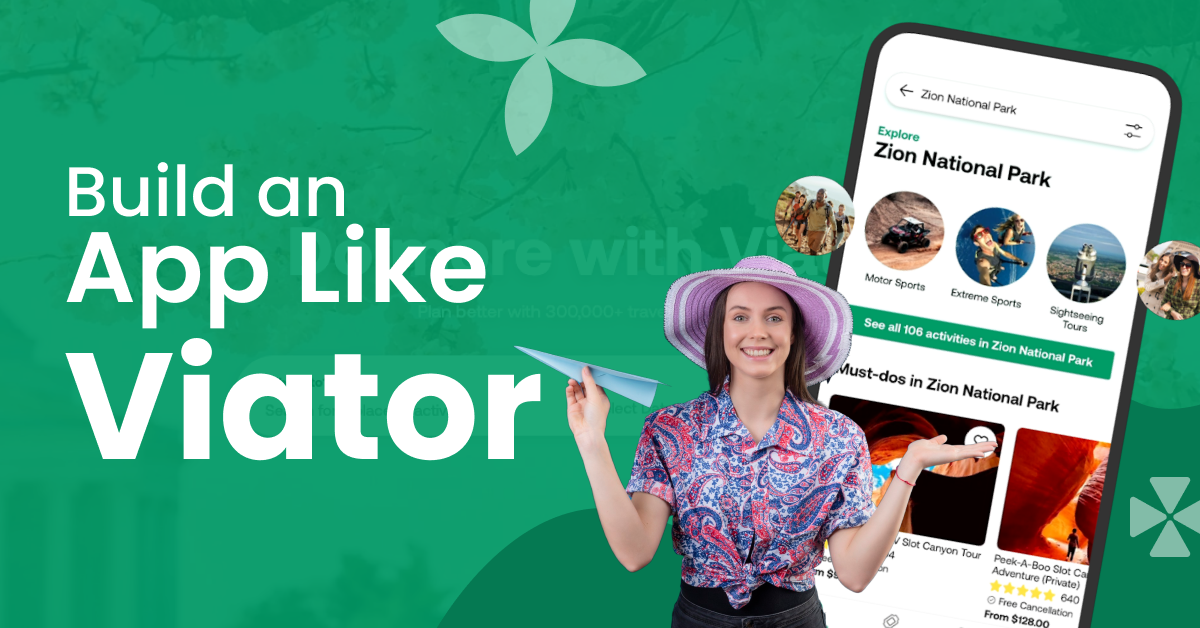
The Viator app is a travel and tour booking platform that allows users to discover and reserve experiences worldwide. Owned by TripAdvisor, it offers access to thousands of activities, including guided tours, skip-the-line tickets, day trips, and cultural experiences.
Similar to an App Like Wego, your app features user reviews, photos, and flexible booking options, including free cancellations on many activities. Travelers can filter by location, price, duration, and popularity, making trip planning easy and customizable.
With real-time availability and mobile ticketing, the Viator mobile app provides a convenient, all-in-one solution for exploring destinations and enhancing travel experiences globally.
Future Predictions & Projections of Travel App
- Total revenue in the Travel market is projected to reach US$1.07bn in 2025.
- Total revenue is expected to grow at an annual rate (CAGR 2025-2029) of 8.52%, resulting in a projected market volume of US$2.27bn by 2029.
- In-app purchase (IAP) revenue in the Travel market will reach US$137.40m in 2025.
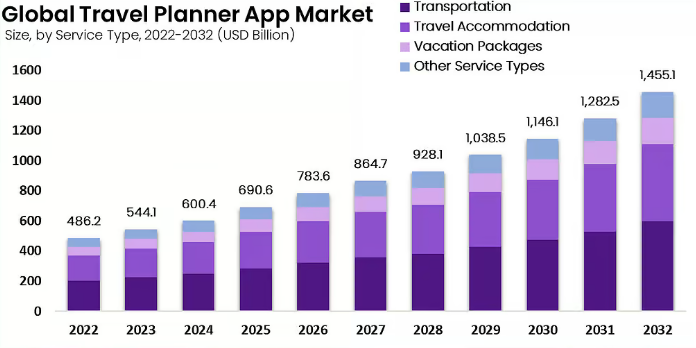
Source: Market.us
- Paid app revenue in the Travel market will reach US$98.15m in 2025.
- Advertising revenue in the Travel market is projected to reach US$833.41m in 2025.
How Does a Viator App Work?
The Viator app simplifies travel planning by providing a one-stop shop for discovering and booking curated experiences. It leverages real-time data, user reviews, secure payment options, and customer service to ensure a seamless and trustworthy booking experience for travelers worldwide.

1. Browse Tours and Activities
Open the Viator host app and search for tours, activities, or attractions in the city you’re visiting.
2. Filter and Compare
Use filters like price, rating, or duration to find what suits you best. You can also read reviews and see photos from other travelers.
3. Book Instantly
Once you find an activity you like, you can choose the date and number of people and book it directly through an app like Goibibo. Many options offer free cancellation.
4. Get Confirmation and Tickets
After booking, you get an email or in-app confirmation. Some tours include digital tickets or vouchers.
5. Enjoy Your Experience
Go to the meeting point on the scheduled day, show your ticket (digital or printed), and enjoy the activity.
Steps To Build an App Like Viator
If you want to develop an app like Viator, you’re stepping into an exciting travel-tech space. Creating such an app involves strategic planning, user-friendly design, and powerful features that meet user needs. Below are the key steps to help you build an app like Viator.
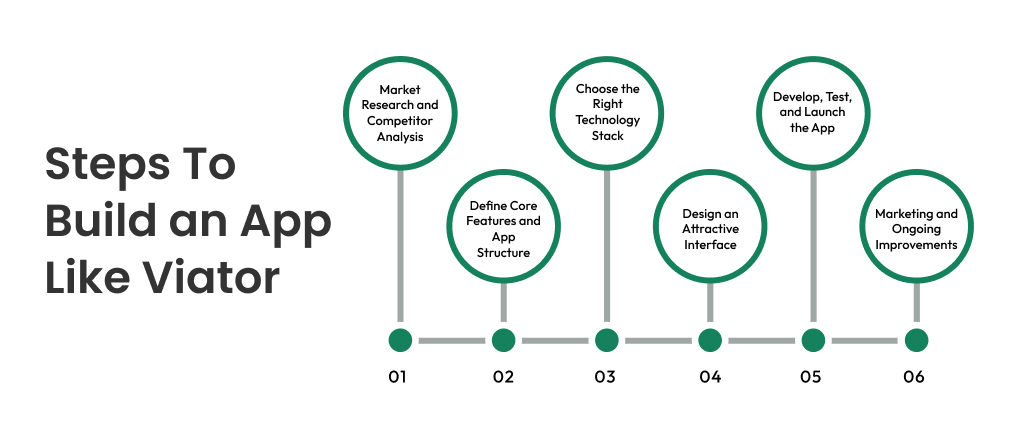
1. Market Research and Competitor Analysis
Start with deep market research before you make an app like Viator. Understand your target audience, tourists, travelers, and local guides. What kind of activities are popular in your target regions?
What pain points do users face with existing Viator owners apps, GetYourGuide, or Klook? Study competitors for an app like Airbnb to identify what they do well and where they fall short. This will help you find your unique selling proposition and shape a better experience for your users.
|
2. Define Core Features and App Structure
Next, outline what features your app must have. Essential features for a Viator-like app include user registration, tour search and filtering, booking system, secure payment gateway, user reviews, and customer support.
You might also want to include real-time availability, a map view, and language/currency options. Sketch out how users will navigate your Viator vacation rentals app, from discovering activities to completing a booking. A clean and intuitive user flow is key for high user engagement.
|
3. Choose the Right Technology Stack
Selecting the right technology stack ensures your Viator hospitality app is scalable and performs well. For a cross-platform mobile app, you’ll need backend technologies like Node.js or Django and frontend frameworks such as React Native or Flutter.
For payments, integrate reliable services like Stripe or PayPal. Cloud services like AWS or Firebase can be used for storage and hosting. Ensure the tech stack you choose aligns with your budget and development timeline.
|
4. Design an Attractive Interface
Design plays a huge role in travel apps. Travelers want smooth, enjoyable experiences, both online and offline. Hire experienced UI/UX designers to create a visually appealing, simple, and functional interface.
The mobile application development companies in USA use high-quality images, clear fonts, and consistent colors. Make it easy for users to find and book tours within just a few taps. Also, don’t forget to optimize the Viator mobile hospitality app for both Android and iOS devices.
|
5. Develop, Test, and Launch the App
Once the design and features are finalized, begin to build an app like Viator. Start with a Minimum Viable Product (MVP) to test your idea with essential features.
After building the MVP, thoroughly test the app for bugs, crashes, and performance issues. Gather user feedback during beta testing to make necessary improvements. Then, launch your app on the App Store and Google Play.
|
6. Marketing and Ongoing Improvements
Your app’s journey doesn’t end at launch. Promote your app through SEO, social media, influencer marketing, and travel blogs. Offer promotions to attract first-time users.
Continuously gather user feedback and analyze app data to understand what’s working and what’s not. Keep improving the Viator proprietarios app by adding new features, optimizing speed, and expanding to new markets.
|
Want a chatbot demo or pricing? Fill the form and talk to our experts today.
Pick what you need below — you can select more than one — then tap Get detail to continue.
-
Chatbot demo dashboard
-
Cost to develop an app
-
Industry report
-
Case study
Key Features To Develop an App Like Viator
Creating an app like Viator, which specializes in tours, activities, and travel experiences, involves integrating a range of features that appeal to both users and service providers. Below are the key features to develop a competitive and functional Viator-like app:
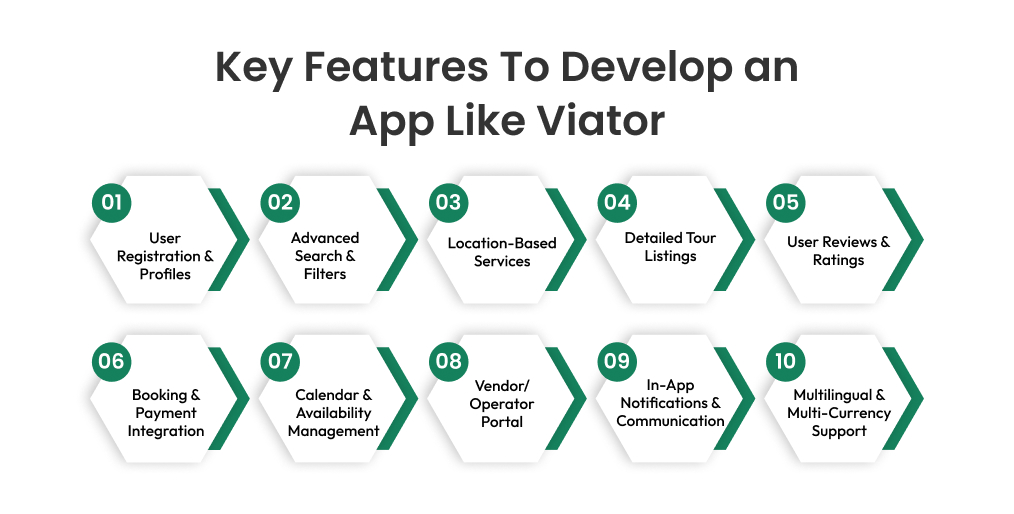
i. User Registration & Profiles
A seamless onboarding process with multiple sign-up options (email, social logins) is crucial. Users should be able to create and manage their profiles, view booking history, and save favorite experiences or destinations for future reference.
ii. Advanced Search & Filters
An intelligent search engine helps users quickly find tours or activities based on keywords, destination, travel dates, category, duration, price range, or ratings. Filters enhance usability and help users find relevant experiences more efficiently.
iii. Location-Based Services
Similar to an App Like Agoda, you can integrate GPS feature and allow users to discover nearby attractions and tours. Real-time location services can also suggest popular or trending experiences based on current location, improving user engagement and personalization.
iv. Detailed Tour Listings
Each tour or activity should have a detailed listing, including high-quality images, descriptions, itineraries, duration, inclusion/exclusion lists, availability calendar, and pricing. This helps users make informed decisions before booking.
v. User Reviews & Ratings
A robust review and rating system helps build trust from the home away Viator app. Verified users should be able to rate their experiences and leave feedback, which others can use to evaluate tour quality and reliability.
vi. Booking & Payment Integration
A secure, smooth booking process is essential. Include options for selecting dates, number of participants, and add-ons. Integration with multiple payment gateways (credit/debit cards, digital wallets, etc.) and support for multiple currencies are important for a global user base.
vi. Calendar & Availability Management
As per the Hotel Booking App Development Services provider, real-time calendar integration ensures that users can only book available slots. For vendors, a backend panel to update availability and manage schedules is crucial.
vii. Vendor/Operator Portal
Vendors should have a dedicated dashboard to list and manage their offerings, track bookings, respond to reviews, and access performance analytics. This allows scalability by enabling multiple operators to use the platform.
viii. In-App Notifications & Communication
Push notifications keep users updated on booking confirmations, reminders, or special offers. In-app chat or messaging between users and vendors adds convenience and builds trust.
ix. Multilingual & Multi-Currency Support
To cater to international travelers, the app should support multiple languages and currencies. Automatic translation and real-time currency conversion enhance accessibility and user satisfaction globally.
Top 5 Travel Apps Like Viator
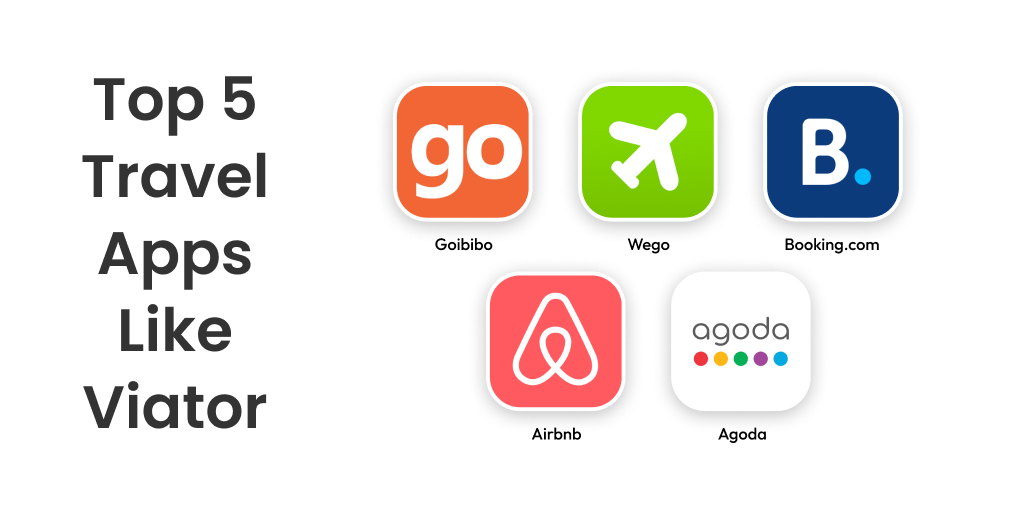
Best Travel Apps Like Viator |
Available Platforms |
Downloads |
Ratings |
| Goibibo | Android | iOS | 50M+ | 4.5 |
| Wego | Android | iOS | 10M+ | 4.4 |
| Booking.com | Android | iOS | 500M+ | 4.7 |
| Airbnb | Android | iOS | 100M+ | 4.3 |
| Agoda | Android | iOS | 50M+ | 4.5 |
How Much Does It Cost To Build an App Like Viator?
The cost to build an app like Viator can be between $10,000 to $25,000 or more, depending on the complexity, features, and iOS App Development Company location.
Key factors influencing the cost to develop an app like Viatorinclude design, user interface, integration with payment systems, geolocation features, real-time booking, and multi-platform support.
Additional costs for backend Viator Travel App Development Cost, database management, security features, and maintenance should also be considered. Customization, scalability, and ongoing updates can further increase the budget. It’s essential to choose an Android App Development Company experienced in short term rental apps for a successful launch.
1. App Features and Functionality
The complexity and range of features directly impact the Cost to develop an App Like Viator. Viator includes functionalities such as user registration, tour listings, advanced search filters, real-time booking, payment gateway integration, user reviews, and multilingual support.
Developing basic versions of these features will cost significantly less than Viator app development advanced, highly customized versions of the Viator app. For instance, if a Hotel Booking App Development company adds AI-based recommendations, dynamic pricing, or live chat support, it can considerably increase development time and cost.
| Feature Category | Basic Implementation Cost |
| User Registration & Profile | $1,000 – $3,000 |
| Tour Listings | $2,000 – $5,000 |
| Search & Filters | $1,500 – $4,000 |
| Real-time Booking | $2,000 – $4,000 |
| Payment Gateway Integration | $2,000 – $3,000 |
| User Reviews & Ratings | $1,000 – $3,000 |
| Multilingual Support | $1,500 – $4,000 |

2. Platform Choice
Choosing whether to develop the app for iOS, Android, or both platforms significantly affects the budget. A single-platform Viator app development will cost less but reach a smaller audience.
Cross-platform development using frameworks like Flutter or React Native can offer cost savings compared to building two separate native apps and vacation rentals websites, although native Best Travel Apps may provide better performance and user experience.
Platform |
Estimated Cost Multiplier |
| Single Platform (iOS or Android) | 1x |
| Native (iOS and Android) | 1.8x – 2x |
| Cross-Platform (e.g., Flutter, React Native) | 1.2x – 1.6x |
3. UI/UX Design Complexity
A travel Viator vacation rental app needs an intuitive, visually appealing, and user-friendly interface. The cost will vary depending on the depth of customization, number of screens, branding elements, and the overall design polish.
High-quality design that includes interactive elements, smooth transitions, and a responsive layout adds to the Viator app development time and budget but enhances user retention.
Design Complexity |
Estimated Cost |
| Basic | $8,000 – $15,000 |
| Medium | $15,000 – $18,000 |
| High | $19,000 – $25,000+ |
4. Development Team and Location
The location and size of your mobile apps development agency greatly influence cost. Hiring a team in North America or Western Europe can cost upwards of $150/hour, while teams in Eastern Europe, South Asia, or Latin America may charge between $15–$25/hour. A full team typically includes project managers, designers, frontend and backend developers, and QA engineers.
Location |
Average Hourly Rate |
| North America/W. Europe | $100 – $250+ |
| Eastern Europe | $40 – $80+ |
| South Asia/Latin America | $25 – $75+ |
| In-house Team | Varies |
How To Monetize Your Travel Apps like Viator?
Building a travel app like Viator can be a highly profitable venture if you implement smart monetization strategies. Viator, a TripAdvisor-owned platform, specializes in tours and activities, and it earns revenue by connecting travelers with local service providers. Here are the effective ways to monetize your travel app like Viator:
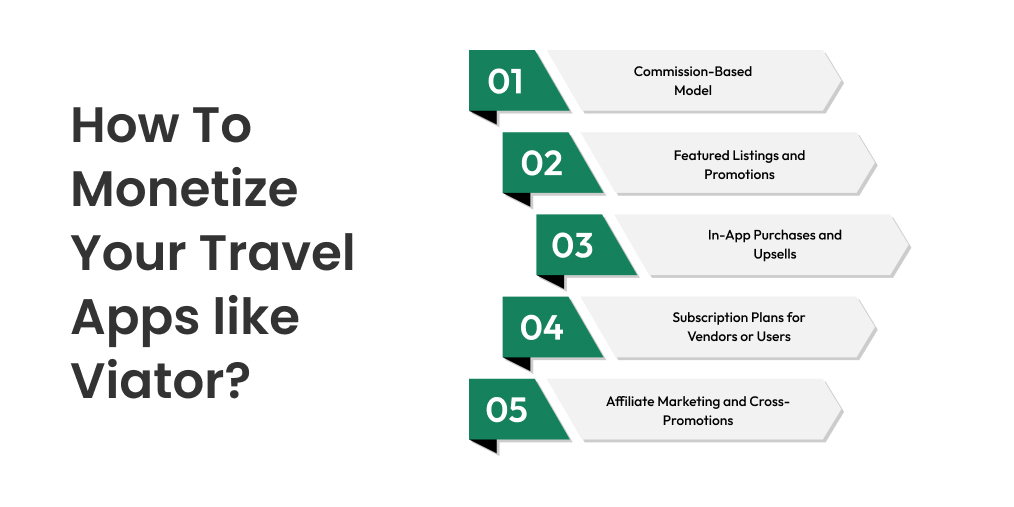
1. Commission-Based Model
The most direct and proven monetization method is to charge a commission on every booking made through the app. This is Viator’s primary revenue stream. You partner with local tour operators, guides, transportation providers, or event organizers and list their services on your platform.
When users make a booking, you earn a percentage, usually between 10% and 30% of the total cost. This Taxi Booking App Development model scales well with growth, as your earnings increase in proportion to the number of transactions processed.
2. Featured Listings and Promotions
Allow service providers to pay for better visibility within websites for renting vacation houses. This can include promoted tours, highlighted experiences, or top-of-search placements. By offering premium advertising spots or priority listings, your platform can generate additional revenue while helping vendors attract more customers.
As per the travel application development services provider, this model works especially well in competitive markets, where tour operators are eager to stand out.
3. In-App Purchases and Upsells
Beyond standard bookings, offer in-app purchases or upsells that enhance the user experience. For example, you can offer add-ons like travel insurance, priority check-ins, special access (e.g., VIP tours), or additional services (e.g., luggage handling, meal plans).
These small purchases can significantly boost your average revenue per user (ARPU). A well-designed user journey that recommends upsells at the right moment can greatly increase conversion rates.
4. Subscription Plans for Vendors or Users
From travel mobile app development, introduce subscription models tailored to both vendors and end-users. For service providers, offer a subscription plan that includes advanced analytics, priority support, or access to premium marketing tools.
For users, consider a VIP membership offering benefits like exclusive discounts, early access to bookings, or a concierge travel planner. Subscription plans provide predictable, recurring revenue and can enhance loyalty among users and partners alike.
5. Affiliate Marketing and Cross-Promotions
Your app can also serve as a gateway for related travel services such as flights, hotels, travel insurance, or car rentals. Partner with major booking platforms (e.g., Expedia, Booking.com, Skyscanner) and earn affiliate commissions when users book through your referral links. You can also cross-promote with local businesses such as restaurants or museums, earning a fee for each customer directed their way.

Final Thoughts
Building an app like Viator is an exciting journey that combines innovative technology with the allure of travel. By focusing on seamless user experience, robust booking systems, and personalized recommendations, you can create an app that connects travelers with unforgettable experiences.
Keep your design intuitive, ensure a secure platform for transactions, and continuously evolve based on user feedback. With the help of a travel app development company, your travel app can soon become the go-to guide for wanderlust-filled explorers. Ready to embark on the adventure? Let’s make it happen!
FAQs
Q1. How much does it cost to create an app like Viator?
The cost to build an app like Viator can range from $10,000 to $25,000 or more, depending on the complexity, features, design, and development team’s hourly rate. The cost can vary greatly based on whether you choose to develop it in-house or outsource it, and if you want cross-platform or native app development.
Q2. How long does it take to make an app like Viator?
Developing an app like Viator typically takes anywhere from 4 to 12 months. This timeline includes design, development, testing, and deployment phases. The duration may vary depending on the complexity of the features, the size of the development team, and the feedback cycle during the development process.
Q3. What are the core features of an app like Viator?
To build an app like Viator, you’ll need core features like:
- User registration and profiles: Let users create accounts, save preferences, and access past bookings.
- Search and filters: Allow users to search and filter tours and activities based on location, type, price, duration, etc.
- Booking and payment gateway: Enable users to book tours and pay securely through integrated payment gateways.
- Ratings and reviews: Provide a system for users to leave feedback on their experiences.
- Maps and itinerary integration: Include maps and detailed itineraries for each tour or activity.
- Push notifications: Send updates about new tours, upcoming bookings, and special offers.
Q4. How can I monetize an app like Viator?
Monetization options for an app like Viator include:
- Commission-based model: Charge a commission for each booking made through your platform.
- Subscription model: Offer premium access to exclusive deals, early booking, or VIP services.
- Advertising: Partner with travel-related brands and run ads within the app.
- Featured listings: Charge tour operators to get featured in search results or on top of listings.
- Booking fees: Charge a small fee for every booking made on the platform.
Q5. What technologies are required to build a travel app like Viator?
Building an app like Viator typically requires:
- Mobile development platforms
- Backend technologies
- Database
- Payment gateways
- Maps and location APIs
- Cloud services