















Key takeaways:
-
- The cost to build home services business management software is around $8,000 to $25,000..
- According to market reports, the global home services market is projected to reach $1.82 trillion by 2027, growing at a CAGR of 18–20%.
- To build a home service app, it is crucial to define your goals first. Clearly outline the services, target audience, and core problems your software will solve before starting development.
- Urban Company is an all-in-one platform that provides professional services to users, such as cleaning, electricity fitting, beauty, home cleaning, bathroom cleaning, etc.
Online on-demand home service businesses are experiencing significant growth due to the increasing adoption of home service apps. Apps like Urban Company make living in the modern world easier by offering benefits such as online appointment scheduling, real-time communication, and a wide range of service offerings.
According to the latest report by Technavio, the online on-demand home services market size is expected to increase to USD 36.4 billion, at a CAGR of 80.3% between 2024 and 2029. Businesses are now investing in home services business management software development to meet the overwhelming market demand.
This blog covers everything you need to know about home services business management software development, including features, steps, benefits, cost, and more. Let’s take a closer look at how you can build home services business management software while keeping your budget in check.
On-Demand Home Services Market Insights
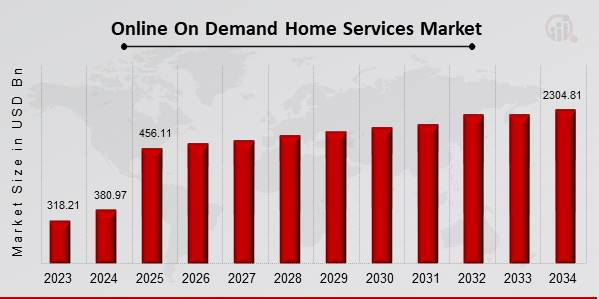
- The online on-demand home services market industry is expected to grow from $456.11 billion in 2025 to $2,304.81 billion by 2034. The online on-demand home services market is projected to grow at a CAGR of 7% during the predicted period (2025-2034).
- The Asia Pacific region is expected to experience substantial growth by the end of the projection period, with a CAGR of 2%.
- By 2032, the sector of home repairs and maintenance is projected to make USD 327.02 billion, expanding at a CAGR of 5%.
- The Home Installation and Assembly segment is projected to increase by 6% during the forecast period. It is expected to reach USD 289.43 billion by 2032.
What is Home Services Business Management Software?
As the name suggests, home services business management software is specifically designed for companies to provide home services directly to customers.
This type of software serves as a crucial tool for businesses offering a range of home services, including plumbing, electrical work, HVAC, repair, cleaning services, and pest control. Home service apps enable enterprises to enhance efficiency, streamline paperwork, and boost customer satisfaction.
The common services provided by home services business management software are:
- Scheduling & Dispatching
- Customer Management
- Invoicing & Payments
- Work Order Tracking
- Inventory Management
- Mobile Access for Field Technicians
- Reporting & Analytics
What are the Types of Home Services Business Management Software?
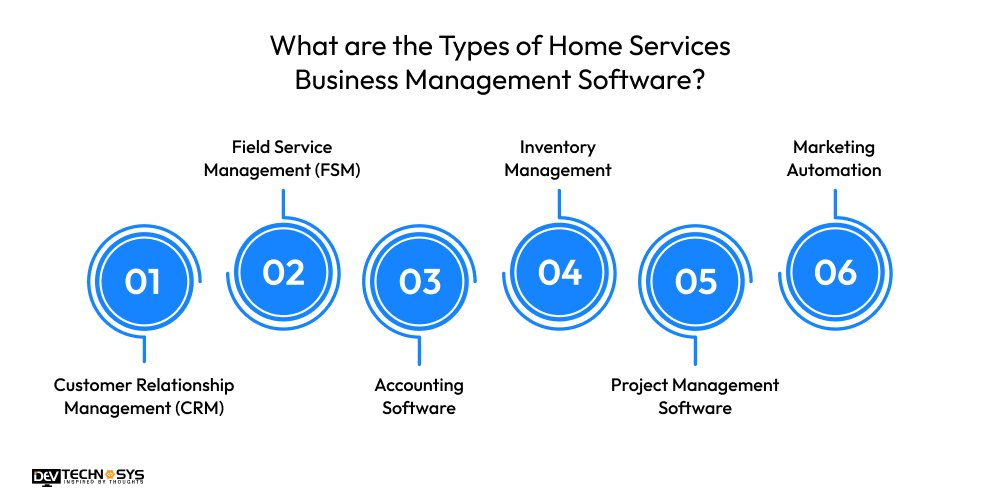
Before jumping into on-demand home service app development, let’s take a look at the different types of home service management software. Take a look at the types below:
1. Customer Relationship Management (CRM):
CRM interacts with current and potential customers, tracking customer data, sales activities, and marketing campaigns. Popular examples are HubSpot CRM, Zoho CRM, and Freshsales.
2. Field Service Management (FSM):
Field service management streamlines operations for businesses with technicians in the field, including scheduling, dispatching, and tracking orders. Popular examples include ServiceTitan and Service CRM.
3. Accounting Software:
Accounting software manages financial transactions, generates financial reports, and handles tasks like invoicing and expense tracking. Popular examples include Intuit QuickBooks, Xero, and FreshBooks.
4. Inventory Management:
Inventory management software tracks and manages inventory levels, movements, and reordering. The software offers Inventory tracking, stock level monitoring, reordering alerts, and reporting.
5. Project Management Software:
Project management software manages planning, organizing, and handling tasks and resources for specific projects. Popular examples of project management include Monday.com, Asana, and Trello.
6. Marketing Automation:
It helps automate marketing tasks such as email campaigns, social media posting, and ad targeting. Popular examples include AWeber, Constant Contact, and Mailchimp.
Why Should Entrepreneurs Invest in Home Services Business Management Software Development?
Businesses are turning to dedicated business management software to simplify their tasks and differentiate themselves in the competitive market, particularly those in the plumbing, HVAC, or cleaning industries. Here’s an in-depth look at why this investment is crucial.
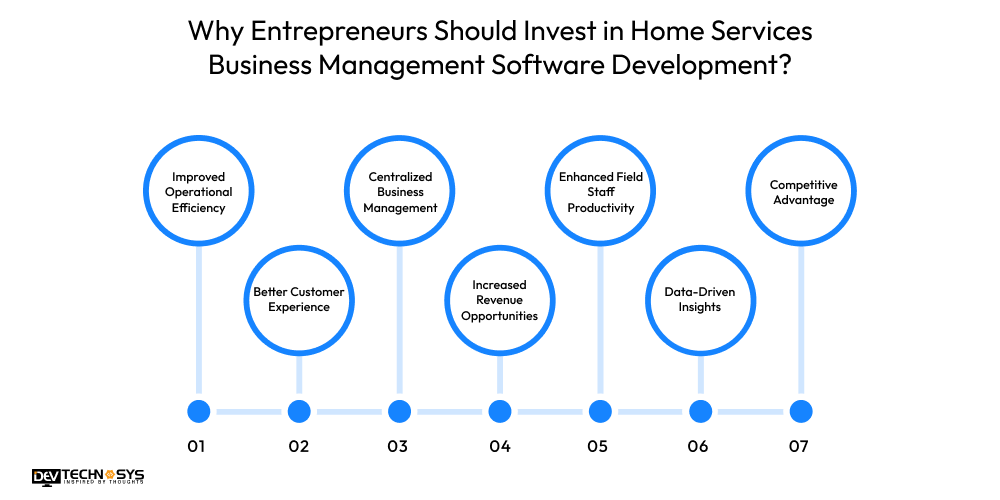
1. Improved Operational Efficiency
Home services software automates time-consuming, manual tasks like scheduling, invoicing, and dispatching. With a central system, managers can easily assign jobs, track technician availability in real-time, and optimize routes, which minimizes travel time.
2. Better Customer Experience
Businesses should develop an app like Jobber because it allows quick booking and service tracking through a user-friendly platform. They can provide real-time updates to customers and automated reminders, which reduces no-shows and builds trust.
3. Centralized Business Management
A single, integrated platform consolidates all business functions. This includes CRM, payments, inventory, and analytics. This centralization leads to better, more informed decision-making and a more organized workflow.
4. Increased Revenue Opportunities
With workflow automation and optimization, the software allows businesses to achieve more goals with fewer resources. They should build home services business management software, as it helps them assign jobs faster.
Want a chatbot demo or pricing? Fill the form and talk to our experts today.
Pick what you need below — you can select more than one — then tap Get detail to continue.
-
Chatbot demo dashboard
-
Cost to develop an app
-
Industry report
-
Case study
5. Enhanced Field Staff Productivity
Businesses should build a home services app like Angi because the software empowers field staff with mobile access to all the necessary information. Technicians can view their schedules, customer details, and job history from their mobile devices.
6. Data-Driven Insights
The software offers robust reporting and analytics tools that provide detailed insights into revenue streams, business, and performance. It enables them to make data-driven decisions, refining their strategies and allocating resources more effectively.
7. Competitive Advantage
It is beneficial for businesses to make home services business management software because it can help them differentiate themselves by offering faster, more reliable, and more transparent services.
Top 10 Home Services Business Management Software to Consider in 2025
Here are the top 10 home service business management software that you can consider in 2025. You can also study these apps to build home services business management software for the future.
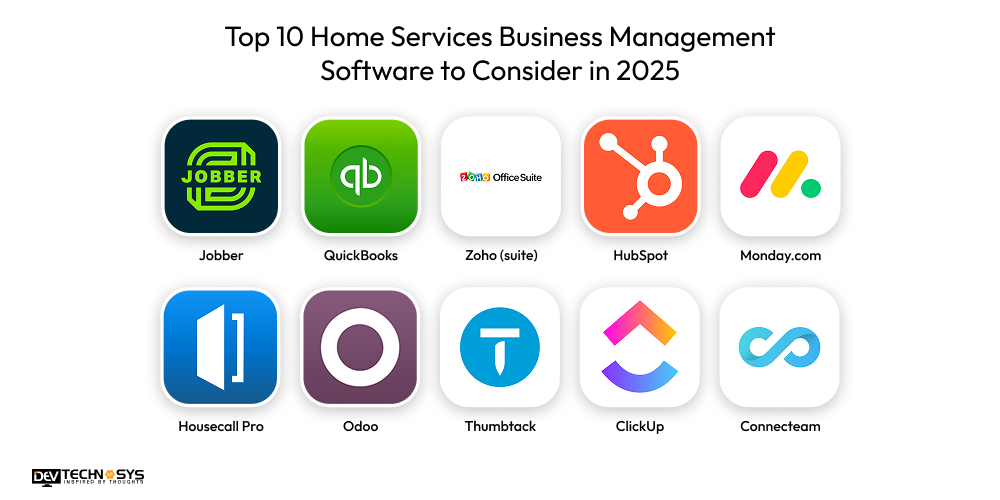
| Software | Launch Year* | Play Store Rating | Platforms |
| Jobber | 2011 | 4.5 | Android, iOS, Web |
| QuickBooks | 2014 | 3.7 | Android, iOS, Web |
| Zoho (suite) | 1996 | 4.4** | Android, iOS, Web |
| HubSpot | 2017 (app) | 4.4 | Android, iOS, Web |
| Monday.com | 2012 | 4.8 | Android, iOS, Web |
| Housecall Pro | 2013 | 4.7 | Android, iOS, Web |
| Odoo | 2005 | 4.3 | Android, iOS, Web |
| Thumbtack | 2008 | 4.6 | Android, iOS, Web |
| ClickUp | 2017 | 4.5 | Android, iOS, Web |
| Connecteam | 2016 | 4.8 | Android, iOS, Web |
Steps to Develop a Home Service Business Management Software
Are you a business wanting to develop home services business management software, but don’t know where to start? If yes, then this section is for you. This section will guide you through the home service business management software development process in a step-by-step manner. Let’s dive in!
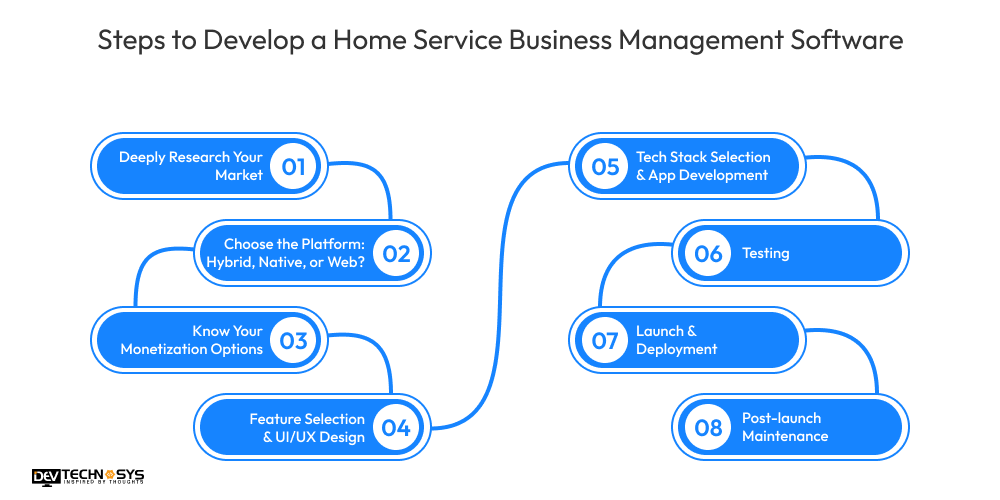
Step 1: Deeply Research Your Market
The first step in developing home services business management software is comprehensive market research and analysis. Conduct in-depth competitor research and analyze existing market trends to understand your current position and determine the necessary actions to take. Discover what customers want and what others lack, and develop a fresh, comprehensive solution to meet their needs.
Detailed research on the market will help you find:
- Who is your competitor?
- What strategy do they use?
- What are their strengths and weaknesses?
- What is their unique selling point?
- What reviews do they get on social media from customers?
Step 2: Choose the Platform: Hybrid, Native, or Web?
Before hiring a top home services business management software development company, you need to decide what kind of app you want. For that, you need to make a few operational choices in advance. After the market analysis, you will get the idea of what type of app you want: Native, Hybrid, or Web platform.
- Native platforms are ideal for those who want to build home services business management software for heavy-duty applications, such as photo editing, playback, or video streaming. You can access naive apps through app stores, but they are more costly to build.
- Web applications are a perfect solution for those who want quick upgrades without needing to tap into the native functionalities of an app. The development cost of web apps is lower than that of native apps, but they can’t be deployed through app stores or accessed by customers.
- Hybrid apps offer the best of both worlds, utilizing the same code for both platforms, accessing device features, and being available in both app stores. Hybrid home services business management software is also suitable for most systems and frameworks, including those for efficiency, utility, and business applications.
Step 3: Know Your Monetization Options
According to a top mobile app development company, an app can play a wide range of roles in your company and industry. Businesses can generate revenue directly through the apps. In contrast, others serve as a simple tool for the public to assist with specific steps in the sales process, thereby indirectly expanding the brand’s versatility. Monetization Options for home services business management software include:
- Subscription Plans: Charge users monthly or annually for premium features.
- One-Time Purchase: Offer lifetime access with a single payment.
- Freemium Model: Provide basic features for free, with paid upgrades.
- In-App Advertising: Generate revenue through targeted ads.
- Lead Generation Fees: Charge service providers for the customer leads they generate.
- Transaction Fees: Take a commission on each booking or payment processed.
- Partnership Programs: Collaborate with third-party vendors for affiliate income.
Step 4: Feature Selection & UI/UX Design
The next step to build home services business management software is to select features and design an appealing and easily navigable UI/UX. To decide on a list of features for a home service business management app, you need to learn what your software should do. For example, appointment scheduling, service tracking, invoicing, payment processing, customer communication, and staff management.
Designing an intuitive and user-friendly user interface is highly crucial for a home service business management app. Hire software developers to create wireframes (blueprints) to visualize the layout, then design an interface that’s easy to use, attractive, and optimized for mobile and web users. Good design keeps users engaged and reduces confusion.

Step 5: Tech Stack Selection & App Development
Choose the technologies you’ll use to build home services business management software. For the front-end, use React, Angular, and Flutter. For back-end, use Node.js, Django, or Laravel for server-side logic. And for the database, use MySQL, PostgreSQL, or MongoDB.
Tech stack table:
| Category | Tech Options |
| Front-end (Web) | React.js, Angular |
| Mobile App | Flutter, React Native |
| Back-end | Node.js, Django |
| Database | MySQL, MongoDB |
| Auth | Firebase Auth, Auth0 |
| Hosting | AWS, Google Cloud |
| Payments | Stripe, Razorpay |
| Notifications | FCM, OneSignal |
| Analytics | Google Analytics, Mixpanel |
| Maps/Location | Google Maps API |
| Security | SSL/TLS, JWT |
| DevOps & Deployment | Docker, Kubernetes, GitHub Actions |
Your developers who build home services business management software turn designs into a functional product by coding both the front-end (what users see) and the back-end (logic, data, and integrations). Both parts work together so that when a user taps an item, the app responds smoothly and processes the data correctly. Without this coding step, your app would simply be a collection of pretty pictures with no actual function, akin to a car without an engine.
Step 6: Testing
Before launching the home services business management software, it’s crucial to conduct thorough testing to ensure optimal performance and security. This involves functional testing to verify that all features function as intended and performance testing to assess speed, load times, and stability under heavy usage.
There’s also security testing, which safeguards user data against potential cyber threats. Any bugs, glitches, or vulnerabilities identified during this stage should be fixed promptly to ensure a smooth and reliable user experience at launch.
Step 7: Launch & Deployment
After getting a green flag from the testing team, your home services business management software is ready for launch. Create an effective strategy to launch your app successfully on the app stores. The launching process includes:
- App Submission: Submit your software to the Google Play Store and Apple App Store following their specific guidelines.
- App Store Optimization (ASO): Utilize the right keywords, craft an engaging app description, and upload visually appealing screenshots and videos to attract downloads.
- Marketing Materials: Prepare launch videos, feature highlights, and promotional banners.
Step 8: Post-launch Maintenance
After the software is launched, ongoing maintenance is essential to ensure its long-term success. This includes regularly updating the app with new features to meet evolving user needs and applying bug fixes to resolve any issues that arise.
To build a home service app like Urban Company, developers also implement performance enhancements to maintain speed, stability, and overall usability. Continuous monitoring, user feedback collection, and timely updates help keep customers engaged, ensure smooth operations, and maintain a competitive edge in the market.
Features to Include in Home Service Business Management Software
Features play a crucial role in the development of home service business management software. Here are some of the essential features to add to the software for home service business management. Take a look:
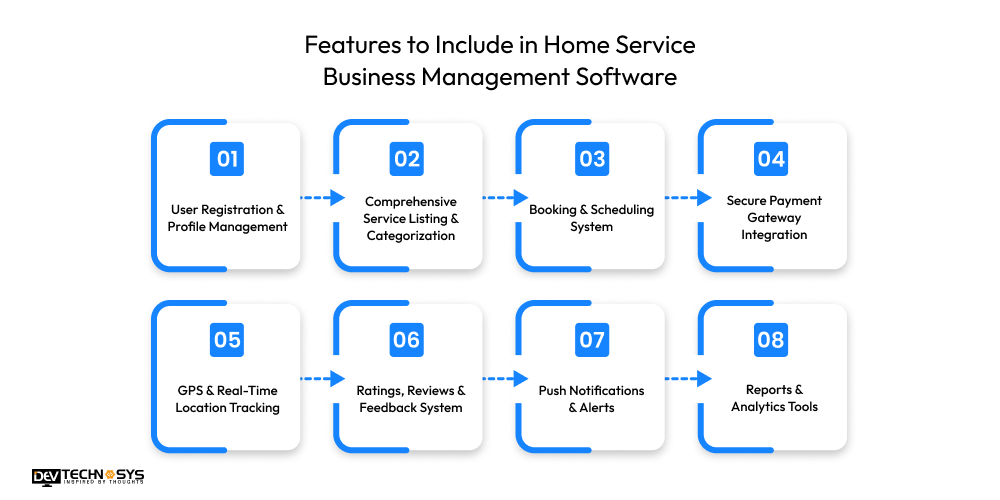
1. User Registration & Profile Management
The user registration feature is used by customers and service providers to register, create profiles, and update details, including contact information, service expertise, and availability.
2. Comprehensive Service Listing & Categorization
To develop home services business management software, developers integrate a service listing feature. It organizes services into clear categories with detailed descriptions, images, and service areas for easy browsing.
3. Booking & Scheduling System
A booking and scheduling system enables customers to book services instantly or schedule them for a specific date and time, with calendar synchronization. If you want to create home service business management software, then adding this feature is crucial.
4. Secure Payment Gateway Integration
A secure payment gateway integration system enables users to make secure payments through multiple payment methods, generates invoices, and tracks payment history. It is a must-have in home service business management software.
5. GPS & Real-Time Location Tracking
The GPS feature allows customers to track service providers en route and helps providers navigate efficiently. If you want to create home service business management software, then don’t forget to add this feature.
6. Ratings, Reviews & Feedback System
It is one of the most important features to add if you want to make home services business management software. This feature collects customer reviews to ensure service quality and build trust.
7. Push Notifications & Alerts
Push notification plays a vital role in increasing user engagement and retention. This feature sends users notifications about booking confirmations, reminders, payment updates, and promotional offers.
8. Reports & Analytics Tools
Reports and analytics tools offer valuable insights into popular services, revenue trends, and customer behavior. If you want to develop home services business management software, then adding this feature is a must.

Cost to Build Home Services Business Management Software
The cost to build a home service app can range from $8,000 to $25,000. However, this estimate may vary depending on the specific features and functionalities required. The cost of building home services business management software differs from developing software with advanced features and functionalities.
Basic home service business management software can range from $8,000 to $15,000, whereas advanced software development with AI integration can cost up to $ 25,000 or more. With increasing app complexity, the price will also increase, so it’s better to plan the budget accordingly.
| Development Stage | Estimated Timeline | Cost Range (USD) |
| Discovery & Planning | 1 – 2 weeks | $800 – $2,000 |
| UI/UX Design | 2 – 3 weeks | $1,000 – $3,000 |
| Front-end Development | 3 – 5 weeks | $1,500 – $4,000 |
| Back-end Development | 4 – 6 weeks | $2,000 – $6,000 |
| API & Third-party Integration | 2 – 4 weeks | $800 – $2,500 |
| Testing & QA | 1 – 2 weeks | $700 – $2,000 |
| Deployment | 1 week | $200 – $800 |
| Post-launch Maintenance (Yearly) | Ongoing | $1,000 – $4,000 |
Factors Affecting the Cost to Build A Home Service Business Management Software
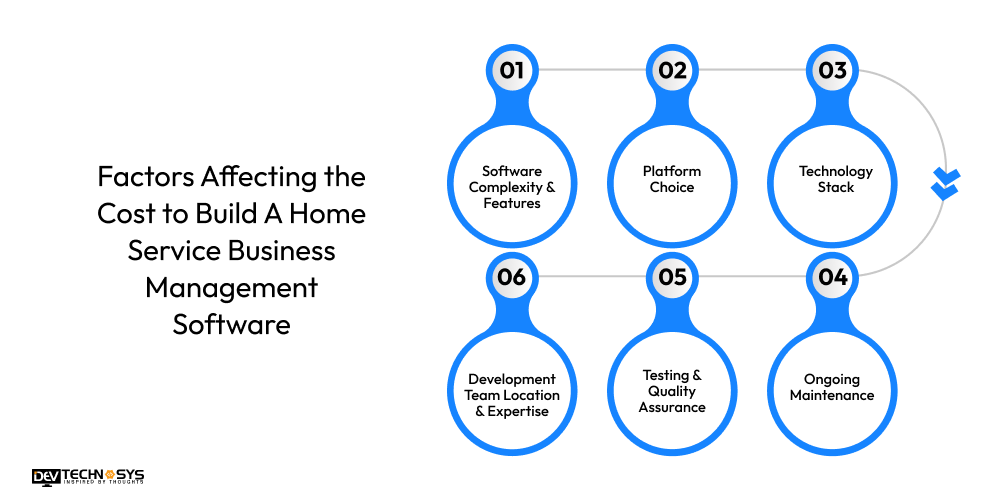
The cost to build home services business management software can differ depending on various factors. Here’s the list of some major cost-affected factors you need to consider:
1. Software Complexity & Features
The complexity of your software is one of the most significant cost drivers. A basic version might only have essential features such as service listings and customer profiles, which require less development time.
Adding advanced features requires more specialized expertise, significantly increasing the cost to build home services business management software.
| Feature Set Level | Example Features | Estimated Cost Range |
| Basic | Service listing, booking, basic CRM | $8,000 – $10,000 |
| Moderate | GPS tracking, advanced scheduling, and multiple payment options | $11,000 – $17,000 |
| Advanced | AI analytics, intelligent recommendations, and multi-user role management | $18,000 – $25,000 |
2. Platform Choice
The choice of platforms directly impacts the cost to build home services business management Software. Creating an app for a web version only makes development simpler and cheaper. If you want to develop advanced software with the latest features, the software development cost and timeline will be higher.
| Platform | Description | Estimated Cost Range |
| Web Only | Accessible via browser, responsive design | $8,000 – $12,000 |
| Mobile App (Single Platform) | Android or iOS app with core features | $10,000 – $15,000 |
| Cross-Platform | Android, iOS, and web with a shared codebase | $15,000 – $25,000 |
3. Technology Stack
The tools and technologies you choose for your project play a significant role in the cost to develop home services business management software. High-performance systems with real-time data processing, advanced API integrations, and strong security protocols may need premium technologies and additional development time.
| Tech Stack Level | Example Tools | Estimated Cost Range |
| Standard | PHP/Laravel, MySQL | $8,000 – $12,000 |
| Modern | React/Node.js, MongoDB | $12,000 – $18,000 |
| Advanced | Flutter, microservices, and AI integrations | $18,000 – $25,000 |
4. Development Team Location & Expertise
According to a top home services business management software development company, the geographical location of your development team has a significant impact on your business.
For example, hiring experienced developers in the US can cost four to five times more than hiring equally skilled professionals from Eastern Europe or Southeast Asia.
| Location | Average Hourly Rate | Estimated Cost Range |
| India / Southeast Asia | $20 – $40/hr | $8,000 – $14,000 |
| Eastern Europe | $35 – $60/hr | $12,000 – $18,000 |
| North America / Western Europe | $60 – $120/hr | $18,000 – $25,000 |
5. Testing & Quality Assurance
Quality assurance is crucial for creating reliable software. A minimal testing process might keep costs down, but it increases the risk of bugs and performance issues after launch.
More quality assurance testing, such as automated testing, manual testing, and performance optimization, can increase the budget but ensure a more polished final product.
| Testing Level | Description | Estimated Cost Range |
| Basic | Manual testing for core features | $1,000 – $2,000 |
| Moderate | Manual + limited automated testing | $2,500 – $4,000 |
| Extensive | Continuous integration + automated testing suites | $4,500 – $6,000 |
6. Ongoing Maintenance
Even after launch, the work is far from complete. Hire mobile app developers who would provide regular updates, bug fixes, security patches, and feature enhancements.
This step is necessary to keep your software functional and competitive. The more advanced your platform, the more you’ll need to invest in continuous improvements, which adds to the long-term costs.
| Maintenance Level | Description | Estimated Annual Cost |
| Basic | Minor updates, security patches | $1,000 – $2,000/year |
| Moderate | Regular feature updates, performance monitoring | $2,500 – $4,000/year |
| Comprehensive | 24/7 support, complete feature upgrades | $4,500 – $6,000/year |
Monetization Strategies for Home Services Business Management Software
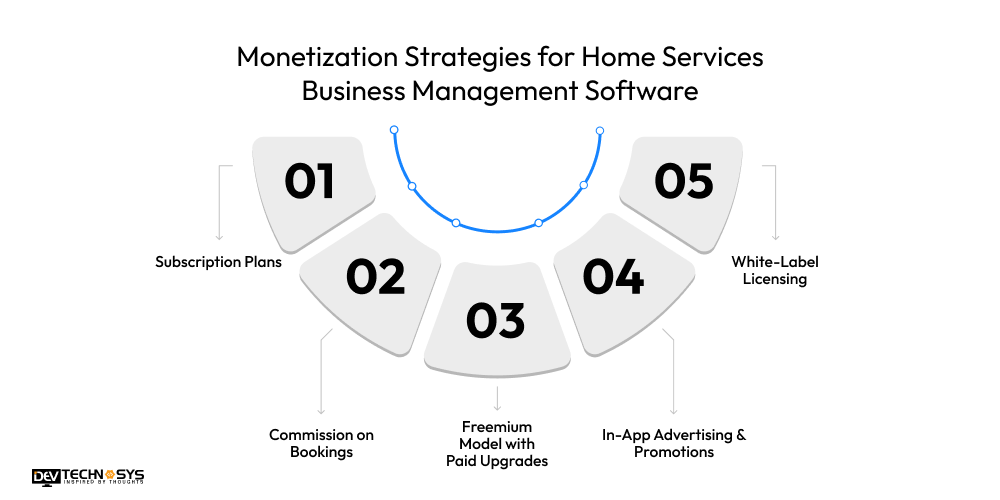
Here are some of the top monetization strategies you can implement to generate revenue from your home service business management software:
1. Subscription Plans
Offer tiered subscription packages (e.g., Basic, Standard, Premium) based on features and usage limits. For example: Basic for $29/month (limited users & features), Premium for $99/month (unlimited access & advanced tools).
2. Commission on Bookings
Charge a small commission fee for each service booking made through the platform. It helps by directly scaling with platform usage, motivating you to attract more users. For example, 5% per completed booking.
3. Freemium Model with Paid Upgrades
Offer a free version with essential features and charge for premium functionalities like advanced analytics, multi-location support, or API integrations. It encourages mass adoption while monetizing power users.
4. In-App Advertising & Promotions
Allow service providers to pay for featured listings, priority placement, or banner ads within the software. It helps generate additional revenue without charging end-users directly. For example: $50/week for a top search ranking.
5. White-Label Licensing
License your software as a white-label solution, allowing other businesses to brand and resell it. This strategy helps by expanding your revenue potential beyond your direct customer base. For example, charge $5,000–$10,000 for setup and annual maintenance fees.
How Does AI Impact Home Services Business Management Software Development?
Artificial Intelligence (AI) is transforming home services business management software by automating processes, improving decision-making, and enhancing user experiences.
It streamlines operations through predictive analytics, intelligent scheduling, and real-time communication tools. AI also enables personalized service recommendations, better resource allocation, and improved security measures, leading to higher efficiency and customer satisfaction.
Key Impacts of AI on business management software development are:
- Smart Scheduling: Auto-optimizes bookings.
- Demand Forecasting: Predicts future service needs.
- Personalized Suggestions: Recommends relevant services.
- Chatbots: Handle customer queries instantly.
- Security Alerts: Detects suspicious activities.
Conclusion
The above-provided details and information talk about home services business management software development. Developing home services business management software is a strategic investment that can transform how service providers operate and interact with customers. With the proper planning and execution, such software can become the backbone of a thriving home services business.
If you are a business seeking home services business management software development, contact Dev Technosys, a leading custom software development company. Stay tuned for more informative updates.
FAQs
Q1. How Long Does It Take To Build Home Services Business Management Software?
The development timeline typically ranges from 3 to 8 months, depending on the complexity, number of features, design customization, and testing requirements. A basic MVP can be built more quickly, while a fully featured platform takes longer to ensure quality and scalability.
Q2. How Much Does It Cost To Develop The Software?
Generally, the cost to develop a business management software falls between $8,000 and $25,000, depending on factors such as the feature set, chosen technology stack, platform type (web, mobile, or both), and the experience level of the development team.
Q3. Which Features Are Essential For This Software?
Features can significantly enhance the user experience. Core features to include in a home service business management software usually include
- booking management
- customer profiles
- service scheduling
- invoice generation
- analytics dashboard
- payment integration
- Adding AI-based recommendations
- GPS tracking
- Automated reminders
Q4. Can AI Be Integrated Into The Software?
Yes, AI integration can bring in intelligent automation, predictive analytics, personalized service recommendations, and chatbots for customer support, helping businesses improve efficiency and customer satisfaction.
Q5. What Are The Monetization Options For This Software?
You can monetize the platform through subscription plans, commission fees on each booking, premium feature upgrades, in-app advertisements, and service provider listing fees. Choosing a mix of these can help ensure steady revenue streams.