

















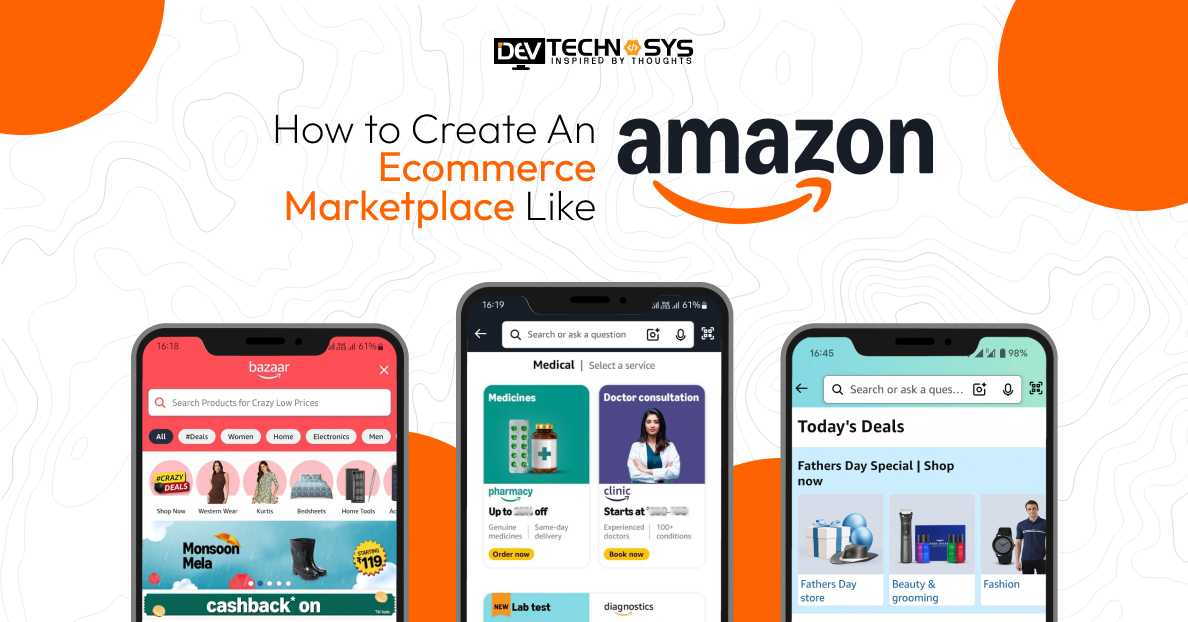
Have you ever dreamt of creating your own online shopping empire where buyers and sellers meet in an active digital marketplace? Multi-vendor ecommerce platform development like Amazon isn’t just about selling products; it’s about crafting a seamless experience that keeps customers coming back for more. With millions of users shopping online daily, a well-designed marketplace can turn your vision into a profitable venture, connecting sellers with buyers worldwide.
But how to create an ecommerce marketplace like Amazon in NYC? Read the blog till the end to find out! This blog will guide you through the essentials of Amazon clone app development, including development steps, features, benefits, cost factors, monetization strategies, and more.
Whether you’re a startup founder or a tech enthusiast, understanding the essentials of multi-vendor platforms, robust technology, and smart development strategies is your first step toward launching the next big eCommerce success story!
What is the Amazon Marketplace Platform?
The Amazon app is the official mobile application for Amazon.com’s e-commerce marketplace, designed for easy shopping, browsing, and product scanning on smartphones and tablets.
It allows users to manage orders, track shipments, read reviews, and use features like voice search, image search, and augmented reality to visualize products.
E-commerce Market Insights
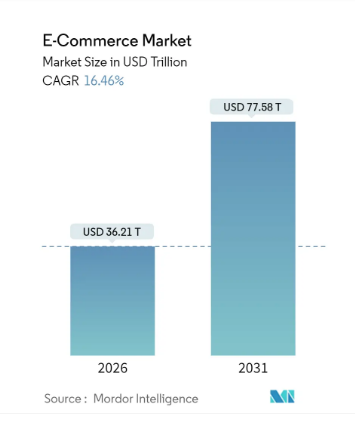
- The e-commerce market size stands at USD 36.21 trillion in 2026 and is projected to reach USD 77.58 trillion by 2031, expanding at a 16.46% CAGR.
- By geography, Asia-Pacific accounted for 54.46% of revenue in 2025, while South America is forecast to expand at an 18.12% CAGR through 2031.
- By business model, B2C led with 54.89% share in 2025; B2B is advancing at a 17.43% CAGR to 2031.
- By device type, smartphones captured 72.67% of the e-commerce market share in 2025 and are registering an 18.17% CAGR through 2031.
- By payment method, digital wallets contributed 43.92% to the e-commerce market size in 2025, and Buy Now Pay Later is rising at a 19.28% CAGR.
How Do Custom E-commerce Marketplace Like Amazon Work?
Custom e-commerce marketplaces like Amazon function as intermediating, multi-vendor platforms that connect numerous third-party sellers with buyers. Instead of selling its own products only, the platform allows third-party vendors to list, manage, and sell their products directly to customers.
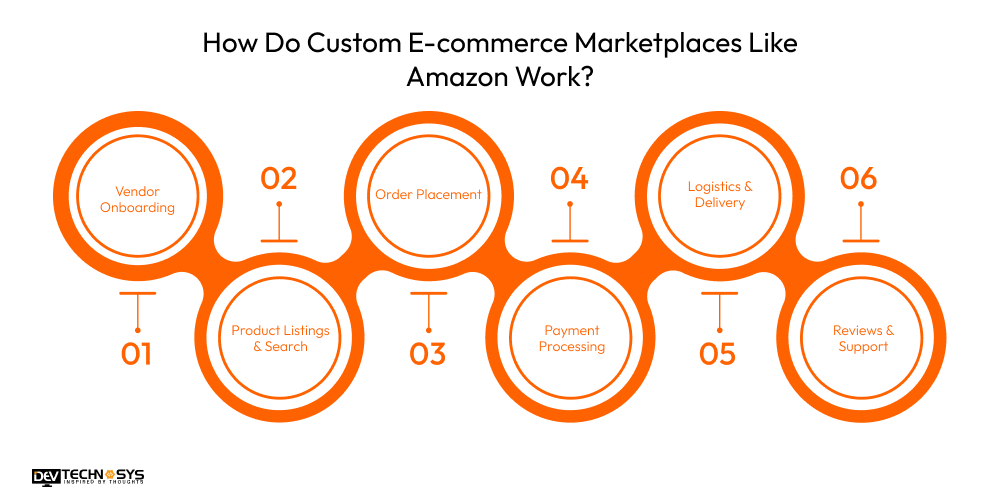
1. Vendor Onboarding:
The e-commerce platform allows sellers to register, verify their business details, and create store profiles. Businesses can upload products, set pricing, manage inventory, and monitor sales performance through an easy-to-use vendor dashboard.
2. Product Listings & Search:
Uploaded products are then categorized with detailed descriptions, images, and specifications. Smart search filters and AI-based recommendations help customers quickly find items based on preferences, pricing, and ratings.
3. Order Placement:
A popular e-commerce website like eBay lets customers browse products, compare options, add items to their cart, and proceed to checkout. Secure payment gateways ensure safe transactions and a smooth purchasing experience.
4. Payment Processing:
Multi-vendor ecommerce platforms process payments securely, deduct commissions or service fees, and transfer the remaining amount to sellers while maintaining transparent transaction records.
5. Logistics & Delivery:
Orders are shipped either by the sellers or logistics partners. Integrated tracking systems provide real-time updates, ensuring timely deliveries and a seamless fulfillment experience.
6. Reviews & Support:
Customers leave ratings and reviews to share feedback. Support teams manage returns, refunds, and disputes, helping maintain trust and reliability across the marketplace.
What are the Top 10 Ecommerce Marketplaces Like Amazon?
Looking forward to build online marketplace platform development like Amazon? Great, but before that, let’s take a look at the top 10 ecommerce marketplaces like Amazon. All the e-commerce platforms mentioned in this list are dominating the global digital commerce space today.
Marketplace |
Launch Year |
Rating (out of 5) |
Platform |
| Walmart Marketplace | 2009 | 4.2 | Web, iOS, Android |
| eBay | 1995 | 4.1 | Web, iOS, Android |
| AliExpress | 2010 | 4.0 | Web, iOS, Android |
| Etsy | 2005 | 4.3 | Web, iOS, Android |
| Temu | 2022 | 3.8 | Web, iOS, Android |
| TikTok Shop | 2023 | 4.0 | TikTok app |
| Target+ | 2019 | 4.1 | Web, iOS, Android |
| Mercado Libre | 1999 | 4.2 | Web, iOS, Android |
| Wayfair | 2011 | 4.0 | Web, iOS, Android |
| Flipkart | 2007 | 4.1 | Web, iOS, Android |
1. Build App Like Walmart Marketplace
Walmart Marketplace is a multi-vendor eCommerce platform allowing third-party sellers to list products alongside Walmart inventory. It offers nationwide reach, fulfillment services, secure payments, advertising tools, analytics dashboards, and trusted brand credibility within the U.S. retail ecosystem.
If you wish to develop a large-scale multi-vendor platform, you need strong supplier verification and inventory control. Focus on competitive pricing, omnichannel integration, and seamless logistics management.
Industry Insights:
According to the report by Internet Office Today, the Walmart Marketplace generated about $134 B+ GMV in 2023–24 and reached over 200,000 active sellers by mid-2025.
2. Build App Like eBay
eBay is a global online marketplace connecting buyers and sellers through auctions and fixed-price listings. Key features include bidding options, seller ratings, buyer protection, international shipping support, secure payments, and resale opportunities across diverse product categories.
Your iOS app development services providers should create a marketplace that supports both auctions and fixed-price listings for a diverse range of sellers. Include bidding systems, seller ratings, and secure global transaction features.
3. Build App Like Etsy
Etsy is a niche marketplace focused on handmade, vintage, and creative goods. It empowers small businesses with customizable storefronts, global exposure, secure checkout, marketing tools, personalized recommendations, and a strong community-driven shopping experience.
To develop marketplace apps like ETSY for handmade, vintage, or custom products, focus on creative branding tools, personalized storefronts, and strong community engagement.
Industry Insights:
BusinessDasher states that Etsy’s marketplace had over 95 million active buyers and about 8.1 million active sellers in 2024, driving nearly $2.8 billion+ in revenue from marketplace operations.
4. Build App Like Temu
Temu is a fast-growing online marketplace offering low-cost products across multiple categories. It provides direct-from-manufacturer pricing, flash deals, personalized recommendations, mobile-first shopping, and promotional discounts targeting budget-conscious global consumers.
Build a budget-focused marketplace driven by bulk suppliers and flash deals. Integrate dynamic pricing, discounts, and AI-powered product recommendations.

5. Build App Like Target+
Target+ is Target’s invite-only third-party marketplace featuring curated brands and premium sellers. It focuses on quality control, seamless integration with Target’s website, reliable fulfillment, secure transactions, and a trusted shopping experience for customers.
Develop a shopping app like Target, allowing only selected, high-quality sellers. Prioritize premium branding, strict quality control, and a smooth shopping experience.
Industry Insights:
Marketplace Pulse states that Unlike open marketplaces, Target Plus uses an invite-only seller model, keeping the platform curated and aligned with brand quality.
How to Create an Ecommerce Marketplace Like Amazon in 2026?
Wondering how to create an ecommerce marketplace like Amazon? Well, creating an ecommerce marketplace like Amazon in 2026 requires a strong business strategy, a scalable technology stack, and a user-centric design.
With the rapid growth of online shopping, building a multi-vendor marketplace can help businesses connect sellers and buyers on a single powerful digital platform
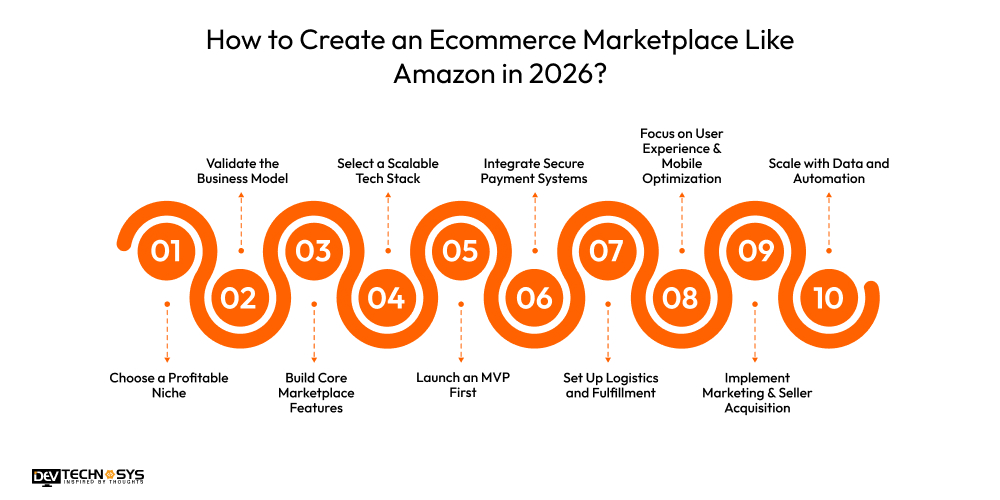
1. Choose a Profitable Niche
Start marketplace app development by identifying a focused niche instead of launching a broad marketplace immediately. Analyze customer demand, competition, and profit margins.
A niche approach to develop B2C marketplace development solutions helps you build authority, attract targeted sellers, and manage operations efficiently before expanding into multiple product categories at scale.
2. Validate the Business Model
Your lifestyle app development company will create revenue models that define how your marketplace will generate revenue. Common models include commission per sale, seller subscription fees, featured listings, and advertising.
To create an ecommerce marketplace like Amazon, study competitors and market trends to ensure your pricing structure is attractive to sellers while maintaining healthy profit margins for long-term sustainability.
Revenue Model |
How It Works |
| Commission Per sale | % from each sale |
| Seller Subscription | Monthly seller fees |
| Listing Fees | Charge per product |
| Ads | Paid product promotion |
| Fulfillment | Storage & shipping charges |
3. Build Core Marketplace Features
Develop essential features for Amazon clone script such as vendor registration, product management, advanced search filters, secure checkout, order tracking, ratings, and return management. A strong admin panel is also crucial for monitoring transactions, managing disputes, and maintaining platform quality control across all sellers.
4. Select a Scalable Tech Stack
The experts who offer Android app development services will choose modern, scalable technologies to ensure long-term growth and performance. To create an ecommerce marketplace like Amazon, Use React or Vue for a dynamic frontend experience and Node.js or Django for a powerful backend.
Deploy on cloud platforms like AWS or Azure for flexibility, security, and global scalability. In 2026, integrating AI-driven recommendations, automation tools, and data analytics is essential to stay competitive and enhance user experience.
Layer |
Technology Options |
Purpose |
| Frontend | React.js, Vue.js | Fast, responsive user interface |
| Mobile App | Flutter, React Native | Cross-platform mobile development |
| Backend | Node.js, Django | APIs & business logic handling |
| Database | PostgreSQL, MongoDB | Data storage & management |
| Cloud | AWS, Azure | Hosting, scalability, security |
| Payments | Stripe, PayPal | Secure transactions |
| Search | Elasticsearch, Algolia | Smart product search |
5. Launch an MVP First
Rather than building a fully loaded marketplace initially, start with a Minimum Viable Product (MVP) that includes only core features like vendor onboarding, product listings, and secure checkout.
This approach helps validate demand, gather real user feedback, and refine functionality. Iterative development minimizes risks, controls costs, and ensures your marketplace evolves based on real market needs.
6. Integrate Secure Payment Systems
Implement trusted payment gateways with multi-currency support and fraud detection. Ensure PCI compliance and secure encryption protocols to protect user data. Smooth, secure transactions build trust among customers and sellers, directly influencing retention and platform credibility.
7. Set Up Logistics and Fulfillment
Decide whether sellers handle shipping independently or if you provide centralized fulfillment services. Partner with reliable logistics providers and integrate real-time tracking systems. Efficient delivery and transparent return policies significantly improve customer satisfaction and repeat purchases.
8. Focus on User Experience & Mobile Optimization
Design a clean, intuitive interface with fast loading speed and mobile-first responsiveness. Most shoppers browse and purchase via smartphones, so seamless navigation, quick checkout, and personalized recommendations are critical for increasing engagement and conversions.
9. Implement Marketing & Seller Acquisition
Experts who provide marketplace app development services will attract sellers and buyers through SEO, paid ads, influencer marketing, and referral programs. Offer onboarding support and promotional incentives to early vendors. Strong marketing combined with a smooth seller experience accelerates marketplace growth and strengthens network effects.
10. Scale with Data and Automation
Use analytics tools to monitor customer behavior, sales trends, and inventory patterns. Implement AI chatbots, automated marketing campaigns, and predictive analytics to improve personalization. Data-driven decisions help optimize performance, increase revenue, and support sustainable long-term growth.
Want a chatbot demo or pricing? Fill the form and talk to our experts today.
Pick what you need below — you can select more than one — then tap Get detail to continue.
-
Chatbot demo dashboard
-
Cost to develop an app
-
Industry report
-
Case study
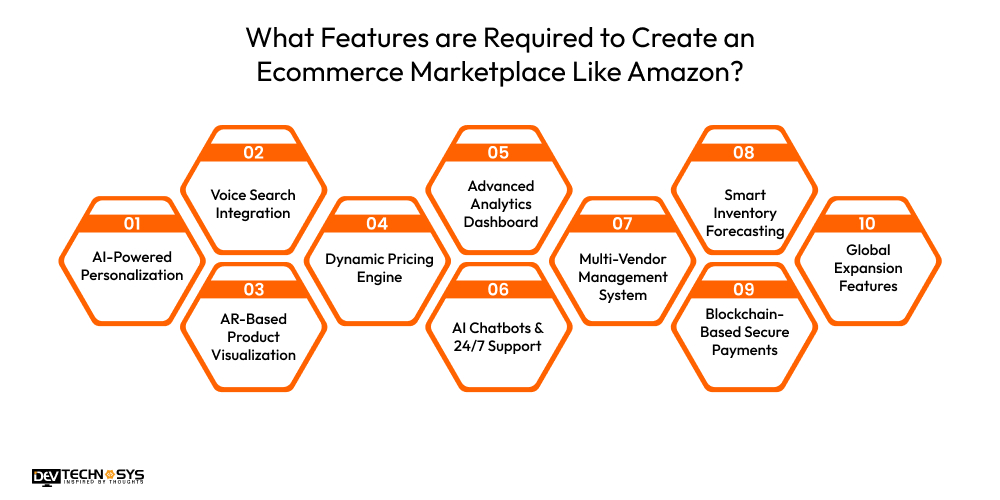
What Features are Required to Create an Ecommerce Marketplace Like Amazon?
The features of amazon-like marketplace play a huge role in creating a platform. let’s take a look at these amazing features and show they help in amazon like marketplace app development.
Buyer Panel |
Seller Panel |
Admin Panel |
Payment & Security |
| Registration & Login | Seller Onboarding | User Management | Multi-Payment Gateways |
| Smart Search & Filters | Product Listing | Seller Management | Secure Checkout |
| Wishlist & Cart | Inventory Management | Category Control | PCI Compliance |
| Order Tracking | Order Processing | Commission Setup | Data Encryption |
| Ratings & Reviews | Sales Analytics | Revenue Dashboard | Fraud Detection |
| Returns & Refunds | Promotion Tools | Dispute Resolution | Wallet Integration |
| Product Recommendations | Shipping Management | CMS Management | Secure Transactions |
1. AI-Powered Personalization
The system analyzes what users search for, view, and buy to suggest products they may like. This makes shopping easier, saves time, and increases sales. It also helps customers discover new products that match their interests.
2. Voice Search Integration
Create an ecommerce marketplace like Amazon in USA that help users search for products by speaking instead of typing. This makes browsing faster and more convenient, especially on mobile devices. It also improves accessibility for users who prefer hands-free navigation.
3. AR-Based Product Visualization
Customers can see how a product looks in real life using 3D views or virtual try-ons. This builds confidence before buying and reduces return rates. It also creates a more interactive and engaging shopping experience.
4. Dynamic Pricing Engine
Amazon-like ecommerce website development prices change automatically based on demand, competition, and trends. This helps sellers stay competitive and maximize profits. It also reduces the need for constant manual price updates.
5. Advanced Analytics Dashboard
Provides clear reports on sales, customer behavior, and traffic performance. These insights help businesses make better decisions and improve strategies. It also helps identify top-performing products and marketing campaigns.
6. AI Chatbots & 24/7 Support
Automated chatbots answer customer questions anytime, day or night. This improves response time and reduces support costs. It also ensures customers receive instant help without waiting for human agents.
7. Multi-Vendor Management System
It is one of the crucial Amazon clone app features. A multi-vendor management system allows multiple sellers to manage their products on one platform. Each seller gets a dashboard to track sales and orders. It also simplifies communication between sellers and the admin team.
8. Smart Inventory Forecasting
E-commerce platforms incorporate smart tools to predict how much stock will be needed in the future. It prevents overstocking and stock shortages. It also improves supply chain planning and warehouse management.
9. Blockchain-Based Secure Payments
eCommerce website development experts in USA use advanced technology to make transactions more secure and transparent. It reduces fraud risks and protects payment data. It also builds greater trust between buyers and sellers.
10. Global Expansion Features
Supports multiple languages, currencies, and regional tax systems. This makes it easier to sell products in different countries. It also helps businesses comply with international regulations and expand smoothly.
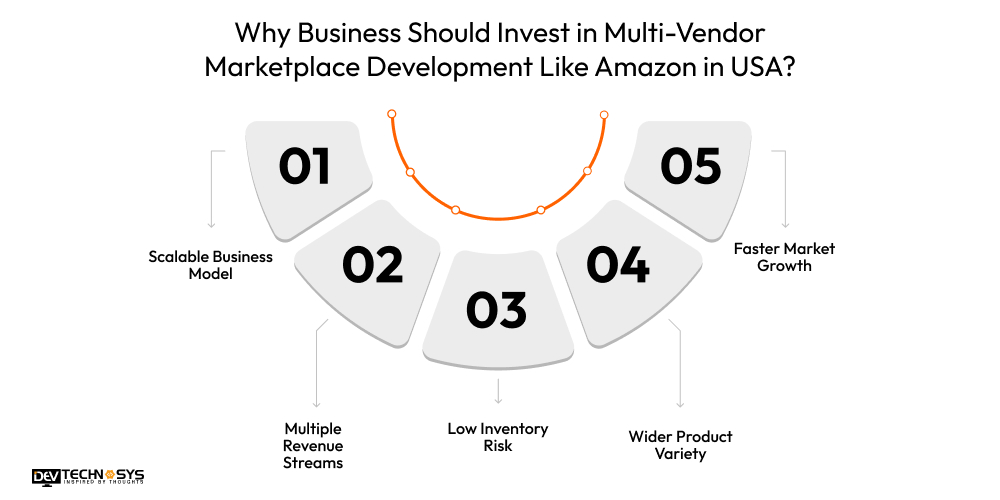
Why Business Should Invest in Multi-Vendor Marketplace Development Like Amazon in USA?
Businesses should invest in multi-vendor marketplace development like Amazon because it offers scalability, diversified revenue, and long-term growth opportunities. Here are some of th major business benefits of investing in Ecommerce marketplace software development, like Amazon
1. Scalable Business Model
A Custom ecommerce marketplace development iallows businesses to scale quickly by adding new sellers and product categories without investing in inventory. Multi-vendor model flexibility supports long-term growth and helps the platform expand into new markets with minimal operational risk.
2. Multiple Revenue Streams
Businesses can earn revenue through commissions on each sale, seller subscription fees, featured listings, advertisements, and premium services. This diversified income model increases profitability and reduces dependence on a single revenue source.
3. Low Inventory Risk
Since vendors manage their own stock and fulfillment, the platform owner does not need to invest heavily in warehousing or product storage. It significantly lowers operational costs and reduces the financial risks of unsold inventory.
4. Wider Product Variety
Multiple sellers offering different products create a diverse marketplace that attracts a broader audience. Customers enjoy more choices, competitive pricing, and better availability, which increases traffic and boosts overall sales performance.
5. Faster Market Growth
As more sellers join the platform, product variety increases, attracting more buyers. It creates a strong network effect that benefits both buyers and sellers, leading to continuous growth and stronger market positioning.
How Much Does it Cost to Develop A Marketplace App Like Amazon?
The cost to develop a Marketplace app like Amazon ranges from $8,000 to $25,000. Depending on various factors like features, platform, design, backend technology, APi Integrations, and more.
The basic MVP cost will be around $8,000 to $12,000, whereas the Cost to develop a marketplace App with advanced features like AI chatbots, smart inventory forecasting, and blockchain-based secure payments may exceed to $25,000.
App Type |
Estimated Cost (USD) |
| Basic Marketplace App | $8,000 – $12,000 |
| Standard Marketplace App | $12,000 – $18,000 |
| Feature-Rich Marketplace App | $18,000 – $25,000 |
The Cost to build a marketplace like Amazon also depends on maintenance services, updates, and server costs, which are additional ongoing expenses (15% to 25% annually). Here are the factors that affect the Marketplace website development cost. Take a look:
1. Feature Complexity
The number and sophistication of app features directly influence the marketplace website development cost. Basic functionalities like product listings and search are inexpensive, whereas advanced features like AI recommendations, chat support, multi-vendor dashboards, loyalty programs, and real-time analytics significantly increase complexity, time, and overall cost to develop a mobile app.
Complexity Level |
Estimated Cost |
| Basic | $3,000 – $5,000 |
| Medium | $6,000 – $8,000 |
| Advanced | $8,000 – $10,000+ |
2. Development Timeline
According to a top ecommerce marketplace development company in California, the project duration affects the cost to develop a marketplace app like Amazon due to resource allocation, team hours, and project management.
A lean MVP may take 3 to 5 months, a standard app 6 to 8 months, and a feature-rich marketplace 9 to 12 months or more. Longer timelines typically increase development and maintenance expenses.
Project Scope |
Estimated Timeline |
Cost Impact |
| MVP Marketplace | 3 – 4 months | $5,000 – $8,000 |
| Mid-Level Marketplace | 5 – 7 months | $8,000 – $10,000 |
| Enterprise Marketplace | 9 – 12+ months | $10,000 – $12,000+ |
3. UI/UX Design
Designing a clean, intuitive interface is critical for engagement and retention. The cost to build an online marketplace website covers wireframes, mockups, visual elements, and navigation flow. Complex designs with animations or interactive features increase expenses but significantly enhance user experience and app adoption.
Component |
Estimated Cost (USD) |
| Wireframes & Mockups | $7,000 – $10,000 |
| Visual Design | $6,800 – $10,000 |
| Interactive Features | $8,000 – $12,000 |
| Total | $8,000 – $14,000 |
4. Third-Party APIs
Involves integrating shipping, notifications, analytics, and optional AI recommendation engines. Using third-party APIs speeds up development but may add subscription or usage costs. Hybrid app development companies in USA add these integrations to improve functionality, tracking, and user engagement.
Integration Type |
Estimated Cost |
| Payment Gateways | $2,000 – $5,000 |
| Shipping APIs | $3,000 – $7,000 |
| Analytics & CRM | $3,000 – $8,000 |
| AI Recommendation Tools | $8,000 – $15,000 |
5. Testing & Quality Assurance
Covers bug fixing, performance optimization, and ensuring compatibility across devices and platforms. Thorough QA prevents crashes, improves user retention, and reduces post-launch maintenance costs. Automated and manual testing increase accuracy but affect total development time and budget.
Testing Type |
Estimated Cost |
| Functional Testing | $3,000 – $6,000 |
| Security Testing | $4,000 – $7,000 |
| Performance Testing | $3,000 – $5,000 |
6. Maintenance & Updates
Post-launch maintenance includes server management, bug fixes, feature upgrades, and performance improvements. Typically accounts for 15% to 25% of initial development cost annually. Regular updates ensure security, keep users engaged, and support new features or platforms.
Maintenance Type |
Estimated Cost |
| Monthly Maintenance | $1,000 – $2,800/month |
| Feature Updates | $5,000 – $7,000/year |
| Security & Scaling | $6,000 – $8,000/year |
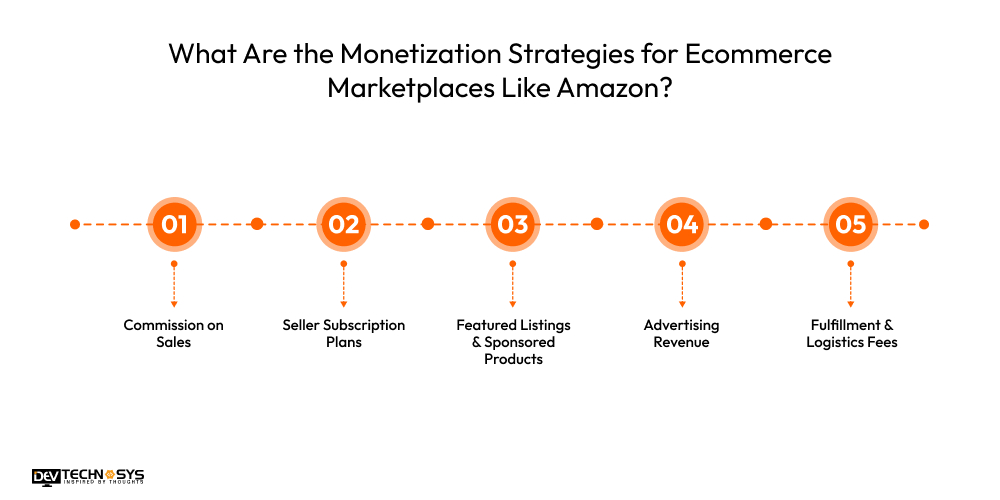
What Are the Monetization Strategies for Ecommerce Marketplaces Like Amazon?
Monetizing an eCommerce marketplace like Amazon requires a diversified revenue strategy beyond product sales alone. By combining commissions, subscriptions, advertising, and value-added services, businesses can create multiple income streams and ensure long-term, scalable profitability.
1. Commission on Sales
The platform charges sellers a fixed percentage or variable commission on every successful sale. This is the most common and scalable revenue model because earnings grow automatically as transaction volume increases. Higher categories or premium sellers may be charged different commission rates.
2. Seller Subscription Plans
Offer monthly or annual subscription packages that provide added benefits such as lower commission rates, advanced analytics, priority customer support, or enhanced product visibility. This creates predictable recurring revenue while encouraging serious sellers to invest more in the platform.
3. Featured Listings & Sponsored Products
Sellers can pay to promote their products in top search results, homepage banners, or category pages. Sponsored placements improve product visibility and conversions, while the marketplace earns advertising revenue without depending solely on sales commissions.
4. Advertising Revenue
Brands and third-party businesses can run display ads, banner ads, or targeted promotional campaigns within the marketplace. By leveraging user data and shopping behavior, the platform can offer highly targeted advertising solutions that generate substantial additional income.
5. Fulfillment & Logistics Fees
Provide warehousing, packaging, shipping, and last-mile delivery services for sellers and charge service fees. This not only adds convenience for vendors but also builds an integrated ecosystem where the marketplace earns revenue from logistics operations.
You can reach out anytime; we are available 24/7. Our team provides a quick response.

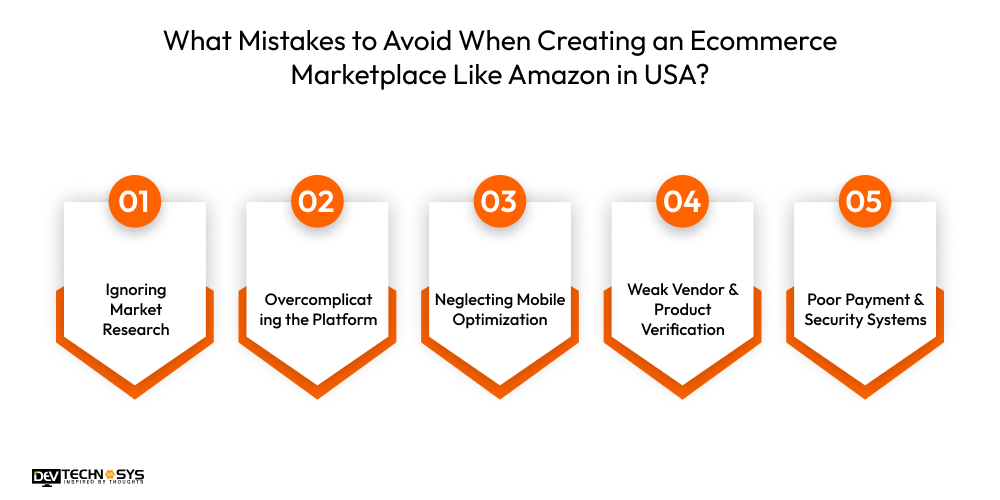
What Mistakes to Avoid When Creating an Ecommerce Marketplace Like Amazon in USA?
Building a successful eCommerce marketplace requires more than just listing products online. Avoiding common mistakes in market research, platform design, mobile optimization, and security is crucial to attract users, retain sellers, and ensure long-term growth and profitability.
1. Ignoring Market Research
If you want to build multi-seller ecommerce website in America, then skipping competitor analysis, audience behavior, and market trends can result in a platform that fails to meet user expectations. Conduct thorough research to understand demand, pricing strategies, and essential features that attract both buyers and sellers.
2. Overcomplicating the Platform
Launching with too many features can overwhelm users and inflate development costs. Begin with an MVP (Minimum Viable Product) focusing on core functions like product listing, search, payments, and user accounts, then gradually expand based on user feedback.
3. Neglecting Mobile Optimization
With most shoppers using smartphones, a slow or non-responsive mobile interface reduces engagement. Ensure your marketplace is fully mobile-optimized, offering fast load times, smooth navigation, and seamless checkout experiences across all devices.
4. Weak Vendor & Product Verification
Trust is crucial in a marketplace. Failing to verify vendors or allowing low-quality listings can harm credibility. Implement a strong vendor onboarding process and a product review system to maintain high standards and build user confidence.
5. Poor Payment & Security Systems
Weak payment gateways or security can lead to abandoned carts or fraud. Integrate secure, reliable payment methods, ensure PCI compliance, and protect users’ financial and personal data to maintain trust and smooth transactions.
Conclusion
Building an ecommerce marketplace like Amazon requires strategic planning, scalable technology, and a strong focus on user experience. With the right development approach, continuous innovation, and effective marketing strategies, businesses can build a scalable, profitable marketplace like Amazon.
If you want to build a platform similar to Amazon but don’t know which agency to trust, turn to Dev Technosys, a leading mobile application development company in USA. We create future-ready marketplace platforms that will lead the industry.
Frequently Asked Questions
Find answers to the most common questions related to this article.
An ecommerce marketplace is an online platform where multiple sellers can list and sell their products to customers. The marketplace owner manages the platform, payments, and user experience while third-party vendors handle inventory and product fulfillment.
The development cost can vary depending on features, technology stack, and platform complexity. A basic marketplace may cost around $8,000 to $12,000, while a feature-rich platform with advanced integrations, AI recommendations, and scalable infrastructure can exceed $25,000.
Developing a marketplace app typically takes 4 to 12 months. A minimum viable product (MVP) with essential features can be built in about 3 to 4 months, while a fully scalable marketplace with advanced tools and integrations may require longer development time.
Key features include user registration, seller onboarding, product listings, search and filters, shopping cart, secure payment gateways, order tracking, reviews and ratings, and an admin dashboard to manage users, products, and transactions.
Marketplace platforms generate revenue through commission fees on sales, subscription plans for sellers, featured product listings, advertising placements, and service fees for logistics or payment processing.
Building from scratch provides full customization and scalability but requires more time and investment. Ready-made solutions or marketplace frameworks allow faster launch and lower initial costs, making them suitable for startups testing their business model.